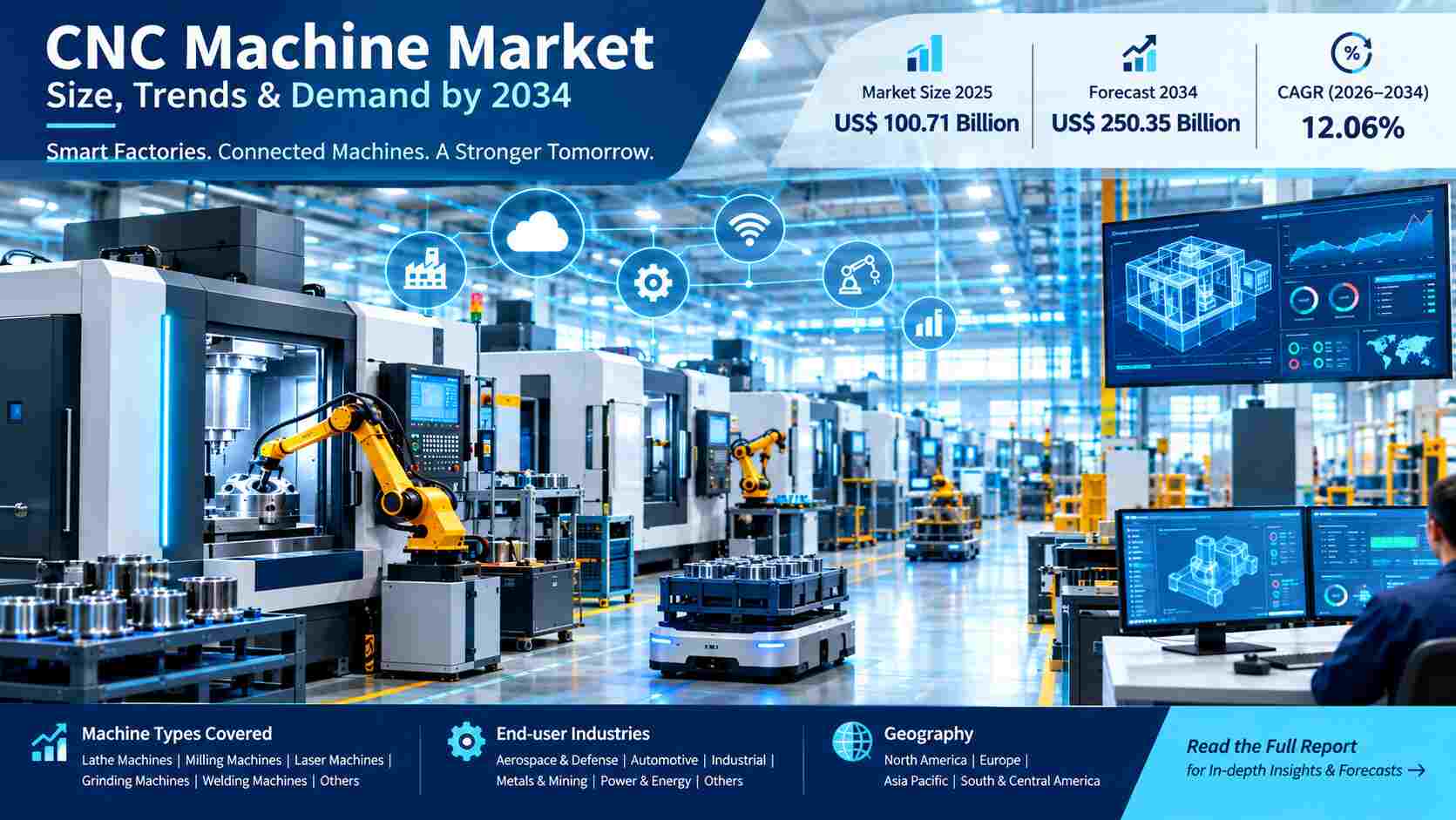
Manufacturing is moving beyond standalone machines and isolated production lines toward highly connected, data-driven, and automated smart factories. At the center of this transformation are Computer Numerical Control (CNC) machines, which are evolving from programmable production equipment into intelligent manufacturing assets capable of communicating with factory systems, monitoring processes, supporting predictive maintenance, and improving production efficiency.
The shift toward connected manufacturing is creating significant opportunities for the global CNC machine industry. According to The Insight Partners, the global CNC Machine Market was valued at US$100.71 billion in 2025 and is projected to reach US$250.35 billion by 2034, registering a 12.06% CAGR from 2026 to 2034. The report also estimates a total addressable market of approximately US$1,671.76 billion during 2026–2034, highlighting the significant opportunity created by increasing adoption of advanced machining and smart manufacturing technologies.
From Standalone CNC Machines to Connected Manufacturing
Traditional CNC machines primarily focused on executing programmed machining operations with high levels of accuracy and repeatability. While these capabilities remain fundamental, manufacturers increasingly expect CNC equipment to participate in broader digital production ecosystems.
Modern CNC machines can be connected with industrial IoT platforms, robotics, sensors, metrology systems, production-management software, and cloud-based analytics. This connectivity allows manufacturers to collect production data and use it to understand machine utilization, tool performance, production cycles, energy consumption, quality, and maintenance requirements.
The Insight Partners identifies advancements in automation and smart manufacturing technologies, including Internet of Things (IoT) and AI, as important drivers of CNC machine market growth. Connected CNC equipment can support real-time data collection and analysis, enabling manufacturers to improve production scheduling, reduce downtime, and optimize machine performance.
This evolution is particularly important as manufacturers face increasing pressure to produce customized products, shorten production cycles, maintain tight tolerances, and operate with limited skilled labor.
AI and Data Are Making CNC Machines More Intelligent
Artificial intelligence is expected to become increasingly important in connected CNC manufacturing. AI-enabled systems can analyze machine and production data to identify patterns that may not be immediately visible to operators.
For example, machine data can be analyzed to identify abnormal vibration, temperature changes, tool wear, or deviations in machining performance. Manufacturers can use these insights to schedule maintenance before equipment failure occurs.
This transition from reactive maintenance to predictive maintenance can help reduce unexpected downtime and improve equipment availability. It also enables manufacturers to make decisions based on actual production conditions rather than fixed maintenance schedules.
Advanced controls are also improving machining performance. According to The Insight Partners, the manufacturing environment is moving from individual three-axis machines toward multi-axis machines connected with robots, metrology equipment, and production-floor software. Enhanced controls, thermal compensation, in-process inspection, and digital twins are contributing to better tool paths, fewer setup loops, and lower scrap rates.
Robotics and CNC Machines Are Creating More Automated Production Cells
Robotics is another important component of the smart factory. CNC machines can increasingly operate as part of automated cells in which robots perform material handling, machine tending, inspection, pallet movement, and other repetitive tasks.
This is particularly valuable for manufacturers seeking higher machine utilization. Instead of relying entirely on operators to load and unload components, robotic systems can continuously supply parts to CNC equipment.
The combination of CNC machines and robotics is also supporting lights-out manufacturing, where selected production processes can operate with minimal human intervention. Such systems can be particularly attractive in environments where manufacturers need to increase output while managing labor shortages.
Connected automation also provides greater visibility. Production managers can monitor machine status and production performance across multiple machines rather than relying exclusively on physical inspection of individual equipment.
Digital Twins and In-Process Monitoring Improve Production Accuracy
Digital twin technology is becoming another important element of smart manufacturing. A digital representation of a CNC machine or manufacturing process can help manufacturers simulate machining operations, analyze production conditions, and identify potential problems before they affect physical production.
For complex components, simulation can help optimize tool paths and reduce unnecessary machining steps. When combined with real-time machine data, digital twins can also provide manufacturers with a better understanding of how equipment performs under different operating conditions.
In-process inspection further strengthens this capability. Instead of waiting until machining is complete to identify dimensional errors, integrated probing and inspection technologies can detect deviations during production. This can reduce scrap, rework, and production delays.
Multi-Axis Machining Is Supporting More Complex Manufacturing
The growing complexity of components is increasing demand for advanced CNC configurations. Five-axis and multi-axis machines can perform multiple machining operations with fewer setups, helping manufacturers reduce handling time and improve dimensional consistency.
The Insight Partners notes that lathe machines remain the leading machine-type segment, accounting for approximately 38–42% of the market in 2025, while the overall machine-type segment is expected to grow at 11.5–12.5% CAGR during 2026–2034. Milling machines, laser machines, grinding machines, and welding machines also play important roles in increasingly automated production environments.
The shift toward multitasking equipment is particularly significant because manufacturers can combine turning, milling, grinding, and inspection activities into fewer setups. This can reduce floor-space requirements, workholding changes, transfer time, and accumulated dimensional errors.
CNC Machines Are Becoming Critical Across Major Industries
The smart factory transformation is influencing CNC demand across multiple industries.
Automotive manufacturers are using advanced CNC equipment to support complex components, electric vehicle production, powertrain systems, and customized manufacturing requirements. The ability to quickly modify production programs is particularly valuable as automotive manufacturers introduce new platforms and components.
In aerospace and defense, CNC machines are essential for manufacturing components with complex geometries and demanding tolerances. The Insight Partners identifies aerospace and defense as a high-growth end-user segment, representing approximately 15–18% of the CNC machine market in 2025 and expected to grow at 13.5–14.5% CAGR from 2026 to 2034.
Industrial manufacturers, metals and mining companies, and power and energy producers also require reliable machining solutions for components, equipment, infrastructure, and replacement parts.
Asia Pacific Is Emerging as a Major Growth Engine
Regional manufacturing expansion is further supporting the adoption of connected CNC machines. Asia Pacific accounted for approximately 45–47% of the global CNC machine market in 2025 and is projected to grow at 13.5–14.5% CAGR through 2034, according to The Insight Partners. China, Japan, South Korea, and India are identified as important markets within the region.
China benefits from its large manufacturing base, automotive and electric vehicle production, electronics industry, and domestic machine-tool capabilities. Japan and South Korea remain important centers for precision machinery, controls, automotive production, and advanced manufacturing technologies.
India is also becoming increasingly important as manufacturing localization, infrastructure development, automotive production, defense manufacturing, and general engineering activities create demand for advanced machining equipment.
North America and Europe Focus on Modernization and Automation
North America is another important CNC machine market, with the region accounting for approximately 21–23% of the market in 2025 and expected to grow at 10.5–11.5% CAGR during 2026–2034. Reshoring, aerospace programs, defense production, semiconductor manufacturing, and automation-led modernization are supporting investment in advanced CNC equipment.
Europe, meanwhile, held approximately 25–27% market share in 2025 and is expected to register 9.5–10.5% CAGR through 2034. The region's established automotive, aerospace, industrial machinery, and engineering sectors are supporting demand for sophisticated CNC systems, particularly those capable of automation, process integration, and energy-efficient operation.
The Future of CNC Manufacturing Is Connected
The future of CNC machines will increasingly be defined by their ability to operate as part of a connected manufacturing ecosystem. Machine connectivity, AI, robotics, digital twins, predictive maintenance, automated inspection, and advanced controls are gradually changing how factories plan, execute, and optimize production.
Manufacturers are also becoming more focused on the total cost per machined part, including energy consumption, tooling, software compatibility, productivity, maintenance, and labor requirements. This means future CNC purchasing decisions will increasingly consider the complete digital and operational ecosystem rather than machine specifications alone.
As smart factories expand, CNC machines are positioned to become more than precision machining tools. They are becoming connected production assets capable of generating data, communicating with other systems, supporting automation, and contributing to continuous process optimization.
For manufacturers, technology providers, investors, and other industry stakeholders, understanding this transition will be essential for identifying opportunities in the rapidly evolving connected manufacturing landscape.