Enterprise decision-making is entering a new phase as organizations move from traditional business intelligence dashboards toward AI-enabled, conversational, and increasingly automated analytics. In 2026, Generative AI is becoming an important layer across the analytics workflow, helping organizations interpret complex datasets, generate insights, automate reporting, identify patterns, and support faster business decisions. This transformation is creating new opportunities for Analytics as a Service (AaaS), particularly as enterprises seek scalable analytics capabilities without building and maintaining extensive infrastructure internally.
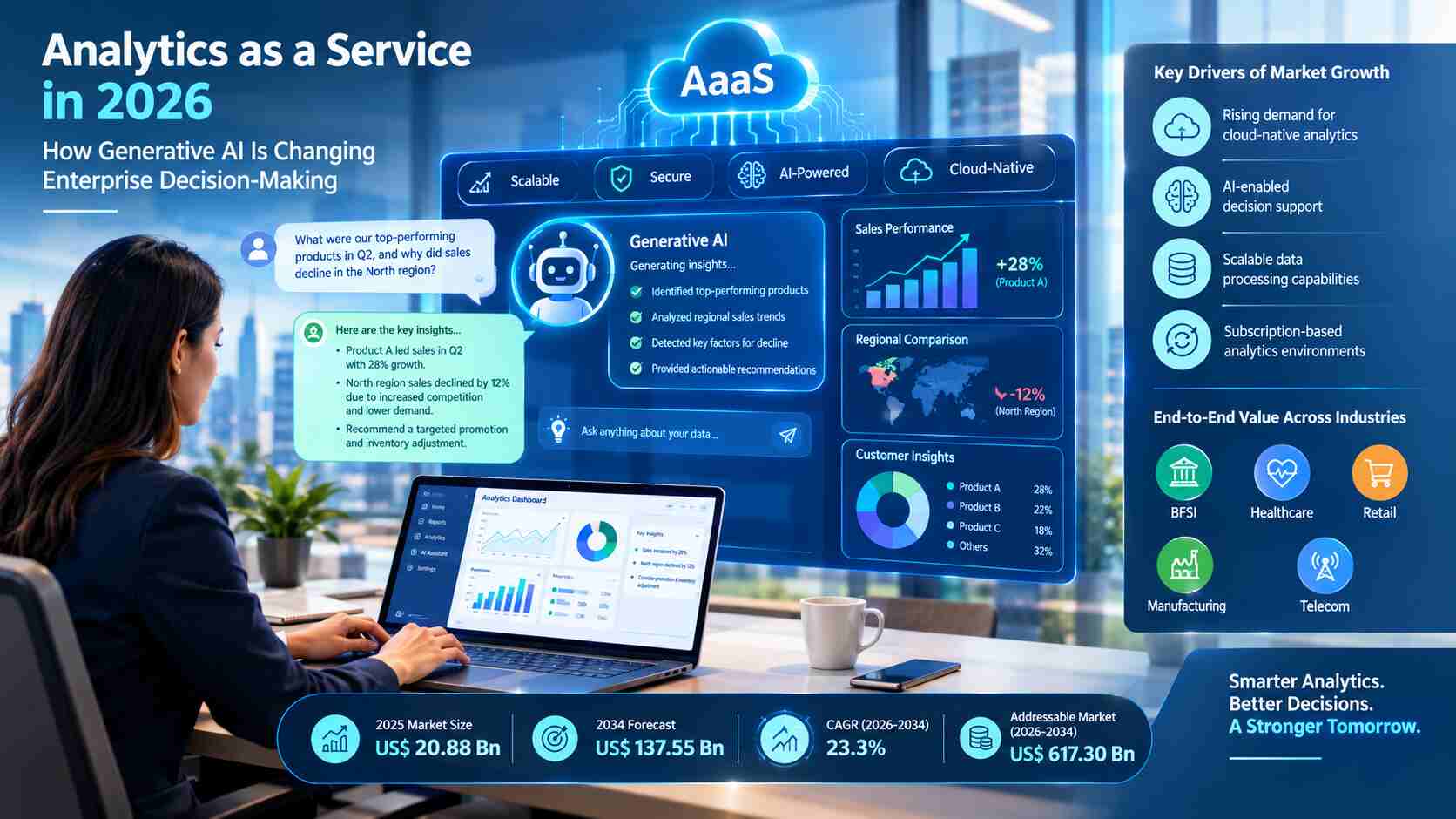
According to The Insight Partners, the Analytics as a Service Market was valued at US$ 20.88 billion in 2025 and is projected to reach US$ 137.55 billion by 2034, expanding at a CAGR of 23.3% during 2026–2034. The market is being supported by rising demand for cloud-native analytics, AI-enabled decision support, scalable data processing, and subscription-based analytics environments.
Generative AI Is Transforming Enterprise Analytics
Traditional analytics typically requires users to navigate dashboards, select predefined metrics, build queries, and interpret charts before making business decisions. Generative AI is changing this interaction by allowing users to engage with enterprise data using natural language. Instead of manually searching through multiple dashboards, business users can ask questions, request summaries, identify trends, and explore potential scenarios through conversational interfaces.
The Insight Partners identifies the acceleration of artificial intelligence integration as a major driver of the Analytics as a Service Market. AI capabilities are increasingly being incorporated into analytics platforms to support prediction, automated reporting, anomaly detection, and natural-language interaction. Generative AI further expands these capabilities by enabling organizations to access advanced analytics without requiring every business user to have specialized data science expertise.
This direction is consistent with broader 2026 analytics developments. Gartner has highlighted the movement toward AI-first operating models and identified AI agents, semantic technologies, and converged data and analytics platforms as major data and analytics trends.
From Dashboards to Conversational Decision Support
One of the most visible changes brought by Generative AI is the evolution of how employees consume enterprise data. Dashboards remain important for monitoring key performance indicators and understanding complex relationships, but conversational analytics can provide an additional interface for users who need fast answers.
For example, a retail manager could ask an analytics platform why sales declined in a particular region. Instead of manually comparing multiple reports, the platform could potentially identify relevant changes in demand, customer behavior, inventory levels, or product performance and present the findings in a business-oriented format.
Similarly, a financial services organization could use AI-enabled analytics to investigate unusual transaction patterns, while a manufacturing company could analyze equipment data to identify potential maintenance requirements. The underlying objective is to shorten the path between data collection, analysis, interpretation, and action.
Forrester's 2026 research also describes natural-language interaction as an emerging way for business users to consume enterprise data, while emphasizing that organizations may need multiple complementary approaches, including visual analytics, semantic models, and agentic data consumption.
Cloud Delivery Makes Advanced Analytics More Accessible
Generative AI is only one part of the Analytics as a Service transformation. Cloud delivery is equally important because it allows enterprises to access analytics capabilities without making the same level of infrastructure investments associated with traditional on-premises environments.
The Insight Partners reports that enterprises are increasingly adopting subscription-based analytics environments to reduce infrastructure complexity while improving access to business intelligence. Cloud-based analytics can also scale according to demand, which is particularly valuable as organizations generate increasing volumes of transactional, operational, customer, and connected-device data.
The market report covers Private Cloud, Public Cloud, and Hybrid Cloud deployment models. Hybrid Cloud is identified as a high-growth segment because enterprises are balancing flexibility, compliance, workload optimization, and integration between legacy infrastructure and cloud-native environments.
This flexibility becomes increasingly relevant for GenAI applications because organizations need to determine where sensitive data, analytical workloads, and AI models should operate.
AI-Native Analytics Is Becoming a Key Market Trend
The next stage of Analytics as a Service is moving beyond simply adding AI features to existing dashboards. The market is progressing toward AI-native analytics ecosystems in which predictive modeling, generative assistance, automated insight generation, conversational interfaces, data preparation, and governance are integrated into a single environment.
The Insight Partners expects AI-native analytical platforms to become increasingly important as organizations seek faster decision-making while reducing dependence on highly specialized data science resources. Continued advances in large language models and automation technologies are also expected to influence how analytics services are delivered.
This shift can create a more continuous decision-support environment. Rather than waiting for analysts to prepare periodic reports, organizations can increasingly use analytics platforms to monitor data, identify significant changes, generate explanations, and bring relevant information to decision-makers.
Industry Applications Are Expanding
Generative AI-enabled Analytics as a Service has applications across multiple industries, but requirements differ significantly by sector.
In BFSI, analytics platforms can support fraud detection, risk assessment, customer analytics, and regulatory compliance. In healthcare, analytics can contribute to patient management, resource allocation, clinical analysis, and operational decision support. Retail organizations can use analytics for demand forecasting, personalization, inventory optimization, and omnichannel management. Manufacturing companies can apply analytics to predictive maintenance, quality monitoring, supply chain intelligence, and production optimization. Telecommunications companies can use analytics for network optimization, service assurance, customer intelligence, and operational efficiency.
These applications demonstrate why industry-specific analytics platforms are becoming increasingly important. The Insight Partners notes that vendors are developing specialized analytical systems for healthcare, finance, manufacturing, retail, and telecommunications, incorporating curated data models, compliance controls, and workflow automation.
Data Governance Remains Critical for AI-Driven Analytics
The expansion of Generative AI does not eliminate the need for reliable data. Instead, it makes data quality, governance, security, and contextual understanding even more important.
AI-generated insights are only as useful as the underlying data and analytical context. Enterprises therefore need appropriate governance frameworks, access controls, data quality processes, and model management capabilities. The Analytics as a Service Market is increasingly influenced by governance and cybersecurity requirements, particularly among organizations operating in highly regulated industries.
Recent enterprise AI developments reinforce this requirement. Organizations are increasingly moving AI from experimentation into operational workflows, making trustworthy data foundations and governance important considerations for scaling AI applications.
Asia Pacific Creates New Growth Opportunities
Geographic expansion is another important component of the Analytics as a Service opportunity. The Insight Partners estimates that Asia Pacific accounted for approximately 28–32% of market revenue in 2025 and is expected to record a 25–28% CAGR through 2034, making it the fastest-expanding regional market in the report's assessment. China remains a major contributor, while India, Japan, South Korea, and Australia continue investing in cloud infrastructure and data modernization.
The region's expanding digital economy, cloud adoption, government-led modernization programs, and growing demand for real-time operational intelligence create opportunities for analytics providers. Similar opportunities are emerging across the Middle East and Africa as enterprises invest in cloud infrastructure, smart-city programs, digital government initiatives, and technology modernization.
What Does the Future Hold for Analytics as a Service?
The Analytics as a Service market is moving toward a model in which analytics is more accessible, automated, contextual, and integrated into everyday enterprise workflows. Generative AI is accelerating this transition by changing how employees interact with data and how organizations convert analytical information into business decisions.
The combination of Generative AI, cloud computing, predictive analytics, natural-language interfaces, hybrid deployment, automation, and industry-specific intelligence is expected to create new opportunities across the enterprise analytics ecosystem. At the same time, organizations will need to address data governance, cybersecurity, integration, and responsible AI requirements as these technologies become more deeply embedded in business processes.
For organizations evaluating investments in cloud analytics, AI-enabled decision intelligence, or managed analytical environments, detailed market intelligence can help identify growth areas, technology trends, regional opportunities, competitive developments, and segment-level dynamics. The Insight Partners' Analytics as a Service Market report provides market sizing, forecasts, segmentation analysis, regional insights, competitive analysis, market dynamics, and strategic intelligence to support business planning and investment decisions.