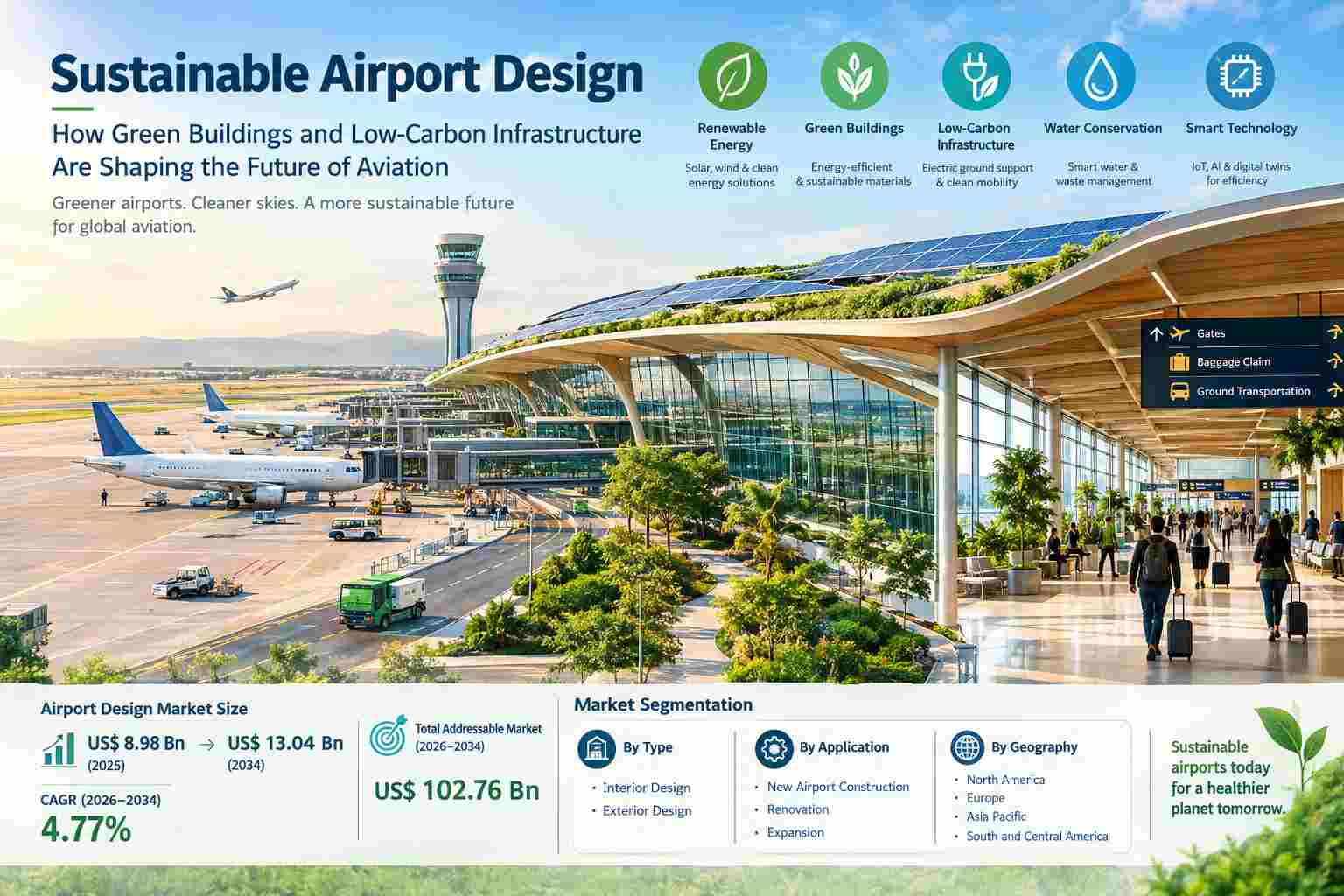
Airports are evolving from conventional transportation facilities into complex, technology-enabled infrastructure ecosystems. As passenger traffic increases, airports are under growing pressure to expand capacity while improving energy efficiency, reducing environmental impact, and delivering better passenger experiences. This transformation is creating new opportunities for sustainable airport design, where green buildings, low-carbon materials, renewable energy, smart technologies, and resilient infrastructure are becoming increasingly important.
According to The Insight Partners, the global Airport Design Market was valued at US$8.98 billion in 2025 and is projected to reach US$13.04 billion by 2034, registering a CAGR of 4.77% from 2026 to 2034. The total addressable market is projected to reach approximately US$102.76 billion during 2026–2034. The market covers Interior Design and Exterior Design, as well as applications including New Airport Construction, Renovation, and Expansion.
Sustainability Is Becoming Central to Airport Design
Airports have traditionally required large buildings, extensive paved areas, lighting systems, heating and cooling infrastructure, transportation networks, baggage systems, and other energy-intensive facilities. As aviation infrastructure expands, airport developers and authorities are increasingly considering environmental performance throughout the design and construction lifecycle.
Sustainable airport design can include energy-efficient terminal buildings, optimized building envelopes, natural lighting and ventilation, renewable energy generation, water conservation systems, sustainable construction materials, electric ground-support infrastructure, and intelligent building-management systems.
Rather than treating sustainability as a standalone feature, modern airport projects are increasingly integrating environmental considerations into architectural planning, engineering, construction, and long-term facility management.
Green Buildings Are Transforming Airport Exterior Design
Exterior design is an important component of sustainable airport development. Terminal façades, roofs, windows, structural materials, and surrounding infrastructure can significantly influence energy consumption and the overall environmental performance of an airport.
Modern airport architecture can incorporate high-performance façades, energy-efficient glazing, reflective roofing, improved insulation, daylight optimization, and solar installations. These features can help reduce the energy required for heating, cooling, and artificial lighting.
Large airport terminals also provide opportunities for rooftop solar generation and other renewable-energy installations. Integrating renewable-energy infrastructure into airport buildings can support broader efforts to reduce dependence on conventional energy sources.
Landscaping is another important consideration. Green spaces, vegetation, water-management systems, and heat-reduction strategies can contribute to more resilient airport environments while improving the overall passenger experience.
Sustainable Interior Design Is Improving Passenger Experience
Sustainability is not limited to an airport's external structure. Interior design is also becoming an important part of environmentally responsible airport development.
Airport interiors can incorporate energy-efficient lighting, smart HVAC systems, recycled or low-impact materials, durable furnishings, and intelligent occupancy management. LED lighting and automated controls can help optimize electricity consumption according to passenger movement and operational requirements.
At the same time, sustainable interior design increasingly overlaps with passenger-centric design. Natural lighting, indoor greenery, improved acoustics, comfortable seating, and better air-quality management can contribute to a more pleasant terminal environment.
Smart sensors can further support efficient facility management by monitoring occupancy, temperature, lighting requirements, and equipment performance. This allows airport operators to adjust building systems according to actual usage rather than relying exclusively on fixed operating schedules.
Renovation Is Creating New Opportunities for Sustainable Airports
Airport sustainability is not limited to newly constructed facilities. Renovation represents an important application area within the Airport Design Market because many airports need to modernize existing terminals while continuing daily operations.
Renovation projects can provide opportunities to replace inefficient lighting, HVAC systems, windows, insulation, and building-management infrastructure. Existing airport buildings can also be upgraded with renewable-energy systems, smart monitoring technologies, water-saving solutions, and more sustainable interior materials.
This approach can be particularly important where constructing an entirely new terminal is impractical or where airport authorities want to increase capacity without completely replacing existing infrastructure.
Expansion Projects Need Flexible and Low-Carbon Planning
Growing passenger demand is another major factor supporting airport design investments. Rising air travel demand is encouraging airport authorities to expand terminals, runways, taxiways, hangars, cargo facilities, and other infrastructure.
However, airport expansion can create challenges related to energy consumption, land use, construction materials, transportation, and emissions. Sustainable planning can help address these challenges by incorporating energy-efficient systems and environmentally conscious materials from the early design stage.
Expansion projects can also use modular and adaptable approaches that allow infrastructure to be upgraded as passenger volumes and operational requirements change. Designing facilities for future expansion can reduce the need for disruptive reconstruction and potentially improve long-term resource efficiency.
Smart Airports Are Supporting Sustainable Infrastructure
The emergence of smart airports is closely connected with sustainable airport design. Technologies such as IoT sensors, artificial intelligence, biometric systems, automation, and real-time monitoring can improve airport operations while supporting more efficient resource utilization.
For example, connected sensors can monitor energy consumption across different areas of a terminal. Airport operators can use this information to identify inefficient systems and optimize building operations. AI-enabled analytics can also help forecast passenger flows and operational requirements, potentially allowing facilities to adjust lighting, ventilation, security resources, and other systems according to real-time demand.
Digital technologies can therefore influence both the design and operation of airport infrastructure.
Digital Twins Can Support Sustainable Airport Planning
Digital twins are another emerging technology relevant to the future of airport design. A digital representation of an airport facility can help architects, engineers, and operators analyze building performance and simulate different operational scenarios.
During the design phase, digital models can be used to assess passenger movement, energy requirements, space utilization, and infrastructure performance. After construction, similar systems can support facility management and predictive maintenance.
This creates an opportunity to consider sustainability across the entire airport lifecycle rather than focusing only on construction.
Vertiports Could Introduce New Sustainable Design Requirements
The development of electric vertical takeoff and landing aircraft, or eVTOLs, is also creating new opportunities within airport infrastructure. Vertiports are being developed as potential hubs for air taxis, drones, and other vertical-flight vehicles.
Because these facilities may be integrated into urban transportation networks, their design requirements can differ from those of conventional airports. Compact layouts, efficient energy systems, charging infrastructure, noise considerations, and connections with existing transportation networks could become important design factors.
The development of vertiports therefore represents an emerging opportunity for airport designers and infrastructure providers as aviation expands toward new forms of urban mobility.
Regional Development Will Influence Sustainable Airport Design
Sustainable airport development is expected to progress across major aviation markets, including North America, Europe, Asia Pacific, and South and Central America, alongside other global regions covered in the market analysis.
North America remains an important market, supported by airport construction and modernization, passenger growth, air travel demand, and infrastructure investments. Meanwhile, rapid aviation development and increasing airport capacity requirements across Asia Pacific can create opportunities for new terminals and expansion projects.
Europe's airport infrastructure is also positioned around modernization, efficiency, and sustainability considerations, while emerging aviation markets in other regions are creating demand for new and upgraded infrastructure.
Future Outlook for the Airport Design Industry
The Airport Design Industry is expected to witness steady growth during the forecast period, supported by rising passenger traffic and airport expansion. The market is being influenced by smart airport development, technology integration, new airport and vertiport construction, infrastructure modernization, and continued investments in advanced aviation facilities.
The future of airport design will increasingly involve balancing capacity, passenger experience, operational efficiency, technology, and environmental performance. Green buildings and low-carbon infrastructure can become integral components of this transformation, particularly as airport authorities seek infrastructure that can operate efficiently over decades.
Ultimately, sustainable airport design is moving beyond the concept of simply constructing environmentally friendly terminals. It is becoming a broader approach that combines architecture, engineering, digital technologies, renewable energy, intelligent operations, and long-term infrastructure planning. As airports prepare for changing passenger volumes and emerging aviation technologies, sustainability is likely to remain an important consideration in how the airports of the future are designed, renovated, and expanded.