Humidity monitoring is becoming an increasingly important component of connected environments, smart manufacturing, precision agriculture, pharmaceutical production, food processing, and advanced building management. As industries move toward real-time monitoring and data-driven decision-making, humidity sensors are evolving from standalone measurement devices into intelligent sensing solutions capable of communicating with connected systems and supporting automated control.
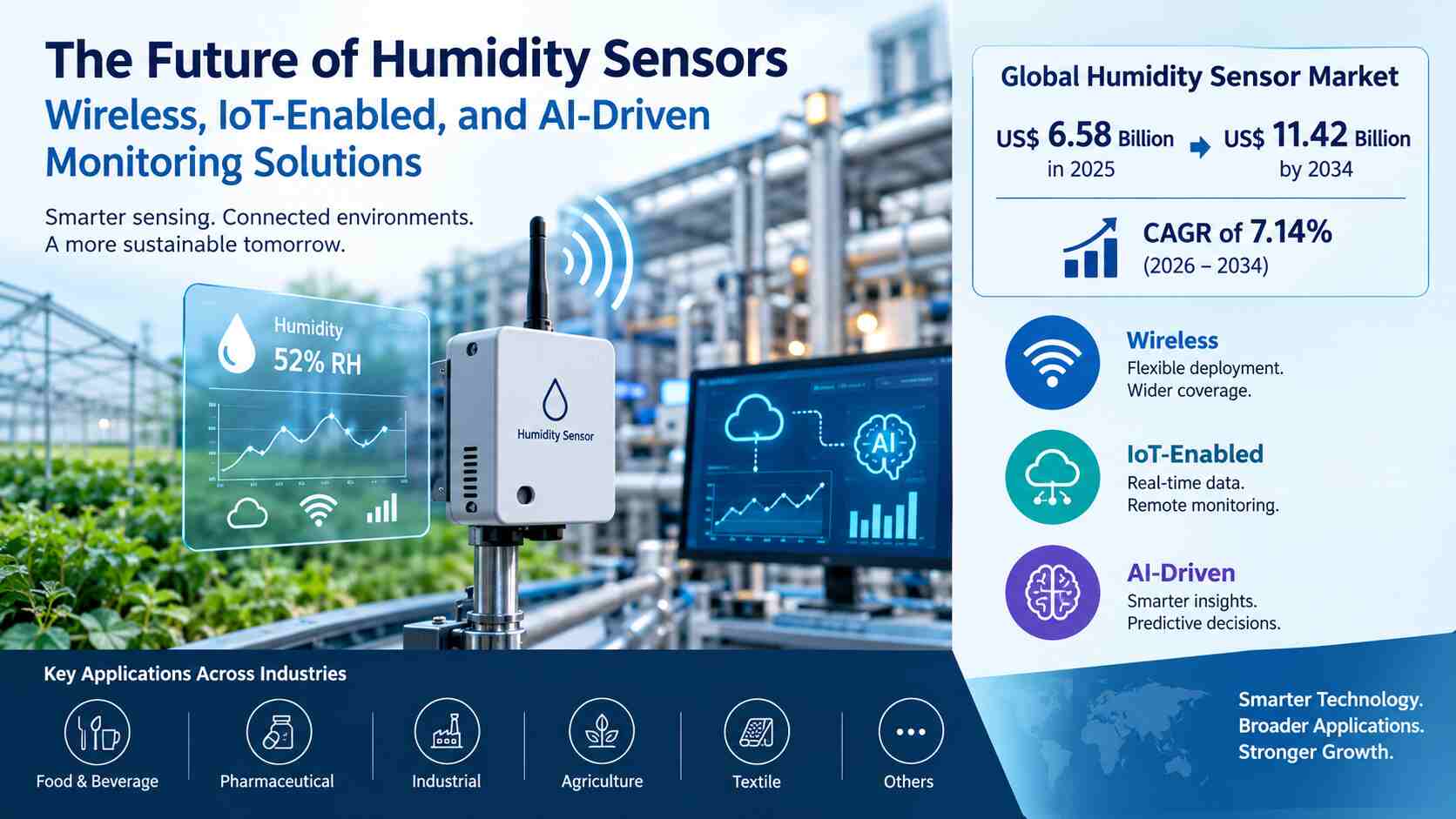
According to The Insight Partners, the global Humidity Sensor Market was valued at US$ 6.58 billion in 2025 and is projected to reach US$ 11.42 billion by 2034, registering a CAGR of 7.14% from 2026 to 2034. The market is being supported by the growing need for indoor air quality monitoring, expanding HVAC and smart building systems, increasing industrial automation, and the adoption of connected sensing technologies.
From Traditional Measurement to Intelligent Humidity Monitoring
Traditional humidity sensors primarily focused on measuring moisture levels and transmitting basic readings. However, the requirements of modern industries are changing. Manufacturers and facility operators increasingly need continuous monitoring, remote access, automated alerts, predictive insights, and integration with broader digital platforms.
This transition is creating opportunities for wireless and IoT-enabled humidity sensors. Instead of operating independently, sensors can collect environmental data and transmit it to gateways, cloud platforms, building management systems, industrial control systems, or other connected devices. This enables organizations to monitor humidity conditions across multiple locations without relying exclusively on manual inspections.
The integration of humidity sensors with IoT technologies is particularly important in smart buildings. Connected humidity data can be used alongside temperature, air-quality, occupancy, and HVAC information to optimize indoor environmental conditions. The Insight Partners identifies integration with IoT and smart devices as a key future trend, with humidity sensors increasingly incorporated into smart thermostats, air purifiers, weather stations, and other connected products.
Wireless Sensors Enable Real-Time Remote Monitoring
Wireless connectivity is expected to play an important role in the next generation of humidity monitoring. Wireless sensors can reduce the need for extensive cabling and provide greater flexibility when monitoring large facilities, warehouses, greenhouses, production plants, and commercial buildings.
For industrial users, wireless humidity sensors can support distributed monitoring across production environments. Data from multiple sensing points can be collected in real time, helping operators identify abnormal humidity conditions before they affect production processes or product quality.
In warehouses and storage facilities, continuous monitoring can also help identify environmental changes that could damage humidity-sensitive materials. This is particularly relevant for pharmaceutical products, food products, chemicals, electronics, and other materials requiring controlled environmental conditions.
IoT Connectivity Is Expanding the Role of Humidity Sensors
IoT connectivity is transforming humidity sensors from measurement components into sources of actionable operational data. Connected sensors can continuously transmit readings to centralized platforms, enabling users to monitor environmental conditions remotely.
For example, a pharmaceutical manufacturing facility could deploy multiple humidity sensors throughout controlled areas and use connected data to identify deviations. Similarly, food and beverage manufacturers can use humidity monitoring to support process control and maintain appropriate environmental conditions.
In agriculture, IoT-enabled humidity sensors can contribute to greenhouse monitoring and precision farming applications. Sensors can provide continuous environmental information that helps growers understand changing conditions and make more informed decisions regarding irrigation, ventilation, and crop management.
The Insight Partners identifies agricultural and environmental monitoring as important opportunities for humidity sensor adoption, particularly as precision agriculture technologies expand.
AI-Driven Monitoring Can Make Sensor Data More Valuable
The next stage of development is expected to involve greater use of artificial intelligence and advanced analytics. Collecting humidity data is only the first step. The greater value comes from analyzing that data to identify patterns, detect anomalies, predict potential problems, and support automated decision-making.
AI-enabled systems can analyze historical humidity readings alongside temperature, equipment performance, energy consumption, and other environmental parameters. This can help organizations identify unusual patterns that may not be immediately visible through conventional monitoring.
For example, an AI-based building management platform could identify recurring humidity increases in a particular area and determine whether they are associated with HVAC performance, occupancy patterns, or other operational factors. Industrial facilities could similarly use analytics to identify environmental conditions associated with production inefficiencies or equipment issues.
The growing combination of AI, IoT, and sensor technologies is therefore expected to expand the strategic role of humidity monitoring across multiple industries.
Miniaturization Will Support New Applications
Another important development is sensor miniaturization. Smaller sensors can be integrated into compact electronic devices, wearables, connected appliances, industrial equipment, and portable monitoring systems.
The Insight Partners identifies miniaturization and enhanced accuracy as key future trends in the Humidity Sensor Market. Smaller and more precise sensors can create opportunities in applications where space, power consumption, and measurement accuracy are critical.
The growth of consumer electronics and wearable devices could further expand the addressable market. Environmental sensing capabilities can be integrated into increasingly compact products, creating demand for sensors that combine small form factors with reliable performance.
Industry Verticals Driving Demand
The future growth of humidity sensing is not limited to a single industry. The market covers Food and Beverage, Pharmaceutical, Industrial, Agriculture, Textile, and other applications.
In the pharmaceutical sector, humidity monitoring is important for controlled manufacturing, storage, and processing environments. In food and beverage, monitoring environmental conditions can support quality and process consistency. Industrial facilities are increasingly incorporating sensors into automated production and monitoring systems.
Agriculture represents another important opportunity as precision farming and controlled-environment agriculture gain adoption. Humidity information can complement other environmental parameters to support optimized growing conditions.
Meanwhile, the textile industry can benefit from accurate humidity monitoring because environmental conditions can influence material handling and manufacturing processes.
Sensor Technology Will Continue to Diversify
The Humidity Sensor Market encompasses multiple sensing approaches, including Absolute Humidity Sensors, Relative Humidity Sensors, Optical Hygrometers, Oscillating Hygrometers, and Gravimetric Hygrometers.
Each technology can address different measurement requirements, creating opportunities for manufacturers to develop solutions tailored to specific industrial and commercial applications. As connected systems become more sophisticated, sensor selection will increasingly depend not only on measurement capability but also on accuracy, response time, connectivity, power consumption, size, reliability, and integration capabilities.
Asia Pacific to Remain an Important Growth Region
Regional developments will also influence the future of the humidity sensing industry. The market is analyzed across North America, Europe, Asia Pacific, and South and Central America, with country-level analysis covering major markets.
Asia Pacific is expected to remain an important market as manufacturing, electronics, industrial automation, smart infrastructure, and agricultural technologies continue to develop. Increasing adoption of connected technologies across industrial and commercial environments can create additional opportunities for advanced humidity monitoring solutions.
North America and Europe are also important markets because of the adoption of smart building technologies, industrial automation, advanced HVAC systems, and sophisticated environmental monitoring infrastructure.
The Road Ahead for Humidity Sensors
The future of humidity sensors is moving beyond simple measurement toward connected, intelligent, and predictive environmental monitoring. Wireless connectivity can make sensor deployment more flexible, IoT platforms can enable continuous remote monitoring, and AI-driven analytics can transform raw humidity readings into actionable insights.
At the same time, miniaturization and improvements in sensor accuracy can open new opportunities across consumer electronics, wearables, industrial equipment, agriculture, and smart buildings.
As businesses increasingly prioritize automation, energy efficiency, environmental control, and real-time decision-making, humidity sensors are positioned to become an increasingly integral part of the connected infrastructure powering next-generation industrial and commercial environments.