Industries across the world are moving toward connected, automated, and data-driven operations, creating growing demand for technologies that can identify, track, and monitor physical assets in real time. Radio Frequency Identification (RFID) has emerged as an important technology in this transformation. While traditional RFID systems were primarily used for identification and inventory tracking, next-generation RFID readers are evolving into intelligent, connected devices that can integrate with Internet of Things (IoT) platforms, enterprise systems, analytics tools, and automated workflows.
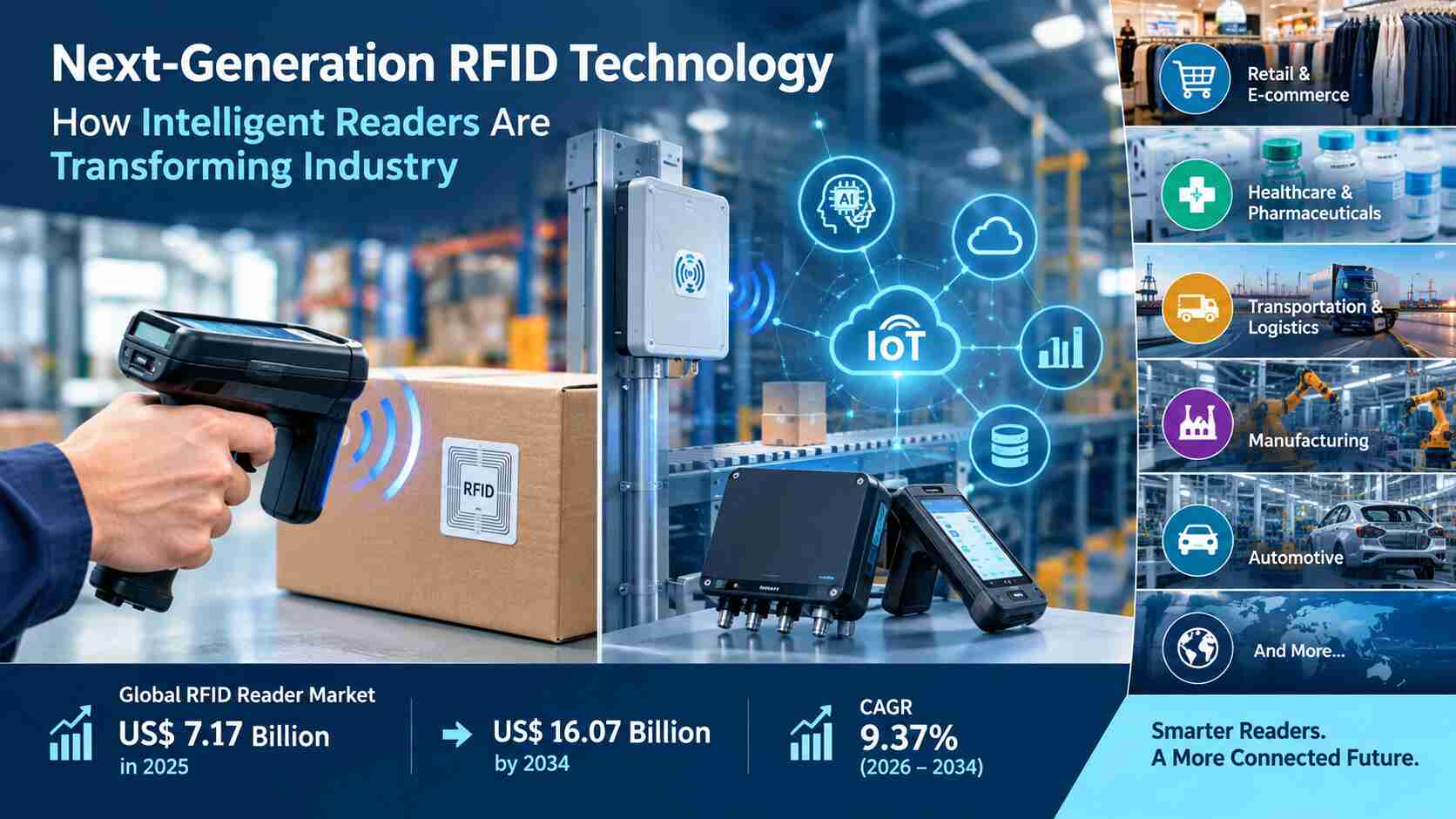
The global RFID Reader Market is gaining significant momentum as organizations increasingly prioritize real-time visibility, supply chain efficiency, inventory accuracy, and automation. According to The Insight Partners, the global RFID Reader Market was valued at US$ 7.17 billion in 2025 and is projected to reach US$ 16.07 billion by 2034, registering a CAGR of 9.37% from 2026 to 2034. The addressable market is estimated at approximately US$ 103.71 billion during 2026–2034, highlighting the broader opportunities emerging around RFID-enabled tracking and identification solutions.
From RFID Identification to Intelligent Tracking
The role of RFID readers is changing rapidly. Earlier deployments largely focused on reading information stored on RFID tags. Today, organizations increasingly expect RFID infrastructure to deliver continuous visibility and actionable operational information.
Modern RFID readers can capture data from multiple tags, connect with enterprise software, and support automated decision-making. Fixed readers can be installed at warehouse entrances, production lines, loading docks, and other strategic locations, while handheld readers provide flexibility for inventory audits, asset tracking, and field operations.
This transition from basic identification toward intelligent tracking is particularly important as businesses seek to connect physical assets with digital systems. RFID readers can serve as an interface between tagged products and broader digital ecosystems, enabling organizations to understand where assets are located, when they move, and whether they are following expected operational processes.
IoT Integration Is Creating Connected RFID Ecosystems
One of the most important trends shaping next-generation RFID technology is the integration of RFID readers with IoT networks. Connecting RFID readers to IoT infrastructure allows organizations to collect and transmit identification data across connected environments.
In logistics and warehousing, RFID readers can provide real-time information about products moving through receiving areas, storage locations, and shipping zones. In manufacturing, RFID data can be connected with production systems to monitor raw materials, work-in-progress items, tools, and equipment.
The Insight Partners identifies RFID-IoT integration as a significant future trend, with connected RFID systems supporting real-time tracking, remote monitoring, data collection, and greater automation across logistics, manufacturing, and healthcare applications.
This connectivity can also help organizations build more responsive supply chains. Instead of relying exclusively on periodic manual inventory checks, companies can use RFID-enabled systems to continuously capture movement and status information.
AI and Edge Computing Add Intelligence to RFID Data
The increasing adoption of artificial intelligence and edge computing is creating another layer of opportunity for RFID readers. RFID systems can generate large volumes of data, particularly in environments where thousands of tags are read throughout the day. Intelligent software can analyze this information to identify patterns, exceptions, and operational inefficiencies.
For example, AI-enabled analytics can potentially help businesses identify unusual inventory movements, detect process deviations, support demand forecasting, and improve replenishment decisions. In manufacturing environments, RFID data can be combined with production information to provide greater visibility into material movement and operational workflows.
Edge computing can further enhance these capabilities by processing RFID data closer to the point where it is generated. Rather than sending every raw read to a centralized cloud platform, edge-enabled systems can filter and process information locally. This can help reduce unnecessary data transmission and support faster responses in time-sensitive applications.
The convergence of RFID, IoT, cloud platforms, edge computing, and analytics is therefore changing the role of the RFID reader from a simple data-capture device into a connected component of intelligent infrastructure.
Fixed and Handheld Readers Support Diverse Applications
The RFID Reader Market includes handheld RFID readers and fixed RFID readers, each serving different operational requirements.
Handheld RFID readers provide mobility and are useful for inventory counting, asset verification, warehouse operations, retail stock audits, and field-service applications. Their portability allows employees to scan and identify tagged assets without being restricted to a fixed location.
Fixed RFID readers, on the other hand, can be installed at strategic points such as warehouse gates, dock doors, conveyor systems, production lines, and access points. They can automatically capture tag information as products or assets pass through designated locations.
The combination of fixed and handheld infrastructure can provide organizations with both continuous automated tracking and flexible on-demand identification capabilities.
UHF RFID Is Supporting Large-Scale Tracking
RFID reader technologies operate across different frequency ranges, including low frequency (125 kHz–134 kHz), high frequency (13.56 MHz), and ultra-high frequency (860 MHz–960 MHz).
Each frequency range can address different application requirements depending on factors such as read range, operating environment, tag design, and the type of asset being tracked.
UHF RFID is particularly relevant to large-scale inventory and supply chain applications because it can support the simultaneous identification of multiple tagged items over relatively longer distances. This makes the technology suitable for applications such as warehouse inventory, retail merchandise tracking, logistics operations, and manufacturing workflows.
Advancements in RFID technology are also improving data capacity and read-range capabilities, supporting faster data collection in large-scale operational environments.
Transforming Retail and E-Commerce
Retail and e-commerce represent important opportunity areas for RFID readers. The growth of omnichannel retail has increased the importance of accurate, real-time inventory information.
Retailers can use RFID readers to improve inventory visibility across stores, warehouses, distribution centers, and fulfillment operations. More accurate inventory information can support activities such as replenishment, order fulfillment, stock audits, and product availability management.
RFID can also help retailers connect physical stores with digital commerce operations. As customers increasingly expect products to be available across multiple channels, accurate inventory information becomes an important part of omnichannel fulfillment strategies.
The Insight Partners identifies retail and e-commerce applications as significant opportunities for RFID reader adoption, particularly for inventory management, product tracking, customer experience, and omnichannel strategies.
Supporting Healthcare and Pharmaceutical Traceability
Healthcare and pharmaceutical organizations are also exploring RFID readers for applications requiring accurate tracking and traceability. Hospitals can use RFID systems to monitor medical equipment, pharmaceuticals, supplies, and other valuable assets.
For healthcare providers, improved asset visibility can help locate equipment and support more efficient utilization. RFID-enabled workflows can also contribute to patient and medication tracking applications where appropriate.
Regulatory requirements around product and asset traceability are another factor supporting technology adoption in certain healthcare and pharmaceutical environments. The Insight Partners identifies healthcare asset tracking and patient monitoring as important opportunity areas for RFID reader market growth.
Enabling Smart Manufacturing and Automotive Operations
Manufacturers are increasingly adopting connected technologies as part of Industry 4.0 and smart factory initiatives. RFID readers can support these efforts by providing visibility into materials, components, tools, work-in-progress products, and finished goods.
In automotive manufacturing, RFID-enabled tracking can help organizations monitor components as they move through production processes. In industrial manufacturing, readers can be integrated with automated systems to support material handling, production tracking, and equipment management.
When RFID data is combined with manufacturing execution systems, enterprise resource planning platforms, IoT networks, and analytics applications, organizations can create a more connected view of production activities.
The expansion of industrial automation and smart manufacturing is identified by The Insight Partners as a key opportunity for RFID reader adoption.
RFID Readers and the Future of Connected Supply Chains
The evolution of RFID readers reflects a broader transition toward connected physical infrastructure. Businesses are no longer looking only for technologies that identify products. They increasingly need systems that provide continuous visibility and integrate with their wider digital operations.
The future of RFID technology is likely to involve greater integration with IoT, AI, edge computing, cloud platforms, robotics, and enterprise applications. Smaller and more portable readers can support mobile operations, while advanced fixed readers can provide automated monitoring across warehouses, factories, transportation hubs, and retail environments.
As organizations continue to prioritize automation, real-time tracking, and supply chain transparency, intelligent RFID readers can become an important component of connected operational ecosystems.
Future Industry Outlook
Next-generation RFID technology is transforming the role of identification systems across industries. From smart warehouses and connected supply chains to retail, healthcare, automotive, and industrial manufacturing, intelligent RFID readers are enabling organizations to capture and use real-time information more efficiently.
The combination of RFID with IoT connectivity, AI-powered analytics, edge computing, automation, and enterprise software is creating new possibilities for real-time visibility and intelligent decision-making. As industries move toward increasingly connected operations, RFID readers are evolving from standalone identification devices into critical building blocks of the digital enterprise.