Dental 3D printing is moving beyond the production of models and temporary devices toward increasingly sophisticated applications in prosthodontics, implantology, and endodontics. At the center of this transformation is the rapid evolution of dental 3D printing materials. Advanced resins, metal powders, and other engineered materials are enabling dental professionals and laboratories to produce highly customized components with greater precision, improved functionality, and more efficient digital workflows.
According to The Insight Partners’ Dental 3D Printing Market report, the global Dental 3D Printing Market was valued at US$4.37 billion in 2025 and is projected to reach US$15.64 billion by 2034, registering a CAGR of 15.21% from 2026 to 2034. The report identifies plastics, metals, and other materials as key material categories shaping this market.
Why Materials Matter in Dental 3D Printing
The capabilities of a 3D printer are closely connected to the properties of the material being processed. In dentistry, materials must meet demanding requirements related to dimensional accuracy, strength, durability, aesthetics, biocompatibility, and application-specific performance.
Traditional dental manufacturing often involves multiple manual steps, material waste, and extended production times. Additive manufacturing allows dental laboratories and clinics to build components layer by layer based on digital designs. This makes it possible to use material more efficiently while producing geometrically complex and patient-specific products.
Recent research continues to demonstrate how additive manufacturing is expanding across dental implants, prostheses, surgical guides, orthodontic appliances, and other dental devices.
As a result, material innovation is becoming just as important as advances in printers, software, and scanning technologies.
Advanced Resins Expand the Role of Polymer-Based Printing
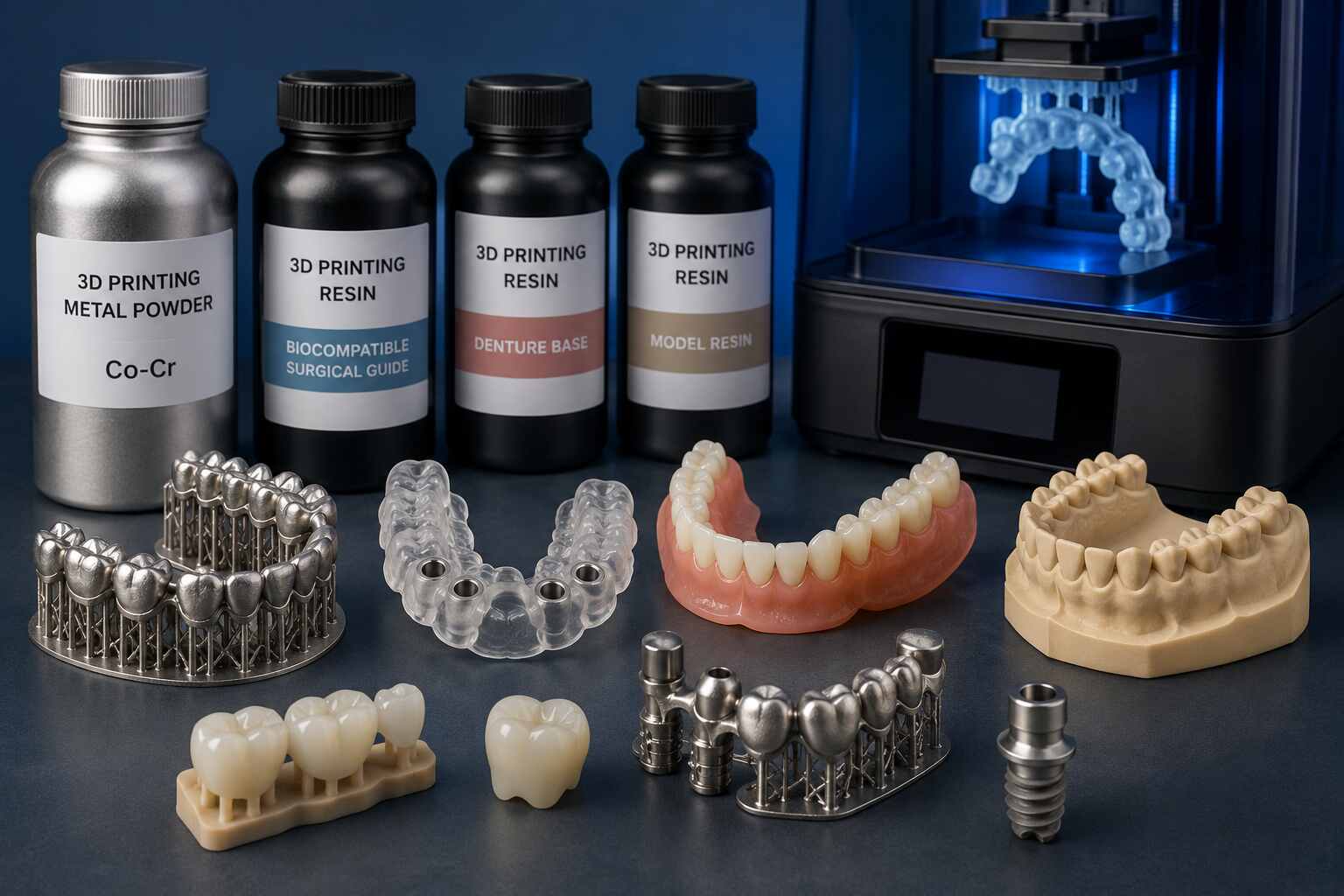
Resins have become an important material category in dental 3D printing, particularly in technologies based on vat photopolymerization. Their ability to reproduce intricate geometries, fine details, and smooth surfaces makes them suitable for a wide range of dental applications.
Modern dental resins are being developed for different performance requirements rather than functioning as one-size-fits-all materials. Depending on their formulation, they can support applications such as dental models, surgical guides, temporary restorations, orthodontic appliances, dentures, and other customized components.
One important direction is the development of biocompatible resins designed for applications where the printed component interacts closely with oral tissues. Improved formulations are also targeting mechanical strength, dimensional stability, wear resistance, and aesthetic performance.
Research published in 2026 highlights continued investigation into the mechanical, optical, biological, and long-term properties of 3D-printed resins intended for definitive dental restorations.
This evolution is important because the expansion of dental 3D printing depends not only on producing components quickly but also on demonstrating that materials can deliver reliable performance over their intended service life.
Metals Bring Strength and Performance to Complex Applications
While polymer-based materials are highly valuable for numerous dental applications, metals offer characteristics that make them attractive for applications requiring greater mechanical strength and durability.
Metal additive manufacturing can support the production of customized dental components with complex geometries that may be difficult or inefficient to manufacture using conventional methods. Titanium and cobalt-chromium-based materials, for example, are relevant to dental manufacturing because of their combination of strength and application-specific performance.
Metal 3D printing can be particularly significant in areas such as implantology and prosthodontics, where mechanical performance is a critical consideration. Instead of relying exclusively on standardized geometries, additive manufacturing can enable designs to be adapted to patient-specific anatomical requirements.
The broader additive manufacturing literature also identifies implants and prostheses among the important dental applications benefiting from advances in 3D-printing technologies and materials.
From Temporary Products to Definitive Restorations
One of the most significant developments in dental 3D printing is the gradual expansion from auxiliary products toward more definitive dental restorations.
Historically, 3D printing was frequently associated with diagnostic models, prototypes, surgical guides, and other workflow-supporting products. However, advances in materials and printing processes are opening opportunities for crowns, bridges, dentures, veneers, endocrowns, overlays, and other restorative applications.
A September 2026 scoping review specifically examined 3D-printed resin and ceramic-based materials for definitive tooth-supported restorations, reflecting the industry's continuing movement toward clinically relevant final products.
For manufacturers, this creates an opportunity to develop material portfolios targeted at specific clinical indications. For dental laboratories, it can potentially simplify production workflows by allowing multiple product categories to be manufactured digitally.
Material Innovation Supports Personalized Dentistry
Personalization is one of the fundamental drivers of the Dental 3D Printing Market. The Insight Partners identifies increasing demand for personalized dental care as a major growth driver because 3D printing enables dental products to be manufactured according to individual patient requirements.
Advanced materials strengthen this advantage.
A digitally designed restoration can be manufactured according to the patient's anatomy, while material characteristics can be selected according to the intended application. This combination of digital design + additive manufacturing + application-specific materials creates a more flexible production model than standardized manufacturing.
For example, a dental laboratory may use different resin formulations for models, temporary restorations, surgical guides, or orthodontic applications, while metal-based additive manufacturing can address applications requiring greater mechanical strength.
Integration with Digital Dentistry
Material innovation is also closely linked to the broader digital dentistry ecosystem. The Insight Partners expects dental 3D printing to become increasingly integrated with technologies such as intraoral scanning and CAD/CAM systems, creating more efficient and accurate workflows from diagnosis through treatment.
A typical digital workflow can involve capturing a patient's oral anatomy through an intraoral scanner, creating a digital model, designing the required dental component using specialized software, and sending the digital file to a 3D printer.
As these workflows become more integrated, materials must become increasingly compatible with automated and digitally controlled production processes.
Sustainability and Material Efficiency
Sustainability is another factor supporting the development of additive manufacturing in dentistry. Conventional subtractive manufacturing can involve removing significant quantities of material from blocks to achieve the desired shape. In contrast, additive manufacturing builds components layer by layer and can reduce unnecessary material consumption.
The Insight Partners identifies increased sustainability as a future trend for the Dental 3D Printing Market, noting the potential for reduced waste and the use of more environmentally friendly materials.
However, sustainability will increasingly depend on the complete lifecycle of dental materials, including formulation, printing efficiency, post-processing, durability, and disposal. Material manufacturers therefore have an opportunity to focus not only on performance but also on more sustainable material systems.
Challenges Will Shape the Next Stage of Material Development
Despite significant progress, advanced dental materials still face challenges. Materials intended for clinical applications need to demonstrate appropriate mechanical and biological characteristics, while manufacturers must address consistency, post-processing requirements, regulatory expectations, and long-term performance.
Recent research has particularly emphasized the importance of evaluating the durability and biological behavior of 3D-printed resin-based materials.
Regulatory advances could therefore become increasingly important as dental 3D printing moves into more demanding applications. The Insight Partners identifies clearer regulatory guidelines and standards as an opportunity that could enhance confidence among dental professionals and patients.
Outlook for Dental 3D Printing Materials
The future of dental 3D printing will increasingly depend on the ability of material developers to combine precision, strength, biocompatibility, aesthetics, durability, printability, and cost efficiency.
Advanced resins are likely to continue expanding polymer-based applications, while metal additive manufacturing can support applications where mechanical performance is paramount. At the same time, continued research into ceramics, composites, and other specialized materials could broaden the range of printable dental products.
Ultimately, the next generation of dental 3D printing will not be defined solely by faster printers or better software. Material innovation will be a fundamental enabler of what dental 3D printing can produce and where it can be used. As advanced resins, metals, and other materials become more application-specific and digitally integrated, 3D printing is positioned to move deeper into mainstream dental manufacturing and personalized patient care.