Cardiovascular diseases remain a major healthcare challenge worldwide, increasing the need for advanced technologies that can support early diagnosis, continuous monitoring, and effective treatment. At the same time, rapid developments in artificial intelligence (AI), connected healthcare, remote monitoring, minimally invasive procedures, and personalized medicine are changing how cardiac conditions are detected and managed. These developments are creating new opportunities across the global Cardiac Equipment Market, spanning cardiac ultrasound devices, implantable cardioverter defibrillators (ICDs), pacemakers, cardiac resynchronization therapy (CRT) devices, ventricular assist devices, balloon pumps, cardiopulmonary bypass pumps, artificial hearts, and counterpulsation devices.
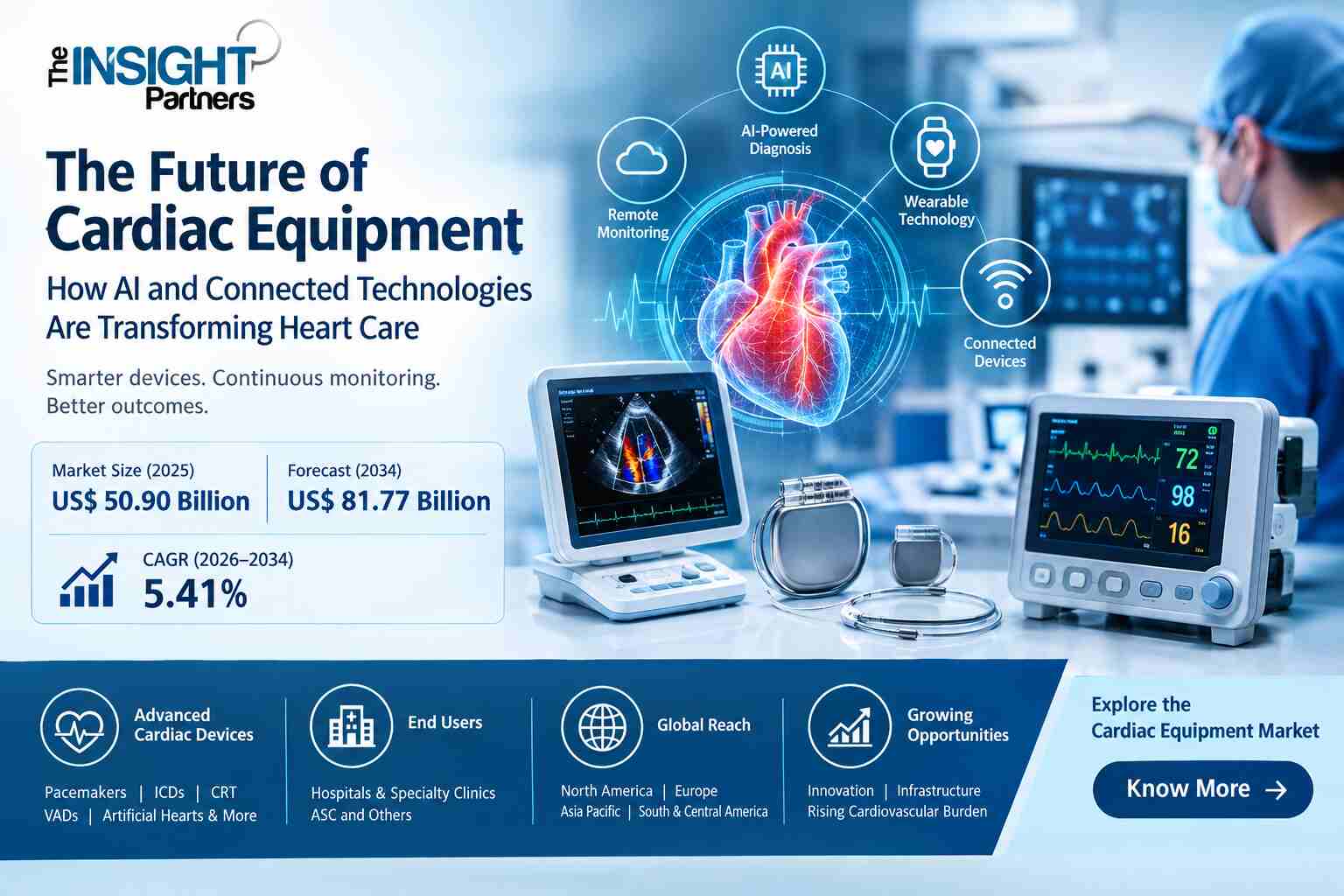
According to The Insight Partners, the global Cardiac Equipment Market was valued at US$ 50.90 billion in 2025 and is projected to reach US$ 81.77 billion by 2034, registering a CAGR of 5.41% during 2026–2034. The report also estimates the total addressable market during the forecast period at approximately US$ 601.70 billion, highlighting the substantial commercial potential associated with next-generation cardiac technologies.
AI Is Reshaping Cardiac Diagnosis and Decision-Making
Artificial intelligence is emerging as an important technology across cardiovascular healthcare. Modern cardiac equipment increasingly generates large volumes of clinical data through imaging, monitoring, implanted devices, and diagnostic systems. AI-based technologies can help healthcare professionals analyze this information more efficiently and identify clinically relevant patterns.
Cardiac ultrasound devices, for example, are becoming increasingly sophisticated as digital imaging and intelligent analysis capabilities advance. AI-assisted imaging can support the interpretation of cardiac images and potentially improve workflow efficiency. Similarly, data generated by implantable cardiac devices can be analyzed to support continuous assessment of patient conditions.
The integration of AI with cardiac equipment also supports the broader movement toward data-driven healthcare. Instead of relying exclusively on periodic clinical assessments, healthcare providers can increasingly use continuously generated information to understand changes in cardiac health and determine when additional evaluation may be required.
Connected Cardiac Equipment Enables Continuous Monitoring
One of the most significant developments shaping the future of cardiac equipment is the integration of connected technologies. Wearable devices, mobile health applications, remote monitoring platforms, and connected medical devices are creating an ecosystem in which cardiac information can move beyond hospitals and specialty clinics.
The Insight Partners identifies telehealth integration with remote monitoring as an important future trend in the Cardiac Equipment Market. Wearable devices and mobile health applications can enable real-time monitoring and facilitate the sharing of information with healthcare providers. This approach can support more proactive management of cardiovascular conditions while giving patients greater visibility into their health.
Remote monitoring is particularly relevant for patients requiring long-term cardiovascular management. Instead of depending entirely on periodic hospital visits, connected devices can contribute to ongoing observation and timely communication between patients and healthcare professionals.
Pacemakers, ICDs, and CRT Devices Are Becoming More Connected
Cardiac rhythm management represents an important area of innovation. Pacemakers, ICDs, and CRT devices have traditionally played critical roles in managing abnormal heart rhythms and supporting cardiac function. Increasing connectivity is now adding another dimension to these technologies.
Connected cardiac implants can facilitate the transfer of device and patient information to healthcare teams. This can support remote follow-up and potentially allow healthcare professionals to identify changes that warrant closer evaluation.
As the healthcare industry moves toward personalized treatment, the combination of connected devices and advanced analytics could enable more individualized management strategies. The Insight Partners highlights personalized medicine as another important future trend, with research into genomics and biomarkers contributing to increasingly customized cardiac devices and therapies.
Minimally Invasive Procedures Are Driving Equipment Innovation
The evolution of cardiac equipment is also closely connected with the increasing adoption of less-invasive treatment approaches. Catheter-based interventions and robotic-assisted procedures are gaining attention because they can reduce recovery time and complications compared with some conventional approaches.
This transition is encouraging manufacturers to develop equipment that supports more precise and minimally invasive cardiac procedures. Advanced imaging, monitoring systems, and specialized cardiac devices can contribute to improved procedural visibility and treatment efficiency.
As hospitals and specialty clinics continue investing in modern infrastructure, demand for sophisticated equipment is expected to expand. Ambulatory surgical centers and other healthcare facilities may also contribute to market development as cardiovascular procedures increasingly evolve toward efficient and less-invasive models.
Wearable Technologies Create New Opportunities
Wearable technology represents another promising opportunity for the Cardiac Equipment Market. Smartwatches, fitness trackers, and other connected devices are expanding the role of technology in preventive healthcare and personal health management.
The Insight Partners identifies innovative wearable technologies as a market opportunity, particularly because these technologies can support real-time monitoring of heart health. As consumers become increasingly aware of cardiovascular wellness, wearable solutions could complement conventional medical equipment by providing continuous health information outside clinical settings.
For manufacturers, this creates opportunities to combine hardware, software, analytics, connectivity, and digital services into broader cardiac care ecosystems.
Ventricular Assist Devices and Artificial Hearts Support Advanced Cardiac Care
Innovation is not limited to monitoring and diagnosis. Advanced cardiac equipment such as ventricular assist devices (VADs) and total artificial hearts continues to play an important role in supporting patients with severe cardiac conditions.
These technologies represent the intersection of medical engineering and advanced cardiovascular treatment. Improvements in device design, monitoring capabilities, materials, and control technologies could contribute to their continued evolution.
The market's coverage of VADs, total artificial hearts, balloon pumps, cardiopulmonary bypass pumps, and counterpulsation devices demonstrates the broad technological landscape within the Cardiac Equipment Market.
Asia Pacific Presents Significant Growth Potential
Geographically, the Cardiac Equipment Market presents opportunities across North America, Europe, Asia Pacific, and South and Central America. North America currently accounts for the highest revenue share, while Asia Pacific is identified as the fastest-growing region during the forecast period.
Growing healthcare infrastructure, increasing awareness of cardiovascular health, technological adoption, and expanding healthcare expenditure can create opportunities for cardiac equipment manufacturers in emerging markets. Countries such as China, India, Japan, and Australia are included in the report's Asia Pacific analysis.
The expansion of advanced healthcare facilities in emerging economies may also increase demand for sophisticated cardiac diagnostic and treatment equipment.
What Does the Future Hold for Cardiac Equipment?
The future of cardiac equipment will increasingly be defined by the convergence of AI, connectivity, remote monitoring, minimally invasive procedures, wearable technologies, and personalized medicine. Rather than functioning as standalone medical devices, cardiac technologies are evolving into interconnected components of broader digital healthcare ecosystems.
For manufacturers and technology providers, this transformation creates opportunities to develop intelligent devices capable of collecting, analyzing, and communicating clinically relevant information. For hospitals and specialty clinics, connected equipment can support more efficient workflows and potentially strengthen continuity of care. For patients, remote monitoring and wearable technologies can make cardiac health management more continuous and accessible.
Explore the Cardiac Equipment Market
The Insight Partners' Cardiac Equipment Market report provides comprehensive analysis of market size, forecasts, growth drivers, future trends, opportunities, competitive landscape, type, end-user, regional, and country-level developments. The report covers 2021–2024 historical data, 2025 as the base year, and forecasts through 2034, helping technology providers, manufacturers, investors, and other stakeholders evaluate emerging opportunities across the cardiac equipment value chain.