Modern dentistry is moving toward procedures that are more conservative, predictable, efficient, and patient-centric. At the center of this transformation is dental bonding, an essential step in many restorative and prosthetic procedures. As dentists increasingly work with composite resins, ceramics, resin cements, veneers, crowns, and other advanced restorative materials, the need for reliable and versatile bonding systems continues to increase. Among the most important developments in this space is the growing adoption of universal dental adhesives, which are designed to simplify bonding protocols while providing flexibility across different substrates and etching techniques.
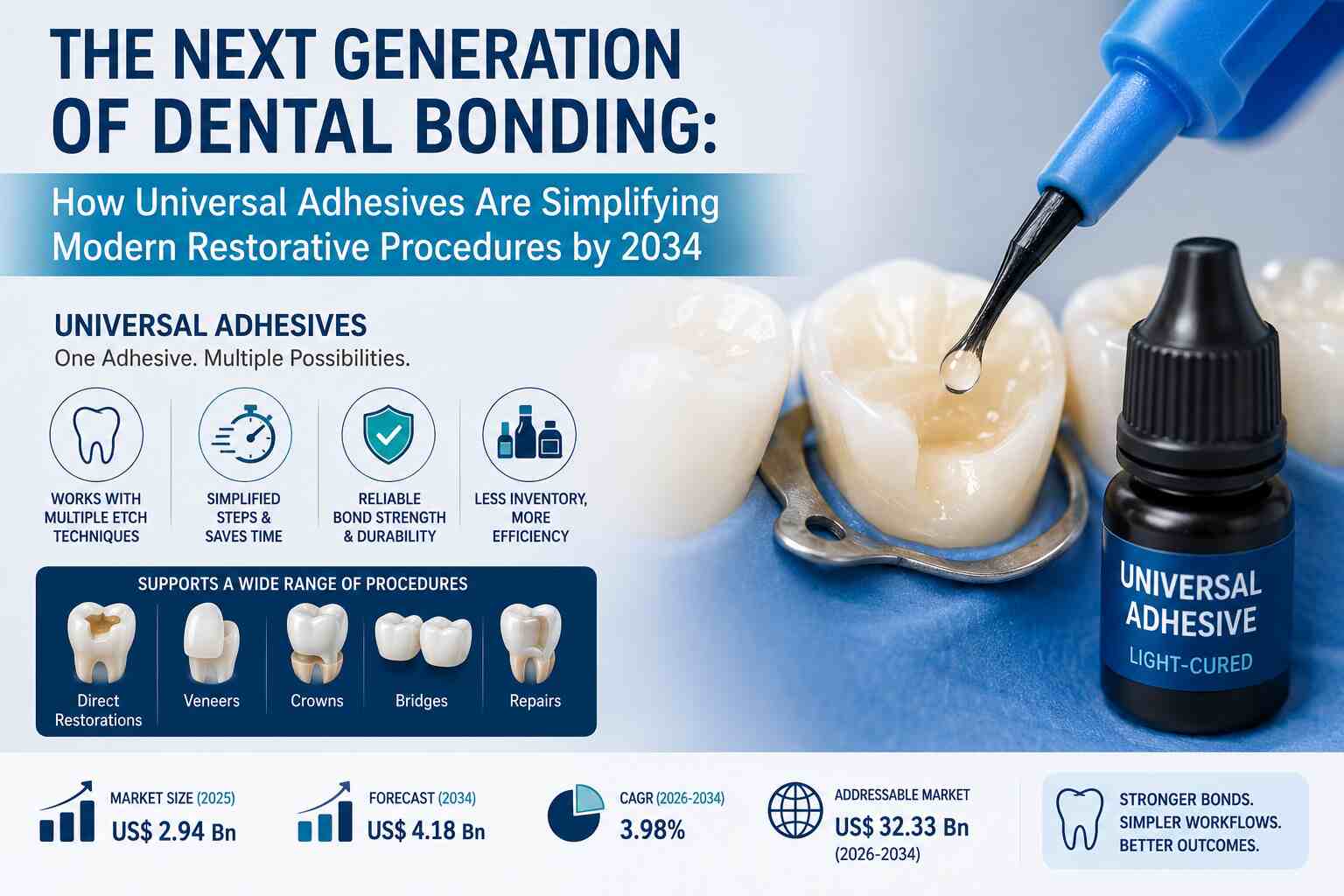
According to market analysis, the Dental Adhesive Market was valued at US$ 2.94 billion in 2025 and is projected to reach US$ 4.18 billion by 2034, expanding at a CAGR of 3.98% from 2026 to 2034. The market is being supported by increasing restorative treatment volumes, growing interest in minimally invasive dentistry, cosmetic dental procedures, and continuous improvements in adhesive formulations.
Why Universal Adhesives Are Changing Dental Bonding
Traditional dental bonding procedures often involved multiple steps, separate bottles, and technique-sensitive etching protocols. Etch-and-rinse systems, for example, require careful control of phosphoric acid etching, rinsing, moisture management, primer application, and adhesive placement. Although these approaches can provide effective bonding, variations in clinical technique can influence outcomes.
Universal adhesives have emerged as a response to this complexity. These systems can generally be used with different etching strategies, including total-etch, self-etch, and selective-etch approaches, depending on the clinical situation and manufacturer's instructions. Their versatility can help dentists simplify chairside workflows while reducing the number of materials required in everyday procedures.
For dental practices, the advantages extend beyond application. A universal adhesive capable of supporting multiple restorative procedures can help simplify inventory management, reduce product fragmentation, and make staff training more straightforward. This becomes particularly important for large dental groups and multi-location practices seeking greater consistency across clinical workflows.
Restorative Dentistry Remains the Core Demand Generator
Restorative adhesives represent the largest product segment within the Dental Adhesive Market, estimated to account for approximately 68%–72% of market share in 2025. Their widespread use across direct and indirect restorative procedures makes them a central component of modern dental care.
Composite restorations, veneers, crowns, bridges, repairs, and other procedures rely on effective adhesion between tooth structures and restorative materials. As minimally invasive dentistry becomes more prominent, effective bonding becomes even more important because conservative procedures often preserve more natural tooth structure and place greater reliance on adhesive interfaces.
Universal adhesives are well positioned within this environment because they can accommodate different clinical approaches and restorative substrates. Their application across composite, ceramic, and resin cement workflows gives manufacturers an opportunity to serve multiple treatment categories through integrated product portfolios.
Minimally Invasive Dentistry Is Raising the Importance of Adhesive Performance
The shift toward minimally invasive restorative care is another important factor shaping dental adhesive development. Modern dentists increasingly aim to preserve healthy enamel and dentin while achieving durable restoration outcomes. This approach can reduce unnecessary removal of tooth structure, but it also increases the importance of dependable adhesion.
Consequently, adhesive manufacturers are focusing on factors such as bond strength, moisture tolerance, film thickness, curing characteristics, postoperative sensitivity, and long-term durability. The objective is no longer simply to create a strong bond. Products must also deliver predictable handling and performance under real-world clinical conditions.
This trend is encouraging manufacturers to invest in formulation improvements involving resin monomers, solvents, fillers, initiators, and functional components. Better chemistry can potentially improve compatibility with different substrates while making the bonding process more forgiving and efficient.
Simplification Is Becoming a Competitive Advantage
Dental professionals increasingly evaluate materials according to their overall contribution to workflow efficiency rather than simply their purchase price. Universal adhesives directly address this shift.
A simplified bonding system can potentially reduce the number of application stages and materials required for a procedure. This can help shorten preparation time, reduce inventory complexity, and support greater consistency among dental staff.
For large dental organizations, workflow standardization is particularly valuable. When a common adhesive platform can be used across multiple procedures, practices may find it easier to establish standardized protocols and training programs.
Manufacturers are therefore competing not only on adhesive chemistry but also on delivery systems, packaging, clinical education, documentation, and compatibility with broader restorative ecosystems.
Digital Dentistry Is Creating New Opportunities
The expansion of digital dentistry is also influencing the evolution of dental bonding. CAD/CAM workflows, digital impressions, digitally designed restorations, and advanced ceramic materials are becoming increasingly integrated into restorative practices.
As digital workflows expand, adhesives need to function effectively alongside modern restorative materials and cementation techniques. This is encouraging suppliers to develop more integrated product portfolios that combine adhesives, resin cements, composites, curing technologies, and other restorative products.
The future could therefore involve a shift from purchasing individual adhesive products toward selecting complete restorative systems designed to work together. Such integration may provide clinicians with more predictable workflows while creating stronger relationships between manufacturers and dental practices.
North America Leads While Asia Pacific Gains Momentum
North America is expected to remain the largest regional market, accounting for an estimated 44%–47% of the Dental Adhesive Market in 2025. The region is projected to grow at approximately 4.2%–4.7% CAGR between 2026 and 2034. Established dental infrastructure, high restorative procedure volumes, clinician familiarity with advanced materials, and strong availability of premium products support demand.
The US represents the principal North American market, accounting for an estimated 82%–86% of regional revenue in 2025. Demand is supported by direct restorations, veneers, crowns, bridges, cosmetic dentistry, and repair procedures.
Meanwhile, Asia Pacific represents an important growth opportunity. The region is estimated to hold approximately 19%–22% market share in 2025 and is projected to expand at around 4.8%–5.5% CAGR through 2034. China, Japan, India, South Korea, and Australia are expected to contribute significantly as dental infrastructure expands, the number of dental professionals increases, and awareness of restorative treatment grows.
Emerging dental economies may also create opportunities for localized manufacturing, regional distribution partnerships, professional training, and affordable universal bonding solutions.
Research and Education Will Shape Future Adoption
Dental academic and research institutes represent a smaller portion of current consumption but have strategic importance for the industry's future. These institutions evaluate new formulations, conduct comparative testing, train dental students, and contribute to the development of future clinical protocols.
The segment is estimated to account for approximately 7%–10% of the market in 2025, with a projected CAGR of 4.6%–5.2% between 2026 and 2034.
Greater collaboration between manufacturers and academic institutions could accelerate innovation in areas such as bond durability, substrate compatibility, moisture management, postoperative sensitivity, and interactions between adhesives and next-generation restorative materials.
What the Dental Adhesive Market Could Look Like by 2034
By 2034, dental bonding is likely to be increasingly characterized by simplicity, versatility, integration, and evidence-based performance. Universal adhesives are expected to remain an important part of this evolution as clinicians seek products capable of supporting multiple applications without unnecessarily complicated protocols.
Future innovation could also involve improved moisture tolerance, thinner adhesive films, enhanced radiopacity, more efficient dispensing systems, and better compatibility with advanced restorative materials. Manufacturers may increasingly combine material science with clinical education and digital workflows to differentiate their offerings.
Regulatory compliance will remain another important consideration. Requirements related to biocompatibility, composition, labeling, safety, and clinical performance will continue influencing product development and commercialization.
Future Outlook
The evolution from multi-step bonding protocols toward universal adhesive systems represents more than a change in dental materials. It reflects a broader transformation in dentistry toward simpler workflows, minimally invasive procedures, predictable outcomes, and integrated restorative care.
With the Dental Adhesive Market continuing to expand, manufacturers have significant opportunities to develop products that combine performance with clinical convenience. Restorative adhesives will remain the dominant product category, while universal bonding systems, advanced materials, digital dentistry, and academic research are expected to shape the next phase of market development.
As dentists continue to demand fewer procedural steps without compromising clinical performance, universal adhesives are positioned to become an increasingly important technology in the modern restorative toolkit. By 2034, the most successful dental bonding solutions are likely to be those that make complex procedures more predictable, efficient, and adaptable to the evolving needs of clinicians and patients.