
Dental Adhesive Market Size, Trends & Demand by 2034
Coverage: By Adhesive Type ( Denture Adhesives, Restorative Adhesives ); End User ( Dental Hospitals and Clinics, Dental Academic and Research Institutes ), and Geography (North America, Europe, Asia Pacific, and South and Central America)
- Status : Data Released
- Report Code : TIPRE00020047
- Category : Life Sciences
- No. of Pages : 150
- Available Report Formats :


- Last update date : August 18, 2026


2025 Market Size
US$ 2.94 Bn
Base year value
2034 Forecast
US$ 4.18 Bn
Projected by 2034
CAGR 2026-2034
3.98 %
Growth rate
Addressable Market
US$ 32.33 Bn
(2026-2034)
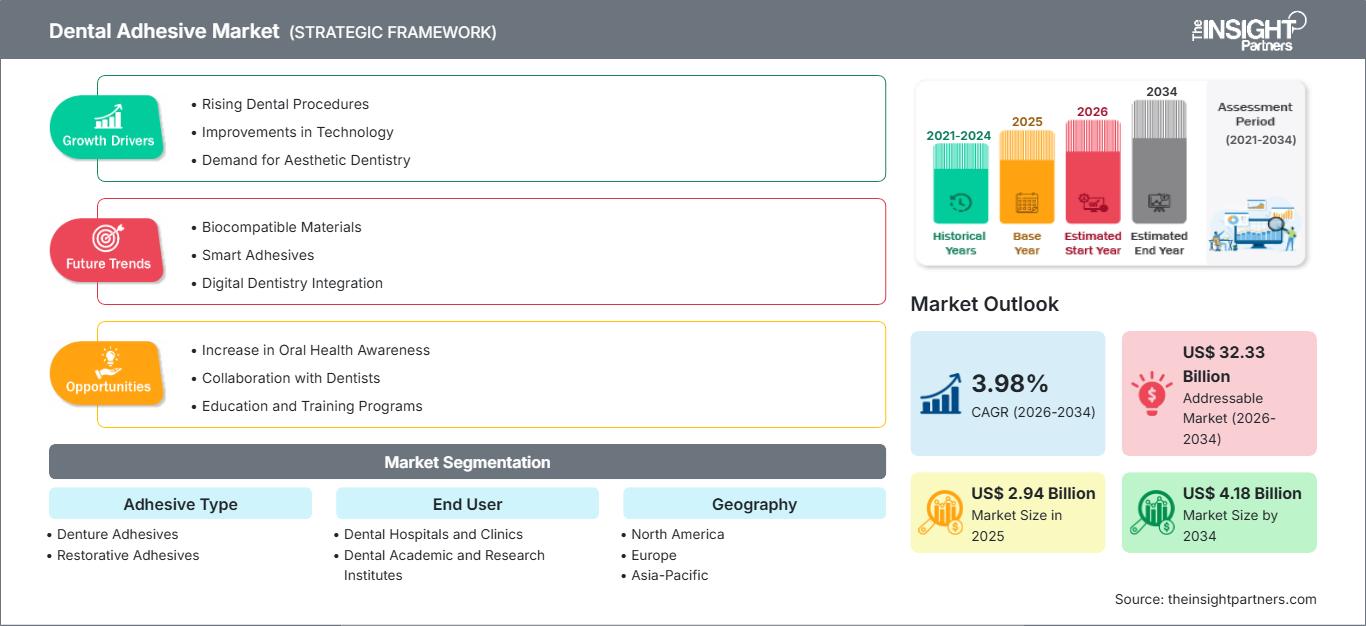
The Dental Adhesive Market was valued at US$ 2.94 Billion in 2025 and is projected to reach US$ 4.18 Billion by 2034, registering a CAGR of 3.98% during 2026–2034. Expansion is supported by continued restorative treatment volumes, increasing preference for minimally invasive procedures, and ongoing formulation improvements. The market encompasses materials used to establish durable adhesion between tooth structures and restorative or prosthetic materials across professional dental settings.
North American demand remains structurally supported by established dental infrastructure, high restorative procedure utilization, and strong clinician familiarity with advanced bonding systems. The Dental Adhesive Market size is expected to expand at an estimated 4.2–4.7% CAGR between 2026 and 2034, with universal adhesive adoption, cosmetic restoration activity, and replacement of older bonding protocols supporting incremental consumption.
Dental Adhesive Market Assessment and Insights
- North America: The region is expected to retain the largest position, with a 2025 share of 44–47% and CAGR of 4.2–4.7% between 2026–2034, supported by mature dental practices, restorative procedure volumes, and broad availability of advanced materials.
- US: The US represents the principal North American market, holding 82–86% of regional revenue in 2025 and growing at a 4.0–4.5% CAGR during 2026–2034, supported by sophisticated restorative workflows.
- Europe: Europe is estimated at a 25–28% share in 2025, with a 3.6–4.1% CAGR between 2026–2034. Germany, the UK, France, Italy, and Spain provide the region's principal demand centers through established clinical networks and restorative care.
- Asia Pacific: Asia Pacific is estimated to account for 19–22% in 2025 and grow at 4.8–5.5% CAGR between 2026–2034. China, Japan, India, South Korea, and Australia are expected to shape regional demand through expanding clinical capacity.
- Largest Segment: Restorative Adhesives are estimated to hold a 68–72% market share in 2025, with a 4.0–4.4% CAGR during 2026–2034, reflecting broad use in direct and indirect restoration workflows.
- High Growth Segment: Dental Academic and Research Institutes are modeled at a 7–10% share in 2025, with a 4.6–5.2% CAGR during 2026–2034, supported by materials research and clinical training.
- Key companies analyzed in detail: Dentsply Sirona Inc., 3M Company, KURARAY NORITAKE DENTAL INC., GlaxoSmithKline plc, Ultradent Products, Inc., SUN MEDICAL CO., LTD., Ivoclar Vivadent AG, Tokuyama Dental Corporation, VOCO GmbH, GC Corporation.
Source: The Insight Partners' analysis based on proprietary research, government publications, company annual reports, investor presentations, industry databases, and expert interviews.
The Dental Adhesive Market has seen its way through multi-step etch-and-rinse techniques to simpler, more efficient universal systems suitable for different substrates and methods of etching. Current product innovation focuses on moisture management, film-thickness reduction, better bond strength, radiopacity, and adaptability to composite, ceramic, and resin cement techniques. Product manufacturing considerations now include standardization of the formulation, efficient dispensation systems, and variety across many restorative applications.
Future growth will most probably come in regions with expanding capacity for dental services outpacing standardization of materials. Incremental gains could come from emerging Asian markets, while replacement of old products will be the driver for existing markets. Compliance with regulatory requirements on biocompatibility, composition, labeling, and performance will still be the main factors in product innovation, while investment in professional education will promote the use of new bonding techniques.
Dental Adhesive Market Report Scope
| Report Attribute | Details |
|---|---|
| Market size in 2025 | US$ 2.94 Billion |
| Market Size by 2034 | US$ 4.18 Billion |
| Global CAGR (2026 - 2034) | 3.98% |
| Historical Data | 2021-2024 |
| Forecast period | 2026-2034 |
Dental Adhesive Market Analysis
Demand is highly associated with restorative dentistry, prosthodontics, cosmetics, and replacement of existing restorations. The growth of the Dental Adhesives Market is thus dependent on procedure volume, and not just adhesive volume, which means that factors such as patient access, dentist density, cost, and choice of restorative materials become important in determining demand. Value chain players include specialty chemical manufacturers, adhesive manufacturers, dental distributors, laboratories, clinics, hospitals, and research institutions.
Supply considerations favor manufacturers who are capable of controlling the formulation chemistry, curing attributes, packaging and clinical education concurrently. The resin monomer, solvents, fillers, initiators and functionals influence handling and bonding capability of the adhesives, while packaging plays an important role in ensuring shelf life and usability at the chair side. The manufacturers also have the challenge of ensuring consistency in batch production and compliance to regulations.
Competition revolves around extensive dental product lines, unique chemistry, training, and market presence. According to the Dental Adhesive Market Report, the main players such as Dentsply Sirona Inc., 3M Company, KURARAY NORITAKE DENTAL INC., and Ivoclar Vivadent AG offer competitive solutions by way of already existing restorative ecosystems and adhesives. Ultradent Products, Inc., VOCO GmbH, GC Corporation, Tokuyama Dental Corporation, and SUN MEDICAL CO., LTD. enhance specialization in terms of coverage of restorative and bonding solutions.
Positioning is the simplification of the procedure without compromising on efficiency. Universal systems, perfect cementation procedures, delivery systems, and scientific training are becoming increasingly important for corporations. GlaxoSmithKline plc maintains its relevance through consumer and professional oral care awareness while specialist companies concentrate on materials science and application. Investment priorities therefore differ based on the portfolio strategy, premium product formulation, and specific applications such as orthodontic and prosthetic bonding.
● REPORT CUSTOMIZATION
Tailor This Report To Align With Your Specific Business Requirements
This report can be customized to align precisely with your business objectives, scope, and target markets. Customization options include tailored segmentation, geography, competitive analysis, and strategic insights to support informed decision-making.
Customize This Report →WHAT YOU CAN ADJUST
- ● Segmentations
- ● Geography
- ● Competitive Analysis
- ● Language Preferences
Dental Adhesive Market: Strategic Insights
Regional Insights
North America Dental Adhesive Market
North America is estimated with 44% - 47% of the Dental Adhesive Market share in 2025 and 4.2% - 4.7% CAGR up until 2034. It is well-endowed with dental infrastructure, high application of restorative treatments, excellent training of clinicians and wide availability of premium dental materials. The US is the main market for demands, but Canada and Mexico add to it with their private dental services and availability of restorative treatments.
The region’s inherent strengths are also seen in its efficient procurement channels and relationships between the manufacturers, distributors, laboratories and dental practices. The universal bonding systems become more popular due to preference for fewer steps and predictable processing by the clinicians. Replacements of old formulas, cosmetic restorations and continued training are expected to provide growth rates. High competition will continue due to large product ranges and clinical awareness of leaders.
U.S. Dental Adhesive Market
The United States comprises an estimated 82-86% of North America’s revenue in 2025 and is expected to exhibit a 4.0-4.5% CAGR during 2026-2034. Demand emanates from dental clinics and multiple-site organizations that use direct restorations, veneers, crowns, bridges, and repair services. Existing distributors offer wide distribution channels whereas specialist dentists facilitate premium material usage.
Dentsply Sirona Inc., 3M Company, Ultradent Products, Inc. along with several other vendors hold strong market presence throughout the restorative process. The trend focuses on universal adhesives that help in simplifying etching process and ease of inventory management. Growing concern on postoperative sensitivity, longevity of restoration, and consistent bond also drive product replacement. Buying decisions are still impacted by clinical data, workflow optimization, training needs, and overall cost per procedure than product cost only.
Europe Dental Adhesive Market
Europe is forecast to be modelled at a 25%–28% share in 2025, growing at a CAGR of 3.6%–4.1% to 2034. The leading national markets include Germany, the United Kingdom, France, Italy, and Spain. Regional consumption is driven by well-developed dental infrastructure, existing professional standards, and restorative treatment volumes, while product regulation and sustainability concerns drive portfolio strategies.
The UK offers both a broad private dental market and public service delivery, which drives different procurement approaches and focuses on cost-effective materials. Germany is aided by strong dental manufacturing knowledge and a large professional pool for advanced material use. France, Italy, and Spain offer additional demand from private practices, restorations, cosmetic dentistry, and replacement. European producers offer very competitive technologies related to clinical studies, formulation effectiveness, and efficiency of work processes.
APAC Dental Adhesive Market
The APAC region accounts for 19-22% market share in 2025 and will grow at a CAGR of 4.8-5.5% from 2025 to 2034. The dominant regional market is China; other regional markets are Japan, India, South Korea, and Australia due to clinical infrastructure development, demographic aging, and increasing awareness about restorative treatment.
Industrial development enables local manufacture and distribution, whereas health policy emphasizes preventative and restorative treatment. Potential for volume is high in China and India because of their huge population and increasing number of dental practitioners. Japan has highly developed clinical services and an aging population, while South Korea and Australia have high-end dental facilities, and therefore demand exists in them for premium restorative products.
Middle East & Africa Dental Adhesive Market
The Middle East and Africa market is projected to experience a 5.0%–5.8% CAGR expansion until 2034. It will be driven by healthcare investment, construction of private clinics, medical tourism, and increased accessibility of sophisticated treatments. Saudi Arabia is seen as the primary region, followed by the United Arab Emirates and South Africa.
Healthcare investments in Saudi Arabia and the UAE are more concentrated and there are modern private clinics. As for South Africa, it represents an already developed dental market environment. The Rest of MEA market is less consolidated due to the diversity of affordability, availability of specialists and distribution network. Energy income and infrastructure development can be used in Gulf countries for health care modernization, while Africa needs more supply access and specialists.
Segmentation Analysis
Adhesive Type
Adhesive Type is projected to expand at a 4.0–4.4% CAGR during 2026–2034. The scope within this segment is shaped by restorative procedure volumes, denture use, aesthetic dentistry, and demand for simplified bonding protocols. Restorative adhesives represent the principal value pool because they serve a broad range of direct and indirect clinical procedures, while denture adhesives address prosthetic retention and patient comfort.
- Denture Adhesives: Demand is associated with removable prosthetic use, retention requirements, comfort, and patient preference. Cream and related delivery formats benefit from straightforward application, while product differentiation increasingly centers on hold duration and ease of removal.
- Restorative Adhesives: This segment maintains the dominant position because bonding is integral to composite, ceramic, and indirect restorative workflows. Adoption is supported by universal systems that reduce procedural complexity while accommodating multiple etching and curing approaches.
End User
End User is projected to grow at a 4.1–4.6% CAGR during 2026–2034. Dental hospitals and clinics account for the principal consumption base because routine restorative procedures generate recurring adhesive requirements. Dental academic and research institutes represent a smaller but strategically important channel, supporting formulation evaluation, clinician training, laboratory research, and future protocol development.
- Dental Hospitals and Clinics: These facilities generate the largest recurring demand through direct restorations, prosthodontics, cosmetic dentistry, and repair procedures. Purchasing priorities center on reliability, clinical evidence, handling efficiency, and compatibility with existing restorative systems.
- Dental Academic and Research Institutes: Institutions use adhesives for teaching, comparative testing, clinical research, and materials development. Their strategic importance exceeds their immediate consumption because educational protocols can influence future clinician preferences and technology adoption.
Opportunity Snapshot
| Segment Name | Revenue Contribution (High/Medium/Low) | Trend Tag (MAX 2 words) | Adoption Stage |
| Dental Hospitals and Clinics | High | Chairside Bonding | Mature |
| Dental Academic and Research Institutes | Medium | Material Trials | Scaling |
Dental Adhesive Market Growth Drivers and Impact Analysis
Expansion of Restorative and Aesthetic Dentistry
Growing utilization of composite restorations, veneers, crowns, bridges, and repair procedures directly expands adhesive consumption because bonding materials are embedded within the clinical workflow. Demand is reinforced by patient preference for tooth-colored restorations and conservative preparation approaches that preserve healthy tooth structure. The commercial effect is strongest in private practices where cosmetic and restorative procedures generate recurring material purchases. For manufacturers, this environment favors products that combine predictable bond strength with efficient handling across multiple substrates. Suppliers that can demonstrate compatibility with contemporary restorative materials can improve portfolio relevance without relying solely on higher procedure volumes. The resulting impact is a gradual increase in replacement demand as clinicians transition from older adhesive systems toward universal products offering broader indications and simpler application protocols.
Preference for Simplified Universal Bonding Protocols
Clinical workflows increasingly favor materials that reduce the number of bottles, application stages, and technique-sensitive decisions required during restoration placement. Universal adhesives can address multiple etching approaches and substrates, allowing practices to consolidate inventories while maintaining procedural flexibility. This shift affects procurement decisions because clinicians evaluate not only bond performance but also dispensing convenience, working time, moisture tolerance, and compatibility with resin cements or composites. Manufacturers benefit when a single formulation can support several indications, increasing utilization per practice and reducing portfolio fragmentation. The market impact extends beyond product sales because simplified systems can lower training requirements for dental staff and standardize procedures across multi-site organizations. As group practices continue expanding, workflow consistency becomes an increasingly important criterion in adhesive selection and supplier negotiations.
Rising Focus on Minimally Invasive Restorative Care
Minimally invasive dentistry is increasing the importance of reliable adhesion because conservative preparations depend more heavily on effective bonding between remaining tooth structure and restorative materials. Stronger emphasis on preserving enamel and dentin changes the technical requirements for adhesives, particularly where moisture control and substrate variability affect clinical outcomes. The resulting demand favors formulations capable of maintaining consistent performance across different surface conditions while minimizing postoperative sensitivity and restoration failure. Manufacturers can capture this shift through evidence-backed products designed for conservative preparation protocols, supported by clinical education and procedural guidance. For dental practices, improved adhesive reliability can reduce retreatment risk and support more predictable restorative outcomes. Consequently, material selection is increasingly viewed as part of clinical risk management rather than a simple consumables purchasing decision.
Dental Adhesive Market Future Trends
Greater Integration of Adhesives With Restorative Systems
Dental Adhesive Market trends are likely to move toward integrated material systems in which adhesives, resin cements, composites, and curing technologies are engineered to function together. Suppliers will increasingly design portfolios around compatibility rather than isolated product performance, enabling more predictable workflows and reducing technique variability. Packaging may also become more application-specific, with unit-dose formats and dispensing systems supporting infection-control requirements and faster chairside preparation. Over time, purchasing departments may evaluate bundled restorative ecosystems rather than individual adhesive products. This shift could strengthen supplier relationships while raising switching costs for clinics. Smaller manufacturers may respond by emphasizing interoperability and open compatibility. The resulting competitive environment should reward suppliers capable of combining material science, workflow design, education, and regulatory support without compromising flexibility for clinicians.
Material Intelligence and Evidence-Led Formulation Development
Future product development will increasingly combine advanced polymer chemistry with data from laboratory testing, clinical studies, and digital treatment workflows. Manufacturers are likely to focus on formulations that respond more consistently to variations in dentin moisture, substrate composition, curing conditions, and restorative material selection. Evidence generation will become a stronger differentiator as clinicians demand reproducible performance rather than isolated laboratory claims. Academic collaborations can accelerate evaluation of long-term bond durability, degradation mechanisms, and interactions between adhesives and emerging restorative materials. Regulatory expectations may also encourage more detailed characterization of chemical composition and clinical performance. As a result, innovation spending should shift toward targeted formulation improvements, validation programs, and application-specific products rather than frequent cosmetic modifications with limited clinical differentiation.
Dental Adhesive Market Opportunities
Localized Manufacturing and Distribution in Emerging Dental Economies
Dental Adhesive Market Forecasts indicate attractive strategic potential in countries where dental clinic networks and restorative treatment capacity are expanding from relatively low bases. Investors and manufacturers can pursue localized packaging, regional distribution partnerships, and clinician education programs to reduce supply barriers. India, Southeast Asia, selected Middle Eastern markets, and parts of Latin America offer opportunities for suppliers able to balance price sensitivity with reliable clinical performance. Local manufacturing can shorten lead times and reduce exposure to international logistics disruptions, while regional distributors can improve access to smaller practices. Market entry strategies should prioritize regulatory registration, professional training, and predictable availability rather than broad product launches. A focused portfolio covering high-volume restorative indications may provide a more efficient route to scale than a full-spectrum offering.
Academic Partnerships for Next-Generation Adhesive Development
Research institutions provide an opportunity to establish differentiated technology pipelines through collaborative testing, formulation development, and clinician education. Companies can use academic partnerships to evaluate bond durability, substrate compatibility, postoperative sensitivity, and performance alongside emerging restorative materials. Such programs can also improve credibility among clinicians by generating independent evidence and supporting continuing education. Dental Adhesive Market Forecasts support a long-term opportunity for suppliers that connect research investment with commercialization, particularly in markets where university dental centers influence treatment protocols. Strategic agreements can include sponsored studies, shared laboratories, training programs, and structured feedback from clinicians. The most effective approach is likely to combine formulation science with real-world workflow assessment, allowing manufacturers to identify unmet technical needs before competing products establish strong clinical familiarity.
Recent Developments
- May 2026: Dentsply Sirona Inc. reported first-quarter 2026 sales of US$880 million and announced the launch of Smart View-Detect, alongside continued investment in connected dentistry and strengthened distribution initiatives. The broader portfolio strategy reinforces the company’s focus on integrated digital and restorative workflows, creating additional opportunities to connect adhesive products with comprehensive clinical solutions.
- May 2025: 3M Company highlighted Scotchbond Universal Plus Adhesive through its dental education platform, emphasizing clinical evidence, simplified universal bonding, and streamlined office workflows. The product combines broad restorative indications with one-bottle delivery, reflecting continued industry movement toward reducing procedural complexity and inventory requirements for professional dental practices.
- April 2025: KURARAY NORITAKE DENTAL INC. announced the launch of SA Attachment for Aligner, a resin material designed to create orthodontic attachments without a separate bonding material. The product targets shorter treatment workflows and reduced procedural steps, illustrating continued development of adhesive-related materials that combine bonding functionality with application-specific restorative or orthodontic requirements.
Frequently Asked Questions

- Comprehensive Market Sizing and Forecast Analysis
- Detailed Segmentation Analysis
- In-Depth Market Dynamics Assessment
- Regional and Country-Level Insights
- Competitive Landscape and Company Benchmarking
- Strategic Business Intelligence
Recent Reports
Testimonials

The Insight Partners' SCADA System Market report is comprehensive, with valuable insights on current trends and future forecasts. The team was highly professional, responsive, and supportive throughout. We are very satisfied and highly recommend their services.
RAN KEDEM Partner, Reali Technologies LTDs
I requested a report on a very specific software market and the team produced the report in a few days. The information was very relevant and well presented. I then requested some changes and additions to the report. The team was again very responsive and I got the final report in less than a week.
JEAN-HERVE JENN Chairman, Future Analytica
We worked with The Insight Partners for an important market study and forecast. They gave us clear insights into opportunities and risks, which helped shape our plans. Their research was easy to use and based on solid data. It helped us make smart, confident decisions. We highly recommend them.
PIYUSH NAGPAL Sr. Vice President, High Beam Global
The Insight Partners delivered insightful, well-structured market research with strong domain expertise. Their team was professional and responsive throughout. The user-friendly website made accessing industry reports seamless. We highly recommend them for reliable, high-quality research services
YUKIHIKO ADACHI CEO, Deep Blue, LLC.
This is the first time I have purchased a market report from The Insight Partners.While I was unsure at first, I visited their web site and felt more comfortable to take the risk and purchase a market report.I am completely satisfied with the quality of the report and customer service. I had several questions and comments with the initial report, but after a couple of dialogs over email with their analyst I believe I have a report that I can use as input to our strategic planning process.Thank you so much for taking the extra time and making this a positive experience.I will definitely recommend your service to others and you will be my first call when we need further market data.
JOHN SUZUKI President and Chief Executive Officer, Board Director, BK Technologies
I wish to appreciate your support and the professionalism you displayed in the course of attending to my request for information regarding to infectious disease IVD market in Nigeria. I appreciate your patience, your guidance, and the fact that you were willing to offer a discount, which eventually made it possible for us to close a deal. I look forward to engaging The Insight Partners in the future, all thanks to the impression you have created in me as a result of this first encounter.
DR CHIJIOKE ONYIA MANAGING DIRECTOR, PineCrest Healthcare Ltd.Reason to Buy
- Informed Decision-Making
- Understanding Market Dynamics
- Competitive Analysis
- Identifying Emerging Markets
- Customer Insights
- Market Forecasts
- Risk Mitigation
- Boosting Operational Efficiency
- Strategic Planning
- Investment Justification
- Tracking Industry Innovations
- Aligning with Regulatory Trends





 Get Free Sample for