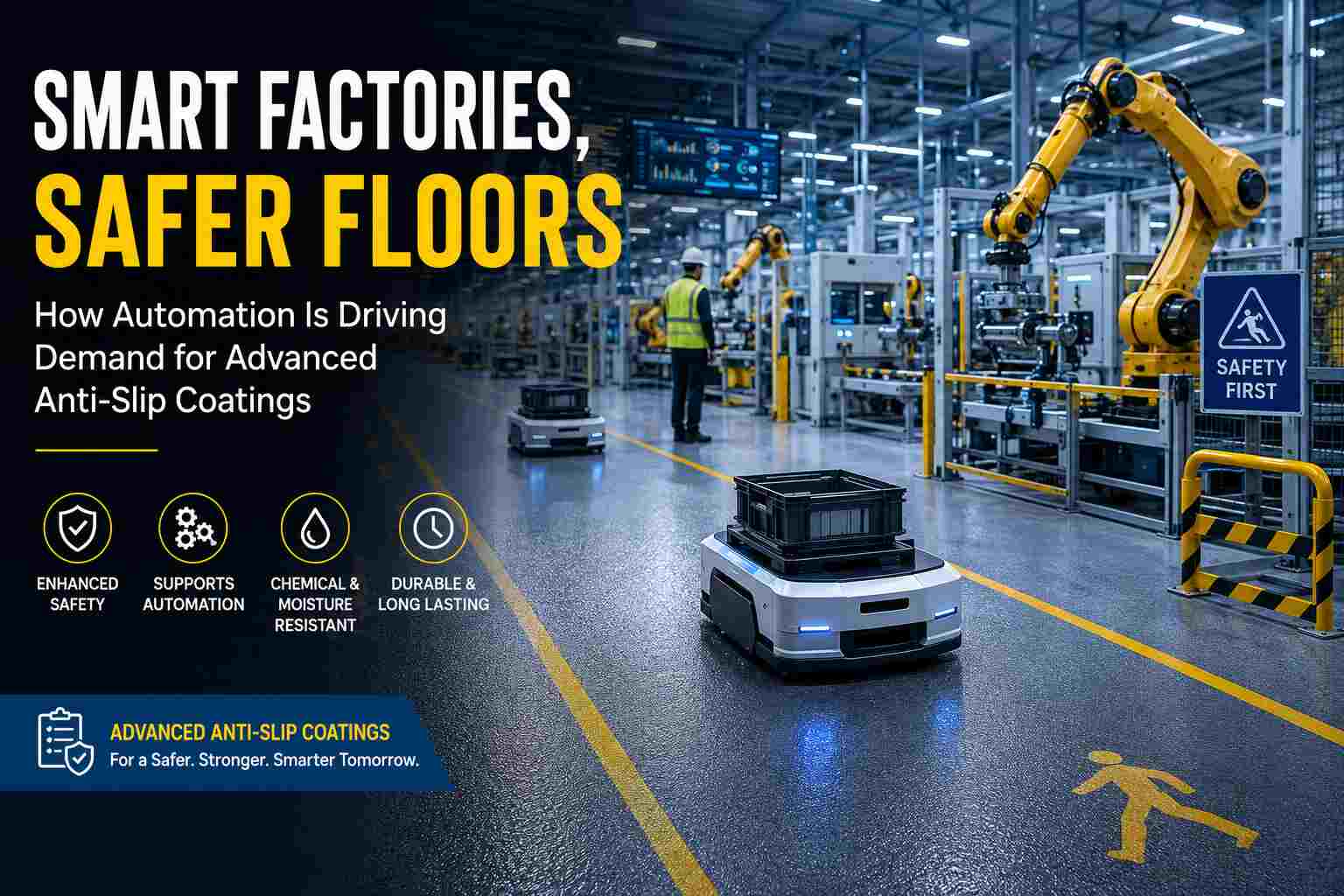
As manufacturing facilities become increasingly automated, workplace safety is evolving alongside robotics, connected machinery, automated guided vehicles (AGVs), and high-speed production systems. One often-overlooked element of this transformation is the factory floor. Modern industrial facilities require flooring that can withstand continuous movement, heavy equipment, chemical exposure, moisture, and intensive foot and vehicle traffic while maintaining safe operating conditions. This is creating new opportunities for the Anti-Slip Coating Market, particularly for advanced formulations designed for demanding industrial environments.
According to The Insight Partners, the global Anti-Slip Coating Market was valued at US$ 1.72 billion in 2025 and is projected to reach US$ 3.02 billion by 2034, expanding at a CAGR of 6.46% from 2026 to 2034. The market is supported by growing safety concerns, construction activity, technological advancements, and increasing adoption of anti-slip solutions across industrial and commercial spaces.
Automation Is Changing the Requirements for Industrial Floors
The traditional factory floor was primarily designed to support workers, forklifts, machinery, and basic production processes. Smart factories have introduced a much more complex operating environment. Robots move materials between production stations, automated systems transport components, and connected equipment operates continuously with limited downtime.
These developments place greater performance demands on flooring systems. A slippery surface can affect not only worker safety but also the movement and stability of equipment operating within an automated environment. In warehouses and manufacturing facilities, moisture, oil, dust, chemicals, and cleaning agents can further reduce surface traction.
As factories adopt automation, manufacturers are therefore looking for floor protection systems that combine slip resistance, durability, chemical resistance, easy maintenance, and long service life. Anti-slip coatings can provide an engineered surface that improves traction while protecting the underlying floor.
Workplace Safety Remains a Major Market Driver
Safety concerns remain one of the key growth drivers for the Anti-Slip Coating Market. Slip-and-fall incidents can result in injuries, operational disruptions, productivity losses, and higher costs for businesses. The increasing focus on workplace safety is encouraging industrial and commercial facilities to identify and reduce potential hazards before accidents occur.
In automated factories, this requirement becomes even more important. Workers may share production areas with robots, automated transport systems, and high-speed machinery. Maintaining a predictable and stable walking surface can help create safer working conditions.
Anti-slip coatings can also be applied to areas such as ramps, stairs, platforms, walkways, loading zones, and production floors. This flexibility makes them suitable for facilities where different parts of the operation face different levels of slip risk.
Epoxy and Polyurethane Resins Support Performance Requirements
Resin technology plays an important role in determining the performance of anti-slip coatings. The Insight Partners segments the market by epoxy resin, polyurethane resin, and other resins, highlighting the importance of formulation technology in addressing different application requirements.
Epoxy-based anti-slip coatings are particularly relevant for industrial flooring because of their durability and ability to create a robust surface. They can be used in environments exposed to heavy traffic and demanding operating conditions.
Polyurethane-based coatings, meanwhile, can offer properties suited to applications requiring flexibility, wear resistance, and resistance to environmental conditions. The selection between epoxy and polyurethane depends on factors such as substrate, expected traffic, chemical exposure, temperature, moisture, and required service life.
As automated facilities become more sophisticated, coating manufacturers have an opportunity to develop specialized resin systems tailored to specific industrial environments.
Water-Based Coatings Gain Importance as Sustainability Rises
Automation is not the only transformation taking place in industrial facilities. Sustainability has become another major consideration in construction and manufacturing. The Insight Partners identifies an increased focus on eco-friendly solutions as an important future trend for the Anti-Slip Coating Market.
The market is segmented into water-based and solvent-based coatings. Water-based formulations can become increasingly attractive as industries seek solutions with lower environmental impact and improved workplace conditions.
For factories operating continuously, coating selection also involves considerations such as application time, curing requirements, odor, maintenance, and downtime. Advances in formulation technologies could help manufacturers develop anti-slip coatings that combine environmental benefits with the durability required by modern industrial facilities.
Smart Technologies Could Take Anti-Slip Flooring Further
The next stage of development could involve combining anti-slip surfaces with smart technologies. The Insight Partners identifies the integration of anti-slip coatings with smart technologies as a future trend, including the potential use of sensors to detect moisture or slippery conditions.
This could create a more proactive approach to workplace safety. Instead of relying solely on a coating to provide traction, connected systems could potentially monitor environmental conditions and alert facility operators when surfaces become hazardous.
For example, sensors could potentially identify excessive moisture in high-risk areas and send alerts to facility management systems. When combined with broader Industrial Internet of Things (IIoT) infrastructure, such capabilities could contribute to more connected and responsive safety management.
Although these applications are still developing, the convergence of smart buildings, IoT, automation, and advanced materials could open new opportunities for the anti-slip coating industry.
Construction Flooring Remains a Key Application
The impact of automation extends beyond manufacturing plants. Automated warehouses, logistics hubs, distribution centers, and technologically advanced commercial facilities are also increasing the need for high-performance flooring.
The Insight Partners identifies construction flooring and marine decks as key end-use industries within its Anti-Slip Coating Market analysis.
Construction flooring applications can include industrial buildings, commercial facilities, public spaces, warehouses, and other high-traffic environments. As infrastructure becomes more sophisticated, flooring systems are increasingly expected to provide both functional and safety benefits.
The growing adoption of automated storage and retrieval systems, robotics, and advanced material-handling equipment can further increase the importance of durable flooring surfaces in logistics and industrial facilities.
Marine Applications Expand the Opportunity
While smart factories represent an important growth opportunity, anti-slip coatings are also finding applications beyond industrial floors. Marine decks require surfaces that can provide traction under challenging conditions involving water, humidity, salt, and continuous exposure to the outdoor environment.
This makes marine applications another important opportunity for coating manufacturers. Advanced formulations capable of maintaining slip resistance while resisting environmental degradation can help address the requirements of vessels and marine infrastructure.
The combination of construction flooring and marine deck applications demonstrates the broad potential of anti-slip coating technologies across environments where surface safety is critical.
Asia Pacific Offers Significant Growth Potential
Regional development is another important factor shaping the market. The Insight Partners identifies Asia Pacific as the largest regional market for anti-slip coatings. The region includes rapidly developing manufacturing and construction markets such as China and India, alongside established industrial economies such as Japan and Australia.
Rapid industrialization, urbanization, infrastructure development, and increasing adoption of modern manufacturing technologies can create additional opportunities for anti-slip coating suppliers.
Emerging markets are particularly significant because new factories, warehouses, commercial buildings, transportation infrastructure, and public facilities can incorporate advanced safety flooring during the initial construction or modernization process.
The Future of Anti-Slip Coatings Is Built Around Performance and Intelligence
The evolution of smart factories is changing how industrial facilities approach workplace safety. Flooring is no longer simply a structural surface; it is increasingly viewed as part of the overall facility-performance and safety environment.
As manufacturers move toward more automated, connected, and sustainable facilities, demand will increasingly favor anti-slip coatings that deliver more than basic traction. High-performance resin systems, water-based formulations, durable surface technologies, and potentially sensor-enabled solutions could define the next generation of industrial flooring.
For coating manufacturers, technology providers, construction companies, and industrial facility operators, the opportunity is clear: safer floors are becoming an increasingly important component of smarter factories.