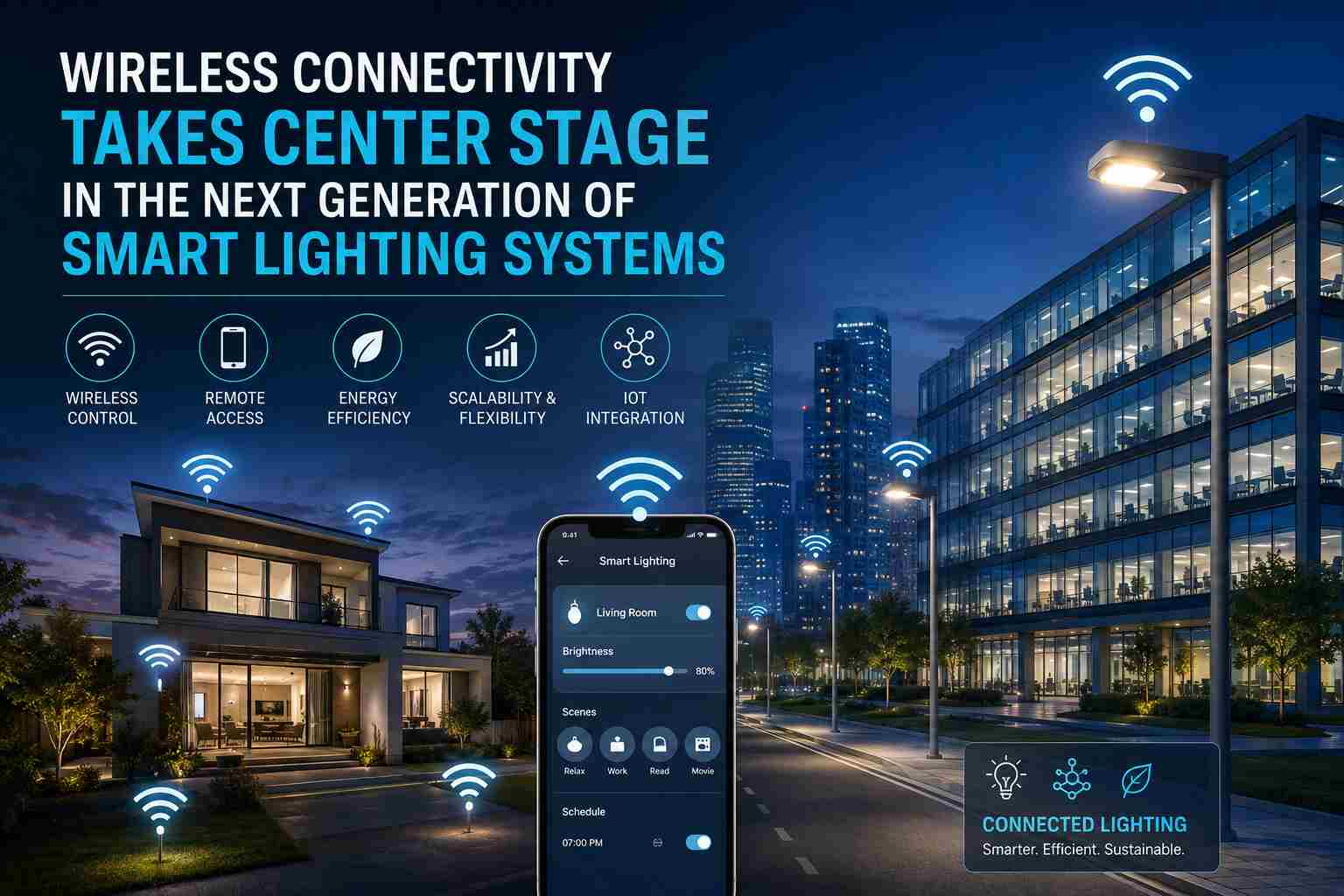
Lighting is rapidly moving beyond its traditional role of simply illuminating homes, offices, factories, streets, and public spaces. The emergence of connected lighting systems is transforming conventional fixtures into intelligent devices capable of sensing, communicating, adjusting, and responding to changing environmental and user requirements. At the center of this transformation is wireless connectivity, which is enabling smart lighting systems to become more flexible, scalable, and easier to integrate with broader digital ecosystems.
According to The Insight Partners, the global Smart Lighting Market was valued at US$ 18.45 billion in 2025 and is projected to reach US$ 78.33 billion by 2034, expanding at a CAGR of 19.8% from 2026 to 2034. The report identifies wireless connectivity as the fastest-growing connectivity segment, with an estimated 21–23% CAGR during 2026–2034, supported by easier installation, scalability for retrofit projects, and growing integration with smart home platforms.
Wireless Connectivity Is Redefining Smart Lighting
Traditional lighting infrastructure typically depends on physical wiring to connect fixtures with switches, control systems, and building infrastructure. Although wired solutions remain relevant where reliability and stable performance are priorities, wireless technologies are changing the economics and deployment possibilities of smart lighting.
Wireless connectivity allows lighting fixtures, sensors, switches, gateways, and centralized management platforms to communicate without requiring extensive additional cabling. This is particularly valuable in existing buildings where installing new wiring can involve significant construction work, operational disruption, and cost.
As a result, wireless smart lighting can support incremental deployment. A building owner can upgrade selected rooms, floors, or zones before expanding the system across the entire facility. This flexibility is particularly relevant for commercial buildings, retail facilities, hospitality properties, warehouses, and older residential buildings undergoing modernization.
The Insight Partners highlights scalability, flexibility, and lower installation costs as important factors supporting the rapid growth of wireless connectivity in smart lighting.
IoT Is Turning Lighting Into a Connected Infrastructure Layer
The growth of wireless smart lighting is closely linked to the expansion of the Internet of Things (IoT). Rather than operating as isolated fixtures, connected lights can become part of larger networks that include occupancy sensors, environmental sensors, thermostats, security systems, building management platforms, and energy-monitoring solutions.
For example, an office lighting system can use occupancy information to automatically adjust illumination in different work areas. Daylight sensors can reduce artificial lighting when sufficient natural light is available, while centralized platforms can provide facility managers with information about lighting performance and energy consumption.
The Insight Partners notes that smart lighting has evolved into sophisticated IoT-enabled platforms incorporating sensors, wireless connectivity, and software, with capabilities such as occupancy detection, daylight harvesting, and remote control.
This evolution changes the value proposition of lighting. The fixture is no longer simply a hardware product; it becomes a connected endpoint within a wider digital infrastructure.
Why Wireless Technology Is Attractive for Retrofit Projects
One of the strongest opportunities for wireless smart lighting lies in the modernization of existing buildings. A large share of commercial and industrial infrastructure was designed before today's IoT-enabled lighting technologies became widely available.
Replacing conventional fixtures with connected LED systems can deliver efficiency benefits, but adding communication capabilities can be challenging if the existing electrical infrastructure does not support sophisticated control networks.
Wireless systems can reduce the complexity of these upgrades. Sensors, switches, controllers, and luminaires can communicate through wireless networks, allowing organizations to introduce intelligent control capabilities without undertaking extensive rewiring.
This creates opportunities across:
- Office buildings
- Retail stores
- Hotels and hospitality facilities
- Warehouses and logistics centers
- Manufacturing plants
- Educational institutions
- Healthcare facilities
- Government buildings
- Residential properties
- Outdoor and public infrastructure
The retrofit opportunity is particularly important because smart lighting adoption is increasingly associated with building modernization and energy optimization rather than only new construction.
LED and Wireless Connectivity Are Becoming a Powerful Combination
Wireless connectivity is not developing independently from lighting hardware. The transition toward LED technology is providing an important foundation for connected lighting systems.
The Insight Partners estimates that LED lamps accounted for approximately 60–65% of the Smart Lighting Market in 2025, supported by energy efficiency, long operating life, and compatibility with smart controls.
LED technology provides the controllability required for intelligent lighting applications. Brightness can be adjusted dynamically, colors can be tuned in suitable systems, and lighting schedules can be automated according to occupancy or time of day.
When LED fixtures are combined with wireless communication and sensors, the result is a highly adaptable lighting platform. A single system can support automated dimming, remote monitoring, occupancy-based control, scheduling, energy management, and integration with other connected devices.
This convergence is likely to remain an important technology pathway through 2034.
Smart Homes Are Accelerating Wireless Lighting Adoption
Residential environments represent another major opportunity for wireless smart lighting. Consumers increasingly expect lighting systems to integrate with connected home ecosystems, smartphones, voice assistants, and other smart devices.
Wireless smart bulbs, switches, sensors, and lighting controls can be installed without major modifications to a home's infrastructure. Users can remotely switch lights on or off, create schedules, adjust brightness, and establish lighting scenes through connected applications or voice interfaces.
The Insight Partners identifies residential lighting as the fastest-growing application segment, with an estimated 21–23% CAGR through 2034. Growth is being supported by smart home adoption, connected ecosystems, and voice assistants.
As smart homes become more interconnected, lighting can also interact with other systems. For instance, lighting can respond to occupancy, security events, entertainment requirements, or predefined household routines.
Commercial Buildings Are Moving Toward Intelligent Lighting Management
Commercial buildings are among the most important users of connected lighting because lighting represents a recurring operational expense and affects occupant experience.
Offices, retail stores, hotels, and other commercial properties can use wireless lighting systems to manage large numbers of fixtures from centralized platforms. Facility managers can monitor lighting schedules, identify areas of unnecessary consumption, and modify settings without manually accessing individual fixtures.
Integration with building management systems can further expand these capabilities. Lighting information can be combined with data from HVAC, occupancy, security, and energy systems to create a more coordinated approach to facility management.
The Insight Partners identifies commercial lighting as the largest application segment, supported by energy-saving requirements, operational efficiency, regulatory compliance, and centralized facility management needs.
Wireless Lighting Is Supporting the Evolution of Smart Cities
The opportunity for wireless connectivity extends beyond buildings. Outdoor lighting and intelligent street lighting are increasingly becoming components of smart city infrastructure.
Connected streetlights can support remote monitoring, adaptive dimming, maintenance management, and other intelligent functions. When lighting infrastructure is connected to broader urban networks, streetlight poles can potentially become platforms for additional sensors and smart-city services.
The growing emphasis on smart city development is particularly relevant in rapidly urbanizing economies. The Insight Partners identifies Asia Pacific as the fastest-growing regional market for smart lighting, with an estimated 21–23% CAGR through 2034. China, Japan, South Korea, and India are among the markets contributing to regional adoption through urban development, smart home ecosystems, 5G infrastructure, and smart city initiatives.
This creates an important long-term opportunity: lighting infrastructure can evolve from an energy-consuming asset into a connected infrastructure layer capable of supporting multiple urban applications.
AI and Advanced Analytics Will Add Another Layer of Intelligence
Wireless connectivity provides the communication infrastructure, but artificial intelligence and analytics can make connected lighting systems more intelligent.
Smart lighting platforms can collect information from fixtures and sensors and use that data to identify usage patterns. AI-enabled systems can potentially optimize lighting schedules, identify unusual energy consumption, support predictive maintenance, and dynamically adjust illumination according to changing conditions.
The Insight Partners points to increasing investment in AI-enabled analytics, software differentiation, and service-based revenue models within the Smart Lighting Market. It also highlights the industry's movement toward hardware-software-service offerings rather than hardware-only products.
This shift could change how lighting companies compete. Hardware performance will remain important, but software capabilities, analytics, interoperability, cybersecurity, and platform integration are likely to become increasingly significant differentiators.
Interoperability Will Become Increasingly Important
As wireless smart lighting systems become more sophisticated, interoperability will be critical. Consumers and businesses do not want lighting systems that operate as isolated networks.
The ability to integrate lighting with smart home platforms, building management systems, energy-management software, sensors, and other connected devices can significantly improve the usefulness of a lighting solution.
The Insight Partners notes that market participants are increasingly focused on interoperability and ecosystem compatibility, including integration with platforms such as Amazon Alexa, Google Home, and Apple HomeKit.
For manufacturers, this means future product development will need to consider the broader connected ecosystem rather than focusing solely on the lamp or fixture.
Regional Markets Present Diverse Opportunities
Wireless smart lighting adoption is progressing differently across regions.
North America represents a significant portion of the global market, supported by smart home adoption, commercial building modernization, energy-efficiency initiatives, and the presence of major technology and lighting companies. The US accounts for approximately 85–90% of North American market revenue, according to The Insight Partners.
Europe is benefiting from energy-efficiency regulations, sustainable building renovation, and smart home adoption. Germany, the UK, and France are among the leading markets in the region.
Asia Pacific presents particularly strong growth potential. Rapid urbanization, smart city investments, domestic technology manufacturing, and expanding connected-home ecosystems are supporting adoption across China, Japan, South Korea, and India.
Meanwhile, the Middle East and Africa are emerging as attractive markets as large-scale urban development, smart city programs, hospitality projects, and infrastructure investments increase demand for connected lighting solutions.
The Competitive Landscape Is Moving Beyond Lighting Hardware
The expansion of wireless connectivity is also changing competition within the Smart Lighting Market. Traditional lighting manufacturers are increasingly competing alongside technology companies, software providers, connectivity specialists, and system integrators.
The Insight Partners identifies companies including Signify Holding, Legrand North America, Acuity Brands, Lutron Electronics, Leviton Manufacturing, Zumtobel Group, Honeywell International, Savant Technologies, Dialight, and Panasonic Corporation among the key companies analyzed in the market.
Competition is increasingly focused on complete ecosystems. Companies are investing in wireless modules, control platforms, sensors, software, analytics, interoperability, and partnerships to create integrated solutions.
What Lies Ahead for Wireless Smart Lighting?
The next generation of smart lighting will likely be defined by the convergence of LED technology, wireless connectivity, IoT, sensors, AI, cloud platforms, and building automation.
Wireless systems offer a compelling combination of flexibility and scalability, particularly where users want to modernize existing infrastructure without undertaking extensive rewiring. As smart home adoption expands and businesses prioritize energy efficiency, wireless lighting can become a practical entry point into broader connected environments.
At the same time, the role of lighting is expanding. Intelligent fixtures can contribute to energy management, occupant comfort, automation, security, maintenance, and smart city infrastructure. This makes connectivity increasingly central to the value of a lighting system.
As organizations and consumers increasingly demand lighting that is controllable, adaptive, connected, and energy efficient, wireless technology is set to move from an optional feature to a fundamental building block of next-generation smart lighting systems.