The global Beeswax Market is moving beyond its traditional associations with candles and handcrafted products as manufacturers increasingly seek natural, functional, and traceable ingredients. Advances in refining, filtration, bleaching, deodorization, and grading are enabling beeswax suppliers to deliver more consistent materials for cosmetics, food, pharmaceutical, and industrial applications. At the same time, growing consumer interest in clean-label products and sustainable materials is creating new opportunities for beeswax across the value chain.
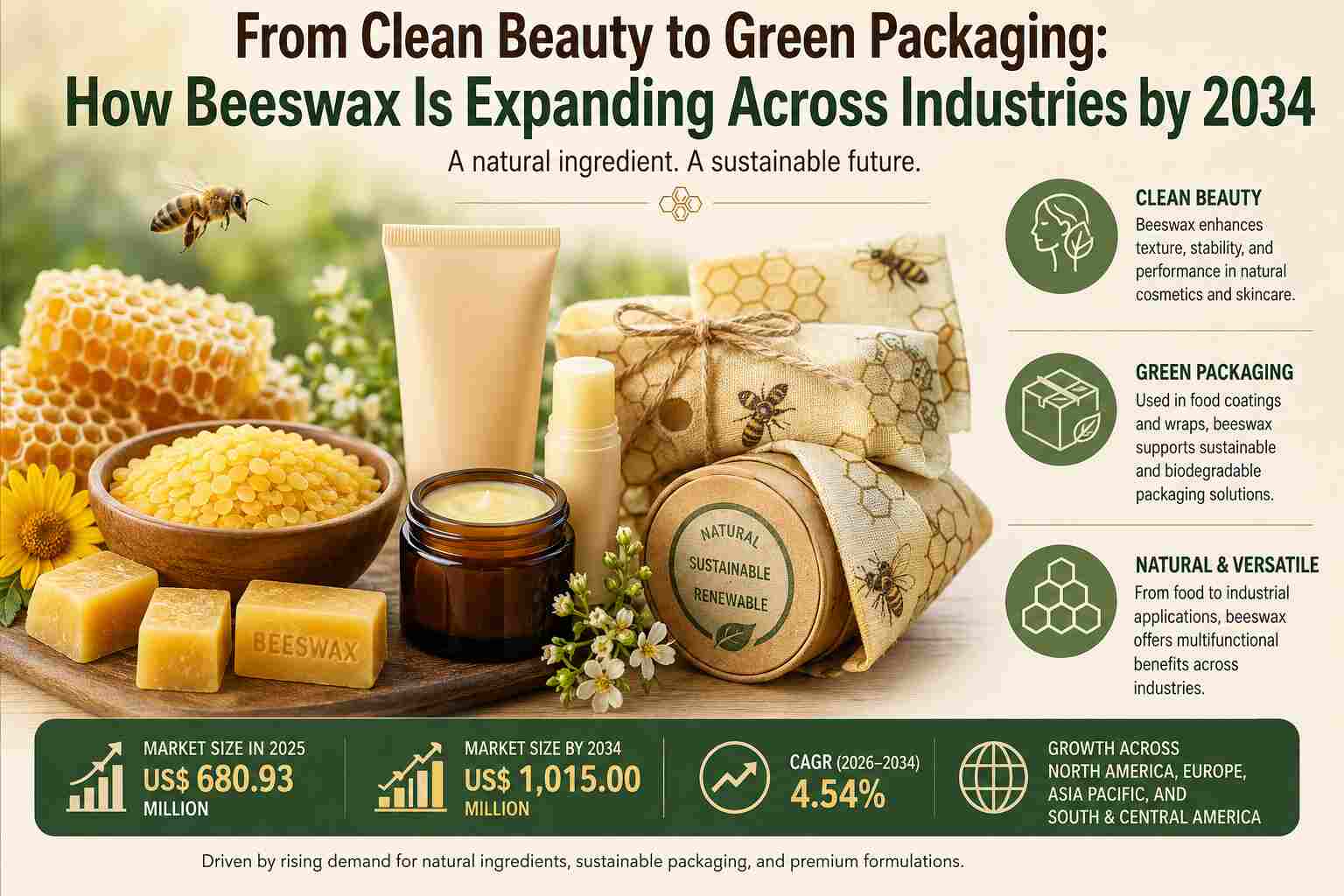
The Beeswax Market was valued at US$ 680.93 million in 2025 and is projected to reach US$ 1,015.00 million by 2034, expanding at a CAGR of 4.54% from 2026 to 2034. The market includes yellow beeswax, white beeswax, and absolute beeswax, with both organic and conventional variants serving diverse end-use industries.
Clean Beauty Is Putting Beeswax in the Spotlight
One of the most important factors shaping the Beeswax Market is the continued expansion of natural and clean beauty formulations. Consumers are increasingly examining ingredient lists and looking for products positioned around naturally derived, recognizable, and responsibly sourced ingredients. This shift is encouraging cosmetic manufacturers to reconsider the role of traditional functional ingredients such as beeswax.
Beeswax provides several properties that make it useful in personal care formulations. It can contribute structure, consistency, texture, film formation, emollience, and stability. These characteristics make it suitable for products such as lip balms, creams, lotions, hair care products, sticks, ointments, and color cosmetics.
The cosmetics segment represented an estimated 38–42% of the Beeswax Market in 2025, making it the largest application category. It is also projected to expand at approximately 5.0–5.5% CAGR between 2026 and 2034. Premium cosmetic brands are particularly interested in refined grades with controlled color, odor, purity, and traceability.
This creates an opportunity for suppliers to move beyond commodity beeswax and offer application-specific grades designed for particular formulation requirements.
Organic Beeswax Creates a Premium Market Opportunity
The shift toward clean beauty is closely connected to the growing demand for organic ingredients. Organic beeswax accounted for approximately 18–22% of the market in 2025 and is expected to grow at a faster 6.0–6.6% CAGR through 2034.
Organic beeswax is increasingly relevant to premium personal care, wellness, and specialty food brands that want to demonstrate responsible sourcing and greater transparency. Buyers may evaluate certification, origin, beekeeper practices, pesticide controls, chain-of-custody documentation, and processing methods when selecting suppliers.
This means that the competitive landscape is gradually changing. Price and availability remain important, but premium buyers are increasingly considering the overall quality and credibility of the supply chain.
For beeswax processors, investments in certification, analytical testing, traceability systems, and controlled purification can therefore provide a pathway toward higher-value markets.
Green Packaging Opens a New Avenue for Beeswax
While cosmetics currently represent the largest application, food-related uses provide another important avenue for market expansion. Beeswax can be used in approved glazing and coating applications where surface appearance, moisture management, and protection are important.
The broader movement toward sustainable packaging and natural food ingredients could increase interest in wax-based solutions. Beeswax can contribute functional properties while supporting product positioning around naturally derived materials.
Its use in food coatings and glazing is particularly relevant for confectionery, specialty foods, and selected fresh produce applications. However, food manufacturers require consistent, compliant, and well-characterized material. As a result, suppliers that can provide food-grade beeswax with appropriate purification, testing, and documentation may gain an advantage.
The opportunity extends beyond simply selling raw wax. Refiners can develop grades with controlled color, odor, melting characteristics, and particle size to meet specific processing requirements.
Refining Technology Is Transforming Beeswax Quality
A key development within the Beeswax Market is the improvement of processing technology. Raw beeswax can vary considerably depending on its geographical source, plant environment, harvesting practices, colony conditions, and processing methods.
Modern filtration, bleaching, deodorization, refining, and grading technologies allow processors to convert variable raw material into more standardized products. These improvements are particularly important for cosmetics and food manufacturers, where changes in color, odor, purity, or melting behavior can affect the final product.
Yellow beeswax continues to have broad applications because of its natural color and characteristic properties. White beeswax is more suitable for formulations where lighter color and controlled sensory characteristics are required. Absolute beeswax occupies a more specialized position, particularly in fragrance and premium personal care formulations.
As formulation requirements become more sophisticated, product differentiation is likely to increasingly depend on technical specifications rather than simply product type.
Asia Pacific Could Become a Major Growth Engine
Asia Pacific represented approximately 30–34% of the Beeswax Market in 2025, making it one of the most significant regional markets. The region is expected to register a 5.0–5.6% CAGR between 2026 and 2034, exceeding the global market growth rate.
China is an important regional processing and consumption center, while India benefits from its beekeeping ecosystem and expanding cosmetics and food-processing industries. Japan and South Korea contribute through premium cosmetic formulations, while Australia has established strengths in beekeeping and natural ingredients.
Growing manufacturing activity across Asia is likely to increase demand for refined and application-specific beeswax. At the same time, local investments in processing and purification could allow regional suppliers to capture more value from raw beeswax before it enters international supply chains.
Recent developments also illustrate this potential. In India, the development of organized honey-processing infrastructure can improve the recovery and commercialization of beeswax as a valuable byproduct. Such developments could strengthen the connection between honey production and downstream beeswax processing.
North America Emphasizes Quality and Traceability
North America accounted for approximately 28–32% of the Beeswax Market in 2025 and is expected to grow at a 4.1–4.6% CAGR through 2034. The US represents approximately 68–72% of North American demand.
The region benefits from established cosmetics, food processing, pharmaceuticals, candles, and specialty formulation industries. Beeswax demand is therefore distributed across multiple downstream applications.
However, the most important differentiator in North America is likely to be product consistency and documentation. Buyers increasingly seek information concerning origin, purity, processing, sustainability, certification, and batch quality.
This trend creates opportunities for suppliers that can combine reliable sourcing with laboratory testing, standardized processing, and comprehensive documentation.
Europe Prioritizes Certification and Compliance
Europe accounted for approximately 24–28% of the market in 2025 and is projected to expand at a 3.8–4.3% CAGR from 2026 to 2034. Germany, France, Italy, Spain, and the UK are important markets for refined beeswax.
The region's sophisticated cosmetics, food, pharmaceutical, and specialty chemical industries create demand for consistent natural waxes. European buyers are also increasingly focused on traceability, certification, purity, and compliance.
Consequently, suppliers targeting European customers may need to demonstrate more than technical performance. Documented sourcing and transparent processing practices can become important elements of supplier qualification.
Supply-Chain Resilience Will Shape the Competitive Landscape
Beeswax is fundamentally linked to beekeeping and honey production. Colony health, harvesting cycles, collection techniques, geography, and seasonal conditions can all influence raw-material availability.
This makes supply diversification an important strategic consideration. Refiners with sourcing relationships across Africa, Asia, Latin America, and other producing regions may be better positioned to manage regional or seasonal fluctuations.
The Tanzania International Bee Company Limited agreement to supply 240 metric tons of beeswax annually to a Lithuanian company is an example of how organized supply relationships can connect beekeeping communities with international markets. Such arrangements can also support smallholder beekeepers while strengthening the global supply chain.
Digital Traceability Could Become a Competitive Advantage
Another emerging trend is the integration of digital traceability into natural ingredient procurement. Cosmetics, food, and pharmaceutical manufacturers increasingly need to verify the origin and quality of raw materials.
Digital batch records, certificates, sourcing information, laboratory results, and certification documents can make supplier qualification more efficient. They can also help manufacturers identify quality variations and connect finished products with specific raw-material batches.
Over time, traceability could evolve from a premium feature into a standard requirement for major international buyers.
The Road Ahead for the Beeswax Market
The future of the Beeswax Market will be shaped by the intersection of natural ingredients, clean beauty, sustainable materials, advanced refining, traceability, and application-specific product development.
Cosmetics are expected to remain the largest application, while food coatings and industrial formulations will provide additional sources of demand. Organic beeswax is positioned for faster growth as premium brands seek certified and responsibly sourced ingredients.
At the same time, suppliers are likely to invest in advanced purification, customized grades, digital documentation, and diversified sourcing networks. Companies that can combine reliable raw-material procurement with sophisticated processing and technical support will be better positioned to capture value across the expanding market.
With the Beeswax Market expected to experience significant growth, beeswax is increasingly evolving from a traditional natural wax into a versatile specialty ingredient. From clean beauty formulations to food coatings and sustainable product development, beeswax is positioned to play a growing role in industries seeking functional performance without moving away from natural and responsibly sourced materials.