
AI Sensors Market Growth, Trends & Demand by 2034
AI Sensors Market Size and Forecasts (2021 - 2034), Global and Regional Share, Trends, and Growth Opportunity Analysis Report Coverage : By Sensor Type (Motion, Pressure, Temperature, Optical, Position), Application (Automotive, Consumer Electronics, Manufacturing).
- Status : Data Released
- Report Code : TIPRE00039716
- Category : Electronics and Semiconductor
- No. of Pages : 150
- Available Report Formats :


- Last update date : July 16, 2026


2025 Market Size
US$ 7.20 Bn
Base year value
2034 Forecast
US$ 180.70 Bn
Projected by 2034
CAGR 2026-2034
43.07 %
Growth rate
Addressable Market
US$ 576.76 Bn
(2026-2034)
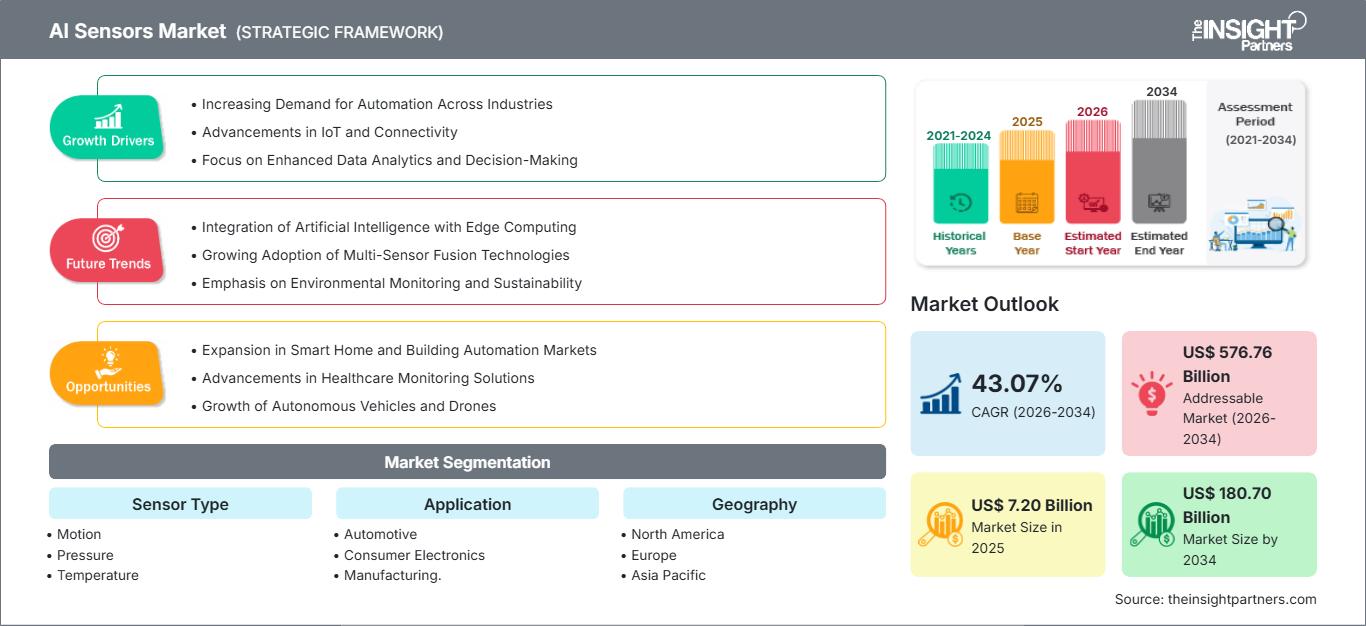
The AI Sensors Market is valued at US$ 7.20 Billion in 2025 and is projected to reach US$ 180.70 Billion by 2034, expanding at a CAGR of 43.07% during 2026–2034. This remarkable expansion is driven by the increasing integration of artificial intelligence capabilities directly into sensor architectures, enabling real-time data processing and decision-making at the edge. The convergence of advancing machine learning algorithms, sophisticated microelectromechanical systems (MEMS), and the proliferation of connected devices has created a fertile ground for AI sensor adoption across diverse industry verticals. Industries are increasingly deploying these intelligent sensors to enhance operational efficiency, enable predictive maintenance, and facilitate autonomous decision-making, fundamentally reshaping traditional sensing paradigms.
North America is estimated to account for approximately 32–36% of the global AI Sensors Market size in 2025, growing at a CAGR of 41–44% during the forecast period. This regional dominance is underpinned by the early and aggressive adoption of autonomous systems in the automotive sector, substantial investments in AI research and defense applications, and a robust ecosystem of leading semiconductor and technology companies. The presence of key players such as Teledyne Technologies Incorporated, SAS Institute, and Oracle Corporation, alongside significant funding for AI infrastructure and domestic semiconductor production, provides a strong structural foundation for market growth in the region. Furthermore, the increasing deployment of AI-enabled sensors in precision healthcare, digital manufacturing, and smart city initiatives continues to fuel regional demand.
AI Sensors Market Assessment and Insights
- North America: Expected to hold 32–36% share in 2025, growing at 41–44% CAGR 2026–2034. Growth is fueled by autonomous vehicle development, defense technology investments, and a strong AI research ecosystem. The U.S. leads in both innovation and deployment.
- U.S. AI Sensors Market: Accounted for approximately 85–90% of the North American market in 2025, expanding at a CAGR of 42–45%. Significant government funding for AI and semiconductor initiatives, coupled with high private sector investment, accelerates adoption across automotive, healthcare, and industrial automation.
- Europe: Estimated to capture 24–28% share in 2025, with a projected CAGR of 39–42%. Germany, the UK, and France are leading adopters. Growth is propelled by stringent automotive safety regulations, Industry 4.0 initiatives, and a strong emphasis on data privacy and sustainable IoT design.
- Asia Pacific: Expected to be the fastest-growing region, with a 30–34% share in 2025 and a CAGR of 45–48%. China, Japan, and South Korea are key markets, driven by massive electronics manufacturing, government-backed smart city projects, and rapid automotive sector transformation.
- Largest Segment (Automotive): Held a share of 32–36% in 2025, with a CAGR of 42–46%. AI sensors are crucial for ADAS, autonomous driving systems, and in-cabin monitoring, providing real-time data for enhanced safety and navigation.
- High Growth Segment (Consumer Electronics): Captured 28–32% share in 2025, with a CAGR of 44–48%. The demand is driven by AI sensors in smartphones, wearables, AR/VR devices, and smart home appliances for intuitive, personalized user experiences.
- Key Companies Analyzed in Detail: ACI Worldwide; Baidu, Inc.; BAE Systems; LexisNexis Risk Solutions; Oracle Corporation; Teledyne Technologies Incorporated; Robert Bosch GmbH; Sensata Technologies, Inc.; Sensirion AG; Goertek; Hokuriku Electric; MEMSIC Semiconductor; Movella; Silicon Sensing Systems Limited; Sony Corporation; SAS Institute.
Source: The Insight Partners' analysis based on proprietary research, government publications, company annual reports, investor presentations, industry databases, and expert interviews.
The AI Sensors Market is undergoing a profound evolution, shifting from traditional data collection devices to intelligent systems capable of localized analysis and action. This transformation is driven by the integration of artificial intelligence with edge computing, enabling sensors to process data at the source and drastically reduce latency. Production dynamics are increasingly focused on developing ultra-low-power, compact, and multimodal sensors that can be seamlessly embedded into a vast array of devices, from industrial machinery to personal wearables. The industry is witnessing a significant pivot toward multi-sensor fusion technologies, where data from various sensor types, such as optical, motion, and pressure, are combined to create more comprehensive and reliable environmental awareness. This technological shift is supported by advancements in neuromorphic engineering and embedded machine learning models, which allow for more efficient on-device inferencing and pattern recognition.
Looking forward, the AI Sensors Market is poised for unprecedented growth, with emerging economies in Asia-Pacific region presenting significant opportunities due to rapid industrialization and increasing investments in smart infrastructure. Concurrently, regulatory tailwinds in regions like Europe and North America, emphasizing environmental monitoring, sustainability, and automotive safety, are acting as powerful market catalysts. The push for energy-efficient solutions and the growing emphasis on data privacy are driving innovation in privacy-preserving AI sensors, which can perform analytics without transmitting sensitive raw data to the cloud. Furthermore, the convergence of AI sensors with emerging technologies like 5G and the Internet of Things (IoT) is expected to create new application paradigms in sectors like precision agriculture, smart cities, and telemedicine.
AI Sensors Market Report Scope
| Report Attribute | Details |
|---|---|
| Market size in 2025 | US$ 7.20 Billion |
| Market Size by 2034 | US$ 180.70 Billion |
| Global CAGR (2026 - 2034) | 43.07% |
| Historical Data | 2021-2024 |
| Forecast period | 2026-2034 |
AI Sensors Market Analysis
The escalating demand for automation across manufacturing, automotive, and healthcare sectors is a primary driver, as industries adopt AI sensors to optimize processes, minimize errors, and enable predictive maintenance. The value chain for AI sensors is complex, involving semiconductor foundries, MEMS manufacturers, AI algorithm developers, and system integrators, with supply dynamics heavily influenced by global semiconductor production capacity. Organizations are increasingly recognizing the value of real-time data analytics, and AI sensors provide the critical link between the physical and digital worlds, supporting strategic planning and operational innovation. This demand is further amplified by the widespread deployment of IoT ecosystems, where intelligent sensors are essential for data collection, transmission, and intelligent processing in smart homes, cities, and industrial settings, according to the AI Sensors Market Forecast.
The competitive environment includes a combination of leading semiconductor firms, specialists in sensors manufacturing, and innovative start-ups, with the market leaders such as Robert Bosch GmbH, Sony Corporation, and Teledyne Technologies Incorporated having a considerable market share owing to their diverse product lines and effective research and development. Trends in investments are largely oriented towards the development of edge AI functionality, multi-sensor fusion systems, and ultra-low-power technology suited for certain verticals like auto safety and wearable health trackers. The strategic approach will include forming alliances with platform developers of AI, geographical expansion, and innovations in applications to retain a competitive advantage in this fast-developing industry. One of the strategic actions is the acquisition of DD-Scientific Holdings by Teledyne.
● REPORT CUSTOMIZATION
Tailor This Report To Align With Your Specific Business Requirements
This report can be customized to align precisely with your business objectives, scope, and target markets. Customization options include tailored segmentation, geography, competitive analysis, and strategic insights to support informed decision-making.
Customize This Report →WHAT YOU CAN ADJUST
- ● Segmentations
- ● Geography
- ● Competitive Analysis
- ● Language Preferences
AI Sensors Market: Strategic Insights
Regional Insights
North America AI Sensors Market
North America is expected to lead the global AI Sensors Market, holding approximately 32–36% of the share in 2025, with a projected CAGR of 41–44% from 2026 to 2034, according to the AI Sensors Market Report. This dominance is driven by substantial investments in autonomous vehicle technology, a robust defense sector, and strong government funding for AI and semiconductor research. The presence of major technology companies and a culture of rapid innovation adoption further fuel market expansion. The region's focus on developing digital manufacturing and precision healthcare creates a high-demand environment for sophisticated AI sensing solutions, making it a critical hub for both technological advancement and commercial deployment of intelligent sensors.
U.S. AI Sensors Market
The U.S. AI Sensors Market is estimated to represent 85–90% of the North American share in 2025, growing at a CAGR of 42–45%. Growth is propelled by increased funding for AI infrastructure, favorable regulatory support for autonomous systems, and significant private sector investment in smart technologies. Key application sectors include automotive, aerospace and defense, and healthcare, where companies are leveraging national innovation frameworks to accelerate product development and commercialization. The strategic focus on domestic semiconductor production further enhances the country's competitive position in the AI sensor value chain, ensuring a robust ecosystem for innovation and manufacturing.
Europe AI Sensors Market
Europe is anticipated to capture 24–28% of the global market share in 2025, with a CAGR of 39–42%. The region's growth is underpinned by the rapid adoption of Industry 4.0, particularly in Germany, a leader in automotive manufacturing and industrial automation. The UK, France, and Italy are also significant contributors, driven by initiatives focusing on smart mobility and environmental sustainability. The European market is distinguished by a strong emphasis on data privacy and sustainable technology, influencing the design and deployment of AI sensors that comply with stringent regulatory standards like GDPR. This focus on ethical and green technology is shaping a unique market landscape in Europe and reflects emerging AI Sensors Market Trends.
APAC AI Sensors Market
Asia Pacific is poised for the highest growth, holding approximately 30–34% of the market in 2025 and projected to expand at a CAGR of 45–48%. China, Japan, and South Korea are the leading countries, with growth fueled by massive consumer electronics manufacturing, aggressive government support for smart city projects, and a rapidly evolving automotive industry. India and Australia are also emerging as key markets due to increasing industrialization and digital transformation. Government policies like local production initiatives in India are further catalyzing the adoption of advanced sensor technologies across various sectors.
Middle East & Africa AI Sensors Market
The Middle East & Africa region is expected to show steady growth, with a CAGR of 38–41%. Saudi Arabia and the UAE are the primary drivers, investing heavily in smart city projects, energy infrastructure, and industrial diversification, creating demand for AI sensors for environmental monitoring and automation. South Africa is also a notable market, with increasing interest in mining automation and smart grid applications. The region's focus on infrastructure modernization and energy efficiency presents significant opportunities for AI sensor deployment, particularly in smart building and oil & gas applications.
Segmentation Analysis
Sensor Type
The AI Sensors Market is segmented by sensor type into Motion, Pressure, Temperature, Optical, and Position. The sensor type segment is projected to grow at a CAGR of 43–47% from 2026 to 2034, driven by the diversification of application requirements across industries. Each sensor type plays a critical role in specific use cases, from motion sensors enabling autonomous navigation to optical sensors powering machine vision systems. The integration of AI into these sensors enhances their analytical capabilities, allowing them to deliver more value than traditional sensing components.
- Motion Sensors: Motion sensors are critical for applications requiring movement detection, such as autonomous vehicles, robotics, and wearable devices. They analyze changes in velocity, orientation, and acceleration to enable precise control and navigation in dynamic environments.
- Pressure Sensors: Pressure sensors are essential in automotive systems (e.g., tire pressure monitoring), industrial hydraulics, and medical devices for flow monitoring. AI integration allows for predictive diagnostics and more accurate real-time monitoring.
- Temperature Sensors: Temperature sensors are vital for thermal management in industrial processes, data centers, and healthcare. AI-enabled temperature sensors can identify early warning signs of equipment failure and optimize energy usage.
- Optical Sensors: Optical sensors, including LiDAR, image sensors, and photoelectric sensors, are the foundation for machine vision and advanced driver-assistance systems. They enable object recognition, inspection, and autonomous perception.
- Position Sensors: Position sensors, both linear and angular, are crucial for precise control in robotics, manufacturing, and automotive systems. They provide accurate feedback on the location and orientation of mechanical components.
Application
The AI Sensors Market is segmented by application into Automotive, Consumer Electronics, and Manufacturing. The application segment is expected to exhibit a strong CAGR of 43–47% from 2026 to 2034, propelled by the increasing need for automation and intelligent features in end-user industries. Automotive remains a dominant application area due to safety mandates and the shift toward autonomous driving, while consumer electronics are rapidly adopting AI sensors for enhanced user interactivity.
- Automotive: AI sensors in automotive are integral to ADAS, driver monitoring, and autonomous driving. They process data from cameras, LiDAR, and radar to support features like lane departure warnings and adaptive cruise control, enhancing vehicle safety and operational autonomy.
- Consumer Electronics: The consumer electronics sector uses AI sensors in smartphones, AR/VR headsets, and smart home devices to enable gesture recognition, environmental awareness, and personalized user interfaces. This segment is a major driver of compact, multimodal sensor innovation.
- Manufacturing: In manufacturing, AI sensors power predictive maintenance, quality control, and robotics. By analyzing vibration, temperature, and optical data, they help optimize production lines, reduce downtime, and ensure product quality in Industry 4.0 environments.
Opportunity Snapshot
| Segment | Revenue Contribution | Trend Tag | Adoption Stage |
| Automotive | High | Autonomous Driving | Scaling |
| Consumer Electronics | High | Smart Interactivity | Scaling |
| Manufacturing | Medium | Predictive Ops | Mature |
| Motion Sensors | High | Autonomous Navigation | Scaling |
| Optical Sensors | High | Vision Systems | Mature |
| Pressure Sensors | Medium | Process Monitoring | Mature |
| Temperature Sensors | Medium | Thermal Mgmt. | Mature |
| Position Sensors | Medium | Precision Control | Scaling |
AI Sensors Market Growth Drivers and Impact Analysis
Increasing Demand for Automation and Predictive Maintenance
The global push for automation across industries to boost operational efficiency and reduce human error is a primary driver for the AI Sensors Market. In manufacturing, AI sensors enable predictive maintenance by continuously monitoring equipment health, thereby minimizing costly downtime and enhancing product quality. The drive for autonomous solutions in logistics, healthcare, and agriculture is also spurring demand, as intelligent sensors are fundamental to systems that require real-time, data-driven decisions.
Proliferation of IoT and Edge Computing Ecosystems
The rapid expansion of the Internet of Things (IoT) and the shift toward edge computing are significant accelerators for the AI Sensors Market. AI sensors integrate seamlessly into IoT ecosystems, providing the critical data processing and analytics capabilities needed for intelligent decision-making at the edge. This integration reduces latency and bandwidth constraints, making real-time analytics feasible for smart cities, industrial IoT, and connected infrastructure. As connected devices proliferate, the need for efficient, intelligent sensors that can operate autonomously becomes paramount.
Focus on Enhanced Data Analytics and Real-Time Decision-Making
Organizations are increasingly leveraging data analytics for strategic and operational insights, fueling the demand for AI sensors. These sensors collect vast datasets from their environment and apply advanced analytics to extract actionable intelligence, supporting everything from supply chain optimization to consumer behavior analysis. The ability to process data where it is generated, a key feature of AI sensors, enables immediate, context-aware responses, which are transforming industries that rely on split-second decisions.
AI Sensors Market Future Trends
Integration of AI with Edge Computing for Real-Time Processing
A dominant trend is the deeper integration of AI algorithms directly within sensor hardware, moving data processing closer to the source. This "edge AI" approach is critical for applications where latency is unacceptable, such as autonomous driving, industrial robotics, and real-time surveillance. By enabling sensors to analyze data locally, this trend enhances system speed, reduces cloud dependency, and improves privacy. This shift is driving the development of more powerful, yet energy-efficient, system-on-chip (SoC) designs optimized for on-device machine learning workloads.
Growing Adoption of Multi-Sensor Fusion and Neuromorphic Sensing
The future of the market is increasingly defined by multi-sensor fusion, where data from disparate sensor types (optical, pressure, acoustic) are combined to create a comprehensive, holistic view of the environment. This approach is vital for complex systems like autonomous vehicles that require redundancy and varied data inputs for safe navigation. Concurrently, neuromorphic sensors, which mimic biological neural architectures, are emerging to process data more efficiently, consuming significantly less power while enabling real-time learning, marking a major shift in intelligent sensor design.
AI Sensors Market Opportunities
Expansion in Smart Home and Building Automation
The rising trend of the smart homes industry provides a major window of opportunity for AI sensors. With consumers seeking increased levels of convenience, safety, and efficiency, AI sensors are necessary to facilitate the automation and optimization of building conditions. Ranging from smart thermostats to security systems, the list of applications is huge. Those companies that create unique and user-friendly AI sensors will be able to acquire a considerable market share in the growing connected homes segment.
Growth in Autonomous Vehicles and Drone Technologies
The rise of autonomous vehicles (AVs), drones, and other uncrewed systems offers a vast opportunity for the AI Sensors Market. These technologies are entirely reliant on sophisticated sensing and perception capabilities for navigation, object detection, and safe operation. AI sensors like LiDAR, radar, and cameras integrated with advanced machine learning are critical for their functionality. As the AV and drone industries mature and scale from pilot programs to commercial deployment, the demand for high-performance, reliable, and cost-effective AI sensor technologies will increase exponentially, creating a lucrative growth avenue for industry players.
Recent Developments
- May 2026: TDK Corporation (TSE:6762) announces advancements in sensor technology that optimize and accelerate the deployment of smart IoT solutions, SensorGPTTM. This technology uses generative AI, signal processing, statistical methods, and simulations to create and manage sensor data at scale. TDK’s SensorGPT will empower both the smart IoT market and the emerging Ambient IoT market segment to overcome key scalability challenges. It streamlines model development and deployment, cutting both time and cost, and significantly enhancing the performance and efficiency of edge AI models and applications.
- May 2026: Eviden, the Atos Group product branch leading in mission-critical systems, announces the launch of ELIT AI, Avantix’s next-generation radar interceptor. Developed by Avantix, Eviden’s signals intelligence (SIGINT) center of expertise, ELIT AI is an ELINT sensor[1] whose capabilities are augmented by artificial intelligence. It enables real-time tactical radar situational awareness, faster visualization, and identification of next-generation complex radar waves.
- May 2026: Cognex Corporation (NASDAQ: CGNX), the global technology leader in industrial machine vision, announced the launch of the In-Sight 3900 Vision System. Built on a new generation of Cognex embedded AI vision technology and powered by Qualcomm Dragonwing platforms, the In-Sight 3900 is a fully integrated vision system that delivers industry-leading speed, accuracy, and resolution at the edge, enabling manufacturers to run demanding inspections without sacrificing throughput or simplicity.
Frequently Asked Questions

- Comprehensive Market Sizing and Forecast Analysis
- Detailed Segmentation Analysis
- In-Depth Market Dynamics Assessment
- Regional and Country-Level Insights
- Competitive Landscape and Company Benchmarking
- Strategic Business Intelligence
Recent Reports
Testimonials

The Insight Partners' SCADA System Market report is comprehensive, with valuable insights on current trends and future forecasts. The team was highly professional, responsive, and supportive throughout. We are very satisfied and highly recommend their services.
RAN KEDEM Partner, Reali Technologies LTDs
I requested a report on a very specific software market and the team produced the report in a few days. The information was very relevant and well presented. I then requested some changes and additions to the report. The team was again very responsive and I got the final report in less than a week.
JEAN-HERVE JENN Chairman, Future Analytica
We worked with The Insight Partners for an important market study and forecast. They gave us clear insights into opportunities and risks, which helped shape our plans. Their research was easy to use and based on solid data. It helped us make smart, confident decisions. We highly recommend them.
PIYUSH NAGPAL Sr. Vice President, High Beam Global
The Insight Partners delivered insightful, well-structured market research with strong domain expertise. Their team was professional and responsive throughout. The user-friendly website made accessing industry reports seamless. We highly recommend them for reliable, high-quality research services
YUKIHIKO ADACHI CEO, Deep Blue, LLC.
This is the first time I have purchased a market report from The Insight Partners.While I was unsure at first, I visited their web site and felt more comfortable to take the risk and purchase a market report.I am completely satisfied with the quality of the report and customer service. I had several questions and comments with the initial report, but after a couple of dialogs over email with their analyst I believe I have a report that I can use as input to our strategic planning process.Thank you so much for taking the extra time and making this a positive experience.I will definitely recommend your service to others and you will be my first call when we need further market data.
JOHN SUZUKI President and Chief Executive Officer, Board Director, BK Technologies
I wish to appreciate your support and the professionalism you displayed in the course of attending to my request for information regarding to infectious disease IVD market in Nigeria. I appreciate your patience, your guidance, and the fact that you were willing to offer a discount, which eventually made it possible for us to close a deal. I look forward to engaging The Insight Partners in the future, all thanks to the impression you have created in me as a result of this first encounter.
DR CHIJIOKE ONYIA MANAGING DIRECTOR, PineCrest Healthcare Ltd.Reason to Buy
- Informed Decision-Making
- Understanding Market Dynamics
- Competitive Analysis
- Identifying Emerging Markets
- Customer Insights
- Market Forecasts
- Risk Mitigation
- Boosting Operational Efficiency
- Strategic Planning
- Investment Justification
- Tracking Industry Innovations
- Aligning with Regulatory Trends





 Get Free Sample for