
Connector Market Size, Growth & Trends by 2034
Coverage: By Product Type (PCB Connectors, IO Connectors, Circular Connectors, Fiber Optic Connectors, RF Coaxial Connectors , Others); End-user (Telecom, Transportation, Automotive, Industrial, Computer and Peripherals , Others) , and Geography (North America, Europe, Asia Pacific, and South and Central America)
- Status : Data Released
- Report Code : TIPRE00027589
- Category : Electronics and Semiconductor
- No. of Pages : 150
- Available Report Formats :


- Last update date : July 28, 2026


2025 Market Size
US$ 88.77 Bn
Base year value
2034 Forecast
US$ 158.92 Bn
Projected by 2034
CAGR 2026-2034
6.68 %
Growth rate
Addressable Market
US$ 1,119.33 Bn
(2026-2034)
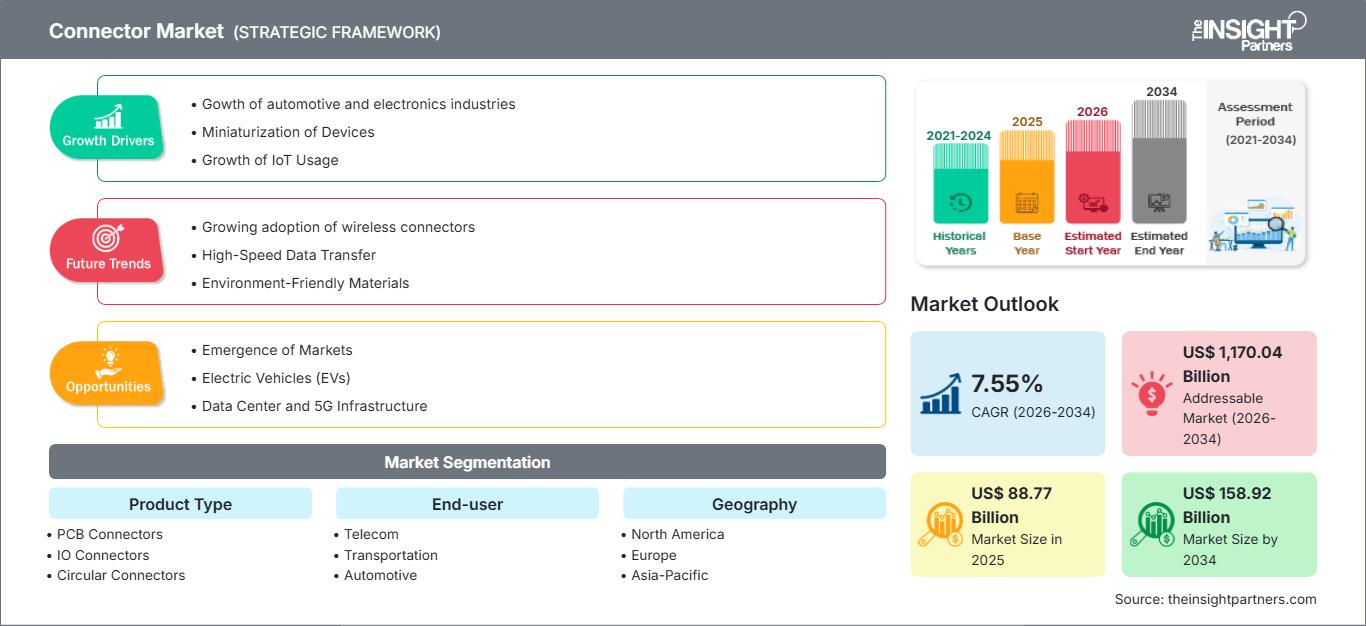
The Connector market was valued at US$ 88.77 billion in 2025 and is expected to reach US$ 158.92 billion by 2034; it is estimated to record a CAGR of 6.68% during 2026-2034.
Connector Market Assessment and Insights
- North America held 24–27% share in 2025 and is growing at a CAGR between 2026–2034 of 6.8–7.3%, supported by AI data centers, defense electronics, EV charging, and industrial automation modernization.
- US represented 78–82% of North America in 2025 and is growing at a CAGR between 2026–2034 of 6.9–7.4%, driven by hyperscale computing and mobility electronics.
- Europe accounted for 19–22% share in 2025 and is growing at a CAGR between 2026–2034 of 6.5–7.1%, led by Germany, France, the UK, Italy, and Spain.
- Asia Pacific captured 42–46% share in 2025 and is growing at a CAGR between 2026–2034 of 8.0–8.7%, led by China, Japan, South Korea, India, and ASEAN electronics production.
- Largest Segment PCB Connectors held 27–31% market share in 2025, with a CAGR range of 6.9–7.5% from 2026–2034, reflecting broad use in servers, vehicles, and electronics.
- High Growth Segment Fiber Optic Connectors held 13–16% market share in 2025, with a CAGR range of 8.8–9.6% from 2026–2034 as AI and telecom networks scale.
- Key companies analyzed in detail: 3M Company, ABB Ltd., AMETEK, Inc., Amphenol Corporation, Aptiv PLC, Huawei Technologies Co., Ltd., Japan Aviation Electronics Industry, Ltd., Nexans S.A., Prysmian S.p.A., TE Connectivity Ltd.
Source: The Insight Partners' analysis based on proprietary research, government publications, company annual reports, investor presentations, industry databases, and expert interviews.
Connectors have evolved from standardized electromechanical parts to engineered interconnect solutions designed specifically for bandwidth, thermal capabilities, vibration resistance, sealing, and manufacturability. The business dynamics have been moving away from procurement of parts at the lowest cost towards customized solutions that require fewer validation steps and higher reliability proof. Electrification of vehicles, 5G densification, satellites, robotics, and computing for AI will drive future demand in these applications.
The future of demand should be expanded beyond North America and China into India, Southeast Asia, Mexico, Eastern Europe, and the Gulf. The tailwinds created by regulation such as charging standardization, telecom security, energy transition, and industrial safety will be advantageous to suppliers who are able to localize production and show regulatory compliance in high-mix programs.
Connector Market Report Scope
| Report Attribute | Details |
|---|---|
| Market size in 2025 | US$ 88.77 Billion |
| Market Size by 2034 | US$ 158.92 Billion |
| Global CAGR (2026 - 2034) | 6.68% |
| Historical Data | 2021-2024 |
| Forecast period | 2026-2034 |
Connector Market Analysis
Connector Market development will be driven by increased levels of data, power, and equipment electrification at the same time. Telecom carriers are switching to fiber and high frequency, automotive systems need more sensors and higher voltage connectors, while industrial customers are using machines that can be connected. The number of bill of materials items is growing because the installation of additional sensors, boards, modules, antennas, and charging connectors demands high-quality connector performance.
Market supply becomes more structured in light of several years of volatility. Manufacturers balance their exposure to copper, resin, plating, and precision machining against the regional manufacturing presence. Customers' assessment of suppliers is shifting from price to qualification, availability, and compliance. It favors manufacturers who have wide product lines, customization, and two-region manufacturing capabilities.
The competitive positioning in Connector Market report is focused on engineering breadth, acquisition capability, and exposure to AI, electrification, and hostile environment. Large interconnect portfolio helps Amphenol Corporation and TE Connectivity Ltd. In turn, Aptiv PLC has strong alignment with automotive architecture. Competitiveness of ABB Ltd., AMETEK, Inc., Nexans S.A., Prysmian S.p.A., 3M Company, Huawei Technologies Co., Ltd. and Japan Aviation Electronics Industry, Ltd. is defined by specific engineering capabilities in the field of industrial, telecom, cable and precision connector solutions.
There is investment trend towards fiber optics, high speed board interconnects, sealed circular connectors, and automation in connector assembly. At the same time, suppliers apply M&A for gaining new optical, cable, sensor and application engineering capabilities. The most successful companies will be those able to combine family of proven products and customer co-design since the choice of connectors is made earlier in the process of platform architecture.
● REPORT CUSTOMIZATION
Tailor This Report To Align With Your Specific Business Requirements
This report can be customized to align precisely with your business objectives, scope, and target markets. Customization options include tailored segmentation, geography, competitive analysis, and strategic insights to support informed decision-making.
Customize This Report →WHAT YOU CAN ADJUST
- ● Segmentations
- ● Geography
- ● Competitive Analysis
- ● Language Preferences
Connector Market: Strategic Insights
Regional Insights
North America Connector Market
The North America region had a share of 24–27% in 2025 and will be growing at a 6.8–7.3% CAGR up to 2034. Growth factors include construction of cloud data centers, purchase of defense electronics, investments in semiconductor equipment, and expansion of charging station infrastructure. The North America share in the Connector Market will also be aided by Mexico's presence of electronic and automotive assembly facilities.
Upgrades of telecommunications networks, aerospace systems, industrial automation, and AI servers are driving the growth of high-speed, RF coaxial, circular, and optical fiber connectors. Customers from this region value compliance, continuity of services, and national support. Thus, there is an advantage for suppliers who have engineering offices in North America and have a history of qualifications in challenging applications.
U.S. Connector Market
The U.S. accounted for 78-82% share of North America in 2025 and projected to grow at a 6.9-7.4% CAGR during 2026-2034. The demand is driven by hyperscale computing, defense electronics, autonomy, aerospace, industrial controls, and EV charging applications. High-performance and robust connectors with enhanced performance in terms of data rates, heat resistance, and vibration are required by large end-users in the country.
There are many company operations, such as Amphenol Corporation, TE Connectivity Ltd., 3M Company, AMETEK, Inc., and Aptiv PLC. There are fiber-dominated data centers, rugged defense electronics, and intelligent vehicles. The purchase of validated connectors assemblies along with their documentation is favored by procurement teams in the country.
Europe Connector Market
Europe represented 19–22% market share in 2025 and is expected to experience a CAGR of 6.5–7.1% during 2025–2034. Germany dominates the regional demand because of electronics used in automobiles, industrial machinery, robotics, and automated factories. United Kingdom is significant for the development of aerospace sector, defense electronics, telecommunication infrastructure, and data centers; circular, RF coaxial, and fiber optic connector types are in great demand here.
France, Italy, and Spain generate additional demand because of railways, renewables, electric vehicle charging infrastructure, machinery, and telecommunication modernization. Safety regulations and environmental compliance together with lifecycle availability are key requirements from the European customers. Growth drivers include vehicle electrification, grid modernization, and advanced manufacturing, but high energy prices and labor costs prompt manufacturers to find a balance between localization and flexibility.
APAC Connector Market
The APAC region holds a market share of 42-46% and is projected to grow at a CAGR of 8.0-8.7%. The dominance of China is due to electronics manufacturing, electric vehicles, telecommunication, and industrial equipment production. The countries Japan and South Korea have demand in advanced automotive, semiconductors, display, and electronics.
Indonesia, Australia, and Southeast Asian region are expanding through electronics localization, renewable energy initiatives, rail modernization, and data center investments. The government incentives on manufacturing activities and digital infrastructure development drive the market demand. The customers need cost-effective high volume manufacturing, whereas premium growth potential is present in fiber optics, high-speed board, and rugged industries.
Middle East & Africa Connector Market
The Middle East & Africa region is forecasted to witness a 5.8–6.4% CAGR during the period of 2034, driven by growth in demand in Saudi Arabia. Energy infrastructure, utility modernization, oil and gas automation, telecommunication tower, and transportation construction projects drive the circular, RF coaxial, optical fiber, and industrial connectors markets.
UAE drives market growth in the data center, smart city, logistics, and aerospace applications, while South Africa drives demand in mining, power, telecommunication, and rail applications. The demand in rest of MEA is project-based. Connectors with ruggedness and long product lifecycle are well suited in tough environmental conditions.
Segmentation Analysis
Product Type
Product Type is expected to grow at a 7.3–7.9% CAGR from 2026–2034, reflecting demand for higher signal density, thermal performance, optical bandwidth, and ruggedization. Connector Market scope across product families is widening as OEMs redesign equipment around modular boards, fiber links, compact housings, and sealed interfaces for mobile, industrial, telecom, and vehicle platforms.
- PCB Connectors remain the largest product family because servers, vehicles, industrial controllers, and consumer electronics rely on board-level interconnects that support miniaturization, durability, and dense packaging.
- IO Connectors serve external device interfaces, industrial modules, computing systems, and communications equipment, making them strategically important where frequent mating cycles and data integrity are critical.
- Circular Connectors are preferred in harsh environments, including defense, aerospace, rail, machinery, and energy systems, where sealing, vibration resistance, and secure locking determine equipment reliability.
- Fiber Optic Connectors are gaining strategic importance as data centers, telecom networks, medical systems, and defense applications require high bandwidth, low latency, and electromagnetic immunity.
- RF Coaxial Connectors support antennas, radar, satellite systems, test equipment, and 5G infrastructure, where controlled impedance and low signal loss are essential.
End-user
End-user demand is projected to grow at a 7.4–8.0% CAGR from 2026–2034 as connectivity content rises across telecom, transportation, automotive, industrial, and computing platforms. Procurement decisions increasingly depend on reliability, application certification, and lifecycle support because connector failure can interrupt data transmission, vehicle operation, production uptime, or safety-critical communication.
- Telecom is a major demand source as fiber rollout, 5G radios, network densification, and data traffic growth increase use of optical, RF, board, and IO connector systems.
- Transportation uses connectors in rail, commercial vehicles, aerospace, marine, and charging infrastructure, where ruggedization, safety compliance, and serviceability are central to design decisions.
- Automotive demand is rising with EV powertrains, advanced driver assistance, infotainment, battery systems, lighting, and zonal architectures that require compact and high-reliability interconnects.
- Industrial applications include robotics, drives, sensors, factory automation, energy equipment, and process control, creating steady demand for sealed circular, IO, PCB, and power connectors.
- Computer and Peripherals depend on board-to-board, high-speed IO, power, and fiber links for servers, storage, AI accelerators, workstations, and peripheral devices.
Opportunity Snapshot
| End-user | Revenue Contribution | Trend Tag | Adoption Stage |
| Telecom | High | Fiber Densification | Scaling |
| Transportation | Medium | Smart Rail | Scaling |
| Automotive | High | EV Platforms | Scaling |
| Industrial | Medium | Factory Sensors | Mature |
| Computer and Peripherals | High | AI Servers | Scaling |
| Others | Low | Specialty Uses | Emerging |
Connector Market Growth Drivers and Impact Analysis
AI Data Centers and High-Speed Computing Architectures
AI clusters require dense board interconnects, fiber optic links, high-current power interfaces, and thermal-resilient assemblies. As rack power rises and accelerator platforms move toward faster signal protocols, connector qualification becomes a system-level engineering issue. This driver expands demand for premium PCB connectors, IO systems, and optical interfaces with lower insertion loss and tighter tolerances. The impact is visible in supplier investment toward high-speed product platforms and data-center acquisitions, because customers need validated solutions that shorten design cycles and reduce signal-integrity risk across rapidly changing server architectures.
Vehicle Electrification and Electronic Content Expansion
Electric vehicles, hybrid platforms, advanced driver assistance systems, and zonal electrical architectures increase connector count and performance requirements per vehicle. High-voltage battery links, charging inlets, infotainment, lighting, sensors, and in-cabin electronics require sealed, thermally stable, and vibration-resistant interfaces. The market impact is a shift from commodity connectors toward application-specific assemblies with safety certification and long lifecycle support. Automotive OEMs and Tier 1 suppliers are therefore deepening collaboration with connector specialists early in platform development to control weight, wiring complexity, reliability, and serviceability.
Industrial Automation and Harsh-Environment Connectivity
Factories, utilities, mining operations, rail systems, and energy assets are adding sensors, drives, controllers, and connected equipment to improve uptime and productivity. Harsh environments require connectors that resist dust, moisture, vibration, chemicals, and temperature variation while maintaining signal and power continuity. This driver supports circular connectors, industrial IO systems, RF coaxial links, and rugged PCB products. The practical impact is higher average selling value for certified, sealed, and application-tested products, especially where equipment downtime creates measurable operating losses or safety exposure.
Connector Market Future Trends
Optical Interconnects Move Deeper into Equipment Architectures
Connector Market trends point toward wider adoption of fiber optic interfaces inside and between equipment, not only in long-haul networks. AI computing, 5G transport, medical imaging, aerospace payloads, and industrial vision systems are increasing requirements for low latency and electromagnetic immunity. Over the forecast period, suppliers are expected to integrate optical connectors with cable assemblies, thermal management, and test documentation. This trend will raise barriers for low-cost manufacturers because customers will require optical performance validation, contamination control, and precise field-service procedures.
Connector Design Becomes More Application-Specific
Future platforms will require connectors engineered for exact combinations of bandwidth, current, sealing, mating cycles, and packaging constraints. Instead of selecting standardized components late in design, OEMs are likely to involve connector suppliers earlier to reduce harness weight, simplify assembly, and improve reliability. Additive manufacturing for tooling, automated inspection, and simulation-led design will compress development timelines. This trend will favor suppliers that can combine catalog breadth with co-engineering capability, particularly in mobility, industrial automation, aerospace, and data-center infrastructure.
Connector Market Opportunities
Localized Supply Programs for Strategic Electronics Platforms
Connector Market Forecasts indicate that electronics manufacturing diversification will create opportunities for suppliers with regional tooling, assembly, and qualification support. Mexico, India, Southeast Asia, Eastern Europe, and the Gulf are attracting investment in vehicles, telecom, data centers, and industrial equipment. Connector makers can capture value by offering local inventory, dual sourcing, and application engineering close to OEM plants. The opportunity is strongest where customers need shorter lead times, compliance documentation, and reduced exposure to freight disruption or trade-policy uncertainty.
Integrated Connector and Cable Assembly Solutions
Customers increasingly prefer validated connector and cable assemblies that reduce procurement complexity and improve installation reliability. This creates an opportunity for suppliers to bundle connectors, cables, shielding, sealing, strain relief, testing, and documentation into platform-specific solutions. The model is attractive in EV charging, data centers, rail, aerospace, telecom, and industrial automation because it reduces field failure risk and accelerates qualification. Companies that combine component manufacturing with assembly, testing, and design support can improve margins while becoming more embedded in customer product roadmaps.
Recent Developments
- June 2026: Geospace Technologies Corporation (NASDAQ: GEOS) (the "Company") announced the introduction of the Hydroconn Series V AMI connector, expanding its portfolio of smart meter connectivity solutions and reinforcing its position as a leading provider of utility connectivity infrastructure. The Hydroconn Series V connector is compatible with Badger Meter connectors and broadens the Hydroconn family of products, which includes the Series III and Series IV connectors, along with the HydroAdapt connectivity platform introduced in 2025.
- June 2026: Amphenol Industrial Operations has introduced two innovative liquid cooling connectors that raise the bar for performance and reliability in high-reliability electronic systems. Designed to address the growing demands of datacom servers, energy storage systems, and electric vehicle infrastructure, the new connectors are built to deliver greater efficiency, durability, and easier installation.
- July 2026: STL Optical Connectivity NALLC (STLOC), the US subsidiary of STL (Sterlite Technologies Ltd), has expanded its optical connectivity portfolio with the launch of CONCAT, a new fibre-to-the-home (FTTH) solution designed to make broadband network deployment simpler and faster. The product was introduced after successfully completing field trials on the network of one of the largest telecom service providers in the US.
Frequently Asked Questions

- Comprehensive Market Sizing and Forecast Analysis
- Detailed Segmentation Analysis
- In-Depth Market Dynamics Assessment
- Regional and Country-Level Insights
- Competitive Landscape and Company Benchmarking
- Strategic Business Intelligence
Recent Reports
Testimonials

The Insight Partners' SCADA System Market report is comprehensive, with valuable insights on current trends and future forecasts. The team was highly professional, responsive, and supportive throughout. We are very satisfied and highly recommend their services.
RAN KEDEM Partner, Reali Technologies LTDs
I requested a report on a very specific software market and the team produced the report in a few days. The information was very relevant and well presented. I then requested some changes and additions to the report. The team was again very responsive and I got the final report in less than a week.
JEAN-HERVE JENN Chairman, Future Analytica
We worked with The Insight Partners for an important market study and forecast. They gave us clear insights into opportunities and risks, which helped shape our plans. Their research was easy to use and based on solid data. It helped us make smart, confident decisions. We highly recommend them.
PIYUSH NAGPAL Sr. Vice President, High Beam Global
The Insight Partners delivered insightful, well-structured market research with strong domain expertise. Their team was professional and responsive throughout. The user-friendly website made accessing industry reports seamless. We highly recommend them for reliable, high-quality research services
YUKIHIKO ADACHI CEO, Deep Blue, LLC.
This is the first time I have purchased a market report from The Insight Partners.While I was unsure at first, I visited their web site and felt more comfortable to take the risk and purchase a market report.I am completely satisfied with the quality of the report and customer service. I had several questions and comments with the initial report, but after a couple of dialogs over email with their analyst I believe I have a report that I can use as input to our strategic planning process.Thank you so much for taking the extra time and making this a positive experience.I will definitely recommend your service to others and you will be my first call when we need further market data.
JOHN SUZUKI President and Chief Executive Officer, Board Director, BK Technologies
I wish to appreciate your support and the professionalism you displayed in the course of attending to my request for information regarding to infectious disease IVD market in Nigeria. I appreciate your patience, your guidance, and the fact that you were willing to offer a discount, which eventually made it possible for us to close a deal. I look forward to engaging The Insight Partners in the future, all thanks to the impression you have created in me as a result of this first encounter.
DR CHIJIOKE ONYIA MANAGING DIRECTOR, PineCrest Healthcare Ltd.Reason to Buy
- Informed Decision-Making
- Understanding Market Dynamics
- Competitive Analysis
- Identifying Emerging Markets
- Customer Insights
- Market Forecasts
- Risk Mitigation
- Boosting Operational Efficiency
- Strategic Planning
- Investment Justification
- Tracking Industry Innovations
- Aligning with Regulatory Trends





 Get Free Sample for