
Industrial Wearable Market Trends, Size & Forecast by 2034
Coverage: Product (AR Glasses, VR Headsets, Smartwatches and Smart Bands, Patches, and Others); Component (Processors and Memory Modules, Optical Systems and Displays, Electromechanical Components, Touchpads and Sensors, Connectivity Components, Camera Modules, and Others); End-User Industry (Automotive, Aerospace, Manufacturing, Oil & Gas, Energy & Power, and Others); and Geography
- Status : Data Released
- Report Code : TIPRE00008352
- Category : Electronics and Semiconductor
- No. of Pages : 150
- Available Report Formats :


- Last update date : October 16, 2026


2025 Market Size
US$ 8.94 Bn
Base year value
2034 Forecast
US$ 14.41 Bn
Projected by 2034
CAGR 2026-2034
5.45 %
Growth rate
Addressable Market
US$ 105.90 Bn
(2026-2034)
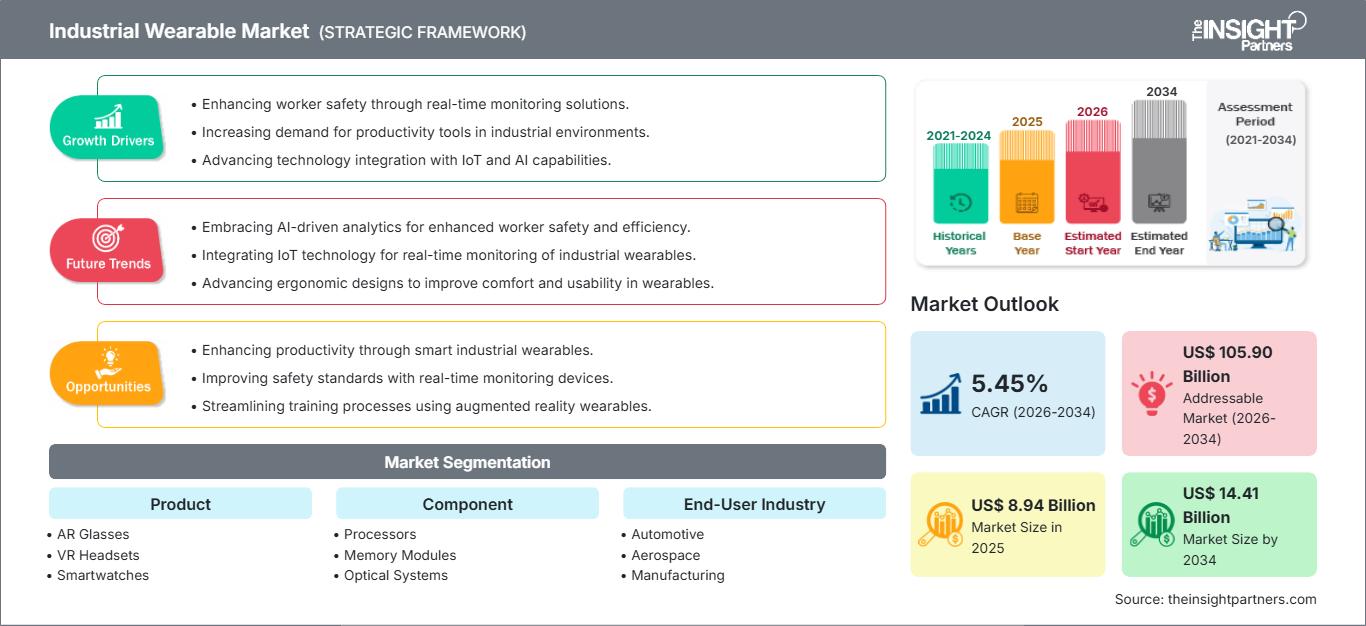
The Industrial Wearable Market is valued at US$ 8.94 Billion in 2025 and is projected to reach US$ 14.41 Billion by 2034, expanding at a CAGR of 5.45% during 2026–2034. The market addresses wearable smart devices for industry workers for increasing the safety, efficiency, ergonomics, visualization, communications, and situational awareness of their activities within manufacturing, energy, aerospace, automotive, and other industries.
North America is likely to continue being an important market for deployment driven by the connected worker initiative, occupational safety, and digitization in the industry. North America Industrial Wearable Market Size is forecast to grow at a rate of 5.7% to 6.5% CAGR up to 2034, backed by workplace surveillance, hands-free operations, wearable safety solutions, and incorporation of workers' data into enterprise software.
Industrial Wearable Market Assessment and Insights
- North America: North America is estimated to hold a 34–38% share in 2025, supported by connected-worker adoption and workplace safety modernization, with a 5.7–6.5% CAGR between 2026–2034.
- US: The US represents 78–83% of North American revenue in 2025 and is projected to grow at a 5.8–6.6% CAGR between 2026–2034.
- Europe: Germany, the UK, France, Italy, and Spain support a 25–29% share in 2025, with industrial automation and worker-safety digitization supporting a 5.1–5.9% CAGR between 2026–2034.
- Asia Pacific: China, Japan, South Korea, India, and Australia account for a 22–26% share in 2025, with manufacturing digitization supporting a 6.3–7.2% CAGR between 2026–2034.
- Largest Segment: Smartwatches hold an estimated 31–35% market share in 2025, with broad functionality supporting a 5.3–6.1% CAGR during 2026–2034.
- High Growth Segment: AR Glasses represent an estimated 18–22% market share in 2025 and are projected to expand at a 7.0–7.8% CAGR during 2026–2034.
- Key companies analyzed in detail: Blackline Safety Corp.; Kenzen, Inc.; Kinetic; MaKuSafe; Modjoul, Inc.; Reactec Ltd.; Sleep Performance Inc.; Valencell, Inc.; Vuzix Corporation; Workaround GmbH (ProGlove).
Source: The Insight Partners' analysis based on proprietary research, government publications, company annual reports, investor presentations, industry databases, and expert interviews.
Industrial Wearables Development in the Market involves transitioning from the use of consumer electronics to devices with the ability to sense workers' data, environmental data, and data from manufacturing processes. Smartwatches and bands have the capability of integrating GPS technology, motion sensors, physiological sensing, and communication functions, while AR glasses are used for hands-free guidance and remote assistance. The manufacturing industry is changing its focus towards ruggedness of the wearable devices, power consumption, compatibility, sensing accuracy, ergonomics, and software integration of wearables.
Expansion should be increasingly driven by the developing manufacturing economies and energy-intensive industries where connected-worker solutions can fulfill the dual objectives of safety and productivity. Investments will probably focus on integrated platforms comprising wearable hardware, analytics, and workforce management applications. Occupational exposure, ergonomics, privacy protection, and data governance considerations may drive the regulation of wearables' deployment, leading to consent capabilities, data security features, and tailored device settings.
Industrial Wearable Market Report Scope
| Report Attribute | Details |
|---|---|
| Market size in 2025 | US$ 8.94 Billion |
| Market Size by 2034 | US$ 14.41 Billion |
| Global CAGR (2026 - 2034) | 5.45% |
| Historical Data | 2021-2024 |
| Forecast period | 2026-2034 |
Industrial Wearable Market Analysis
The demand is influenced by the increasing necessity to provide connection between frontline workers and digital production, safety, and maintenance systems. Industrial Wearable Market development is fostered by location tracking of workers, management of worker fatigue, ergonomics assessment, remote support, and hands-free workflow implementation. The ecosystem comprises the providers of devices, sensors and semiconductors, connectivity providers, software providers, integrators, industrial equipment suppliers, and enterprises. The supply is more dependent on the miniaturization of components, battery efficiency, availability of optics, and sensor calibration.
According to the Industrial Wearable Market report, the competitive landscape covers specialized safety technology, wearable computing, ergonomics, and industrial productivity segments. Blackline Safety Corp. provides for connected worker safety, while Kenzen, Inc. specializes in worker health monitoring. Kinetic and Modjoul, Inc. pay attention to ergonomics and injury prevention, whereas Reactec Ltd. creates technologies for exposure and vibration monitoring. Vuzix Corporation and Workaround GmbH (ProGlove) develop technologies for wearable computing and frontline productivity.
Capabilities provided by Kenzen, Inc., Sleep Performance Inc., and Valencell, Inc. encompass physiological measurement, sleep tracking, and biometric sensing technology. Safety monitoring of workers is provided by MaKuSafe, and companies are becoming focused on software-based revenues through analytics and integration capabilities as opposed to just hardware. The investment focus includes sensor fusion, artificial intelligence, edge computing, low power electronics, industrial strength designs, and application platforms.
● REPORT CUSTOMIZATION
Tailor This Report To Align With Your Specific Business Requirements
This report can be customized to align precisely with your business objectives, scope, and target markets. Customization options include tailored segmentation, geography, competitive analysis, and strategic insights to support informed decision-making.
Customize This Report →WHAT YOU CAN ADJUST
- ● Segmentations
- ● Geography
- ● Competitive Analysis
- ● Language Preferences
Industrial Wearable Market: Strategic Insights
Regional Insights
North America Industrial Wearable Market
It is expected that North America will generate between 34% to 38% of 2025 revenues and will continue growing at a 5.7% to 6.5% CAGR till 2034. In addition, the region enjoys sophisticated manufacturing industry, energy infrastructure, occupational safety programs, as well as usage of enterprise software systems. Increasingly, connected worker strategies are incorporating wearable technology and analytics to enhance incidents management, worker monitoring, and maintenance coordination at industrial facilities.
Leading the region in terms of demand, the USA, whereas Canada provides contribution to the market through its energy, mining, utilities and industrial segments. When buying wearables, purchasers are more focused on device lifetime, robustness, connectivity, sensor precision and software capabilities. Moreover, increasing attention to regulations related to occupational safety and data collection from employees motivates businesses to adopt deployment policies.
U.S. Industrial Wearable Market
In 2025, the US contributes to 78-83% of North American Industrial Wearable Market Share, while expected CAGR growth is estimated between 5.8-6.6% over 2034. The implementation of such systems is observed within manufacturing, aerospace, oil and gas, utility, logistics, and automotive operations. In many cases, companies link wearable systems to safety dashboards, maintenance tools, digital work instruction systems, and enterprise analytics to improve measurability of their frontline operations.
The leading competitors in the industry offering a certain positioning for this market segment are Blackline Safety Corp., Kinetic, Kenzen, Inc., Modjoul, Inc., and Vuzix Corporation. The application areas involve lone worker protection, ergonomics hazard detection, remote expert assistance, warehouse picking operations, fatigue detection, and industrial training programs. Measurement of incident reduction, downtime, manual process and training time reduction becomes a crucial factor in procurement evaluation.
Europe Industrial Wearable Market
It is projected that Europe accounts for 25–29% of 2025 revenues and is projected to exhibit growth rate of 5.1–5.9% CAGR until 2034. Germany leads the pack owing to automation and engineering in industries. Contribution from the UK, France, Italy, and Spain in aerospace, automotive, energy, logistics, and worker safety programs drives the adoption of this technology.
Workplace safety, infrastructure, and logistics are driving factors in the UK's market with demand being driven by connected worker solutions and maintenance becoming increasingly digital. There is huge scope in Germany because of industrial automation, automotive manufacturing, and engineering, which need hands free information and ergonomic monitoring. There is additional demand coming from France, Italy, and Spain for aerospace, manufacturing, energy, and transportation.
APAC Industrial Wearable Market
The APAC region accounts for 22–26% of revenues of 2025 and will grow at a 6.3–7.2% CAGR to 2034. China leads the region followed by Japan, South Korea, India, and Australia. Factors like manufacturing scale, electronics manufacture, automotive investments, and industrial automation drive the need for wearables solutions for enhanced productivity and safety.
Policy-led digital manufacturing drives further growth, especially in places where there is an increased requirement for workforce productivity. China and Japan offer many industrial applications, South Korea has advanced electronics manufacturing capabilities, India has growing manufacturing digitization, and Australia offers mining, energy, and infrastructure opportunities.
Middle East & Africa Industrial Wearable Market
Middle East and Africa is projected to grow at a 5.6–6.4% CAGR through 2034, led by Saudi Arabia and the UAE. Energy, petrochemicals, infrastructure, construction, and large industrial projects create demand for worker monitoring and safety wearables in challenging environments.
South Africa participates by way of mining, manufacturing, and energy; the other MEA countries participate via projects. The hot climate, distant work sites, hazardous working conditions, and mobile workforce make a compelling case for connected safety devices, even though the purchase of these devices may be dependent upon project finance.

Segmentation Analysis
Product
Product is projected to grow at a 5.6–6.4% CAGR during 2026–2034. Smartwatches provide the broadest functional platform, while AR glasses address hands-free productivity. Smart bands, patches, and VR headsets serve more specialized applications involving monitoring, ergonomics, simulation, and training. Product selection increasingly depends on comfort, battery life, application software, and workplace compatibility.
- AR Glasses: AR glasses support hands-free instructions, remote assistance, visualization, inspection, and logistics workflows, making them strategically important where workers must access digital information without interrupting physical tasks.
- VR Headsets: VR headsets are primarily positioned for immersive training, simulation, safety exercises, and equipment familiarization, reducing dependence on physical training environments for selected industrial scenarios.
- Smartwatches: Smartwatches provide a versatile interface for alerts, communication, location, health indicators, and workflow notifications, supporting broad adoption across connected-worker programs.
- Smart Bands: Smart bands offer compact form factors for activity, movement, location, and selected biometric monitoring, making them useful where low weight and continuous wear are priorities.
- Patches: Patches provide discreet sensing and physiological monitoring capabilities, supporting specialized applications where unobtrusive collection and close skin contact are operationally valuable.
Component
Component demand is expected to expand at a 5.2–6.0% CAGR through 2034. Sensor capabilities, processing efficiency, optical systems, displays, connectivity, and camera modules collectively determine wearable performance. Component suppliers increasingly prioritize miniaturization, lower power consumption, thermal efficiency, and integration because industrial devices must remain lightweight while supporting continuous operation.
- Processors: Processors determine computing responsiveness and edge-processing capabilities, supporting increasingly intelligent wearables that analyze sensor inputs without relying entirely on remote computing resources.
- Memory Modules: Memory modules support local storage of applications, sensor information, imagery, and operational data, particularly where intermittent connectivity requires temporary on-device processing.
- Optical Systems: Optical systems are essential to AR glasses, influencing field of view, brightness, image quality, and overall usability in industrial environments.
- Displays: Displays determine how effectively workers receive instructions, alerts, and visual information, with brightness, readability, and power efficiency becoming important selection criteria.
- Electromechanical Components: Electromechanical components support physical interfaces, buttons, haptics, charging mechanisms, and device durability across repetitive industrial use.
- Touchpads: Touchpads provide compact interaction mechanisms for wearable interfaces, especially where conventional keyboards or handheld devices are impractical.
- Sensors: Sensors capture motion, location, environmental, ergonomic, and physiological signals, forming the core data layer for safety and productivity applications.
- Connectivity Components: Connectivity components enable communication with enterprise systems, gateways, mobile networks, and industrial infrastructure, supporting continuous data exchange.
- Camera Modules: Camera modules support visual inspection, remote assistance, documentation, object recognition, and workflow verification, particularly in AR-enabled industrial applications.
End-User Industry
End-User Industry demand is forecast to increase at a 5.5–6.3% CAGR during 2026–2034. Manufacturing and automotive operations provide substantial opportunities because repetitive tasks, quality inspection, maintenance, and worker ergonomics can benefit from wearable technologies. Aerospace, oil and gas, and energy and power add demand where safety, remote operations, and reliability are critical.
- Automotive: Automotive plants use wearables for assembly guidance, inspection, ergonomics, training, and logistics, supporting connected-worker deployment across increasingly automated production lines.
- Aerospace: Aerospace applications emphasize accuracy, traceability, safety, and hands-free access to technical information during manufacturing, maintenance, inspection, and logistics activities.
- Manufacturing: Manufacturing represents a broad deployment environment spanning worker safety, machine interaction, maintenance, quality control, logistics, and productivity measurement.
- Oil & Gas: Oil and gas operations prioritize lone-worker protection, environmental awareness, location monitoring, gas exposure management, and communication across remote or hazardous facilities.
- Energy & Power: Energy and power operators use connected wearables for field-worker communication, safety monitoring, inspection, maintenance, and operational coordination across distributed assets.
Opportunity Snapshot
| End-User Industry | Revenue Contribution (High/Medium/Low) | Trend Tag (MAX 2 words) | Adoption Stage (Emerging/Scaling/Mature) |
| Automotive | High | Assembly Guidance | Scaling |
| Aerospace | Medium | Remote Assistance | Scaling |
| Manufacturing | High | Connected Workers | Scaling |
| Oil & Gas | High | Lone Worker | Mature |
| Energy & Power | Medium | Field Safety | Scaling |
Industrial Wearable Market Growth Drivers and Impact Analysis
Connected worker programs are moving beyond pilot deployments
Industrial organizations are increasingly treating wearable devices as part of broader connected-worker architectures rather than isolated safety tools. This creates demand for systems that combine device data, workforce applications, alerts, analytics, and enterprise integration. The commercial impact is significant because a successful pilot can expand from a limited team to multiple facilities, increasing device volumes and recurring software requirements. Buyers are also becoming more selective about measurable outcomes, including faster incident response, reduced administrative work, improved compliance, and greater maintenance efficiency. Vendors that provide APIs, centralized management, analytics, and deployment support can therefore address larger enterprise programs. As deployment scales, interoperability becomes increasingly important because customers often operate mixed environments containing legacy radios, smartphones, industrial terminals, and specialized safety equipment.
Workplace ergonomics is becoming a measurable operational priority
Ergonomic monitoring is gaining strategic importance as manufacturers seek to reduce repetitive-motion injuries, excessive physical loading, and productivity losses associated with musculoskeletal disorders. Wearables can capture movement patterns and task-related indicators that conventional workplace assessments may not continuously observe. The market impact extends from safety departments to operations and human resources because ergonomic data can inform workstation redesign, task rotation, training, and process engineering. Industrial customers may increasingly favor systems that convert raw sensor information into actionable risk indicators rather than simply recording movement. This creates opportunities for analytics providers and device companies to develop application-specific models for assembly, material handling, logistics, and maintenance. Adoption will depend on transparent worker communication and careful handling of personal data.
Industrial AR is broadening the productivity use case
Augmented reality is extending beyond demonstrations into practical industrial workflows involving maintenance, inspection, picking, training, and remote support. Hands-free access to digital instructions can reduce task interruption and allow less experienced personnel to receive context-specific guidance. The commercial impact is strongest where technical information is complex, equipment downtime is expensive, or specialist expertise is geographically dispersed. AR devices can also capture images and operational evidence, improving documentation and collaboration. However, enterprise deployment requires attention to field of view, weight, battery endurance, safety compatibility, and software integration. Vendors that demonstrate measurable workflow improvements are better positioned to move beyond limited trials. Over time, industrial AR can become an interface layer connecting frontline workers with digital work instructions and remote expertise.
Industrial Wearable Market Future Trends
AI-enabled contextual assistance will reshape frontline interfaces
Industrial Wearable Market trends are likely to increasingly center on contextual artificial intelligence that interprets worker activity, equipment status, and operational information before presenting guidance. Instead of displaying static instructions, future systems may identify the task being performed and surface relevant procedures, warnings, images, or maintenance information automatically. Edge processing will become important where latency, connectivity, or privacy constraints limit cloud dependence. Multimodal interaction combining voice, vision, gesture, and sensor signals could reduce the number of physical controls required. For industrial buyers, the key value will shift from owning wearable hardware toward improving decision quality at the point of work. Vendors will therefore compete increasingly on AI models, workflow integration, data governance, and the quality of contextual recommendations.
Wearables will become more interoperable across industrial software
Future platforms are expected to connect wearable devices more directly with manufacturing execution systems, enterprise resource planning, maintenance applications, safety platforms, and workforce-management software. Greater interoperability can reduce isolated data environments and allow information generated by workers to become part of broader operational workflows. Standardized application interfaces will help organizations mix devices from different suppliers while retaining common analytics and management layers. This direction could also reduce replacement friction because customers may upgrade hardware without rebuilding entire software environments. As deployments mature, identity management, cybersecurity, device provisioning, and data permissions will become integral to wearable architecture. Suppliers that address these requirements alongside device performance can support larger enterprise deployments and longer technology lifecycles.
Industrial Wearable Market Opportunities
Specialized wearables for hazardous and remote industries
Industrial Wearable Market Forecasts point toward opportunities in hazardous environments where connected devices can combine personal safety, location, communication, and environmental awareness. Oil and gas, utilities, mining, chemicals, and remote infrastructure are particularly suitable because workers may operate far from supervisors or medical support. Investors and technology suppliers can target rugged devices designed around specific hazard profiles rather than general-purpose consumer form factors. Features such as intrinsically safe construction, long battery life, satellite or cellular connectivity, and automated alerts can strengthen differentiation. Partnerships with industrial integrators, safety equipment distributors, and large operators can accelerate qualification and deployment. The most attractive opportunities will likely involve recurring service models that combine hardware with monitoring, analytics, maintenance, and support.
Integrated platforms for workforce intelligence
A second opportunity lies in combining wearable-generated information with operational analytics to create workforce intelligence platforms. Companies can aggregate ergonomic, safety, location, productivity, and workflow data to identify recurring risks and process inefficiencies. Such platforms can support management decisions without requiring organizations to operate multiple disconnected applications. Suppliers should prioritize privacy-by-design architecture, role-based access, explainable analytics, and configurable data retention because workforce information can be sensitive. Partnerships with enterprise software providers may broaden distribution and simplify integration. The strongest commercial models are likely to combine device subscriptions with analytics and support services, creating predictable revenue while allowing customers to expand deployments incrementally across facilities and worker groups.
Recent Developments
- July 2025: Samsung Electronics announced an agreement to acquire Xealth, a healthcare integration platform connecting hospitals with digital health tools. The acquisition expands Samsung’s connected-care ecosystem to 500+ hospitals and 70+ digital health solutions, linking wearable/home health data with clinical care and enabling more personalized preventive healthcare.
- April 2026: Wearable Devices announced a collaboration with Meta-Bounds to integrate its Mudra neural wristband with Meta-Bounds AR glasses, enabling intuitive neural control for augmented-reality experiences. The partnership aims to develop touchless spatial interaction and explore enterprise applications for hands-free AR.
Frequently Asked Questions

- Comprehensive Market Sizing and Forecast Analysis
- Detailed Segmentation Analysis
- In-Depth Market Dynamics Assessment
- Regional and Country-Level Insights
- Competitive Landscape and Company Benchmarking
- Strategic Business Intelligence
Recent Reports
Testimonials

The Insight Partners provided valuable market intelligence that supported our global go-to-market strategy. Their team was professional, responsive, and attentive to our feedback, providing thoughtful analysis and helpful methodological clarifications throughout the project.
Junmo Kim Chief Financial Officer (CFO), Enertech Co., Ltd.
The Insight Partners' SCADA System Market report is comprehensive, with valuable insights on current trends and future forecasts. The team was highly professional, responsive, and supportive throughout. We are very satisfied and highly recommend their services.
RAN KEDEM Partner, Reali Technologies LTDs
I requested a report on a very specific software market and the team produced the report in a few days. The information was very relevant and well presented. I then requested some changes and additions to the report. The team was again very responsive and I got the final report in less than a week.
JEAN-HERVE JENN Chairman, Future Analytica
We worked with The Insight Partners for an important market study and forecast. They gave us clear insights into opportunities and risks, which helped shape our plans. Their research was easy to use and based on solid data. It helped us make smart, confident decisions. We highly recommend them.
PIYUSH NAGPAL Sr. Vice President, High Beam Global
The Insight Partners delivered insightful, well-structured market research with strong domain expertise. Their team was professional and responsive throughout. The user-friendly website made accessing industry reports seamless. We highly recommend them for reliable, high-quality research services
YUKIHIKO ADACHI CEO, Deep Blue, LLC.
This is the first time I have purchased a market report from The Insight Partners.While I was unsure at first, I visited their web site and felt more comfortable to take the risk and purchase a market report.I am completely satisfied with the quality of the report and customer service. I had several questions and comments with the initial report, but after a couple of dialogs over email with their analyst I believe I have a report that I can use as input to our strategic planning process.Thank you so much for taking the extra time and making this a positive experience.I will definitely recommend your service to others and you will be my first call when we need further market data.
JOHN SUZUKI President and Chief Executive Officer, Board Director, BK Technologies
I wish to appreciate your support and the professionalism you displayed in the course of attending to my request for information regarding to infectious disease IVD market in Nigeria. I appreciate your patience, your guidance, and the fact that you were willing to offer a discount, which eventually made it possible for us to close a deal. I look forward to engaging The Insight Partners in the future, all thanks to the impression you have created in me as a result of this first encounter.
DR CHIJIOKE ONYIA MANAGING DIRECTOR, PineCrest Healthcare Ltd.Reason to Buy
- Informed Decision-Making
- Understanding Market Dynamics
- Competitive Analysis
- Identifying Emerging Markets
- Customer Insights
- Market Forecasts
- Risk Mitigation
- Boosting Operational Efficiency
- Strategic Planning
- Investment Justification
- Tracking Industry Innovations
- Aligning with Regulatory Trends






 Get Free Sample for