
3D Digital Asset Market Growth, Share & Trends by 2034
3D Digital Asset Market Size and Forecasts (2021–2034), Global and Regional Share, Trends, and Growth Opportunity Analysis Report Coverage : By Component (Hardware, Software, Services); Organization Size (Large Enterprises, SMEs); End Users (Construction, Media & Entertainment, Manufacturing, Healthcare, Retail & Ecommerce, Others)
- Status : Data Released
- Report Code : TIPRE00039687
- Category : Electronics and Semiconductor
- No. of Pages : 150
- Available Report Formats :


- Last update date : July 15, 2026


2025 Market Size
US$ 33.73 Bn
Base year value
2034 Forecast
US$ 88.59 Bn
Projected by 2034
CAGR 2026-2034
11.33 %
Growth rate
Addressable Market
US$ 539.34 Bn
(2026-2034)
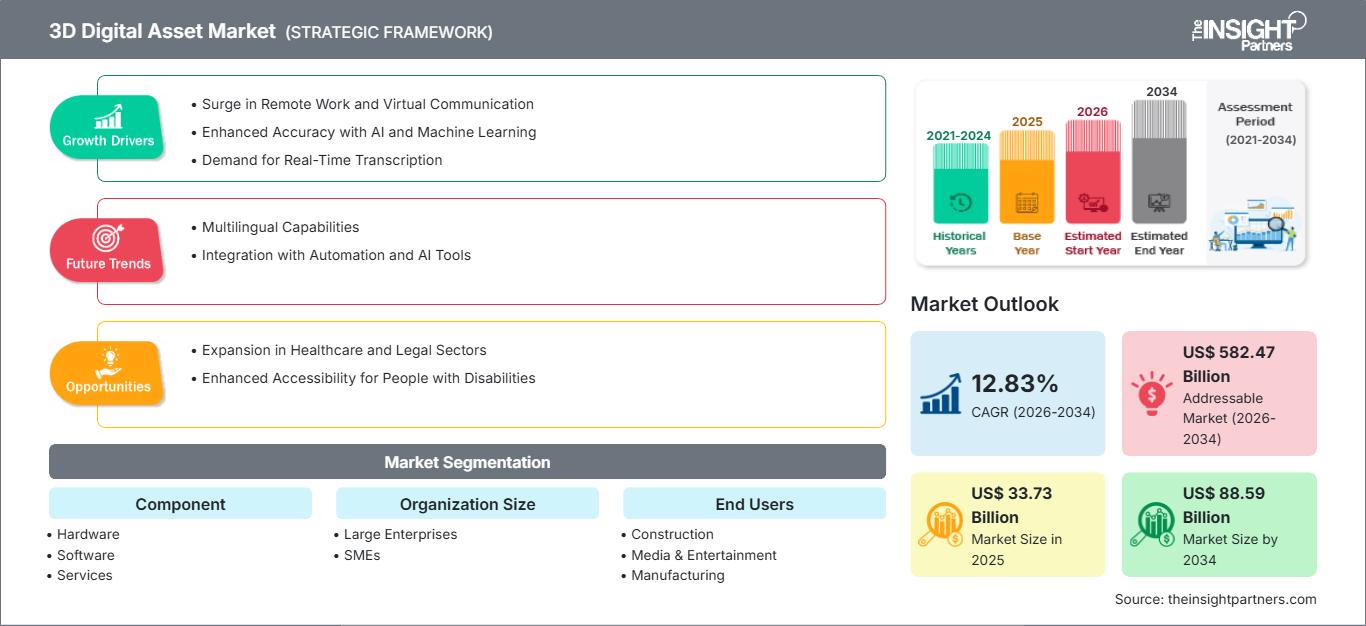
The 3D Digital Asset market was valued at US$ 33.73 billion in 2025 and is expected to reach US$ 88.59 billion by 2034; it is estimated to record a CAGR of 11.33% during 2026-2034.
3D Digital Asset Market Assessment and Insights
- North America and US: 34–38% share in 2025, CAGR 12.1–12.5%; US holds 78–82% regional share, CAGR 12.2–12.6%, led by AI creative workflows and enterprise visualization
- Europe: 23–27% 3D Digital Asset market share in 2025, CAGR 11.4–11.8%; UK, Germany, France lead industrial design, media production, and digital twin adoption
- Asia Pacific: 25–29% share in 2025, CAGR 13.8–14.2%; China, Japan, South Korea lead gaming, electronics, and immersive commerce demand
- Largest Segment: Software, CAGR 12.7–13.1%, driven by modeling, rendering, asset management, and workflow automation
- High Growth Segment: Services, CAGR 14.1–14.5%, driven by outsourcing, digitization projects, and managed 3D content pipelines
- Key companies analyzed in detail: Adobe Inc., Autodesk, Inc., echo3D, Inc., Meta Platforms, Inc., Microsoft Corporation, NVIDIA Corporation, Siemens AG, Sony Group Corporation, Trimble Inc., Unity Software Inc.
Source: The Insight Partners' analysis based on proprietary research, government publications, company annual reports, investor presentations, industry databases, and expert interviews.
The 3D digital asset market report has shifted from manually built 3D files for gaming and animation toward reusable, interoperable assets used in product visualization, construction coordination, digital twins, and simulation. Production dynamics now combine scanning, procedural modeling, real-time rendering, cloud collaboration, and AI-assisted generation. Enterprises are building governed asset libraries to reduce duplication, accelerate content localization, and connect creative output with engineering, commerce, and operations workflows.
Future demand will be shaped by industrial AI, spatial computing, digital product passports, immersive retail, and wider use of digital twins in manufacturing, construction, and healthcare. Emerging economies will adopt cloud-based content platforms as broadband, mobile commerce, and creator ecosystems mature. Regulatory attention to data ownership, provenance, and brand safety will strengthen demand for secure repositories, rights management, and standardized 3D asset governance.
3D Digital Asset Market Report Scope
| Report Attribute | Details |
|---|---|
| Market size in 2025 | US$ 33.73 Billion |
| Market Size by 2034 | US$ 88.59 Billion |
| Global CAGR (2026 - 2034) | 11.33% |
| Historical Data | 2021-2024 |
| Forecast period | 2026-2034 |
3D Digital Asset Market Analysis
Demand is expanding because enterprises need reusable 3D content for product launches, virtual showrooms, construction planning, training, gaming, and simulation. The 3D Digital Asset Market size reflects the convergence of design software, game engines, cloud storage, rendering, photogrammetry, and AI-assisted creation. Value chain participants include hardware capture vendors, software platforms, managed service providers, asset marketplaces, systems integrators, and end users converting physical products into persistent digital representations.
The competitive landscape is shaped by integrated software ecosystems and platform partnerships. Adobe Inc. and NVIDIA Corporation are advancing cloud-native 3D digital twin workflows, while Autodesk, Inc., Siemens AG, Trimble Inc., and Unity Software Inc. support design, construction, manufacturing, and immersive visualization. Meta Platforms, Inc., Microsoft Corporation, Sony Group Corporation, and echo3D, Inc. strengthen demand through spatial experiences, cloud infrastructure, gaming, and asset delivery.
● REPORT CUSTOMIZATION
Tailor This Report To Align With Your Specific Business Requirements
This report can be customized to align precisely with your business objectives, scope, and target markets. Customization options include tailored segmentation, geography, competitive analysis, and strategic insights to support informed decision-making.
Customize This Report →WHAT YOU CAN ADJUST
- ● Segmentations
- ● Geography
- ● Competitive Analysis
- ● Language Preferences
3D Digital Asset Market: Strategic Insights
Regional Insights
North America 3D Digital Asset Market
North America accounts for 34–38% of global demand in 2025 and is projected to grow at a CAGR of 12.1–12.5% during 2026–2034. Demand is supported by cloud-based creative production, gaming engines, digital commerce, industrial simulation, and enterprise 3D repositories. U.S. technology platforms, media studios, and manufacturing companies are converting product, facility, and training content into reusable assets.
The 3D Digital Assets Market share in the region is strengthened by robust software ecosystems, artificial intelligence infrastructure, and the use of digital twins in construction, retail, and manufacturing. Canada's contribution comes from companies operating in gaming, visual effects, educational technology, and simulations. The market's growth is further enabled by interoperability projects that make 3D assets transferable across different platforms.
U.S. 3D Digital Asset Market
The U.S. 3D digital asset market represents 78–82% of North American demand in 2025 and is forecast to grow at a CAGR of 12.2–12.6%. Adoption is concentrated in media production, gaming, retail visualization, architecture, aerospace, automotive, healthcare training, and industrial simulation. Enterprises increasingly use governed 3D libraries to shorten campaign production cycles and improve product configuration accuracy.
Adobe Inc., Autodesk, Inc., Microsoft Corporation, NVIDIA Corporation, Meta Platforms, Inc., and Unity Software Inc. maintain strong U.S. market presence through software, cloud, AI, rendering, and immersive experience platforms. The 3D Digital Asset Market growth in the country is also shaped by spatial commerce pilots, digital twin deployments, and enterprise demand for brand-safe, reusable product representations.
Europe 3D Digital Asset Market
Europe 3D digital asset market holds 23–27% share in 2025 and is expected to grow at a CAGR of 11.4–11.8%. The UK leads in gaming, film production, virtual production, and e-commerce visualization. Demand is supported by creative studios, retail brands, architecture firms, and training providers using 3D assets for interactive customer engagement and immersive learning.
In terms of industries, Germany is at the forefront because manufacturing, automotive, and engineering companies use 3D content for digital twins, factory design, and product lifecycle management. Some examples include Siemens AG, among others, that promote this technology by connecting visual content to operations, engineering, and simulation data.
France, Italy, and Spain have their contributions in luxury retail, cultural heritage digitization, architecture, media, and manufacturing design. European market development is constrained by data regulation and procurement cycles. However, the 3D Digital Asset Market trends are favorable towards the security of asset repositories, standardization, and sustainability through reduced reliance on physical modeling.
APAC 3D Digital Asset Market
Asia Pacific 3D Digital Asset market accounts for 25–29% share in 2025 and is forecast to expand at a CAGR of 13.8–14.2%. China leads regional demand through gaming, e-commerce, manufacturing visualization, smart city models, and domestic digital content platforms.
Japan and South Korea favor the application of digital assets in games, animations, electronics, car visualization, and XR technologies. India has started making headway using 3D outsourcing services, construction technology, creator solutions, and corporate training. Australia has started using digital twins in infrastructure and mining.
Support for digital infrastructure, cloud computing, and manufacturing makes the regional 3D Digital Assets market more appealing. The highest growth occurs where digital content creation, automation, and mobile commerce collide.
Middle East & Africa 3D Digital Asset Market
The Middle East & Africa market is projected to grow at a CAGR of 10.2–10.6%. Saudi Arabia leads demand through smart city projects, tourism visualization, construction planning, and immersive retail linked to economic diversification programs.
Adoption is driven by efforts in real estate, aviation, retail, and digital government in the UAE. In South Africa, it is helped by media production, education, mining simulation, and enterprise training. The other MEA countries remain project-driven and rely on foreign software capabilities.
Energy infrastructure, logistics, and large-scale construction projects facilitate the adoption process. Nevertheless, lack of native 3D capabilities and fragmented procurement continue to restrict demand in smaller projects.
Segmentation Analysis
Component
The component segment is expected to grow at a CAGR of 12.9–13.3% during 2026–2034. Software remains the largest revenue contributor because modeling, rendering, animation, asset management, and collaboration platforms are central to every 3D workflow. Hardware supports capture and visualization, while services accelerate digitization, customization, integration, and managed content production for enterprises lacking specialist internal teams.
- Hardware: Demand centers on 3D scanners, motion capture systems, workstations, XR devices, and visualization equipment that capture physical reality and support high-fidelity review of digital environments.
- Software: This sub-segment leads adoption through modeling, rendering, animation, asset libraries, version control, cloud collaboration, and AI tools that reduce manual production effort.
- Services: Services are strategically important for asset conversion, photogrammetry, digital twin implementation, integration, quality assurance, and outsourced production of scalable enterprise 3D libraries.
Organization Size
The organization size segment is projected to grow at a CAGR of 12.4–12.8% during 2026–2034. Large enterprises lead spending because they manage complex product portfolios, global campaigns, engineering workflows, and multi-market content requirements. SMEs are expanding adoption through subscription software, cloud rendering, asset marketplaces, and service partners that reduce upfront cost and technical barriers.
- Large Enterprises: Adoption is driven by brand governance, digital twin programs, omnichannel commerce, simulation, and global reuse of approved assets across design, marketing, and operations teams.
- SMEs: Demand is supported by lower-cost creative tools, cloud platforms, freelance ecosystems, and marketplaces that make professional 3D asset creation accessible without heavy infrastructure investment.
End Users
The end users segment is expected to grow at a CAGR of 13.2–13.6% during 2026–2034. Media and entertainment remain foundational, but construction, manufacturing, healthcare, and retail are becoming high-value enterprise users. Adoption is driven by digital twins, product configurators, immersive training, virtual production, surgical simulation, and 3D commerce experiences that require consistent, reusable assets.
- Construction: Demand is linked to BIM visualization, clash detection, site planning, and stakeholder communication, where 3D assets improve design coordination and reduce rework risk.
- Media & Entertainment: This sub-segment relies on characters, environments, props, motion capture, and visual effects assets for games, films, virtual production, and immersive storytelling.
- Manufacturing: Adoption is growing for digital twins, product configuration, factory simulation, training, and lifecycle visualization that connect engineering data with operational decision-making.
- Healthcare: Demand is emerging in surgical planning, medical training, anatomy visualization, device design, and patient education where accurate 3D models improve comprehension and simulation realism.
- Retail & Ecommerce: Brands use 3D assets for product visualization, virtual try-ons, configurators, and immersive storefronts that improve engagement and reduce dependence on physical photography.
Opportunity Snapshot
| End Users | Revenue Contribution | Trend Tag | Adoption Stage |
| Construction | Medium | BIM Twins | Scaling |
| Media & Entertainment | High | Virtual Production | Mature |
| Manufacturing | High | Factory Twins | Scaling |
| Healthcare | Low | Surgical Simulation | Emerging |
| Retail & Ecommerce | Medium | Spatial Commerce | Scaling |
3D Digital Asset Market Growth Drivers and Impact Analysis
Enterprise Shift Toward Reusable 3D Content Libraries
Instead of single-use 3D creations, businesses are now employing managed asset libraries that can be reused across their product webpages, marketing campaigns, training programs, simulations, design reviews, and partner portals. It helps increase the ROI on content investments by using a single validated asset across multiple channels and languages. Its benefits are more pronounced in the retail, automotive, manufacturing, and consumer electronics industries, which offer different versions of their products. Brand risks are minimized by ensuring that geometries, materials, and metadata are approved. As companies scale their asset repositories, demand for software platforms, storage, rights management, conversion services, and quality assurance workflows rises.
AI-Assisted Creation and Real-Time Rendering Adoption
AI-assisted modeling, texturing, scene composition, and asset tagging are helping to overcome production bottlenecks that previously hampered 3D content creation. Real-time renderers enable immediate visualization of alterations and collaboration across various departments from creative, engineering, and business perspectives. This driver helps to broaden the addressable market by including not only specialized artists but also marketing, design, and training groups in the content process. At the same time, it affects suppliers' economic models due to clients' need for faster delivery, cloud collaboration, and automated variation creation. The result is increased demand for integrated software, GPUs, workflow orchestration, and service providers capable of validating AI-assisted output.
Industrial Digital Twins and Spatial Commerce Expansion
With digital twins and spatial commerce, 3D assets go beyond visualizations that are created through the creative process and become part of the actual operating infrastructure. They enable manufacturers to plan equipment layouts, test their processes, and train personnel, and help retailers configure products to create an interactive shopping experience. Construction companies use visualizations to communicate and collaborate on projects, eliminating ambiguity in the design process. This is important from a market standpoint because operational use cases need accuracy, metadata, interoperability, and lifecycle management rather than mere visualizations. This expands spending into integration, asset governance, cloud deployment, and analytics, strengthening the 3D Digital Asset Market analysis for enterprise technology budgets.
3D Digital Asset Market Future Trends
Open Interoperability Across 3D Pipelines
In the future, 3D workflow solutions will be designed to be highly interoperable so that the assets can be easily transferred from one solution to another, whether this means transferring assets between modeling solutions, game engines, product lifecycle management systems, commerce platforms, or digital twin platforms, without having to perform any expensive rework. Scene description formats, metadata standards, and connector technology ecosystems will become key buying factors for enterprises. The preference will go towards vendors who offer portability, versioning, rights management, and conversion capabilities.
Generative 3D Workflows with Human Validation
The generative design process for 3D will speed up the development of concepts, the creation of background assets, the materialization of variations, and the creation of prototype scenes; however, enterprise-scale implementation of these processes will still rely on human verification. The buyers will need to verify the accuracy of the generated results, protect their intellectual property, ensure brand compliance, and prepare assets for use in commercial, training, and engineering settings. This shift in trends will lead to increased demand for mixed workflows combining fast AI-based generation with professional validation.
3D Digital Asset Market Opportunities
Managed 3D Asset Operations for Global Brands
Global brand companies require an operating model that enables the creation, storage, updating, localization, and distribution of thousands of 3D assets for their products. It provides scope to offer managed services in which vendors can integrate functions such as scanning, modeling, metadata, quality control, rights management, and platform integration. They can differentiate themselves through repeatable production workflows and quantifiable cost savings. The 3D digital asset market forecast opportunity is attractive because asset libraries require continuous maintenance as products, materials, packaging, and regulatory claims change. Long-term service contracts can therefore complement software subscriptions and hardware capture sales.
Verticalized Digital Twin Content for Industry Workflows
This is why vertical digital twin content has strong investment prospects: users in the manufacturing, construction, healthcare, and retail industries have specific needs for varying degrees of realism, metadata, simulation behavior, and connectivity. Content providers can create templates and workflow connectors suited to factory floor design, facility life-cycle management, medical training, or product customization. The vertical orientation helps minimize complexity and adds value for the customers. Moreover, it adds value beyond general modeling software by linking 3D objects to the processes unique to each industry.
Recent Developments
- April 2025: echo3D, a leading 3D digital asset management platform, announced the official launch of its upgraded 3D Digital Asset Manager, designed to transform e-commerce by streamlining the creation, storage, and management of 3D models. This all-in-one 3D asset management system empowers brands of all sizes — from emerging startups to global enterprises — to scale immersive content across channels quickly, affordably, and without requiring deep technical expertise.
- May 2026: Vayo Technology officially launched the Vayo DFM V8 – 3D Evolving DFM (Design for Manufacturing or Design for Manufacturability), designed to break the limits of traditional reviews. It provides electronics manufacturers with a 3D-capable, continuously evolving, and collaborative digital manufacturing brain, turning every lesson from design, production, and after-sales into reusable digital assets for manufacturing process digitalization
- June 2026: Tripo Studio, an AI-powered 3D content creation platform, announced continued growth in the use of artificial intelligence tools for 3D asset generation as businesses seek faster and more efficient ways to create digital content, product prototypes, and immersive experiences.
Frequently Asked Questions

- Comprehensive Market Sizing and Forecast Analysis
- Detailed Segmentation Analysis
- In-Depth Market Dynamics Assessment
- Regional and Country-Level Insights
- Competitive Landscape and Company Benchmarking
- Strategic Business Intelligence
Recent Reports
Testimonials

The Insight Partners' SCADA System Market report is comprehensive, with valuable insights on current trends and future forecasts. The team was highly professional, responsive, and supportive throughout. We are very satisfied and highly recommend their services.
RAN KEDEM Partner, Reali Technologies LTDs
I requested a report on a very specific software market and the team produced the report in a few days. The information was very relevant and well presented. I then requested some changes and additions to the report. The team was again very responsive and I got the final report in less than a week.
JEAN-HERVE JENN Chairman, Future Analytica
We worked with The Insight Partners for an important market study and forecast. They gave us clear insights into opportunities and risks, which helped shape our plans. Their research was easy to use and based on solid data. It helped us make smart, confident decisions. We highly recommend them.
PIYUSH NAGPAL Sr. Vice President, High Beam Global
The Insight Partners delivered insightful, well-structured market research with strong domain expertise. Their team was professional and responsive throughout. The user-friendly website made accessing industry reports seamless. We highly recommend them for reliable, high-quality research services
YUKIHIKO ADACHI CEO, Deep Blue, LLC.
This is the first time I have purchased a market report from The Insight Partners.While I was unsure at first, I visited their web site and felt more comfortable to take the risk and purchase a market report.I am completely satisfied with the quality of the report and customer service. I had several questions and comments with the initial report, but after a couple of dialogs over email with their analyst I believe I have a report that I can use as input to our strategic planning process.Thank you so much for taking the extra time and making this a positive experience.I will definitely recommend your service to others and you will be my first call when we need further market data.
JOHN SUZUKI President and Chief Executive Officer, Board Director, BK Technologies
I wish to appreciate your support and the professionalism you displayed in the course of attending to my request for information regarding to infectious disease IVD market in Nigeria. I appreciate your patience, your guidance, and the fact that you were willing to offer a discount, which eventually made it possible for us to close a deal. I look forward to engaging The Insight Partners in the future, all thanks to the impression you have created in me as a result of this first encounter.
DR CHIJIOKE ONYIA MANAGING DIRECTOR, PineCrest Healthcare Ltd.Reason to Buy
- Informed Decision-Making
- Understanding Market Dynamics
- Competitive Analysis
- Identifying Emerging Markets
- Customer Insights
- Market Forecasts
- Risk Mitigation
- Boosting Operational Efficiency
- Strategic Planning
- Investment Justification
- Tracking Industry Innovations
- Aligning with Regulatory Trends





 Get Free Sample for