
3D Machine Vision Market Trends, Size & Forecast by 2034
Coverage: By Offering (Hardware, Software); Product (PC Based, Smart Camera Based); Application (Quality Assurance and Inspection, Positioning and Guidance, Measurement, Identification); End-Use (Automotive, Pharmaceuticals and Chemicals, Electronics and Semiconductor, Pulp and Paper, Printing and Labeling, Others) , and Geography (North America, Europe, Asia Pacific, and South and Central America)
- Status : Data Released
- Report Code : TIPRE00012036
- Category : Electronics and Semiconductor
- No. of Pages : 150
- Available Report Formats :


- Last update date : July 16, 2026


2025 Market Size
US$ 886.23 Mn
Base year value
2034 Forecast
US$ 2,694.64 Mn
Projected by 2034
CAGR 2026-2034
13.15 %
Growth rate
Addressable Market
US$ 15,557.20 Mn
(2026-2034)
The 3D Machine Vision Market was valued at US$ 886.23 Million in 2025 and is projected to reach US$ 2,694.64 Million by 2034, expanding at a CAGR of 13.15% during 2026–2034. The market reflects accelerating industrial adoption of three-dimensional imaging, depth sensing, and automated visual interpretation across manufacturing environments where precision inspection, robotic guidance, measurement reliability, and traceability are increasingly critical.
North America 3D machine vision market is expected to register a CAGR range of 12.4–12.8% during 2026–2034, supported by automated quality assurance in automotive, semiconductor, and pharmaceutical production. The region benefits from high robot density, factory digitalization, and strong adoption of AI-enabled inspection platforms. These factors are expanding the 3D Machine Vision scope as manufacturers replace manual inspection with scalable, repeatable, and data-rich vision systems.
3D Machine Vision Market Assessment and Insights
- North America: The region accounts for an estimated 27–31% share of the 3D machine vision market in 2025 and is projected to grow at a CAGR of 12.4–12.8% during 2026–2034. Strong industrial automation adoption, advanced manufacturing infrastructure, and increasing deployment of machine vision systems across key industries support regional growth.
- US: The US represents approximately 78–82% of the North American 3D machine vision market size in 2025 and is expected to expand at a CAGR of 12.6–13.0% during 2026–2034. Rising investments in factory automation, AI-enabled inspection systems, and smart manufacturing initiatives continue to drive market expansion.
- Europe: Europe holds an estimated 22–26% 3D machine vision market share in 2025 and is anticipated to grow at a CAGR of 11.8–12.2% during 2026–2034. Germany, the UK, and France lead regional demand through continued modernization in automotive manufacturing, robotics, and electronics production.
- Asia Pacific: Asia Pacific represents approximately 36–40% of the 3D machine vision market in 2025 and is projected to register a CAGR of 14.1–14.5% during 2026–2034. China, Japan, South Korea, and other emerging manufacturing hubs support growth through expanding electronics production, electric vehicle manufacturing, and industrial automation.
- Largest Segment: Hardware represents the largest 3D machine vision market segment, with a projected CAGR of 12.7–13.1% during 2026–2034, driven by increasing demand for cameras, sensors, optics, processors, and embedded machine vision inspection infrastructure.
- High Growth Segment: Software is expected to witness the fastest growth, registering a CAGR of 14.4–14.8% during 2026–2034, supported by the adoption of AI-powered analytics, low-code vision development platforms, and predictive quality management workflows.
- Key companies analyzed in detail: Basler AG, Cognex Corporation, ISRA VISION GmbH, KEYENCE CORPORATION, LMI Technologies Inc., MVTec Software GmbH, NI Corporation, SICK AG, STEMMER IMAGING AG, and Tordivel AS.
Source: The Insight Partners' analysis based on proprietary research, government publications, company annual reports, investor presentations, industry databases, and expert interviews.
The 3D Machine Vision Market report has evolved from standalone dimensional inspection equipment into integrated factory intelligence infrastructure. Early adoption centered on coordinate measurement and fixed-line quality checks, while current deployments combine smart cameras, structured light, laser triangulation, and AI software. Production teams now use 3D data to reduce scrap, validate assemblies, guide robots, and generate traceable quality records across automotive, electronics, pharmaceutical, labeling, and semiconductor lines.
Over the forecast period, investment is expected to move toward Asia Pacific capacity additions, North American reshoring programs, and European smart-factory upgrades. Public incentives for semiconductor fabrication, battery manufacturing, and pharmaceutical compliance will support demand for high-accuracy inspection. The 3D Machine Vision trends are also shifting toward edge processing, simulation-led deployment, and software-defined inspection, enabling faster commissioning and broader adoption among mid-sized manufacturers.
3D Machine Vision Market Report Scope
| Report Attribute | Details |
|---|---|
| Market size in 2025 | US$ 886.23 Million |
| Market Size by 2034 | US$ 2,694.64 Million |
| Global CAGR (2026 - 2034) | 13.15% |
| Historical Data | 2021-2024 |
| Forecast period | 2026-2034 |
3D Machine Vision Market Analysis
Demand is being shaped by manufacturers’ need to inspect complex surfaces, verify tolerances, and automate repetitive visual decisions. Automotive battery modules, semiconductor packages, medical devices, and printed labels require depth-aware inspection that conventional two-dimensional systems cannot consistently provide. The 3D Machine Vision size is therefore linked to broader capital spending on robotics, industrial IoT, and digital quality systems.
The value chain includes sensor suppliers, illumination providers, optics manufacturers, embedded computing vendors, software developers, system integrators, and automation contractors. Hardware availability remains influenced by image sensor supply, precision optics capacity, and industrial processor lead times. Software differentiation is rising because AI tools, calibration libraries, and application templates reduce engineering effort and improve deployment repeatability.
The competitive landscape is characterized by vendors with domain expertise and a diversified component portfolio. Application-specific products that are offered by companies include AI Inspection Solutions from Cognex Corporation, Camera Ecosystems from Basler AG, Integrated Measurement System from KEYENCE CORPORATION, and 3D Smart Sensors from LMI Technologies Inc. Specific needs related to inspection, software, and integration are provided by ISRA VISION GmbH, SICK AG, MVTec Software GmbH, NI Corporation, STEMMER IMAGING AG, and Tordivel AS.
Current investment trends are moving towards a scalable inspection architecture that connects machine vision and manufacturing execution systems. In the future, vendors will be positioned based on integration features, lifecycle services, AI training efficiency, and application-specific libraries. It is expected that vendors with faster validation and high accuracy will have a higher 3D Machine Vision market share.
● REPORT CUSTOMIZATION
Tailor This Report To Align With Your Specific Business Requirements
This report can be customized to align precisely with your business objectives, scope, and target markets. Customization options include tailored segmentation, geography, competitive analysis, and strategic insights to support informed decision-making.
Customize This Report →WHAT YOU CAN ADJUST
- ● Segmentations
- ● Geography
- ● Competitive Analysis
- ● Language Preferences
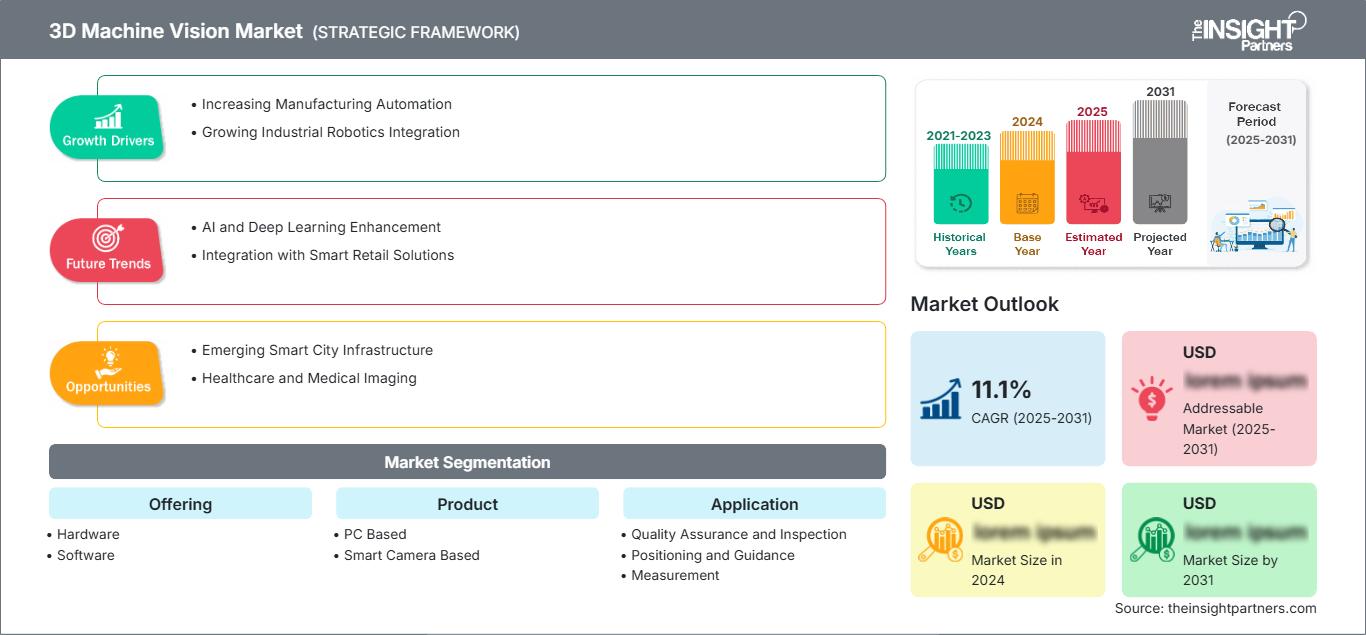
3D Machine Vision Market: Strategic Insights
Regional Insights
North America 3D Machine Vision Market
North America accounted for 27–31% of the global 3D machine vision market revenue in 2025 and is projected to grow at a CAGR of 12.4–12.8% during 2026–2034. Demand is reinforced by investments in advanced manufacturing, high automation intensity, and inspection requirements across electric vehicles, medical devices, and semiconductor assembly. Automotive plants are using depth imaging for weld verification, adhesive bead inspection, and battery tray alignment.
Another driver of the regional deployment of 3D machine vision is the presence of reshoring programs and compliance-based production systems. FDA-approved pharmaceutical packaging, aerospace tracing, and electronic miniaturization create the need for verification of visual information. Smart camera companies in America and Canada are integrating smart cameras with robotic systems to increase manufacturing output without increasing inspection staffing.
U.S. 3D Machine Vision Market
The US 3D machine vision market represented 78–82% of North American demand in 2025 and is expected to expand at a CAGR of 12.6–13.0% through 2034. Growth is driven by automotive, electronics, aerospace, and pharmaceutical applications that require validated inspection data. Domestic semiconductor incentives and EV battery investments are increasing installations of dimensional measurement, surface defect detection, and robot guidance systems.
The Cognex Corporation, NI Corporation, and LMI Technologies Inc. remain highly relevant in their regions through software, sensor technology, and automation alliances. The latest trend in applications is AI-assisted inspection stations that can be configured for different product versions. The US-based manufacturers focus on solutions that minimize erroneous rejects, speed up validation procedures, and link inspection data to factory analytics systems.
Europe 3D Machine Vision Market
Europe held 22–26% of the 3D machine vision market share in 2025 and is forecast to grow at a CAGR of 11.8–12.2%. Germany leads regional adoption because automotive, machinery, and electronics producers require robust inspection for precision assembly. Strong industrial automation clusters support the adoption of 3D cameras, line-scan systems, and software-enabled defect classification in production environments.
The UK 3D machine vision market is driven by applications in the pharmaceutical packaging, aerospace, and advanced engineering industries. Manufacturers employ 3D vision for traceability, serial identification, and dimensional inspection wherever auditability is necessary. Programs for digital manufacturing and cooperation between universities and industries drive the use of 3D vision in flexible production cells, particularly in high-mix production and medtech component manufacturing.
There is a consistent growth of 3D vision systems in France, Italy, and Spain across automotive components, packaging, printing, and industrial machinery. In France, there is a benefit from aerospace production and the pharmaceutical industry; in Italy, there is an advantage from the machine-building and labeling machinery industries; and in Spain, there is an edge from automotive assembly.
APAC 3D Machine Vision Market
Asia Pacific accounted for 36–40% of the 3D machine vision market share in 2025 and is projected to grow at a CAGR of 14.1–14.5%. China leads regional demand through electronics assembly, EV batteries, and industrial robotics.
Japan and South Korea have developed systems in areas such as semiconductor packaging, display inspection, and precision component manufacturing. India has been growing with automation solutions for the automotive, pharmaceutical, and electronics industries.
Australia's contribution comes from sectors such as mining equipment, food packaging, and specialized manufacturing. Government policies on electronics, batteries, and smart factories are helping to develop the 3D Machine Vision market analysis at the regional level.
Middle East & Africa 3D Machine Vision Market
The Middle East & Africa 3D machine vision market is expected to grow at a CAGR of 10.6–11.0%. Saudi Arabia leads regional adoption through industrial diversification, petrochemical automation, and packaging modernization.
The UAE has been investing in the development of advanced manufacturing, automated logistics, and smart industrial zones, creating a need for inspection and identification systems. This technology has found its applications in automotive and packaging lines in South Africa.
The rest of MEA demand remains selective but is improving as energy, infrastructure, and consumer goods producers upgrade quality assurance and reduce their dependence on manual inspection.
Segmentation Analysis
Offering
The offering segment is expected to grow at a CAGR of 13.0–13.4% during 2026–2034. Hardware remains essential because industrial users require cameras, sensors, optics, lighting, and processors capable of operating in variable factory conditions. Software adoption is rising faster as manufacturers seek AI classification, calibration automation, and analytics that convert inspection images into actionable production intelligence.
- Hardware: Cameras, sensors, optics, frame grabbers, controllers, and lighting remain the revenue backbone, driven by plant modernization and harsh-environment inspection requirements.
- Software: AI algorithms, calibration tools, visualization platforms, and low-code development environments are strategically important for reducing engineering time and improving inspection scalability.
Product
The product segment is projected to grow at a CAGR of 12.8–13.2%. PC based systems lead complex inspection environments requiring high processing power, multi-camera synchronization, and integration with factory software. Smart camera-based systems are gaining traction in decentralized inspection cells because they combine imaging, processing, and decision logic in compact devices.
- PC Based: Preferred for high-speed, multi-station, and data-intensive inspection tasks where advanced processors, GPUs, and centralized analytics improve accuracy and throughput.
- Smart Camera Based: Used in compact automation cells, retrofit projects, and distributed inspection points where simplified installation and embedded decision-making reduce system complexity.
Application
The application segment is expected to grow at a CAGR of 13.2–13.6%. Quality assurance and inspection account for broad deployment because manufacturers need automated defect detection, dimensional validation, and audit-ready data. Positioning, measurement, and identification applications are expanding as robots, packaging lines, and semiconductor equipment require reliable spatial awareness.
- Quality Assurance and Inspection: Dominant application, supported by zero-defect production goals, traceability mandates, and the need to inspect complex geometries at production speed.
- Positioning and Guidance: Critical for robotic picking, assembly alignment, and automated material handling where depth perception improves repeatability and reduces fixture dependency.
- Measurement: Used for dimensional verification, surface profiling, gap analysis, and tolerance checks across automotive, semiconductor, packaging, and precision engineering workflows.
- Identification: Supports code reading, object recognition, label verification, and part authentication where three-dimensional data improves reliability on curved or irregular surfaces.
End-Use
The end-use segment is projected to grow at a CAGR of 13.1–13.5%. Automotive, electronics, and semiconductor manufacturers drive adoption through high-volume inspection needs and tight tolerance requirements. Pharmaceuticals, chemicals, pulp and paper, printing, and labeling users increasingly deploy 3D systems for compliance, process stability, and packaging quality assurance.
- Automotive: Strong demand comes from EV batteries, powertrain parts, body-in-white inspection, weld checks, and robotic assembly where dimensional consistency directly affects safety and yield.
- Pharmaceuticals and Chemicals: Adoption is driven by packaging verification, fill-level inspection, serialization support, and regulated production environments requiring documented visual quality control.
- Electronics and Semiconductor: High strategic importance due to miniaturized components, wafer-level packaging, connector inspection, and defect detection requirements in high-value manufacturing lines.
- Pulp and Paper: Used for surface inspection, roll quality checks, thickness measurement, and defect classification, where automated monitoring supports throughput and material efficiency.
- Printing and Labeling: Demand is supported by code verification, label placement, embossing checks, and packaging traceability across consumer goods, healthcare, and logistics operations.
Opportunity Snapshot
| Application | Revenue Contribution | Trend Tag | Adoption Stage |
| Quality Assurance and Inspection | High | Defect Analytics | Mature |
| Positioning and Guidance | Medium | Robot Guidance | Scaling |
| Measurement | High | Inline Metrology | Scaling |
| Identification | Medium | Traceability Codes | Mature |
3D Machine Vision Market Growth Drivers and Impact Analysis
Automation-Led Quality Control in High-Value Manufacturing
Manufacturers use 3D inspection technologies because manual inspection cannot reliably measure complex geometries, reflective surfaces, or microdefects on production lines. Battery modules for the automotive industry, semiconductor wafers, pharmaceutical bottles, and precision machining products require dimensioning to ensure yield and compliance. The effect can be seen in decreased rework, faster root cause analysis, and improved process control. In an era of small batch sizes and greater product variety, flexible vision systems help factories maintain quality through automation.
Rising Robotics Integration Across Factory Operations
Depth sensing is now essential for industrial robots when dealing with variable parts, identifying part position, and adjusting movement without fixturing. 3D machine vision makes picking, glue dispensing, palletizing, alignment in assembling, and bin picking by automated machines more accurate by providing automation systems with spatial awareness. In this way, the applications benefiting from 3D machine vision extend beyond quality assurance to include motion control and process automation. 3D machine vision is particularly relevant in cases where labor is scarce, safety concerns are present, and high throughput is required. Vision-guided robots also enable flexibility in manufacturing.
Electronics and Semiconductor Precision Requirements
In electronics manufacturing and semiconductor production, inspection systems must be able to detect problems such as warpage, coplanarity issues, soldering issues, die placement issues, and package surface problems. With chips, connectors, displays, and modules getting smaller and more expensive, any problem can result in significant yield losses. 3D vision enables the measurement of these items and the classification of defects before faulty pieces proceed through expensive process steps. This driver directly supports capital spending on high-resolution sensors, metrology software, and automated inspection stations across Asia Pacific, North America, and Europe.
3D Machine Vision Market Future Trends
Edge AI Vision Systems for Real-Time Inspection
Future deployments will increasingly process 3D image data at the edge rather than sending every frame to centralized systems. Embedded AI processors, optimized neural networks, and smart camera architectures will allow defect classification, dimensional decisions, and robot guidance within milliseconds. These 3D machine vision market trends will reduce latency, lower bandwidth requirements, and simplify deployment in distributed factory environments. It will also help manufacturers protect sensitive production data while improving responsiveness. Vendors that combine reliable hardware with explainable AI tools will be better positioned for regulated and mission-critical applications.
Simulation-Led Commissioning and Digital Twin Integration
Simulation tools and digital twins will change how manufacturing companies design inspection stations. Engineering staff will be able to virtually try out camera location, lighting angles, cycle times, and defect visibility without having to buy any equipment or reconfigure production lines. It will help avoid commissioning risks and increase validation efficiency and ROI from automation investment. The use of simulation tools is particularly timely in semiconductor fabs, electric-vehicle battery facilities, and mixed-product packaging operations.
3D Machine Vision Market Opportunities
AI Software Platforms for Mid-Market Manufacturers
Medium-sized manufacturers do not usually have large vision engineering departments, which opens the door to software solutions that simplify training, calibration, and installation. This can be done by offering vendors low-code programming, built-in templates for inspection, and analysis services on a subscription basis. It will work well in the packaging, labeling, medical components, and electronics subcontracting segments, where manufacturing processes frequently change. Commercial success and 3D Machine Vision Market forecast outcomes will depend on usability, integration with existing controllers, measurable reductions in false rejects, and retention.
Localized Integration Services in Emerging Manufacturing Hubs
Emerging manufacturing hubs in India, Southeast Asia, the Middle East, and Eastern Europe need local integration capabilities to translate vision technology into working production systems. There is an opportunity for partnerships among camera suppliers, automation distributors, robotics integrators, and factory software providers. Local engineering support can shorten deployment time, address application-specific constraints, and improve after-sales service. Companies that build regional training centers and certified integrator networks can access customers who are modernizing production but require practical implementation support rather than component-only sales.
Recent Developments
- March 2026: Basler AG and Orbbec announced a technology partnership for industrial 3D vision in logistics and factory automation, with the Basler Stereo mini 3D camera presented for applications such as AMRs, AGVs, navigation, obstacle detection, and environment mapping.
- May 2026: Cognex Corporation launched the Insight 3900 Vision System, an embedded AI vision platform powered by Qualcomm technology for high-speed inspection at the edge. The system targets packaging, automotive, electronics, and consumer goods applications where manufacturers need advanced inspection without sacrificing line speed.
- May 2026: MVTec Software GmbH will once again exhibit at Automate this year. From June 22 to 25, the machine vision software provider will be showcasing at booth #618 how modern technologies are transforming industrial automation.
Frequently Asked Questions

- Comprehensive Market Sizing and Forecast Analysis
- Detailed Segmentation Analysis
- In-Depth Market Dynamics Assessment
- Regional and Country-Level Insights
- Competitive Landscape and Company Benchmarking
- Strategic Business Intelligence
Recent Reports
Testimonials

The Insight Partners' SCADA System Market report is comprehensive, with valuable insights on current trends and future forecasts. The team was highly professional, responsive, and supportive throughout. We are very satisfied and highly recommend their services.
RAN KEDEM Partner, Reali Technologies LTDs
I requested a report on a very specific software market and the team produced the report in a few days. The information was very relevant and well presented. I then requested some changes and additions to the report. The team was again very responsive and I got the final report in less than a week.
JEAN-HERVE JENN Chairman, Future Analytica
We worked with The Insight Partners for an important market study and forecast. They gave us clear insights into opportunities and risks, which helped shape our plans. Their research was easy to use and based on solid data. It helped us make smart, confident decisions. We highly recommend them.
PIYUSH NAGPAL Sr. Vice President, High Beam Global
The Insight Partners delivered insightful, well-structured market research with strong domain expertise. Their team was professional and responsive throughout. The user-friendly website made accessing industry reports seamless. We highly recommend them for reliable, high-quality research services
YUKIHIKO ADACHI CEO, Deep Blue, LLC.
This is the first time I have purchased a market report from The Insight Partners.While I was unsure at first, I visited their web site and felt more comfortable to take the risk and purchase a market report.I am completely satisfied with the quality of the report and customer service. I had several questions and comments with the initial report, but after a couple of dialogs over email with their analyst I believe I have a report that I can use as input to our strategic planning process.Thank you so much for taking the extra time and making this a positive experience.I will definitely recommend your service to others and you will be my first call when we need further market data.
JOHN SUZUKI President and Chief Executive Officer, Board Director, BK Technologies
I wish to appreciate your support and the professionalism you displayed in the course of attending to my request for information regarding to infectious disease IVD market in Nigeria. I appreciate your patience, your guidance, and the fact that you were willing to offer a discount, which eventually made it possible for us to close a deal. I look forward to engaging The Insight Partners in the future, all thanks to the impression you have created in me as a result of this first encounter.
DR CHIJIOKE ONYIA MANAGING DIRECTOR, PineCrest Healthcare Ltd.Reason to Buy
- Informed Decision-Making
- Understanding Market Dynamics
- Competitive Analysis
- Identifying Emerging Markets
- Customer Insights
- Market Forecasts
- Risk Mitigation
- Boosting Operational Efficiency
- Strategic Planning
- Investment Justification
- Tracking Industry Innovations
- Aligning with Regulatory Trends





 Get Free Sample for