
4K Display Market Growth, Demand & Size by 2034
Coverage: By Product (Monitor, TV, Smartphone, Others); Refresh Rate (30 Hz, 60 Hz, 90 Hz, 120 Hz and above); Display Technology (Active OLED (AMOLED), Passive OLED (POLED), LCD) , and Geography (North America, Europe, Asia Pacific, and South and Central America)
- Status : Data Released
- Report Code : TIPRE00003028
- Category : Electronics and Semiconductor
- No. of Pages : 150
- Available Report Formats :


- Last update date : July 15, 2026


2025 Market Size
US$ 259.91 Bn
Base year value
2034 Forecast
US$ 1,262.15 Bn
Projected by 2034
CAGR 2026-2034
19.19 %
Growth rate
Addressable Market
US$ 6,222.62 Bn
(2026-2034)
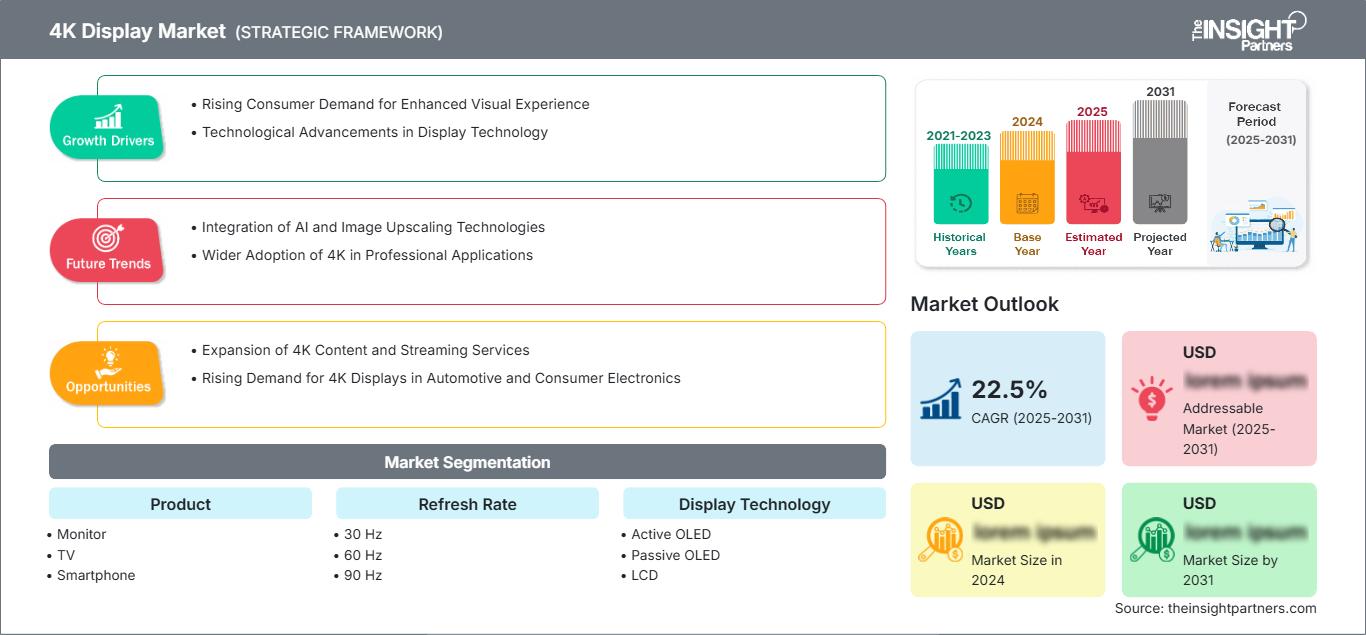
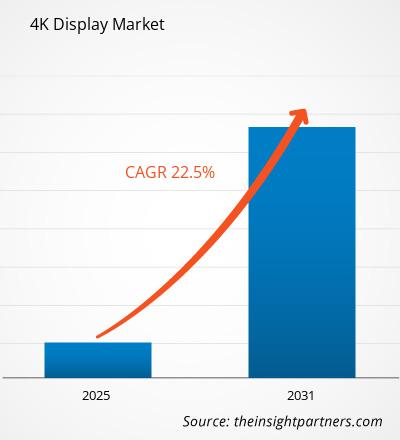
The 4K Display Market reached US$ 259.91 Billion in 2025 and is projected to reach US$ 1,262.15 Billion by 2034; it is expected to register a CAGR of 19.19% during 2026–2034. The market is expanding as ultra-high-definition screens become standard across televisions, monitors, smartphones, professional visualization, retail media, healthcare imaging, gaming, education, and enterprise collaboration environments.
North America is expected to grow at a CAGR of 18%–20% through 2034, supported by premium television replacement, enterprise collaboration upgrades, and demand for high-refresh gaming monitors. Streaming, sports broadcasting, hybrid work, and medical visualization continue to pull 4K displays into mainstream procurement. Strong broadband infrastructure and early OLED adoption keep the region strategically important for margin-led growth.
4K Display Market Assessment and Insights
- North America held a 27%–30% share in 2025 and is projected to grow at 18%–20% CAGR between 2026–2034, driven by premium TV upgrades, hybrid work displays, 4K gaming, and commercial signage.
- The U.S. represented 76%–80% of North America in 2025 and is expected to grow at 18%–19% CAGR, supported by strong household electronics spending and enterprise monitor refreshes.
- Europe accounted for 20%–23% share in 2025 and should expand at 17%–19% CAGR between 2026–2034, led by Germany, the UK, France, Italy, and Spain across TV, retail, and industrial visualization demand.
- Asia Pacific held a 41%–45% share in 2025 and is forecast to grow at 20%–22% CAGR, with China, Japan, South Korea, and India benefiting from panel manufacturing scale and electronics localization.
- Largest Segment: TV captured 62%–66% market share in 2025 and is likely to grow at 17%–19% CAGR, sustained by large-screen replacement and 4K streaming adoption.
- High Growth Segment: Monitor held 18%–22% market share in 2025 and is projected to grow at 21%–24% CAGR, led by gaming, creators, engineering, and hybrid work.
- Key companies analyzed in detail: AUO Corporation, BOE Technology Group Co., Ltd., Haier Smart Home Co., Ltd., Hisense Group Co., Ltd., LG Display Co., Ltd., Panasonic Holdings Corporation, Sharp Corporation, Sony Group Corporation, Samsung Electronics Co., Ltd., Toshiba Corporation, TCL Technology Group Corporation, Innolux Corporation.
Source: The Insight Partners' analysis based on proprietary research, government publications, company annual reports, investor presentations, industry databases, and expert interviews.
The 4K Display Market has evolved from a premium television upgrade cycle into a broader visual infrastructure category. Manufacturing gains in LCD, active OLED, passive OLED, and mini-LED backlighting have reduced panel cost while improving brightness, motion handling, and color performance. Production dynamics are now shaped by large-scale Asian fabrication capacity, disciplined utilization, and rising demand for larger screen area rather than only higher unit shipments.
Future expansion will be led by emerging geographies, premium monitor upgrades, enterprise collaboration rooms, and smart-city visualization projects. Policy support for electronics manufacturing in India, China, and South Korea is strengthening supply resilience, while energy-efficiency rules in Europe are pushing low-power backlighting. The 4K Display Market scope is widening as healthcare, education, retail, sports venues, and control rooms require sharper, reliable visual systems.
4K Display Market Report Scope
| Report Attribute | Details |
|---|---|
| Market size in 2025 | US$ 259.91 Billion |
| Market Size by 2034 | US$ 1,262.15 Billion |
| Global CAGR (2026 - 2034) | 19.19% |
| Historical Data | 2021-2024 |
| Forecast period | 2026-2034 |
4K Display Market Analysis
Demand for the market is anchored in the shift from Full HD to ultra-high-definition viewing across consumer and commercial settings. Streaming platforms, console gaming, premium smartphones, professional design software, and telehealth workflows require sharper text, cleaner motion, and richer color depth. The 4K Display Market size is also supported by larger screen preferences, as 50-inch and above televisions and multi-monitor workstations make resolution gaps more visible.
The ecosystem includes glass substrates, TFT backplanes, OLED materials, driver ICs, timing controllers, backlights, video processors, brands, retailers, integrators, and content platforms. Supply dynamics depend on panel yield, display technology mix, utilization rates, and logistics costs. The market analysis shows that LCD remains essential for scale, while OLED and mini-LED increasingly define premium pricing, margin protection, and product differentiation.
Competition is concentrated among panel specialists and device brands with manufacturing scale, channel reach, and technology depth. Samsung Electronics Co., Ltd., LG Display Co., Ltd., Sony Group Corporation, BOE Technology Group Co., Ltd., AUO Corporation, Hisense Group Co., Ltd., Sharp Corporation, Panasonic Holdings Corporation, TCL Technology Group Corporation, and Innolux Corporation compete through OLED contrast, LCD affordability, high refresh rates, and AI picture processing.
Investment trends favor 8.6-generation OLED lines, QD-OLED monitor capacity, larger LCD motherglass efficiency, and software-defined image engines. Strategic positioning is shifting toward use-case specialization: active OLED for premium TVs, monitors, and smartphones; passive OLED for selected compact devices; and LCD for volume products. Companies that connect panels with gaming, content, enterprise, and retail ecosystems are better placed to capture the strongest market growth.
● REPORT CUSTOMIZATION
Tailor This Report To Align With Your Specific Business Requirements
This report can be customized to align precisely with your business objectives, scope, and target markets. Customization options include tailored segmentation, geography, competitive analysis, and strategic insights to support informed decision-making.
Customize This Report →WHAT YOU CAN ADJUST
- ● Segmentations
- ● Geography
- ● Competitive Analysis
- ● Language Preferences
4K Display Market: Strategic Insights
Regional Insights
North America 4K Display Market
North America held a 27%–30% share in 2025 and is expected to grow at 18%–20% CAGR. The region benefits from premium home entertainment demand, high 4K streaming penetration, large-screen replacement cycles, and console gaming. Enterprise demand is also rising as offices, universities, hospitals, and control rooms replace lower-resolution displays with sharper collaboration and visualization systems.
Structural drivers include strong broadband access, widespread sports and movie streaming, and early adoption of OLED and mini-LED products. The 4K Display Market share in North America remains value-heavy because buyers prioritize brightness, color accuracy, latency, and smart connectivity. Commercial buyers increasingly evaluate total lifecycle cost, serviceability, and software integration rather than only unit price.
U.S. 4K Display Market
The U.S. represented 76%–80% of North America in 2025 and is forecast to grow at 18%–19% CAGR. Demand is concentrated in premium televisions, gaming monitors, creator workstations, telehealth displays, and corporate conferencing systems. Strong retail availability and consumer willingness to pay for advanced picture quality keep product cycles faster than in many mature markets.
Samsung Electronics Co., Ltd., Sony Group Corporation, LG Display Co., Ltd., Panasonic Holdings Corporation, Sharp Corporation, and BOE Technology Group Co., Ltd. maintain visible product and component presence through televisions, monitors, and professional display channels. Application trends include 4K sports viewing, streaming bundles, esports, digital classrooms, radiology review, and retail media networks that require sharper large-format messaging.
Europe 4K Display Market
Europe accounted for 20%–23% share in 2025 and is projected to grow at 17%–19% CAGR. The UK market benefits from strong streaming adoption, gaming culture, and hybrid workplace modernization. Retailers emphasize smaller premium televisions, high-performance monitors, and energy-efficient models, while education and public-sector procurement support interactive 4K classroom and civic communication displays.
Germany is the leading European country because industrial visualization, automotive design, engineering workstations, and premium household electronics create multiple demand channels. The country’s focus on energy efficiency favors advanced backlighting, efficient OLED panels, and durable commercial screens. Professional users often prioritize color accuracy, reliability, and ergonomic workstation integration over lowest-cost display procurement.
France, Italy, and Spain add demand through television replacement, hospitality displays, retail digitization, digital signage, and public cultural venues. France shows steady adoption in media production and education; Italy is supported by hospitality and design applications; Spain benefits from tourism, entertainment venues, and retail media. Across Europe, efficiency labeling and repairability expectations influence supplier positioning.
APAC 4K Display Market
APAC held a 41%–45% share in 2025 and is expected to grow at 20%–22% CAGR. China is the leading country because of LCD capacity, OLED investment, local brands, and broad smart TV adoption. Japan and South Korea strengthen the region through OLED, gaming, semiconductor-display integration, and premium television ecosystems.
India and Australia are expanding through disposable income growth, online video consumption, local assembly, digital education, and enterprise modernization. Government incentives for electronics manufacturing support localization, while broadcasters and streaming platforms raise expectations for UHD content. APAC’s manufacturing scale keeps the 4K Display Market trends closely tied to capacity discipline, component costs, and panel yield.
BOE Technology Group Co., Ltd., Samsung Electronics Co., Ltd., LG Display Co., Ltd., AUO Corporation, Sharp Corporation, Panasonic Holdings Corporation, Hisense Group Co., Ltd., TCL Technology Group Corporation, and Innolux Corporation shape regional supply. Industrial demand includes control rooms, factory dashboards, medical review, broadcast studios, and retail visualization.
Middle East & Africa 4K Display Market
The Middle East & Africa market is projected to grow at 15%–17% CAGR, with the UAE leading premium retail, hospitality, airports, museums, and smart-city displays. Saudi Arabia is accelerating demand through tourism, entertainment, giga-projects, and public infrastructure, where high-brightness 4K screens improve wayfinding, operations, and visitor engagement.
Energy and infrastructure spending support large-format visualization across control rooms, transport hubs, malls, sports venues, and corporate campuses. Buyers often prioritize brightness, heat tolerance, warranty coverage, and remote content management. These requirements create opportunities for vendors that package panels with installation, software, maintenance, and long-term support.
South Africa and the rest of MEA show gradual adoption across education, retail, broadcasting, security monitoring, and premium home electronics. Price sensitivity favors LCD-based 4K televisions and monitors, while urbanization and broadband expansion widen the installed base. Over time, commercial modernization will reduce dependence on household replacement cycles.
Segmentation Analysis
Product
The Product segment is expected to grow at 18%–20% CAGR during 2026–2034. Televisions remain the commercial anchor, while monitors and smartphones extend 4K Display Market growth into work, gaming, and mobile media. Product demand is shaped by screen size, power efficiency, refresh rate, panel technology, smart operating systems, and the ability to support HDR, upscaling, and low-latency applications.
- Monitor: 4K monitors are scaling across gaming, creator, engineering, finance, and hybrid work users who require sharper text, accurate color, larger workspaces, and smoother motion.
- TV: Televisions remain the largest product category as households replace Full HD screens with larger smart 4K models for streaming, sports, cinema, and console gaming.
- Smartphone: Smartphones use 4K-capable displays mainly in premium models where video capture, gaming, image review, and immersive media justify higher pixel density and power optimization.
Refresh Rate
The Refresh Rate segment is projected to grow at 19%–21% CAGR during 2026–2034. Standard 60 Hz panels preserve affordability and compatibility, while 120 Hz and above models are becoming strategic for gaming, sports, premium TVs, and professional visualization. Higher refresh rates increasingly influence purchasing decisions because smooth motion, low latency, and eye comfort create measurable user value.
- 30 Hz: 30 Hz displays serve basic video playback, signage, and cost-sensitive applications where affordability, availability, and acceptable image clarity matter more than fluid motion.
- 60 Hz: 60 Hz remains the mainstream benchmark for televisions, office monitors, and everyday devices by balancing motion quality, content compatibility, energy use, and broad affordability.
- 90 Hz: 90 Hz panels bridge standard and performance categories, improving scrolling, interface response, and mobile gaming while managing power draw better than ultra-high refresh options.
- 120 Hz and above: 120 Hz and above panels target gaming, sports viewing, premium televisions, and professional workflows where low latency and fluid motion enhance visual performance.
Display Technology
The Display Technology segment is expected to grow at 18%–21% CAGR during 2026–2034. LCD supplies most volume because manufacturing is mature and cost-efficient, while active OLED strengthens premium positioning through contrast, speed, and form factor advantages. Passive OLED remains limited but useful in selected compact applications where simplified structure and efficient visual output matter.
- Active OLED: Active OLED delivers deep contrast, fast response, thin form factors, and premium picture quality for high-end televisions, smartphones, gaming monitors, and professional displays.
- Passive OLED: Passive OLED supports selected compact and specialized devices where lower complexity, thin design, and efficient output are more important than large-format scalability.
- LCD: LCD dominates volume demand because of mature manufacturing, competitive pricing, high brightness options, and suitability for televisions, monitors, signage, and cost-sensitive deployments.
Opportunity Snapshot
| Product | Revenue Contribution | Trend Tag | Adoption Stage |
| Monitor | Medium | Gaming Precision | Scaling |
| TV | High | Home Cinema | Mature |
| Smartphone | Medium | Mobile Video | Scaling |
| Others | Low | Digital Signage | Emerging |
4K Display Market Growth Drivers and Impact Analysis
Ultra-High-Definition Viewing Becomes the Default Upgrade
The key factor driving growth is the transition of 4K from a premium position to mass-market sales across televisions, monitors, and select smartphones. End users demand higher-quality images for entertainment, sports, social media videos, games, and video chats, whereas corporations seek clarity in dashboards and collaboration displays. With lower cost of LCD panels, increased availability of OLEDs, and improved content distribution, the entry barriers are being lowered. The real-world impact is a larger replacement pool for brands, retailers, panel suppliers, chip providers, and integrators, especially where 4K improves detail, comfort, and perceived product quality.
Gaming and Sports Raise Display Performance Requirements
Gaming consoles, graphics cards, cloud gaming, eSports, and sports broadcasting are driving demand for 4K displays with greater fluidity and faster refresh rates. Latency, adaptive sync, HDR brightness, response times, and color gamut become the criteria for comparison instead of just resolution. The influence on the market is transformed into high-end TV segments above 120 Hz, OLED gaming monitors, and creator displays. Brands that offer products with good picture quality and fluid motion can sustain their profit margins and customer loyalty.
Commercial Digitization Expands Visualization Demand
As companies adopt the technology, commercial adoption is becoming a reliable factor, with offices, educational institutions, hospitals, airports, manufacturing facilities, hotels, and retailers using better displays for communication, surveillance, training, guidance, and client relations. In such cases, a 4K display enhances visibility and detail clarity, especially on large displays viewed from short distances. Some of the considerations during procurement include light output and connectivity. This shifts revenue from one-time consumer purchases toward integrated solutions, service contracts, and multi-location deployments that stabilize demand through infrastructure refresh cycles, reinforcing the positive 4K Display Market Forecast.
4K Display Market Future Trends
OLED and Mini-LED Define Premium Differentiation
OLED and mini-LED technologies will shape the premium layer of the 4K Display Market as buyers look beyond resolution toward contrast, brightness, response time, and viewing comfort. OLED delivers self-emissive blacks and fast response times, whereas mini-LED enables local dimming and brightening on large LCD panels. Future competition will be based on better yields, burn-in prevention, energy savings, and faster refresh rates. Brands that can quantify their benefits in terms of color accuracy, HDR performance, and eye strain prevention will stand out from other picture-quality claims.
AI Image Processing Moves Into the Display Engine
AI-powered image processing is emerging as a major trend, as there continues to be significant variability across videos in resolution, bitrate, frame rate, and lighting levels. The advanced processors help upscale low-resolution images, minimize noise, boost contrast, improve motion, and adjust settings based on the scene type. Over the forecast period, software will increasingly influence display value, especially in smart televisions, gaming monitors, and professional screens. Vendors that connect AI processing with operating systems, content platforms, power management, and device ecosystems can build stronger differentiation and reduce reliance on hardware specifications alone, reflecting evolving 4K Display Market Trends.
4K Display Market Opportunities
High-Refresh 4K Monitors for Gaming and Workflows
High-refresh 4K displays present a compelling business proposition due to the overlap in demand among gamers, creators, engineers, stock market analysts, designers, and hybrid workers. Users want combination of clearer text, larger workspace, true colors, USB-C connectivity, and smooth motion from a single display. The most promising market potential lies in the 27- to 45-inch segment, where high-end displays remain relevant at the desk level. The focus of vendors must be on 120Hz and higher refresh rate, OLED and high-end LCD technology, factory calibration, ergonomic stands, and ecosystem tie-ups.
Commercial Signage and Visualization Infrastructure
Opportunities in commercial signage and visualization solutions lie in their durability because purchases in retail stores, transport facilities, healthcare facilities, hospitality establishments, schools, and control centers typically entail bulk purchases. Whereas consumer purchasing only entails the purchase of hardware, commercial signage and visualization projects encompass installation, content management, warranty coverage, calibration, maintenance, and service income. Some of the most durable opportunities include areas where resolution enhances decision making or engagement. Vendors that package hardware with software and lifecycle support can reduce exposure to commoditized television pricing, supporting the long-term 4K Display Market Size.
Recent Developments
- May 2026: Samsung Display has successfully developed the first QD-OLED monitors to combine 4K resolution with a 360Hz refresh rate. The company will unveil the panel for the first time at COMPUTEX 2026 in June. Samsung Display announced that it will showcase its 31.5-inch 4K 360Hz QD-OLED for monitors to customers and media at COMPUTEX 2026, taking place in Taipei from June 2 to 5. While monitors supporting either 4K resolution or refresh rates of 360Hz and above have been introduced previously, Samsung Display is the first to deliver both specifications simultaneously.
- December 2025: LG Display, the world’s leading innovator of display technologies, announced today that it will debut the world’s first 27-inch 4K OLED panel for monitors featuring an RGB stripe structure and a 240Hz refresh rate at CES 2026, the world’s largest IT and consumer electronics exhibition.
- March 2025: Sony announced it has developed a new display system incorporating an independent drive RGB LED with a high-density LED backlight that can individually control three primary colors - R (red), G (green), and B (blue) [RGB], and suitable for large screens. This panel allows each RGB color to emit light independently, resulting in high color purity and the ability to reproduce images with a vibrant, wide color gamut. Additionally, the display system is equipped with Sony's proprietary advanced backlight control technology, designed to maximize the panel's characteristics.
Frequently Asked Questions

- Comprehensive Market Sizing and Forecast Analysis
- Detailed Segmentation Analysis
- In-Depth Market Dynamics Assessment
- Regional and Country-Level Insights
- Competitive Landscape and Company Benchmarking
- Strategic Business Intelligence
Recent Reports
Testimonials

The Insight Partners' SCADA System Market report is comprehensive, with valuable insights on current trends and future forecasts. The team was highly professional, responsive, and supportive throughout. We are very satisfied and highly recommend their services.
RAN KEDEM Partner, Reali Technologies LTDs
I requested a report on a very specific software market and the team produced the report in a few days. The information was very relevant and well presented. I then requested some changes and additions to the report. The team was again very responsive and I got the final report in less than a week.
JEAN-HERVE JENN Chairman, Future Analytica
We worked with The Insight Partners for an important market study and forecast. They gave us clear insights into opportunities and risks, which helped shape our plans. Their research was easy to use and based on solid data. It helped us make smart, confident decisions. We highly recommend them.
PIYUSH NAGPAL Sr. Vice President, High Beam Global
The Insight Partners delivered insightful, well-structured market research with strong domain expertise. Their team was professional and responsive throughout. The user-friendly website made accessing industry reports seamless. We highly recommend them for reliable, high-quality research services
YUKIHIKO ADACHI CEO, Deep Blue, LLC.
This is the first time I have purchased a market report from The Insight Partners.While I was unsure at first, I visited their web site and felt more comfortable to take the risk and purchase a market report.I am completely satisfied with the quality of the report and customer service. I had several questions and comments with the initial report, but after a couple of dialogs over email with their analyst I believe I have a report that I can use as input to our strategic planning process.Thank you so much for taking the extra time and making this a positive experience.I will definitely recommend your service to others and you will be my first call when we need further market data.
JOHN SUZUKI President and Chief Executive Officer, Board Director, BK Technologies
I wish to appreciate your support and the professionalism you displayed in the course of attending to my request for information regarding to infectious disease IVD market in Nigeria. I appreciate your patience, your guidance, and the fact that you were willing to offer a discount, which eventually made it possible for us to close a deal. I look forward to engaging The Insight Partners in the future, all thanks to the impression you have created in me as a result of this first encounter.
DR CHIJIOKE ONYIA MANAGING DIRECTOR, PineCrest Healthcare Ltd.Reason to Buy
- Informed Decision-Making
- Understanding Market Dynamics
- Competitive Analysis
- Identifying Emerging Markets
- Customer Insights
- Market Forecasts
- Risk Mitigation
- Boosting Operational Efficiency
- Strategic Planning
- Investment Justification
- Tracking Industry Innovations
- Aligning with Regulatory Trends





 Get Free Sample for