
Commercial Display Market Size, Share & Demand by 2034
Coverage: by Display Type (Video Wall, Outdoor Display, Signage, Variant Display, Interactive Whiteboard (IWB), Others); Technology (OLED, LED, LCD, Quantum Dots); Application (Retail, Automotive, Healthcare, Government, IT and Telecom, BFSI, Others) , and Geography (North America, Europe, Asia Pacific, and South and Central America)
- Status : Data Released
- Report Code : TIPRE00011977
- Category : Electronics and Semiconductor
- No. of Pages : 150
- Available Report Formats :


- Last update date : August 05, 2026


2025 Market Size
US$ 63.75 Bn
Base year value
2034 Forecast
US$ 114.42 Bn
Projected by 2034
CAGR 2026-2034
6.71 %
Growth rate
Addressable Market
US$ 805.08 Bn
(2026-2034)
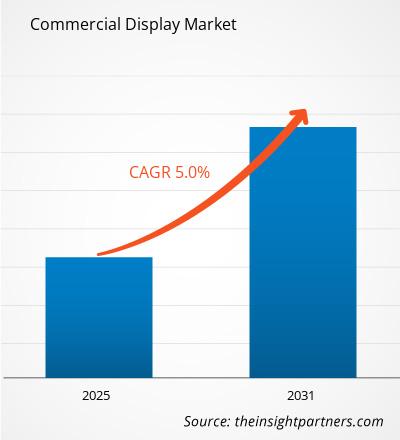
The Commercial Display Market size had a value of US$ 63.75 Billion in 2025 and is expected to be worth US$ 114.42 Billion by 2034, growing at a CAGR of 6.71% during 2026-2034. The market drivers include changes in communication mode from passive to networking through visuals in sectors such as retail, automotive, healthcare, government, IT and telecommunication, and BFSI.
For North America, market growth will be driven by digital outdoor advertisements, store modernizations, transportation stations, business collaborations, and healthcare wayfinding. It is forecast to have a CAGR between 6.1-6.7% from 2026-2034, where premium installations will be characterized by bright LED panels, interactive boards, content management, and energy-efficient signages.
Commercial Display Market Assessment and Insights
- North America: The region is estimated to hold 32–36% share in 2025 and grow at a CAGR of 6.1–6.7% during 2026–2034, supported by retail media networks, smart campuses, airports, and enterprise communication upgrades.
- US: The country represents 76–80% of North America in 2025 and is projected to grow at a CAGR of 6.2–6.8% during 2026–2034.
- Europe: Europe accounts for 23–27% share in 2025 and is expected to grow at a CAGR of 5.7–6.3% during 2026–2034, led by Germany, the UK, France, Italy, and Spain.
- Asia Pacific: Asia Pacific represents 28–32% share in 2025 and is forecast to grow at a CAGR of 7.4–8.0% during 2026–2034, with China, Japan, South Korea, India, and Australia anchoring demand.
- Largest Segment: Signage holds 39–43% market share in 2025 and is expected to grow at a CAGR of 6.4–7.0% during 2026–2034.
- High Growth Segment: Interactive Whiteboard holds 11–15% market share in 2025 and is expected to grow at a CAGR of 8.0–8.6% during 2026–2034.
- Key companies analyzed in detail: CDW Corporation; Cisco Systems, Inc.; Dell Technologies Inc.; Koninklijke Philips N.V.; LG Display Co., Ltd.; Sharp NEC Display Solutions, Ltd.; Panasonic Holdings Corporation; Samsung Electronics Co., Ltd.; Sharp Corporation; Sony Corporation.
Source: The Insight Partners' analysis based on proprietary research, government publications, company annual reports, investor presentations, industry databases, and expert interviews.
The Commercial Display Market is evolving from stand-alone screens into managed visual ecosystems consisting of hardware, operating systems, software, sensors, and analysis tools. Today's production dynamics include a shift towards bigger sizes, smaller pixel pitch LEDs, higher contrast OLEDs, low cost efficiency LCDs, quantum dot color, and reduced power usage. The manufacturers are balancing availability of panels with customization for the ability to manage the displays centrally, interact with the audiences, monitor remotely, and ensure uniform performance.
Future demand will be defined by upcoming urban routes, investments into smart transportation, retail media monetization, connected learning environments, and advances in healthcare communication. The increase in deployment volume will be registered in Asia Pacific region, while North America and Europe will drive adoption of high-end and managed services models. Efficiency in power usage, accessibility requirements, and digitalization of public infrastructure guarantee long-lasting demand for professional-grade commercial displays.
Commercial Display Market Report Scope
| Report Attribute | Details |
|---|---|
| Market size in 2025 | US$ 63.75 Billion |
| Market Size by 2034 | US$ 114.42 Billion |
| Global CAGR (2026 - 2034) | 6.71% |
| Historical Data | 2021-2024 |
| Forecast period | 2026-2034 |
Commercial Display Market Analysis
The market growth is attributed to digital marketing, omnichannel retailing, collaboration services, healthcare communications, and smart cities initiatives. The value chain consists of panel manufacturers, module manufacturers, software providers, AV installation, distributors, managed services providers, content producers, and end-users. The demand becomes robust when businesses need a centrally controlled messaging system, better visual resolution, live updating capabilities, and screens capable of handling extended operating hours.
The supply side favors businesses that can integrate the display hardware with content control capabilities, security, remote monitoring, and full lifecycle management services. According to the Commercial Display Market research, buyers consider the following factors before finalizing their purchasing decision - brightness, resolution, bezel width, operating life, system-on-a-chip ability, warranty coverage, and compatibility with collaboration/signage platforms.
The competitive environment includes Samsung Electronics Co., Ltd., LG Display Co., Ltd., Sharp NEC Display Solutions, Ltd., Sony Corporation, Panasonic Holdings Corporation, Koninklijke Philips N.V., Dell Technologies Inc., Cisco Systems, Inc., CDW Corporation, and Sharp Corporation. Competition between the firms occurs via innovation in panels, distribution channels, enterprise systems integration, software partnerships, and product offerings for signage, video wall, collaboration, and specialty displays.
Trends in investment include AI-driven content scheduling, low power signage, transparent displays, fine pitch LED, cloud device management, and bundled service agreements. The strategy hinges on whether the suppliers emphasize visual impact, scalable enterprise implementations, or efficient signage networks. Integrators and distributors will continue to exert influence since the decision to use certain display solutions is becoming a function of installation, network configuration, cybersecurity, and workflow considerations.
● REPORT CUSTOMIZATION
Tailor This Report To Align With Your Specific Business Requirements
This report can be customized to align precisely with your business objectives, scope, and target markets. Customization options include tailored segmentation, geography, competitive analysis, and strategic insights to support informed decision-making.
Customize This Report →WHAT YOU CAN ADJUST
- ● Segmentations
- ● Geography
- ● Competitive Analysis
- ● Language Preferences
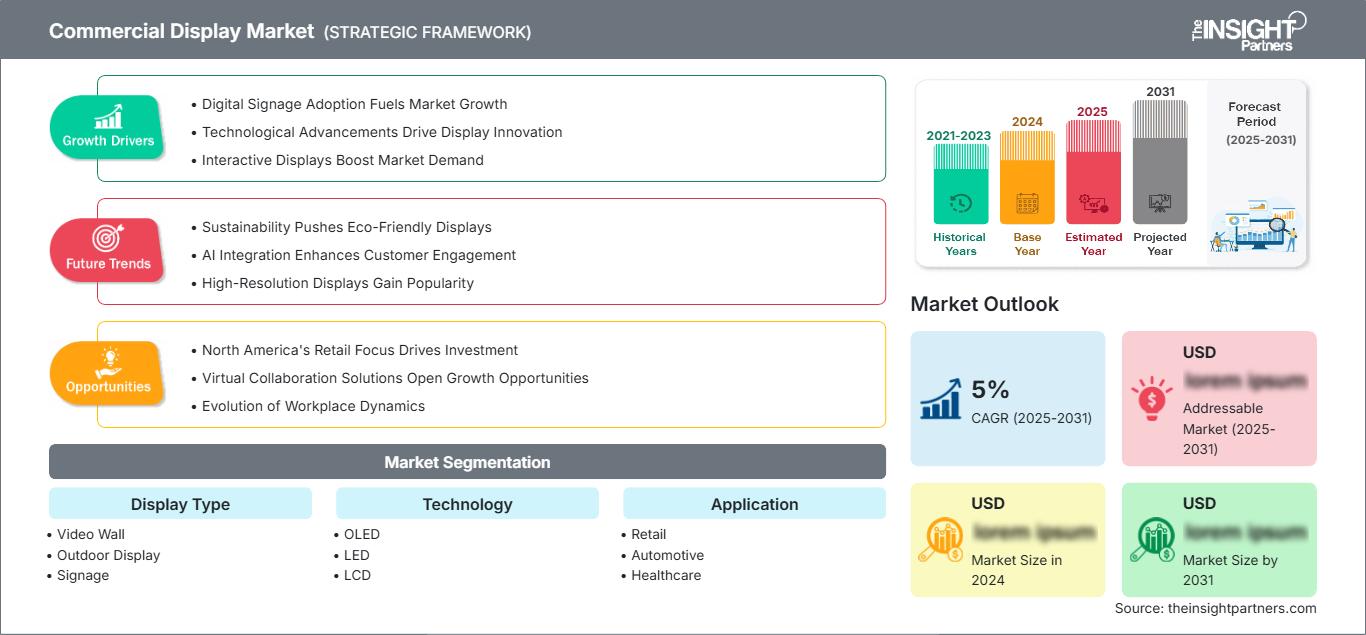
Commercial Display Market: Strategic Insights
Regional Insights
North America Commercial Display Market
North America holds 32–36% share in 2025 and is projected to expand at a CAGR of 6.1–6.7% during 2026–2034. Commercial Display Market share is supported by retail media networks, airport modernization, quick-service restaurant menu boards, healthcare navigation, corporate hybrid workspaces, and financial branch transformation.
Structural demand comes from large-format digital signage, video walls, interactive classrooms, and command centers. Buyers favor high uptime, security-certified device management, and service partners that can support multi-site networks. Samsung Electronics Co., Ltd., Sony Corporation, Dell Technologies Inc., Cisco Systems, Inc., CDW Corporation, and Sharp NEC Display Solutions, Ltd. maintain strong regional relevance.
U.S. Commercial Display Market
The US accounts for 76–80% of North American demand in 2025 and is expected to grow at a CAGR of 6.2–6.8% during 2026–2034. Application demand is strongest in retail, government facilities, healthcare systems, IT and telecom offices, BFSI branches, and automotive showrooms.
Company presence is reinforced by CDW Corporation, Dell Technologies Inc., Cisco Systems, Inc., Samsung Electronics Co., Ltd., Sony Corporation, and Sharp Corporation through enterprise procurement, Pro AV specialists, and national service channels. Retailers are adopting screens for personalized promotions, while healthcare and government buyers prioritize accessibility, reliability, and secure remote management.
Europe Commercial Display Market
Europe accounts for 23%-27% market share in 2025 and is expected to register CAGR of 5.7%-6.3% between 2026 and 2034. Germany dominates the market with industrial control rooms, automotive retail, and transport information systems. The United Kingdom makes contributions with retail media, corporate collaboration, and signage in public venues.
France, Italy, and Spain contribute demand from tourism, airports, banking, healthcare, and municipality communication projects. Europe customers value energy efficiency, serviceability, data security, and visual readability. Koninklijke Philips N.V., Sharp NEC Display Solutions, Ltd., Sony Corporation, LG Display Co., Ltd., and Panasonic Holdings Corporation serve the market via AV integrators and enterprises channels.
APAC Commercial Display Market
APAC accounts for 28–32% share in 2025 and is expected to grow at a CAGR of 7.4–8.0% during 2026–2034. China leads through retail modernization, rail networks, manufacturing campuses, and urban media assets. Japan and South Korea add premium display engineering and high-resolution adoption.
India and Australia support expansion through airports, metro systems, healthcare facilities, education technology, and financial service digitization. Regional policy support for smart cities, digital public infrastructure, and industrial modernization helps commercial displays move from discretionary advertising assets to core communication infrastructure.
Middle East & Africa Commercial Display Market
Middle East & Africa is projected to grow at a CAGR of 6.0–6.6% during 2026–2034. Saudi Arabia is the leading country, supported by airports, tourism destinations, smart city projects, and energy-linked infrastructure. The UAE adds premium retail, hospitality, and transport signage demand.
South Africa and Rest of MEA adoption is concentrated in malls, telecom outlets, banking branches, public buildings, and mining-related facilities. Demand remains project-led, but rugged outdoor displays, LED video walls, and managed signage systems benefit from infrastructure spending and the need for clear public information.
Segmentation Analysis
Display Type
The Display Type segment is projected to grow at a CAGR of 6.5–7.1% during 2026–2034. Commercial Display Market scope covers large visual systems, outdoor communication, signage networks, variant displays, and collaboration tools. Adoption depends on viewing distance, ambient light, interactivity, operating hours, content refresh frequency, and the buyer’s need for centralized or localized screen control.
- Video Wall products serve command centers, control rooms, airports, corporate lobbies, and flagship retail sites where seamless scale, high brightness, and durable operation create visual authority.
- Outdoor Display demand is driven by transit shelters, stadiums, roadside advertising, quick-service restaurants, and public information systems requiring weather resistance, sunlight readability, and remote diagnostics.
- Signage remains the largest display type because retailers, banks, hospitals, campuses, and government facilities need repeatable, networked messaging across distributed locations.
- Variant Display products support specialty formats such as stretch displays, transparent screens, and unconventional aspect ratios used in transport, luxury retail, museums, and experiential environments.
- Interactive Whiteboard adoption is rising in education, corporate training, healthcare collaboration, and hybrid work settings where touch, annotation, and video conferencing improve engagement.
Technology
The Technology segment is estimated to grow at a CAGR of 6.3–6.9% during 2026–2034. LCD continues to support cost-effective rollouts, while LED enables high-impact indoor and outdoor formats. OLED addresses premium contrast and transparency use cases, and quantum dots strengthen color performance where brightness and energy efficiency influence lifecycle value.
- OLED displays are strategically important in premium retail, hospitality, museums, and corporate spaces where contrast, thin profiles, and transparent formats support differentiated experiences.
- LED technology supports large-format visibility, modular video walls, stadium screens, outdoor advertising, and control rooms where brightness, scalability, and serviceability determine procurement.
- LCD remains essential for mainstream signage, meeting rooms, healthcare displays, and branch networks because it offers broad availability, predictable cost, and mature integration options.
- Quantum Dots improve color volume and brightness efficiency, making them relevant for premium signage, high-resolution retail displays, and applications where visual fidelity influences engagement.
Application
The Application segment is projected to grow at a CAGR of 6.6–7.2% during 2026–2034 as enterprises use screens for customer engagement, operational alerts, branding, navigation, and collaboration. Retail leads revenue contribution, while automotive showrooms, hospitals, government service centers, telecom stores, and banks increasingly connect display networks with analytics and content management.
- Retail uses displays for promotions, shelf-edge communication, digital menus, immersive storefronts, and retail media networks that convert store traffic into measurable advertising inventory.
- Automotive demand comes from showrooms, service centers, charging locations, and mobility experience zones where screens explain features, financing, diagnostics, and brand storytelling.
- Healthcare applications include wayfinding, patient communication, waiting room messaging, operating room status boards, and staff coordination where clarity and uptime support service quality.
- Government buyers deploy commercial displays for public information, security operations, transport updates, civic service counters, and emergency communication across buildings and outdoor spaces.
- IT and Telecom adoption is tied to collaboration rooms, network operations centers, customer experience stores, training facilities, and digital signage across distributed office campuses.
- BFSI uses displays in branches, wealth centers, ATMs, and operations spaces to support queue communication, product education, compliance messaging, and differentiated customer experience.
Opportunity Snapshot
| Application | Revenue Contribution | Trend Tag | Adoption Stage |
| Retail | High | Retail Media | Mature |
| Automotive | Medium | Showroom Tech | Scaling |
| Healthcare | Medium | Patient Wayfinding | Scaling |
| Government | Medium | Public Alerts | Scaling |
| IT and Telecom | Medium | Hybrid Rooms | Mature |
| BFSI | Medium | Branch Screens | Scaling |
Commercial Display Market Growth Drivers and Impact Analysis
Retail Media Networks and In-Store Digitization
The retailers are transforming their brick and mortar locations to become measurable media environments through signs, shelf screens, menu boards, and video walls that are capable of refreshing ads on-the-go. The result is enhanced justification for investments in displays because the screens allow advertising, dynamic pricing, omnichannel campaigns, and shopper navigation. It is good for the Commercial Display Market vendors when hardware works in concert with content scheduling, analytics, and services. The big chains favor standardized display families as the small retailers like plug and play solutions.
Enterprise Collaboration and Hybrid Workplace Modernization
Hybrid working has impacted the display needs of meeting rooms, training rooms, control rooms, and executive suites. The organizations have begun to look for interactive whiteboards, collaboration displays, and displays that can be integrated with video conferencing, wireless sharing, and device management systems. Market implications include replacement of existing projector and monitor technology with connected displays that accommodate remote participants and on-site participants. Cisco Systems, Inc., Dell Technologies Inc., and CDW Corporation have a strategic position due to the purchasing decision process of enterprises, which takes into account the display along with networking, collaboration, and security.
Infrastructure, Transport, and Public Communication Upgrades
Airport facilities, railway stations, bus stops, municipal buildings, hospitals, and emergency operations centers require effective communication through visual channels. Smart infrastructure investments make the display technology an indispensable source of information for the public instead of an optional advertising platform. High demand for commercial display market is driven by preference for high-brightness outdoor screens, robust LED technologies, and content networks. The practical implications can be seen in fast movement of passengers, better accessibility, less strain on employees, and increased resilience in case of emergencies.
Commercial Display Market Future Trends
AI-Assisted Content and Device Management
Commercial Display market trends in the future will revolve around AI-powered content scheduling, automatic brightness adjustments, predictive maintenance, and audience-oriented message delivery. Rather than considering display devices to be stationary end points, businesses will look to treat these devices as a connected asset where content can be adjusted based on location, time, occupancy rate, and marketing objectives. This emerging trend will benefit those display vendors who offer both display hardware and software including cloud-based dashboards, cybersecurity measures, analytics, and partnerships. This trend will also enable cost savings due to remote monitoring.
Low-Power and Alternative Display Formats
Efficiency will increasingly become a product differentiator as networks of screens become ubiquitous in stores, universities, and out-of-home installations. The technologies of low-energy consumption e-paper, energy-efficient LED lighting modules, sensors that measure ambient light levels, and better panel technologies will enable consumers to save energy while maintaining their visual impact. Also, transparent OLED and flexible displays will facilitate the creation of innovative spatial solutions in retail, museums, transportation, and hospitality.
Commercial Display Market Opportunities
Managed Signage Networks for Distributed Enterprises
Commercial Display Market Forecasts point to attractive opportunities in managed signage networks for retailers, banks, telecom stores, healthcare groups, and government service centers. Buyers need screens, media players, content platforms, installation, monitoring, and field support in one accountable model. Vendors can capture recurring revenue by offering device health dashboards, content governance, security updates, and replacement planning. The opportunity is strongest for partners that can standardize deployments across hundreds of sites while still allowing localized content and compliance controls.
Premium Visual Systems for Experience-Led Venues
Experience-led venues such as flagship stores, stadiums, airports, museums, corporate briefing centers, and luxury hospitality properties are investing in displays that define space rather than simply present information. This creates opportunities for fine-pitch LED, transparent OLED, video walls, and custom-format screens combined with content design. Suppliers should work with architects, AV consultants, and systems integrators early in project planning. Higher margins are possible when hardware is bundled with design validation, calibration, maintenance, and creative workflow support.
Recent Developments
- June 2026: Epson launched the LE-C1 Series, its first all-in-one direct-view LED (dvLED) displays powered by Chip-on-Board (COB) technology for commercial environments. Available in 135-inch and 162-inch Full HD models and a 135-inch 4K model, the new displays deliver up to 600 nits of brightness, enhanced durability, lower energy consumption, simplified installation with factory-calibrated modules, and an operating system-free design for reduced maintenance and improved reliability.
- May 2026: LG Electronics launched the LG E-Paper Display, an ultra-low-power commercial display designed for retail, hospitality, and corporate environments. The 32-inch QHD electronic ink display consumes power only when content is updated, features a slim paper-like design with a built-in 72Wh battery, supports remote management through webOS and LG SuperSign CMS, and helps businesses reduce energy consumption and reliance on printed signage.
- February 2026: Samsung Electronics launched its 85-inch Spatial Signage, a glasses-free 3D digital signage solution for commercial environments at ISE 2026. The display uses Samsung’s patented 3D Plate technology to deliver immersive 3D visuals without requiring special glasses, while integration with Samsung VXT and the new AI Studio app enables AI-powered content creation, remote management, and optimized 3D signage for retail, hospitality, corporate, and entertainment spaces.
Frequently Asked Questions

- Comprehensive Market Sizing and Forecast Analysis
- Detailed Segmentation Analysis
- In-Depth Market Dynamics Assessment
- Regional and Country-Level Insights
- Competitive Landscape and Company Benchmarking
- Strategic Business Intelligence
Recent Reports
Testimonials

The Insight Partners provided valuable market intelligence that supported our global go-to-market strategy. Their team was professional, responsive, and attentive to our feedback, providing thoughtful analysis and helpful methodological clarifications throughout the project.
Junmo Kim Chief Financial Officer (CFO), Enertech Co., Ltd.
The Insight Partners' SCADA System Market report is comprehensive, with valuable insights on current trends and future forecasts. The team was highly professional, responsive, and supportive throughout. We are very satisfied and highly recommend their services.
RAN KEDEM Partner, Reali Technologies LTDs
I requested a report on a very specific software market and the team produced the report in a few days. The information was very relevant and well presented. I then requested some changes and additions to the report. The team was again very responsive and I got the final report in less than a week.
JEAN-HERVE JENN Chairman, Future Analytica
We worked with The Insight Partners for an important market study and forecast. They gave us clear insights into opportunities and risks, which helped shape our plans. Their research was easy to use and based on solid data. It helped us make smart, confident decisions. We highly recommend them.
PIYUSH NAGPAL Sr. Vice President, High Beam Global
The Insight Partners delivered insightful, well-structured market research with strong domain expertise. Their team was professional and responsive throughout. The user-friendly website made accessing industry reports seamless. We highly recommend them for reliable, high-quality research services
YUKIHIKO ADACHI CEO, Deep Blue, LLC.
This is the first time I have purchased a market report from The Insight Partners.While I was unsure at first, I visited their web site and felt more comfortable to take the risk and purchase a market report.I am completely satisfied with the quality of the report and customer service. I had several questions and comments with the initial report, but after a couple of dialogs over email with their analyst I believe I have a report that I can use as input to our strategic planning process.Thank you so much for taking the extra time and making this a positive experience.I will definitely recommend your service to others and you will be my first call when we need further market data.
JOHN SUZUKI President and Chief Executive Officer, Board Director, BK Technologies
I wish to appreciate your support and the professionalism you displayed in the course of attending to my request for information regarding to infectious disease IVD market in Nigeria. I appreciate your patience, your guidance, and the fact that you were willing to offer a discount, which eventually made it possible for us to close a deal. I look forward to engaging The Insight Partners in the future, all thanks to the impression you have created in me as a result of this first encounter.
DR CHIJIOKE ONYIA MANAGING DIRECTOR, PineCrest Healthcare Ltd.Reason to Buy
- Informed Decision-Making
- Understanding Market Dynamics
- Competitive Analysis
- Identifying Emerging Markets
- Customer Insights
- Market Forecasts
- Risk Mitigation
- Boosting Operational Efficiency
- Strategic Planning
- Investment Justification
- Tracking Industry Innovations
- Aligning with Regulatory Trends





 Get Free Sample for