
Display Driver IC for TVs Market Size, Share & Demand by 2034
Coverage: By Type (HDTV, Full HDTV, 4K2K TV); Application (Residential, Commercial) , and Geography (North America, Europe, Asia Pacific, and South and Central America)
- Status : Data Released
- Report Code : TIPRE00018376
- Category : Electronics and Semiconductor
- No. of Pages : 150
- Available Report Formats :


- Last update date : August 06, 2026


2025 Market Size
US$ 6.55 Bn
Base year value
2034 Forecast
US$ 11.66 Bn
Projected by 2034
CAGR 2026-2034
6.63 %
Growth rate
Addressable Market
US$ 82.38 Bn
(2026-2034)
The Display Driver IC For TVs Market size was estimated at US$ 6.55 Billion in 2025 and is projected to be US$ 11.66 Billion by 2034, growing at a CAGR of 6.63% from 2026 to 2034. This growth is driven by the need for finer pixel management, reduced power loss, improved refresh stability, and image processing compatibility.
For the North America region, the Display Driver IC For TVs Market size is anticipated to grow at a CAGR between 5.5-6.3%, led by demand for advanced television replacement, sports streaming services, gaming displays, and intelligent living room experiences. Demand is supported by the adoption of ultra-high-definition broadcasts, retail bundling, and commercial display upgrades in hotels and corporate settings.
Display Driver IC for TVs Market Assessment and Insights
- North America held 18–22% share in 2025 and is growing at a CAGR range of 5.5–6.3% during 2026–2034, supported by premium TV replacement and commercial display upgrades.
- US represented 76–80% of North America in 2025 and is growing at a CAGR range of 5.6–6.4%, led by 4K replacement and gaming-oriented panels.
- Europe accounted for 16–20% share in 2025 and is advancing at a CAGR range of 5.1–5.9%, with Germany, the UK, France, Italy, and Spain leading demand.
- Asia Pacific captured 50–54% share in 2025 and is expanding at a CAGR range of 7.1–8.0%, led by China, South Korea, Japan, Taiwan, and India.
- Largest Segment 4K TV held 58–62% market share in 2025 and is growing at a CAGR range of 6.4–7.2%, supported by mainstream ultra-high-definition panel shipments.
- High Growth Segment Commercial application held 20–24% market share in 2025 and is growing at a CAGR range of 7.0–8.1%, driven by hospitality and digital signage.
- Key companies analyzed in detail: Fitipower Integrated Technology Inc., Himax Technologies, Inc., ILI Technology Corp., LG Electronics Inc., LUSEM Co., Ltd., Magnachip Semiconductor Corporation, Novatek Microelectronics Corp., Orise Technology Co., Ltd., Raydium Semiconductor Corporation, and Samsung Electronics Co., Ltd.
Source: The Insight Partners' analysis based on proprietary research, government publications, company annual reports, investor presentations, industry databases, and expert interviews.
Technological progression in the Display Driver IC For TVs market has moved from fundamental LCD source and gate drivers to advanced high-channel source drivers, integrated timing control, power management coordination, and compensation for OLED and mini LED televisions. Production trends revolve around Taiwanese fabless design, Korean panel ecosystems, Chinese television assembly, and fabrication capabilities for advanced mixed-signal technologies necessary for large-area display electronics.
Future demand trends will increase as 4K display becomes the mass market baseline and more premium devices become ready for 8K signaling, fast refresh rate and local dimming. Investments will be made in power efficiency of drivers, chip-on-film packaging, co-designing by panel makers, and robustness of supplies. Television consumption of energy will drive the need for IC designs that allow for lower panel energy consumption without lowering brightness, color uniformity or motion effects.
Display Driver IC for TVs Market Report Scope
| Report Attribute | Details |
|---|---|
| Market size in 2025 | US$ 6.55 Billion |
| Market Size by 2034 | US$ 11.66 Billion |
| Global CAGR (2026 - 2034) | 6.63% |
| Historical Data | 2021-2024 |
| Forecast period | 2026-2034 |
Display Driver IC for TVs Market Analysis
Market Drivers for Display Driver IC For TVs Market include the increase in pixel density, color gamut, and refresh rate in both residential and commercial TVs. According to Omdia, LCD TV DDIC faced challenges in terms of dual rate and triple rate driving in 2025; however, LCD TV panel shipment and 4K penetration will pick up in 2026. This ensures the volume of ICs, even as every panel design becomes increasingly efficient.
The supply chain includes panel manufacturers, fabless IC designers, wafer foundries, chip-on-film packagers, television assemblers, and OEMs branding their products. Supply considerations include the availability of mature node foundries, glass generation changes, and price cycles of panels. Therefore, the Display Driver IC For TVs Market study is connected between semiconductor design and panel economics, as driver quantity, power supply voltage, and signal timing affect the costs of televisions and their picture quality.
Competitive positioning is influenced by the tight connections between panel vendors and TV brands. Novatek Microelectronics Corp., Himax Technologies, Inc., Raydium Semiconductor Corporation, ILI Technology Corp., and Fitipower Integrated Technology Inc. compete in terms of driver efficiency, interface performance, and quick qualification. Samsung Electronics Co., Ltd., LG Electronics Inc., LUSEM Co., Ltd., Magnachip Semiconductor Corporation, and Orise Technology Co., Ltd. complement their ecosystems with capabilities in panels, semiconductors, and display supply chain.
The investment pattern highlights low power and large-area drivers, compensation for OLED luminance uniformity, and packages with thinner bezels. The competitive strength is based on co-development speed, quality reliability at large panel volume and price discipline when correcting TV inventories. Suppliers who can meet the demand of 4K volume market as well as prepare for next-generation premium panels are likely to win more in the future.
● REPORT CUSTOMIZATION
Tailor This Report To Align With Your Specific Business Requirements
This report can be customized to align precisely with your business objectives, scope, and target markets. Customization options include tailored segmentation, geography, competitive analysis, and strategic insights to support informed decision-making.
Customize This Report →WHAT YOU CAN ADJUST
- ● Segmentations
- ● Geography
- ● Competitive Analysis
- ● Language Preferences
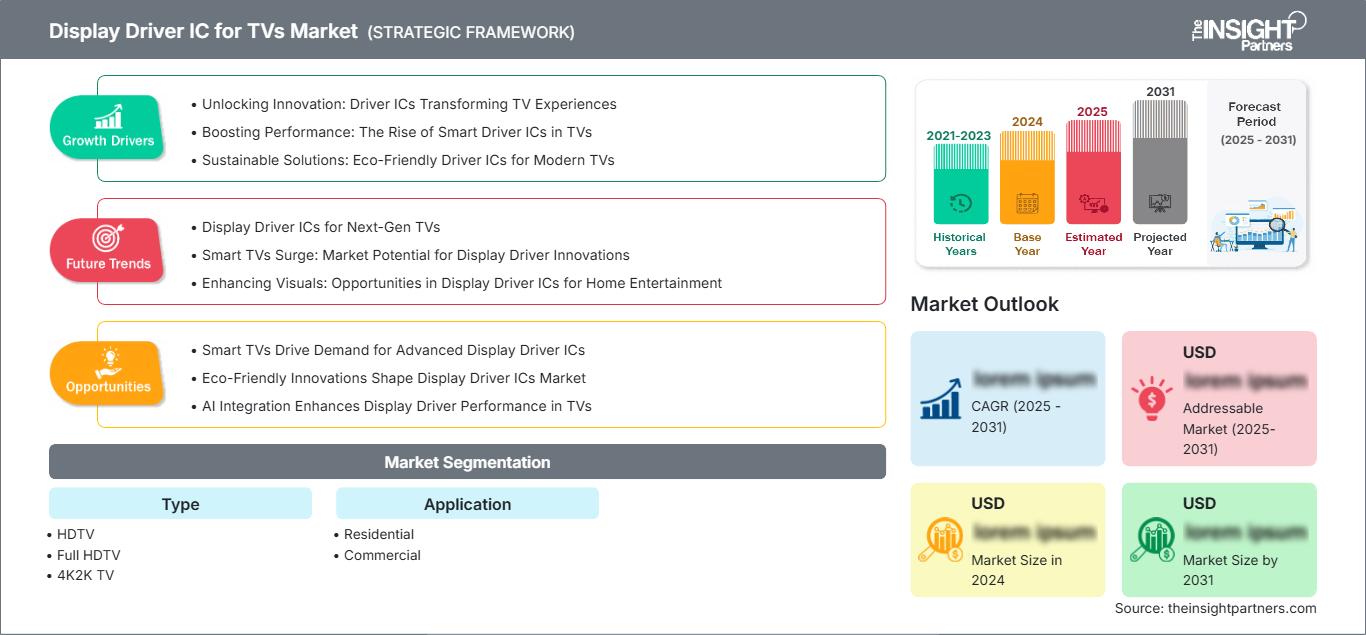
Display Driver IC for TVs Market: Strategic Insights
Regional Insights
North America Display Driver IC For TVs Market
North America held 18–22% share in 2025 and is projected to grow at a CAGR range of 5.5–6.3% through 2034. Display Driver IC For TVs Market share is supported by premium television replacement, streaming-device bundling, gaming displays, and enterprise display refreshes. Demand is less about television unit expansion and more about larger screen sizes, 4K panel standardization, and improved motion handling.
Retailers in the US and Canada influence panel mix through seasonal promotions and private-label smart TV programs. Commercial demand comes from hotels, sports bars, schools, and conference rooms replacing older displays. Mexico contributes through electronics assembly and distribution links. Growth remains below APAC, but higher average selling prices sustain strong value contribution for advanced DDICs.
U.S. Display Driver IC For TVs Market Market
The US represented 76–80% of North America in 2025 and is forecast to grow at a CAGR range of 5.6–6.4%. Samsung Electronics Co., Ltd., LG Electronics Inc., Novatek Microelectronics Corp., Himax Technologies, Inc., and Raydium Semiconductor Corporation maintain relevance through panel supply relationships, television platforms, and premium smart TV ecosystems.
Application trends center on 55-inch and larger 4K televisions, console gaming, sports streaming, and hospitality displays. Retail buyers compare refresh rate, HDR brightness, and price bands, while commercial users prioritize reliability and standardized fleet purchasing. The US market also benefits from content ecosystems that make resolution upgrades more visible to consumers.
Europe Display Driver IC For TVs Market Market
The European region has held 16–20% share in 2025 and will be growing at a CAGR of 5.1–5.9%. Germany takes leadership through high-end consumer electronics retail and replacement needs. The UK has gained advantage through the sports broadcast and streaming services. France, Italy, and Spain contribute to growth through urban households, hotel renovation projects, and eco-friendly TV buying behaviors.
The European market demand focuses on efficient performance of large-screen, discussions about repairability, and product energy regulations. The TV brands have to ensure brightness, panel cost, and power consumption, creating demand for DDICs which drive performance efficiently. Growth will be moderate but steady since premium OLED and Mini-LED TV models need accurate pixel control.
APAC Display Driver IC For TVs Market Market
APAC commanded a market share of 50-54% in 2025 and is projected to experience a CAGR of 7.1-8.0%. China is a dominant market through television assembly, panel production, and 4K smart TVs penetration. Korea, Japan, and Taiwan offer expertise in panel production, IC design, and packaging, respectively, while India and Australia help in boosting the demand through urban replacements and retail financing.
The combination of industrial policies, electronics manufacturing in the region, and panel production makes APAC an important player in the industry. The Display Driver IC for TVs Market in APAC is helped by fast design feedback cycles between the panel manufacturers and the IC producers. Though price wars are fierce, innovation is still underway.
Middle East & Africa Display Driver IC For TVs Market Market
Middle East & Africa is projected to grow at a CAGR range of 6.0–7.0% as Saudi Arabia, the UAE, South Africa, and the rest of MEA invest in hospitality, malls, sports venues, and residential entertainment. The UAE leads premium commercial demand, while Saudi Arabia adds large-format display opportunities tied to infrastructure and tourism.
Adoption is linked to energy-efficient retail electronics, hotel room upgrades, and public viewing venues. Import dependence makes distributor reliability important, but premium residential projects and commercial signage sustain demand for higher-quality television panels using advanced driver ICs.
Segmentation Analysis
Type
Type is expected to grow at a CAGR range of 6.2–7.0% during 2026–2034 as Display Driver IC For TVs Market scope covers HDTV, Full HDTV, 4K TV, and 2K TV architectures. Buyers and panel makers select driver solutions based on resolution, refresh rate, power budget, panel size, and cost targets. The migration toward 4K increases source-driver complexity while legacy resolutions remain relevant in value television ranges.
- HDTV remains relevant in entry-level and smaller televisions where affordability, low panel complexity, and regional broadcast compatibility support steady demand in price-sensitive households and institutional settings.
- Full HDTV serves mid-range televisions, hospitality replacements, and secondary-room displays, balancing better image clarity with manageable IC cost, stable sourcing, and broad compatibility with streaming and broadcast content.
- 4K TV is the strategic volume anchor because higher pixel counts require more precise source driving, better timing control, and stronger power efficiency across mainstream large-screen televisions.
- 2K TV addresses selective regional and commercial requirements where intermediate resolution, lower bandwidth needs, and cost-efficient panels provide a practical bridge between Full HD and 4K formats.
Application
Application is projected to grow at a CAGR range of 6.3–7.2% during 2026–2034 as residential upgrades and commercial deployments expand together. Residential demand dominates through smart TV replacement and larger screens, while commercial applications require reliable panels for hotels, meeting rooms, education, retail signage, and public entertainment venues.
- Residential demand is strongest because households replace older televisions with larger 4K smart models, making DDIC performance critical for brightness, motion stability, color accuracy, and energy use.
- Commercial demand is strategically important in hospitality, retail, education, and corporate environments where long operating hours, consistent image quality, and fleet standardization influence television panel selection.
Opportunity Snapshot
| Application | Revenue Contribution | Trend Tag | Adoption Stage |
| Residential | High | 4K Upgrade | Scaling |
| Commercial | Medium | Venue Displays | Emerging |
Display Driver IC for TVs Market Growth Drivers and Impact Analysis
4K Television Penetration Raises Large-Area DDIC Complexity
The rising penetration of 4K TVs is the best structural factor because each screen needs more precise pixel timing, stable voltage generation, and more efficient source-driver integration compared to other resolution screens. According to Omdia, the penetration of 4K LCD panels is forecasted to rise from 61% in 2025 to 66% in 2026, thus stimulating the growth of LCD TV DDIC shipments regardless of efficiency improvement due to dual-rate and triple-rate driving. It is obvious that the effect on the market will be in reduced development of low resolution screens and increased need for integrated circuits that provide better throughput and picture uniformity.
Panel Efficiency Rules Push Power-Aware Driver Architectures
Energy standards for TVs will be having an ever-greater impact on semiconductor selection since the brightness of the panels, along with their size, could increase electrical usage. In that context, driver IC vendors should now be offering devices that operate at low voltage, have good line driving, and allow timing algorithms to cut down panel power while retaining image quality. That trend will have its greatest impact in Europe, North America, Japan, and South Korea, where energy ratings affect placement on the store shelves and customer comparisons. For the brand names, driver efficiency will help them to maintain their bright screen claims without getting into noncompliance.
Commercial Display Replacement Expands Non-Residential Demand
Commercial display replacement is becoming a distinct demand pillar for the Display Driver IC For TVs Market. Hotels, corporate offices, schools, airports, retail stores, and sports venues need televisions and large-format screens with longer operating hours, consistent color, and fleet-level reliability. These requirements increase the value of robust driver ICs that can maintain uniform output across many units. The impact is visible in hospitality room refreshes, meeting-room upgrades, and public entertainment spaces where displays must be bright and dependable. Commercial buyers are less sensitive to short-term retail promotions than households, so they provide steadier demand for qualified panel platforms and create opportunities for suppliers that can support long product lifecycles.
Display Driver IC for TVs Market Future Trends
Driver and Timing-Control Integration Moves Deeper into Panels
Display Driver IC For TVs Market trends will increasingly center on closer integration between source drivers, timing controllers, power management, and panel compensation logic. As television makers pursue slimmer bezels, fewer interconnects, and simpler assembly, IC suppliers will need to support chip-on-film optimization and firmware-assisted tuning. This shift will not eliminate discrete expertise, but it will reward vendors that understand complete panel behavior rather than isolated driver functions. Future designs will also place greater emphasis on diagnostics, process variation control, and faster qualification cycles, especially for premium OLED and mini-LED televisions where uniformity defects are more visible to viewers.
OLED and Mini-LED Compensation Becomes a Differentiator
Future premium televisions will rely more heavily on driver-level compensation to manage brightness uniformity, aging effects, and local dimming performance. OLED panels need precise current control and compensation for pixel aging, while mini-LED LCD televisions require coordinated driving to reduce blooming and improve contrast. This trend changes the role of DDICs from signal conversion components to contributors to visual performance. Suppliers with strong algorithms, panel-maker relationships, and stable mixed-signal design capabilities will gain influence during early design-in stages. Over time, better compensation can support longer television lifecycles and stronger consumer confidence in premium screen technologies.
Display Driver IC for TVs Market Opportunities
Co-Designed 4K Platforms for Mass Television Brands
Display Driver IC For TVs Market Forecasts point to an investment opportunity in co-designed 4K panel platforms for mass television brands. Suppliers can work with panel makers to standardize source drivers, timing controllers, and power-management interfaces across multiple screen sizes. This reduces qualification cost, improves procurement visibility, and helps television brands launch seasonal product ranges faster. The opportunity is especially attractive in China, India, Southeast Asia, and Latin America, where value 4K models are scaling. IC vendors that combine reliable mature-node supply with adaptable firmware and competitive packaging can gain repeat design wins across high-volume television families.
Premium OLED and Mini-LED Driver Solutions
Premium OLED and mini-LED televisions create an opportunity for higher-value DDIC solutions that support compensation, high refresh rates, and lower power operation. Rather than competing only on unit price, suppliers can position themselves around image quality, thermal management, and panel yield support. Investment should focus on joint validation with panel makers, stronger failure analysis, and software-adjustable driving parameters. The opportunity is most attractive in the US, Europe, South Korea, Japan, and premium Chinese brands, where consumers pay for visible performance differences. Successful vendors can defend margins even when mainstream LCD driver pricing remains cyclical.
Recent Developments
- March 2025: Himax Technologies, Inc. Tata Electronics, Himax Technologies, Inc., and Powerchip Semiconductor Manufacturing Corporation signed an MoU to develop display semiconductor and ultra-low-power AI sensing solutions for India and global markets, including chip design, manufacturing, packaging, and electronics manufacturing services collaboration.
- November 2025: Novatek Microelectronics Corp. The company introduced TCON embedded scaler technology with enhanced image processing, OLED pixel compensation, luminance and chromaticity uniformity correction, and real-time compensation algorithms, supporting mainstream OLED manufacturing and upcoming high-brightness panel technologies.
- November 2025: Himax Technologies, Inc. The company reported Q3 2025 revenue of US$ 199.2 million and highlighted continued development in display IC, Tcon, automotive display, and emerging display-related applications, reinforcing its mixed-signal display semiconductor positioning.
Frequently Asked Questions

- Comprehensive Market Sizing and Forecast Analysis
- Detailed Segmentation Analysis
- In-Depth Market Dynamics Assessment
- Regional and Country-Level Insights
- Competitive Landscape and Company Benchmarking
- Strategic Business Intelligence
Recent Reports
Testimonials

The Insight Partners' SCADA System Market report is comprehensive, with valuable insights on current trends and future forecasts. The team was highly professional, responsive, and supportive throughout. We are very satisfied and highly recommend their services.
RAN KEDEM Partner, Reali Technologies LTDs
I requested a report on a very specific software market and the team produced the report in a few days. The information was very relevant and well presented. I then requested some changes and additions to the report. The team was again very responsive and I got the final report in less than a week.
JEAN-HERVE JENN Chairman, Future Analytica
We worked with The Insight Partners for an important market study and forecast. They gave us clear insights into opportunities and risks, which helped shape our plans. Their research was easy to use and based on solid data. It helped us make smart, confident decisions. We highly recommend them.
PIYUSH NAGPAL Sr. Vice President, High Beam Global
The Insight Partners delivered insightful, well-structured market research with strong domain expertise. Their team was professional and responsive throughout. The user-friendly website made accessing industry reports seamless. We highly recommend them for reliable, high-quality research services
YUKIHIKO ADACHI CEO, Deep Blue, LLC.
This is the first time I have purchased a market report from The Insight Partners.While I was unsure at first, I visited their web site and felt more comfortable to take the risk and purchase a market report.I am completely satisfied with the quality of the report and customer service. I had several questions and comments with the initial report, but after a couple of dialogs over email with their analyst I believe I have a report that I can use as input to our strategic planning process.Thank you so much for taking the extra time and making this a positive experience.I will definitely recommend your service to others and you will be my first call when we need further market data.
JOHN SUZUKI President and Chief Executive Officer, Board Director, BK Technologies
I wish to appreciate your support and the professionalism you displayed in the course of attending to my request for information regarding to infectious disease IVD market in Nigeria. I appreciate your patience, your guidance, and the fact that you were willing to offer a discount, which eventually made it possible for us to close a deal. I look forward to engaging The Insight Partners in the future, all thanks to the impression you have created in me as a result of this first encounter.
DR CHIJIOKE ONYIA MANAGING DIRECTOR, PineCrest Healthcare Ltd.Reason to Buy
- Informed Decision-Making
- Understanding Market Dynamics
- Competitive Analysis
- Identifying Emerging Markets
- Customer Insights
- Market Forecasts
- Risk Mitigation
- Boosting Operational Efficiency
- Strategic Planning
- Investment Justification
- Tracking Industry Innovations
- Aligning with Regulatory Trends





 Get Free Sample for