
Canned Tuna Market Size, Growth & Demand by 2034
Coverage: By Type (Albacore, Yellowfin, Skipjack, and Others), Category (Tuna in Water, Tuna in Oil, and Others), and Distribution Channel (Supermarkets and Hypermarkets, Convenience Stores, Online Retail, and Others)
- Status : Published
- Report Code : TIPRE00014389
- Category : Food and Beverages
- No. of Pages : 226
- Available Report Formats :


- Last update date : May 28, 2026


2025 Market Size
US$ 17.68 Bn
Base year value
2034 Forecast
US$ 30.68 Bn
Projected by 2034
CAGR 2026-2034
6.3 %
Growth rate
Addressable Market
US$ 218.67 Bn
(2026-2034)
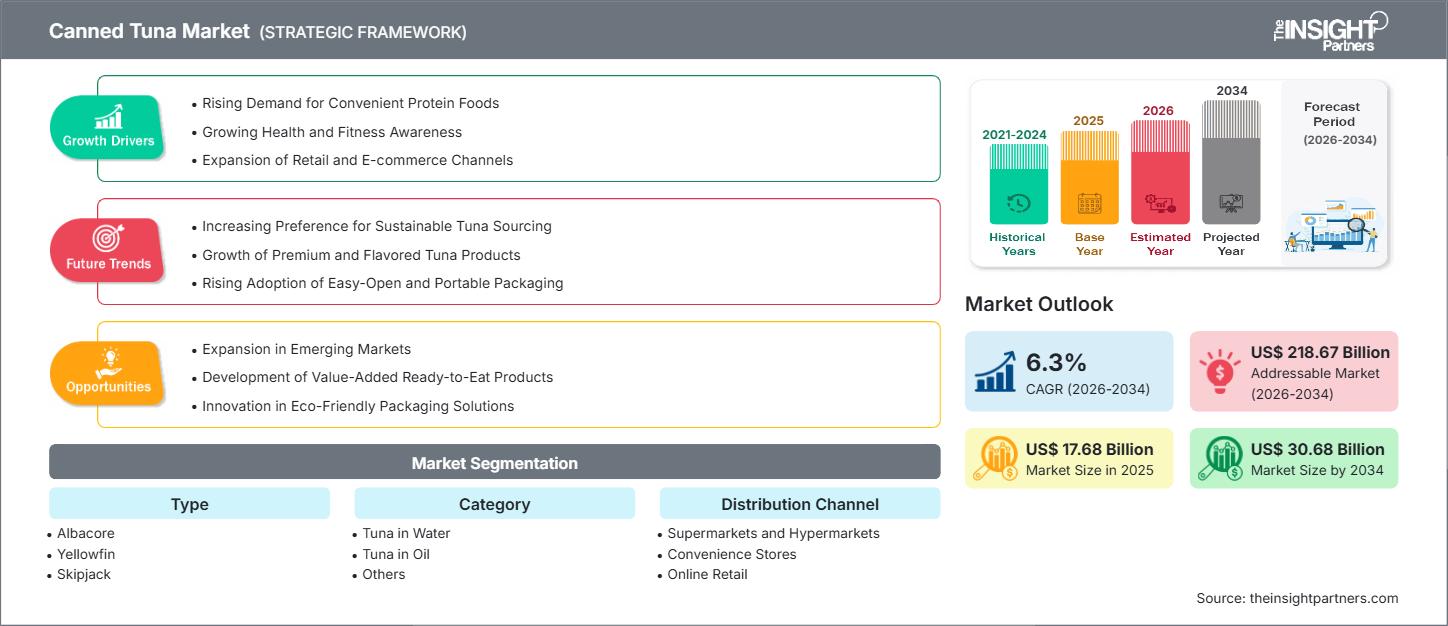
The canned tuna market size is projected to reach US$ 30.68 billion by 2034 from US$ 17.68 billion in 2025. The market is expected to register a CAGR of 6.3% during 2026-2034.
Canned Tuna Market Analysis
Canned tuna is used in retail, foodservice, and packaged food applications, growing due to the need for such convenient, protein-rich, and shelf-stable products. Canned tuna is easily prepared in various food applications, affordable, has a long shelf life, and high nutritional value, making it a major end-user product, such as households, ready-to-eat meal manufacturers, restaurants, and convenience food manufacturers. Growing preference for quick meal solutions, seafood consumption, healthy protein sources, and changing consumer lifestyles are driving growth in the canned tuna market. Advancements in processing, cold chain and packaging technologies, and quality assurance have made canned tuna products safer, more tasty, and longer shelf stable across the international market. Strong demand, consistency, and nutritional positioning make canned tuna a key product for the domestic market and seafood supply chains for export.
Canned Tuna Market Overview
Canned tuna is prepared by using controlled preservation processes, sterilization, and packaging techniques to ensure freshness, flavor, and nutritional quality for long shelf life. Quality canned tuna prioritizes the consistency of texture, preservation of flavor, and adherence to proper handling and preparation procedures for using in different ways, including salads, sandwiches, ready-to-eat meals, and snacks. The recent market trends involve sustainable fishing methods, developing adaptive packaging, diversifying the products as flavored and premium packaging, and increased demand for clean-label and high-protein seafood products. Health awareness and demand for convenience food drive mature, high-consumption markets such as North America and Europe. Asia Pacific is the fastest-growing market owing to rising consumption of seafood, the expansion of the seafood retailing networks, urbanization, and the robust local and export-oriented seafood manufacturing capability.
Market Research Highlights
- Asia Pacific dominated the market with 37.3% share in 2025.
- South and Central America is poised to grow at a CAGR of 6.9% over the forecast period.
- United States market is projected to grow at a CAGR of 6.6% over the forecast period.
- By Type, the Albacore segment accounted for the largest market share of 39.8% in 2025.
- By Category, the Tuna in Water segment is anticipated to witness the fastest growth, registering a CAGR of 6.7% over the forecast period
- By Distribution Channel, the Supermarkets and Hypermarkets segment accounted for the largest market share of 51.6% in 2025.
- The report profiles key industry players such as Princes Limited, Wild Planet Foods, Genova, Conservas Ortiz S.A., American Tuna Inc, Sustainable Seas, Bolton Group S.p.A, Frinsa, John West Foods Limited, RAMIREZ, while also analyzing key developments in novel ideas, disruptive products, and innovative services that could reshape the future market and reveal emerging themes across the industry.
Source: The Insight Partners' analysis based on proprietary research, government publications, company annual reports, investor presentations, industry databases, and expert interviews.
● REPORT CUSTOMIZATION
Tailor This Report To Align With Your Specific Business Requirements
This report can be customized to align precisely with your business objectives, scope, and target markets. Customization options include tailored segmentation, geography, competitive analysis, and strategic insights to support informed decision-making.
Customize This Report →WHAT YOU CAN ADJUST
- ● Segmentations
- ● Geography
- ● Competitive Analysis
- ● Language Preferences
Canned Tuna Market: Strategic Insights
-
Get Top Key Market Trends of this report.This FREE sample will include data analysis, ranging from market trends to estimates and forecasts.
Canned Tuna Market Drivers and Opportunities
Market Drivers:
- Rising Demand for Convenient and Protein-Rich Foods: The demand for canned tuna is fueled by the increasing consumption of ready-to-eat foods, salads, and packaged seafood products, owing to its high protein content and convenience.
- Growing Retail and Foodservice Channels: Canned tuna products are becoming more available and consumed, owing to the spread of supermarkets, hypermarkets, and quick-service restaurants around the world.
- Increasing Health and Nutrition Awareness: Increased demand for canned tuna is driven by consumers' growing preference for lean protein, low-fat, and healthy seafood.
Market Opportunities:
- Surging Development of Premium and Flavored Tuna Products: Changing consumer preferences for diverse flavor profiles and premium seafood brands are driving opportunities for premium canned tuna products.
- Rising Demand in Emerging Economies: The market potential of canned tuna is increasing in Asia Pacific and Latin America due to urbanization, increasing income, and changing eating habits.
- Growing Advancements in Sustainable Fishing and Packaging: Brand value and long-term market growth are increasing with the improvement of eco-friendly sourcing, traceability, and recyclable packaging.
Canned Tuna Market Report Segmentation Analysis
The canned tuna market is divided into different segments to give a clearer view of its growth potential and the latest trends. Below is the standard segmentation approach used in industry reports:
By Type:
- Albacore: Albacore is a premium canned tuna variety with a mild flavor and white meat, and is packed firm. It is employed in premium applications and in high-quality products owing to its lower fat and higher protein content, suitable for health-focused applications.
- Yellowfin: The flesh of yellowfin is firm and highly flavored and is appropriate for canned tuna products. It is popular in retail and foodservice, and provides a middle ground between premium and mass-market.
- Skipjack: Low cost and good availability are the reasons why skipjack is the most commonly used tuna type in canned tuna. It is a common ingredient in mass-produced tuna that is canned, has a stronger flavor, and is softer.
- Others: Other species of tuna include minor or regional species for blended or niche canned tuna. They assist manufacturers with diversifying their sourcing and cost-efficient operations while complying with their basic quality standards.
By Category:
- Tuna in Water
- Tuna in Oil
- Others
By Distribution Channel:
- Supermarkets and Hypermarkets
- Convenience Stores
- Online Retail
- Others
By Geography:
- North America
- Europe
- Asia Pacific
- Middle East & Africa
- South & Central America
Canned Tuna Market Report Scope
| Report Attribute | Details |
|---|---|
| Market size in 2025 | US$ 17.68 Billion |
| Market Size by 2034 | US$ 30.68 Billion |
| Global CAGR (2026 - 2034) | 6.3% |
| Historical Data | 2021-2024 |
| Forecast period | 2026-2034 |
| Segments Covered |
By Type
|
| Regions and Countries Covered |
North America
|
| Market leaders and key company profiles |
|
Canned Tuna Market Players Density: Understanding Its Impact on Business Dynamics
The Canned Tuna Market is growing rapidly, driven by increasing end-user demand due to factors such as evolving consumer preferences, technological advancements, and greater awareness of the product's benefits. As demand rises, businesses are expanding their offerings, innovating to meet consumer needs, and capitalizing on emerging trends, which further fuels market growth.
Canned Tuna Market Share Analysis by Geography
The demand for convenient, protein-rich foods is increasing, and more seafood processing units are built, retail food industries are expanding, and cold storage and supply chain facilities are developed, all of which drive the expansion of the canned tuna market in APAC, Latin America, the Middle East, and Africa. The consumption of tuna is rising in households, foodservice, retail, and packaged food applications as a result of the increasing urbanization, improving living standards, and preference for ready-to-eat and nutritious food products.
The canned tuna market growth differs in each region due to the rate of economic development and consumer preferences. Below is a summary of market share and trends by region:
1. North America
- Market Share: Holds a significant portion of the global canned tuna market
- Key Drivers:
- High demand for convenient, protein-rich seafood products and ready-to-eat meals.
- Strict food safety regulations ensure quality, traceability, and compliance.
- Well-developed retail, cold chain, and distribution networks support a stable supply.
- Trends: Growing preference for premium, clean-label, and sustainably sourced canned tuna products.
2. Europe
- Market Share: Accounts for a strong share of the global canned tuna market.
- Key Drivers:
- Rising demand for healthy, low-fat, and high-protein seafood options.
- Strict environmental and seafood sustainability regulations support responsible sourcing.
- Established retail and foodservice industries drive consistent consumption.
- Trends: Increasing shift toward sustainable tuna sourcing and eco-friendly packaging solutions.
3. Asia Pacific
- Market Share: The largest and fastest-growing market
- Key Drivers:
- High consumption of affordable, protein-rich, and convenient seafood products.
- Expansion of retail chains, urbanization, and changing dietary habits.
- Strong fishing, processing, and export-oriented seafood industries.
- Trends: Rising demand for canned tuna in ready meals and growth of mass-market consumption.
4. Middle East and Africa
- Market Share: A steadily progressing market with strong growth potential
- Key Drivers:
- Increasing demand for affordable protein and packaged seafood products.
- Growth in retail infrastructure and food import dependency.
- Rising urbanization and changing dietary preferences.
- Trends: Gradual expansion of canned tuna consumption in retail and foodservice sectors.
5. South and Central America
- Market Share: Holds a fastest growing market share
- Key Drivers:
- Growing demand for affordable and convenient seafood products.
- Expansion of local food processing and retail industries.
- Increasing consumer awareness of protein-rich diets.
- Trends: Rising use of canned tuna in everyday meals and packaged food applications.
High Market Density and Competition
Competition is intense due to the presence of established players such as Frinsa, Conservas Ortiz S.A., and American Tuna Inc.
This high level of competition urges companies to stand out by:
- Providing canned tuna that has high protein quality, a consistent texture, and dependable taste for retail, foodservice, and ready-to-eat uses.
- Ensuring product safety and freshness through strict quality control, traceability, lower contamination risks, and better preservation performance.
- Using sustainable and efficient fishing and processing practices, such as responsible sourcing, eco-friendly packaging, and less environmental impact.
Opportunities and Strategic Moves
- Create high-quality, flavored, and value-added canned tuna products for health-conscious and convenience-focused consumers.
- Form partnerships with retail chains, food service providers, and seafood suppliers to increase product innovation and market presence.
- Improve cold chain logistics and distribution networks. Work with regulatory bodies and certification agencies to ensure sustainability, product consistency, and broader global market access.
Major companies operating in the canned tuna market are:
- Frinsa
- RAMIREZ
- Wild Planet Foods
- Genova
- Conservas Ortiz S.A.
- American Tuna Inc
- Sustainable Seas
- Bolton Group S.p.A
- Princes Limited
- John West Foods Limited
Disclaimer: The companies listed above are not ranked in any particular order.
Other companies analyzed during research:
- NGHI SON FOODS GROUP
- Tri Marine
- Clover Leaf
- Ocean's
Canned Tuna Market News and Recent Developments
- Bolton Inaugurates First "Bolton Food Research & Innovation Center" to Advance Sustainable Seafood Science: In January 2026, Bolton, through its Food Business Unit, inaugurated its first Bolton Food Research & Innovation Center, marking a milestone in the company's long-standing commitment to innovation, science, and sustainable development in the global seafood industry. Conceived as a permanent platform, the Center is designed to deepen scientific understanding of the impacts of seafood products on both people and the planet, and to translate this knowledge into concrete solutions that optimize resources, reduce waste, and support more resilient food systems.
- Major Tinned Fish Brand John West Launches Vegan Tuna: In June 2024, John West, an international "seafood" brand specializing in tinned fish, launched its first-ever vegan tuna. The plant-based tuna is made from soy and wheat protein, and comes in two flavors, i.e. Vegan Fish-Free Tuna with a Dash of Oil and Vegan Fish-Free Tuna with Tomato & Basil. The launch is reportedly part of Thai Union's aim to become more sustainable.
Canned Tuna Market Report Coverage and Deliverables
The " Canned Tuna Market Size and Forecast (2021–2034)" report provides a detailed analysis of the market covering the following areas:
- Canned Tuna market size and forecast at global, regional, and country levels for all segments covered under the scope
- Canned Tuna market trends, as well as dynamics such as drivers, restraints, and key opportunities
- Detailed Porter's five forces analysis and SWOT analysis
- Canned Tuna market analysis covering market trends, global and regional framework, major players, regulations, and recent developments.
- Industry landscape and competition analysis covering market concentration, heat map analysis, prominent players, and recent developments for the canned tuna market
- Detailed company profiles
Frequently Asked Questions

- Comprehensive Market Sizing and Forecast Analysis
- Detailed Segmentation Analysis
- In-Depth Market Dynamics Assessment
- Regional and Country-Level Insights
- Competitive Landscape and Company Benchmarking
- Strategic Business Intelligence
Recent Reports
Testimonials

The Insight Partners provided valuable market intelligence that supported our global go-to-market strategy. Their team was professional, responsive, and attentive to our feedback, providing thoughtful analysis and helpful methodological clarifications throughout the project.
Junmo Kim Chief Financial Officer (CFO), Enertech Co., Ltd.
The Insight Partners' SCADA System Market report is comprehensive, with valuable insights on current trends and future forecasts. The team was highly professional, responsive, and supportive throughout. We are very satisfied and highly recommend their services.
RAN KEDEM Partner, Reali Technologies LTDs
I requested a report on a very specific software market and the team produced the report in a few days. The information was very relevant and well presented. I then requested some changes and additions to the report. The team was again very responsive and I got the final report in less than a week.
JEAN-HERVE JENN Chairman, Future Analytica
We worked with The Insight Partners for an important market study and forecast. They gave us clear insights into opportunities and risks, which helped shape our plans. Their research was easy to use and based on solid data. It helped us make smart, confident decisions. We highly recommend them.
PIYUSH NAGPAL Sr. Vice President, High Beam Global
The Insight Partners delivered insightful, well-structured market research with strong domain expertise. Their team was professional and responsive throughout. The user-friendly website made accessing industry reports seamless. We highly recommend them for reliable, high-quality research services
YUKIHIKO ADACHI CEO, Deep Blue, LLC.
This is the first time I have purchased a market report from The Insight Partners.While I was unsure at first, I visited their web site and felt more comfortable to take the risk and purchase a market report.I am completely satisfied with the quality of the report and customer service. I had several questions and comments with the initial report, but after a couple of dialogs over email with their analyst I believe I have a report that I can use as input to our strategic planning process.Thank you so much for taking the extra time and making this a positive experience.I will definitely recommend your service to others and you will be my first call when we need further market data.
JOHN SUZUKI President and Chief Executive Officer, Board Director, BK Technologies
I wish to appreciate your support and the professionalism you displayed in the course of attending to my request for information regarding to infectious disease IVD market in Nigeria. I appreciate your patience, your guidance, and the fact that you were willing to offer a discount, which eventually made it possible for us to close a deal. I look forward to engaging The Insight Partners in the future, all thanks to the impression you have created in me as a result of this first encounter.
DR CHIJIOKE ONYIA MANAGING DIRECTOR, PineCrest Healthcare Ltd.Reason to Buy
- Informed Decision-Making
- Understanding Market Dynamics
- Competitive Analysis
- Identifying Emerging Markets
- Customer Insights
- Market Forecasts
- Risk Mitigation
- Boosting Operational Efficiency
- Strategic Planning
- Investment Justification
- Tracking Industry Innovations
- Aligning with Regulatory Trends






 Get Free Sample for