
AC Electric Motor Sales in Oil and Gas Market Size, Demand & Growth by 2034
Coverage: by Type (Induction Motor, Synchronous Motor); Voltage (< 1kV, 1-6.6 kV, >6.6 kV) , and Geography (North America, Europe, Asia Pacific, and South and Central America)
- Status : Data Released
- Report Code : TIPRE00007104
- Category : Electronics and Semiconductor
- No. of Pages : 150
- Available Report Formats :


- Last update date : July 15, 2026


2025 Market Size
US$ 15.63 Bn
Base year value
2034 Forecast
US$ 22.37 Bn
Projected by 2034
CAGR 2026-2034
4.06 %
Growth rate
Addressable Market
US$ 172.55 Bn
(2026-2034)
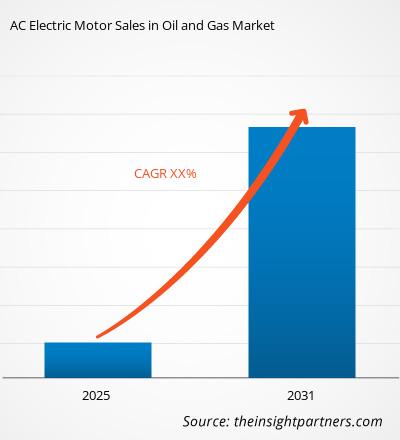
The global AC Electric Motor Sales in Oil and Gas market was valued at US$ 15.63 billion in 2025 and is expected to reach US$ 22.37 billion by 2034; it is estimated to record a CAGR of 4.06% during 2026-2034.
AC Electric Motor Sales in Oil and Gas Market Assessment and Insights
- North America: Share in 2025 is positioned as the leading regional base, with demand growing at a CAGR range of 4.1%–4.6% between 2026–2034, supported by shale optimization, LNG export capacity, refinery modernization, and certified motor replacement.
- US: Share in 2025 is 70%–78% of North America, with demand growing at a CAGR range of 4.2%–4.7% between 2026–2034, led by shale, LNG, refining, and petrochemical applications.
- Europe: Share in 2025 is 20%–24% of global demand, with a CAGR range of 3.6%–4.1% between 2026–2034; Germany leads, while the UK, France, Italy, and Spain support downstream and gas infrastructure upgrades.
- Asia Pacific: Share in 2025 is 30%–35% of global demand, with a CAGR range of 5.0%–5.6% between 2026–2034; China leads, followed by Japan, South Korea, India, and Australia across refinery, LNG, and petrochemical projects.
- Largest Segment: Induction Motor holds the leading market share in 2025 and grows within a 4.0%–4.5% CAGR range between 2026–2034 due to ruggedness, serviceability, and broad oil and gas usage.
- High Growth Segment: Synchronous Motor records a higher-growth profile, with market share below induction motors in 2025 and a CAGR range of 4.8%–5.4% between 2026–2034, supported by efficiency and power-factor benefits.
- Key companies analyzed in detail: ABB Ltd., Allied Motion Inc., General Electric Company, Hitachi, Ltd., Johnson Electric Holdings Limited, Nidec Corporation, Regal Rexnord Corporation, Rockwell Automation, Inc., Siemens AG, Yaskawa Electric Corporation
Source: The Insight Partners' analysis based on proprietary research, government publications, company annual reports, investor presentations, industry databases, and expert interviews.
The AC Electric Motor Sales in Oil And Gas Market has progressed from basic rotating equipment procurement toward lifecycle-oriented motor selection. Oil and gas operators increasingly evaluate AC motors through total installed cost, energy use, downtime risk, certification needs, and service accessibility. This shift is particularly visible in midstream compression, offshore platforms, refinery utilities, and petrochemical units where motor failure can disrupt production chains and raise safety exposure.
Future growth will be determined by brownfield retrofits, electrification of the upstream, construction of liquefied natural gas (LNG) terminals, and decarbonization initiatives that incentivize energy-efficient drive systems. Although oil price cycles affect capital expenditure decisions, maintenance and replacement demand serves as an additional buffer. Key players like ABB Ltd., Siemens AG, Nidec Corporation, Rockwell Automation, Inc., and Yaskawa Electric Corporation are strategically aligning themselves on efficiency and ruggedness.
AC Electric Motor Sales in Oil and Gas Market Report Scope
| Report Attribute | Details |
|---|---|
| Market size in 2025 | US$ 15.63 Billion |
| Market Size by 2034 | US$ 22.37 Billion |
| Global CAGR (2026 - 2034) | 4.06% |
| Historical Data | 2021-2024 |
| Forecast period | 2026-2034 |
AC Electric Motor Sales in Oil and Gas Market Analysis
The demand for this product is driven by its constant use in pumps, fans, compressors, blowers, separators, coolants, drilling support equipment, and pipeline machinery. AC motors have an advantage over other types since they offer high reliability, serviceability, and can work in combination with automation software. In the oil and gas industry, consumers place great importance on ingress protection, explosion-proof design, heat resistance, and consistent torque under variable loads.
The eco-system consists of steel and copper vendors, magnet and bearing vendors, insulating material vendors, motor OEMs, drive vendors, EPC contractors, and field service companies. Purchase decisions usually take into account engineering consultants and asset integrity groups, in addition to procurement offices. This makes for a specification-led market, where compliance with hazardous area codes, API-based specifications, and the approved vendor list of the operators becomes very important.
The competitive landscape is fragmented across global automation majors and specialized industrial motor manufacturers. ABB Ltd., General Electric Company, Hitachi, Ltd., Siemens AG, and Nidec Corporation compete through broad industrial portfolios, while Allied Motion Inc, Johnson Electric Holdings Limited, Regal Beloit Corporation, Rockwell Automation, Inc., and Yaskawa Electric Corporation strengthen offerings through motion control, drives, and engineered motor solutions.
Investments are being made in highly efficient induction motors, synchronous reluctance motors, drive-motor packages, and predictive maintenance offerings. Positioning is becoming more about regional networks of service, fast spare parts replacement, and the capability to serve low voltage process power systems and medium voltage critical rotating machines. The combination of certification and digital monitoring makes for a stronger business case for recurring investments in modernization.
● REPORT CUSTOMIZATION
Tailor This Report To Align With Your Specific Business Requirements
This report can be customized to align precisely with your business objectives, scope, and target markets. Customization options include tailored segmentation, geography, competitive analysis, and strategic insights to support informed decision-making.
Customize This Report →WHAT YOU CAN ADJUST
- ● Segmentations
- ● Geography
- ● Competitive Analysis
- ● Language Preferences
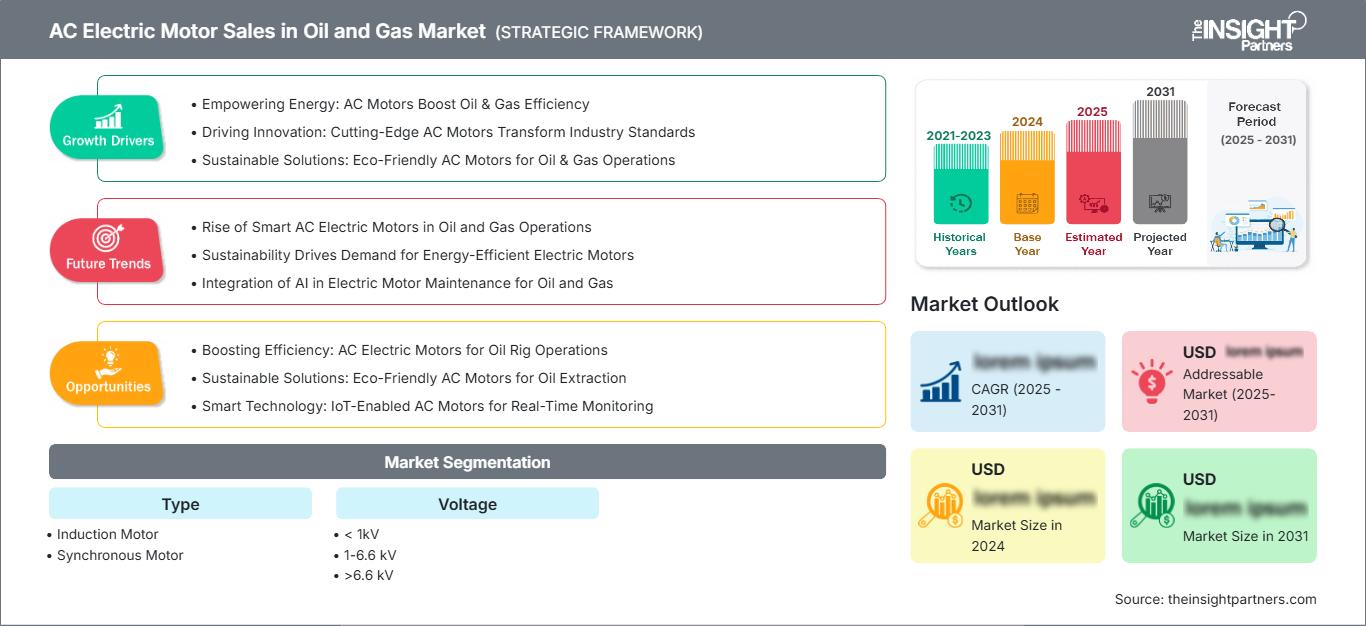
AC Electric Motor Sales in Oil and Gas Market: Strategic Insights
Regional Insights
North America AC Electric Motor Sales in Oil And Gas Market
North America is expected to grow at roughly 4.1%–4.6%, supported by shale production, petrochemical expansions, and LNG export infrastructure. The region’s installed base is large, and replacement sales are significant as operators retrofit motors to reduce energy consumption across compressors, pumps, and auxiliary systems.
Structural drivers include strict safety requirements for classified locations, mature service ecosystems, and strong adoption of variable speed drives, reflecting evolving AC Electric Motor Sales in Oil And Gas Market Trends. The upgrade of motors is usually linked to reliability-based maintenance initiatives. Manufacturers enjoy advantages such as short lead time sales, brownfield automation efforts, and preference for certified products.
U.S. AC Electric Motor Sales in Oil And Gas Market
The U.S. accounts for an estimated 70%–78% of North American demand and is projected to record a CAGR near 4.2%–4.7%. Shale oil, shale gas, LNG export terminals, refineries, and petrochemical corridors create steady demand for medium- and low-voltage AC motors.
Presence of the companies is significant in automation, drives, and rotating equipment services. Some of the prominent companies include ABB Ltd., Rockwell Automation, Inc., General Electric Company, Siemens AG, and Yaskawa Electric Corporation. Applications include oil pipeline pumps, compressor stations, offshore assistance systems, and refinery utilities.
Europe AC Electric Motor Sales in Oil And Gas Market
Europe represents approximately 20%–24% of global demand, with a CAGR of about 3.6%–4.1%. Growth is shaped less by new hydrocarbon megaprojects and more by refinery efficiency, offshore maintenance, gas infrastructure reliability, hydrogen-adjacent investments, and stricter industrial energy performance standards, contributing to sustained AC Electric Motor Sales in Oil And Gas Market Size expansion.
The UK AC Electric Motor Sales in Oil And Gas market benefits from North Sea asset maintenance, subsea support services, and energy security investments. Demands include the use of explosion proof motors, replacement equipment, and drive systems suitable for offshore platforms, terminals, and gas processing facilities, wherein procurement will be driven by safety compliance and harsh environment reliability.
The lead player in Europe would be Germany, because of its engineering base, knowledge in industrial automation, and refinery and chemicals integration. The other European countries that are contributing to the creation of demand would be France, Italy, and Spain, due to their downstream capacity and LNG regasification facilities.
APAC AC Electric Motor Sales in Oil And Gas Market
Asia Pacific is the fastest-growing region, expanding at an estimated 5.0%–5.6% CAGR and holding roughly 30%–35% of global demand. Growth is led by China, supported by refinery additions, petrochemical capacity, LNG terminals, and domestic manufacturing strength in industrial electrical equipment.
China remains the leading country, while Japan and South Korea contribute through high-specification offshore, shipbuilding, LNG, and petrochemical applications. India is gaining momentum from refinery expansions, gas pipeline development, and domestic energy security programs, increasing demand for durable motors in both greenfield and brownfield projects.
Australia adds demand from LNG export assets, offshore gas operations, and maintenance-intensive remote facilities. Policy drivers across the region include energy security, industrial localization, emissions reduction, and efficiency standards. These factors favor motors that combine robust mechanical design with advanced control compatibility and low operating cost.
Middle East & Africa AC Electric Motor Sales in Oil And Gas Market
Middle East & Africa is projected to grow at around 4.4%–5.0%, with Saudi Arabia leading regional demand. National oil companies continue to invest in upstream capacity, gas processing, refining, petrochemicals, and export infrastructure, all of which require reliable AC motors for continuous-duty rotating equipment.
The UAE shows strong demand from gas processing, offshore projects, storage terminals, and integrated downstream assets. Buyers in the Gulf prioritize motors that withstand heat, dust, saline environments, and hazardous operating zones. Premium-efficiency upgrades are increasingly justified by high utilization rates and asset reliability targets.
South Africa and the rest of MEA contribute through refinery maintenance, pipeline infrastructure, mining-linked fuel systems, and power reliability requirements. Growth is more project-led than volume-led, but long equipment lifecycles and harsh operating conditions support aftermarket demand for certified replacement motors and service-intensive solutions.
Segmentation Analysis
Type
The Type segment is expected to grow at a CAGR range of 4.0%–5.4% during 2026–2034. Demand reflects the operating mix of rugged induction motors for broad rotating-equipment fleets and synchronous motors for high-efficiency, stable-speed, and power-factor-sensitive applications across compressors, pumps, and process utilities.
- Induction Motor: Induction motors dominate oil and gas applications because they are rugged, cost-effective, widely serviceable, and suitable for pumps, fans, compressors, drilling auxiliaries, and refinery process equipment.
- Synchronous Motor: Synchronous motors are preferred where high efficiency, power factor correction, and stable speed control are required, particularly in large compressors, pipeline systems, and high-load process operations.
Voltage
The Voltage segment is expected to grow at a CAGR range of 4.1%–5.1% during 2026–2034. Low-voltage motors support auxiliary systems and packaged equipment, while medium- and high-voltage designs serve critical compression, pumping, LNG, offshore, and refinery process applications that require reliability and energy efficiency.
- < 1kV: Low-voltage motors serve auxiliary systems, small pumps, fans, actuators, ventilation, and packaged equipment where flexibility, fast replacement, and compatibility with drives are key purchasing factors.
- 1-6.6 kV: Medium-voltage motors support critical rotating equipment in refineries, LNG facilities, pipelines, and offshore assets, balancing efficiency, torque requirements, and reliability for continuous industrial operation.
- >6.6 kV: High-voltage motors are used in large compressors, major pumping stations, and energy-intensive process systems where power density, grid integration, and lifecycle efficiency carry strategic importance.
Opportunity Snapshot
| Type | Revenue Contribution | Trend Tag | Adoption Stage |
| Induction Motor | High | Fleet Retrofit | Mature |
| Synchronous Motor | Medium | Efficiency Control | Scaling |
AC Electric Motor Sales in Oil and Gas Market Growth Drivers and Impact Analysis
Reliability-Centered Replacement of Aging Motor Fleets
Oil and gas operators are managing large installed bases of AC motors that often operate in corrosive, high-temperature, dusty, or hazardous environments. As these assets age, the cost of unplanned downtime can exceed the purchase price of replacement equipment many times over. This makes reliability-centered replacement a major growth driver, especially in refineries, gas processing plants, offshore platforms, and pipeline compressor stations where motor failures can interrupt throughput and trigger safety reviews.
The real-world impact is a shift from reactive procurement toward planned modernization programs. Buyers increasingly select motors with improved insulation systems, higher efficiency ratings, certified hazardous-area protection, and compatibility with monitoring devices. This supports recurring sales for OEMs and service partners, while enabling operators to reduce maintenance risk and energy waste. It also strengthens demand for suppliers with local repair networks and quick-delivery replacement inventories.
Expansion of LNG, Gas Processing, and Pipeline Infrastructure
Natural gas infrastructure is expanding as countries pursue energy security, power generation flexibility, and lower-carbon fuel pathways compared with coal. LNG terminals, gas treatment units, compressor stations, and long-distance pipelines depend heavily on AC motors for pumps, refrigeration systems, vapor handling, cooling, and compression support. These applications require continuous operation, stable torque, and adherence to demanding safety classifications, making motor specification a critical engineering decision.
The market impact is strongest in regions investing in LNG export and import capacity, including North America, Asia Pacific, and the Middle East. Medium-voltage motors gain traction in compression and pumping systems, while low-voltage motors support auxiliary packages. This driver also benefits drive manufacturers and automation providers because operators seek integrated motor-control packages that improve process flexibility, reduce energy consumption, and simplify asset monitoring, reinforcing the positive AC Electric Motor Sales in Oil And Gas Market Forecast.
Energy Efficiency Pressure Across Downstream Operations
Refineries and petrochemical complexes are intensive users of electric motors, with pumps, fans, compressors, cooling towers, and process utilities running for long operating hours. Even modest efficiency gains can generate meaningful operating cost reductions when applied across large fleets. As operators face emissions scrutiny and energy cost volatility, AC motor upgrades are increasingly evaluated as practical decarbonization measures that do not require major process redesign.
This driver creates demand for premium-efficiency induction motors, synchronous reluctance alternatives, and motors paired with variable speed drives. The impact is particularly visible in brownfield downstream assets where operators seek measurable energy savings, reduced heat generation, and improved control. Manufacturers that can quantify lifecycle savings and provide retrofit-friendly designs gain an advantage, strengthening their AC Electric Motor Sales in Oil And Gas Market Share over suppliers competing only on upfront equipment price.
AC Electric Motor Sales in Oil and Gas Market Future Trends
Digital Condition Monitoring Becomes Standard in Critical Motors
Critical AC motors in oil and gas facilities are moving toward sensor-enabled operation, with vibration, temperature, current, and bearing health data integrated into maintenance systems. The trend reflects the industry’s broader shift from scheduled maintenance to condition-based reliability management. For operators, the value lies in identifying degradation before failure, prioritizing shutdown work, and extending the life of rotating equipment without compromising safety or production continuity.
Forward-looking demand will favor suppliers that package motors with analytics-ready features and interoperable communication options. This may reshape competition because digital service capability becomes as important as mechanical engineering depth. Over time, motor sales could become more closely linked to service contracts, remote diagnostics, and fleet-level performance benchmarking, creating recurring revenue opportunities beyond initial equipment supply.
Hazardous-Area Efficiency Upgrades Gain Momentum
Oil and gas facilities require motors that can operate safely in environments where flammable gases, vapors, or dust may be present. Historically, hazardous-area certification often limited efficiency choices or increased equipment complexity. The AC Electric Motor Sales in Oil And Gas market is now moving toward designs that combine safety certification with higher efficiency, cooler operation, and drive compatibility. This trend directly addresses operator priorities around energy reduction, safety assurance, and easier retrofit planning.
Forward-looking adoption will be strongest in pumps, fans, and compressors where motors run for long periods and energy savings accumulate quickly. Suppliers able to provide certified, high-efficiency motors across multiple voltage classes will be positioned for modernization projects in refineries, LNG plants, offshore platforms, and gas processing units, helping strengthen their AC Electric Motor Sales in Oil And Gas Market Share. This trend also supports closer alignment between motor OEMs, drive suppliers, and engineering contractors.
AC Electric Motor Sales in Oil and Gas Market Opportunities
Brownfield Retrofit Programs in Refineries and Gas Assets
Brownfield facilities represent one of the most actionable opportunities because many oil and gas assets operate with legacy motors that are reliable but inefficient, difficult to monitor, or nearing end-of-life. Retrofitting does not always require full process redesign, making motor replacement a manageable capital project with measurable benefits. Operators can target high-run-hour equipment first, including pumps, blowers, fans, and utility compressors.
Investment-oriented suppliers should develop retrofit packages that combine motor selection, drive integration, installation support, and lifecycle savings analysis, supporting long-term AC Electric Motor Sales in Oil And Gas Market Size expansion. Service partnerships with EPCs and maintenance contractors can improve access to installed-base data and shutdown schedules. The opportunity is not limited to premium products; it also includes standardized replacement programs that reduce procurement complexity while improving reliability and energy performance.
Localized Manufacturing and Service Near Energy Clusters
Lead time, certification familiarity, and service responsiveness strongly influence motor purchasing in oil and gas. Localized manufacturing, assembly, testing, and repair capabilities near major energy clusters can become a meaningful differentiator. This is especially relevant in the Gulf Coast, Middle East, India, China, and Southeast Asia, where operators require fast support for both planned turnarounds and emergency replacements.
The investment case is strongest where suppliers can combine local inventory with engineering customization and certified repair services, supporting the long-term AC Electric Motor Sales in Oil And Gas Market Forecast. Regional hubs reduce downtime risk and help manufacturers qualify for operator vendor lists. Companies that align local capacity with oilfield, LNG, and refinery demand can capture aftermarket revenue, strengthen customer loyalty, and reduce vulnerability to global supply chain disruptions.
Recent Developments
- May 2026: ABB Ltd. introduced what it described as the first magnet-free IE6 motor certified to ATEX and IECEx requirements for hazardous areas. The motor targets pumps, fans, and compressors used in industries including oil and gas, offering higher efficiency for classified zones.
- December 2025: Innomotics India Pvt. Ltd. signed an agreement to acquire the Low Voltage Motors and Geared Motors business from Siemens Limited, expanding its portfolio across low-voltage motors, geared motors, high-voltage motors, and large drives. The announcement noted relevance for chemicals and oil and gas customers.
- September 2025: ABB has expanded its IE5 SynRM motor portfolio with three smaller frame sizes (90, 100, 112), now covering 0.75 kW to 450 kW. This gives customers the broadest range of magnet- and rare earth-free motors to boost efficiency, reliability, and sustainability across even more applications. With extended power and speed options up to 3600 RPM, the motors are ideal for pumps, fans, and compressors perfectly paired with ABB variable speed drives for maximum performance.
Frequently Asked Questions

- Comprehensive Market Sizing and Forecast Analysis
- Detailed Segmentation Analysis
- In-Depth Market Dynamics Assessment
- Regional and Country-Level Insights
- Competitive Landscape and Company Benchmarking
- Strategic Business Intelligence
Recent Reports
Testimonials

The Insight Partners' SCADA System Market report is comprehensive, with valuable insights on current trends and future forecasts. The team was highly professional, responsive, and supportive throughout. We are very satisfied and highly recommend their services.
RAN KEDEM Partner, Reali Technologies LTDs
I requested a report on a very specific software market and the team produced the report in a few days. The information was very relevant and well presented. I then requested some changes and additions to the report. The team was again very responsive and I got the final report in less than a week.
JEAN-HERVE JENN Chairman, Future Analytica
We worked with The Insight Partners for an important market study and forecast. They gave us clear insights into opportunities and risks, which helped shape our plans. Their research was easy to use and based on solid data. It helped us make smart, confident decisions. We highly recommend them.
PIYUSH NAGPAL Sr. Vice President, High Beam Global
The Insight Partners delivered insightful, well-structured market research with strong domain expertise. Their team was professional and responsive throughout. The user-friendly website made accessing industry reports seamless. We highly recommend them for reliable, high-quality research services
YUKIHIKO ADACHI CEO, Deep Blue, LLC.
This is the first time I have purchased a market report from The Insight Partners.While I was unsure at first, I visited their web site and felt more comfortable to take the risk and purchase a market report.I am completely satisfied with the quality of the report and customer service. I had several questions and comments with the initial report, but after a couple of dialogs over email with their analyst I believe I have a report that I can use as input to our strategic planning process.Thank you so much for taking the extra time and making this a positive experience.I will definitely recommend your service to others and you will be my first call when we need further market data.
JOHN SUZUKI President and Chief Executive Officer, Board Director, BK Technologies
I wish to appreciate your support and the professionalism you displayed in the course of attending to my request for information regarding to infectious disease IVD market in Nigeria. I appreciate your patience, your guidance, and the fact that you were willing to offer a discount, which eventually made it possible for us to close a deal. I look forward to engaging The Insight Partners in the future, all thanks to the impression you have created in me as a result of this first encounter.
DR CHIJIOKE ONYIA MANAGING DIRECTOR, PineCrest Healthcare Ltd.Reason to Buy
- Informed Decision-Making
- Understanding Market Dynamics
- Competitive Analysis
- Identifying Emerging Markets
- Customer Insights
- Market Forecasts
- Risk Mitigation
- Boosting Operational Efficiency
- Strategic Planning
- Investment Justification
- Tracking Industry Innovations
- Aligning with Regulatory Trends





 Get Free Sample for