
Adaptive Optics Market Size, Trends & Demand by 2034
Coverage: By Component (Wavefront Sensor, Wavefront Modulator, Control System); End-User (Consumer, Military and Defense, Biomedical, Industrial and Manufacturing, IT and Telecommunication, Others) , and Geography (North America, Europe, Asia Pacific, and South and Central America)
- Status : Data Released
- Report Code : TIPRE00003032
- Category : Electronics and Semiconductor
- No. of Pages : 150
- Available Report Formats :


- Last update date : July 13, 2026


2025 Market Size
US$ 2.63 Bn
Base year value
2034 Forecast
US$ 17.29 Bn
Projected by 2034
CAGR 2026-2034
23.30 %
Growth rate
Addressable Market
US$ 77.75 Bn
(2026-2034)
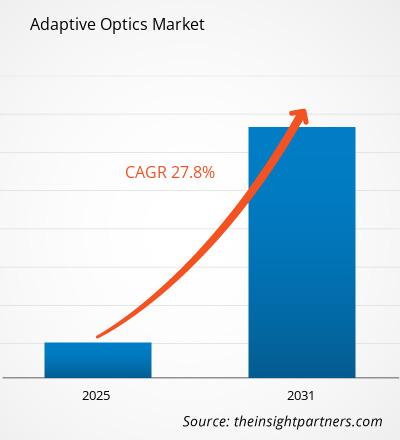
The adaptive optics market was valued at US$ 2.63 Billion in 2025 and is projected to reach US$ 17.29 Billion by 2034; it is expected to register a CAGR of 23.30% during 2026–2034. The increasing demand is due to the application of technologies like wavefront sensing, deformable mirror actuation, and real-time optical corrections from laboratory settings in astronomy to defense imaging, ophthalmology, semiconductor testing, laser communications, and precision industry.
The North American region is projected to continue being the reference region by growing at a 21–24% CAGR from 2026 to 2034 because of defense modernization, NASA’s telescope initiatives, and clinical adoption of retinal imaging technology. There will be an existing base of photonics manufacturers and research conducted in national laboratories within the region.
Adaptive Optics Market Assessment and Insights
- North America held 36–39% share in 2025 and is growing at a 21–24% CAGR between 2026–2034, supported by defense optics, space observation, ophthalmic imaging, and photonics manufacturing clusters.
- The US accounted for 78–82% of North America in 2025 and is growing at a 21–24% CAGR between 2026–2034, led by defense laboratories, observatories, and biomedical imaging deployment.
- Europe captured 24–27% share in 2025 and is growing at a 20–23% CAGR between 2026–2034, with Germany, the UK, and France leading telescope instrumentation, microscopy, and industrial metrology adoption.
- Asia Pacific represented 25–28% share in 2025 and is growing at a 25–28% CAGR between 2026–2034, driven by China, Japan, South Korea, and India across satellites, electronics, and manufacturing inspection.
- Largest Segment: Wavefront Sensor held 34–38% market share in 2025 and is growing at a 22–25% CAGR between 2026–2034 because sensing accuracy determines correction quality.
- High Growth Segment: Control System held 24–28% market share in 2025 and is growing at a 26–29% CAGR between 2026–2034 as AI-based reconstruction reduces latency.
- Key companies analyzed in detail: Adaptica S.r.l., Boston Micromachines Corporation, Flexible Optical B.V., Hamamatsu Photonics K.K., Imagine Optic SA, Iris AO, Inc., Northrop Grumman Corporation, Phasics S.A., Teledyne e2v (UK) Ltd, Thorlabs, Inc.
Source: The Insight Partners' analysis based on proprietary research, government publications, company annual reports, investor presentations, industry databases, and expert interviews.
The development of adaptive optics technology has progressed to become a modular platform consisting of wavefront sensors, wavefront modulators, and high-speed controllers. The production trends have changed in favor of the use of MEMS deformable mirrors, small-size Shack-Hartmann wavefront sensors, liquid crystal spatial light modulators, and software defined controllers. Actuator density, speed, calibrability, and integratability of the whole system are currently key criteria used by suppliers while lifecycle dependability is gaining importance among customers.
Going forward, the demand for the products will increase due to optical research, satellite monitoring, and advanced manufacturing being expanded in India, South Korea, Gulf states, and Central Europe. Medical imaging industry regulations, along with rising defense budgets and investments in photonics infrastructure, are expanding the Adaptive Optics Market scope. The investments in turnkey correction systems are growing in order to make installation less complex for clinical, industrial, and communication applications.
Adaptive Optics Market Report Scope
| Report Attribute | Details |
|---|---|
| Market size in 2025 | US$ 2.63 Billion |
| Market Size by 2034 | US$ 17.29 Billion |
| Global CAGR (2026 - 2034) | 23.30% |
| Historical Data | 2021-2024 |
| Forecast period | 2026-2034 |
Adaptive Optics Market Analysis
Demand is anchored in applications where image degradation directly affects mission outcome, diagnosis, or yield. Astronomy needs atmospheric correction for large ground telescopes; ophthalmology needs cellular-resolution retinal imaging; defense programs need stable laser propagation and surveillance clarity. These requirements create persistent Adaptive Optics Market growth because the value of correction rises with sensor resolution, laser power, and optical path complexity.
The environment includes precision optics producers, MEMS manufacturers, photonics labs, software providers, defense primes, and instrument suppliers. Supply will continue to be technologically constrained as deformable mirrors have to be highly reliable and low in hysteresis. This means that qualification cycles are long and buyer/vendor relationships and engineering are key considerations in the market research.
The competitive landscape is moderately concentrated, with Boston Micromachines Corporation and Iris AO, Inc. serving deformable mirror demand, Imagine Optic SA and Phasics S.A. strengthening sensing and metrology positions, and Thorlabs, Inc. supplying modular research systems. Northrop Grumman Corporation and Teledyne e2v (UK) Ltd support defense and imaging programs, while Hamamatsu Photonics K.K. benefits from biomedical imaging adjacency.
The trend in investment is towards integration as opposed to components. For strategic positioning, vendors that can bundle sensors, mirrors, control mechanisms, and software into calibration sub-systems have an edge. The market share for turnkey suppliers in the Adaptive Optics Market will see an increase owing to the need for reduced deployment cycles and reduced specialist staff.
● REPORT CUSTOMIZATION
Tailor This Report To Align With Your Specific Business Requirements
This report can be customized to align precisely with your business objectives, scope, and target markets. Customization options include tailored segmentation, geography, competitive analysis, and strategic insights to support informed decision-making.
Customize This Report →WHAT YOU CAN ADJUST
- ● Segmentations
- ● Geography
- ● Competitive Analysis
- ● Language Preferences
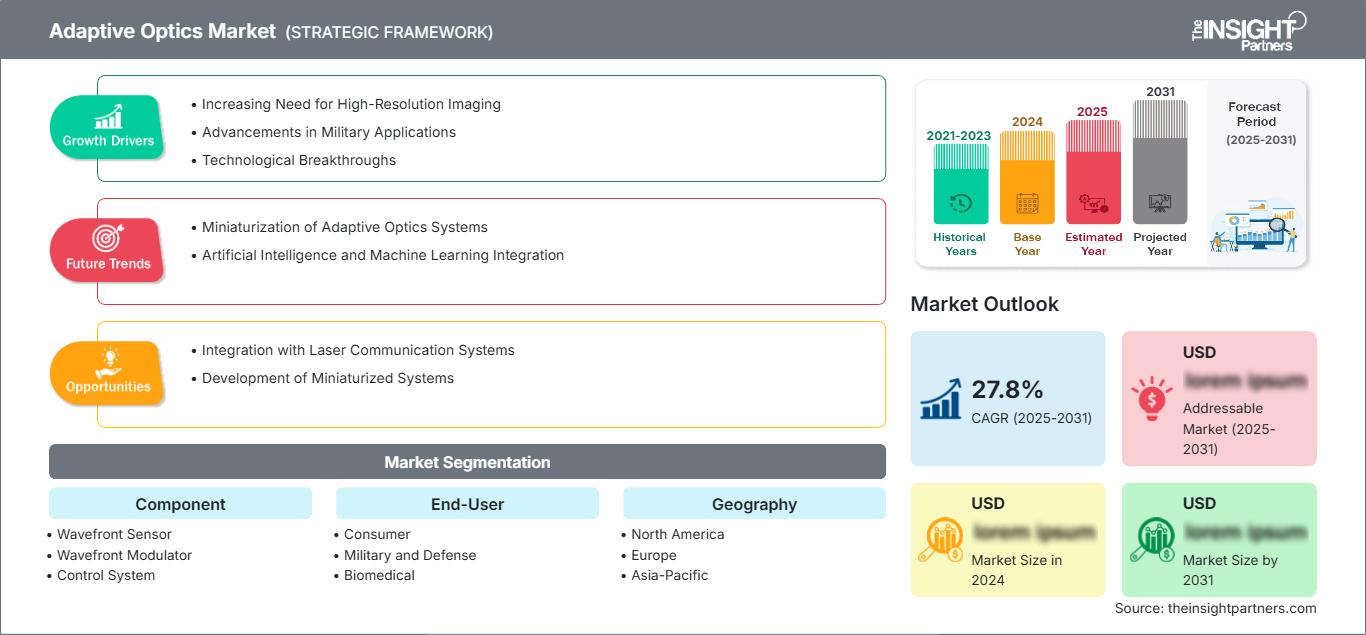
Adaptive Optics Market: Strategic Insights
Regional Insights
North America Adaptive Optics Market
North America held 36–39% share in 2025 and is projected to grow at a 21–24% CAGR through 2034.The demand comes from the areas of defense beams, high-resolution astronomical imaging, ophthalmological studies, and optical satellite communication. U.S. government funding for directed-energy weapons and NASA-based observatory programs results in regular procurements of wavefront sensors and deformable mirrors.
Regional suppliers have an advantage from being located near the photonics centers in Massachusetts, California, New Jersey, and Arizona. Universities and national laboratories help with the validation process, while defense contractors help transform prototypes into robust instruments. Adaptive Optics trends in the region increasingly focus on AI-driven control systems, miniaturized MEMS mirrors, and the incorporation of free-space optical links for communication.
U.S. Adaptive Optics Market
The U.S. accounted for 78–82% of North America in 2025 and is expected to grow at a 21–24% CAGR during 2026–2034. Defense laboratories, astronomical observatories, ophthalmic research centers, and semiconductor inspection users provide a broad application base. The country’s procurement depth supports early adoption of costly high-actuator mirrors and real-time controllers.
Boston Micromachines Corporation, Iris AO, Inc., Thorlabs, Inc., and Northrop Grumman Corporation strengthen domestic capability across components and mission systems. Application trends include adaptive retinal cameras, laser communication terminals, beam-steering platforms, and observatory upgrades. Strong clinical research networks also support the Adaptive Optics size expansion in biomedical imaging.
Europe Adaptive Optics Market
Europe held 24–27% share in 2025 and is growing at a 20–23% CAGR during 2026–2034. The UK benefits from photonics research, astronomy instrumentation, and defense imaging programs, while Teledyne e2v (UK) Ltd supports advanced sensor supply for demanding optical payloads.
The leading European nation in terms of its development is Germany due to the diverse needs for precision engineering, laser processing, microscopy, and industrial metrology. Buyers from Germany place a high value on the accuracy and stability of calibration, and machine integration, hence the importance of control systems.
France, Italy, and Spain contribute to this demand via observatory work, biomedical optics applications, and academia’s involvement in photonics projects. Imagine Optic SA and Phasics S.A. boost French metrology capabilities, whereas Adaptica S.r.l. assists with vision science and ophthalmic applications. European demand for Adaptive Optics is driven by joint funding and high-precision industrial automation, thereby influencing Adaptive Optics Market Size expansion.
APAC Adaptive Optics Market
APAC represented 25–28% share in 2025 and is expected to expand at a 25–28% CAGR during 2026–2034. China is the leading country, supported by satellite monitoring, astronomical observatories, laser research, and electronics manufacturing. Japan contributes through Hamamatsu Photonics K.K. and advanced imaging supply chains.
Increased demand is observed from South Korea, India, and Australia through semiconductor inspection, defense, space technology, and photonics programs within the universities. Domestic policies supporting the development of chip production, space exploration, and optical communications will result in a greater increase in demand in the future. The industrial users have started to consider adaptive optics.
Middle East & Africa Adaptive Optics Market
Middle East & Africa is projected to grow at an 18–21% CAGR during 2026–2034, led by the UAE. Saudi Arabia and the UAE are investing in space observation, secure communications, defense optics, and research infrastructure as part of economic diversification and advanced-technology localization programs.
The contribution from South Africa lies in astronomical resources and optical science. However, the Rest of MEA demonstrates selective demand for energy infrastructure monitoring, border surveillance, and research in academia. The adoption of adaptive correction systems is project driven, but energy, satellite, and security investments have provided a measurable path forward.
Segmentation Analysis
Component
The component segment is growing at a 23–26% CAGR during 2026–2034 as buyers upgrade sensing, modulation, and processing layers together. Component selection determines correction bandwidth, image stability, and total system cost. The Adaptive Optics Market increasingly rewards interoperable hardware and software architectures that can serve defense, biomedical, industrial, and communication environments.
- Wavefront Sensor remains the largest component because accurate distortion measurement defines correction quality, especially in astronomy, ophthalmology, laser communication, and directed-energy systems requiring continuous optical feedback.
- Wavefront Modulator demand is tied to deformable mirrors and spatial light modulators that actively reshape wavefronts, making actuator density, stroke range, and durability decisive purchasing criteria.
- Control System adoption is rising as real-time algorithms, GPUs, and AI reconstruction reduce latency, simplify calibration, and enable compact adaptive correction in commercial instruments.
End-User
The end-user segment is growing at a 22–25% CAGR during 2026–2034 as adaptive correction becomes relevant beyond research instruments. Military and defense, biomedical imaging, and industrial manufacturing account for the strongest value density, while consumer, IT, and telecommunication use cases are scaling as compact optics and integrated software lower adoption barriers.
- Consumer adoption is emerging in AR/VR optics, advanced cameras, and display testing, where compact wavefront correction improves image quality and supports premium device differentiation.
- Military and Defense remains a high-value end user because surveillance, target tracking, laser propagation, and satellite imaging require turbulence compensation under demanding operating conditions.
- Biomedical demand is expanding through retinal imaging, microscopy, and cellular diagnostics, where adaptive correction improves resolution and supports earlier disease detection and research accuracy.
- Industrial and Manufacturing users apply adaptive optics in laser processing, semiconductor inspection, and machine vision, prioritizing repeatability, yield protection, and integration with automated production systems.
- IT and Telecommunication applications are scaling around free-space optical links and laser communication, where wavefront correction can improve link stability, throughput, and secure data transmission.
Opportunity Snapshot
| End-User | Revenue Contribution | Trend Tag | Adoption Stage |
| Consumer | Medium | AR Optics | Emerging |
| Military and Defense | High | Beam Control | Scaling |
| Biomedical | High | Retinal Imaging | Scaling |
| Industrial and Manufacturing | Medium | Laser Metrology | Scaling |
| IT and Telecommunication | Medium | Optical Links | Emerging |
| Others | Low | Research Tools | Mature |
Adaptive Optics Market Growth Drivers and Impact Analysis
Defense beam-control programs increase component qualification
Directed-energy, satellite tracking, and long-range surveillance programs require optical beams to remain stable despite atmospheric turbulence, platform vibration, and thermal distortion. Adaptive optics improves beam quality by measuring aberrations and applying corrective mirror commands in real time. This requirement increases demand for rugged wavefront sensors, high-actuator modulators, and deterministic control systems. The impact is strongest in North America and APAC, where defense budgets support multi-year qualification cycles and domestic sourcing. Once a component is validated in a mission system, replacement demand and upgrade pathways create durable revenue visibility, strengthening suppliers' Adaptive Optics Market Share.
Clinical imaging demand raises resolution requirements
Ophthalmology and biomedical research increasingly depend on images that reveal cellular-level structures rather than broad tissue patterns. Adaptive optics corrects ocular and instrument-induced aberrations, improving retinal visualization, microscopy depth, and diagnostic confidence. The market impact is measurable because healthcare users value better image quality when it can support earlier disease recognition, treatment monitoring, and research reproducibility. Vendors that combine optics with user-friendly workflows are positioned to serve clinics beyond academic centers. This widens the buyer base and supports premium pricing for validated, service-backed systems.
Precision manufacturing pushes adaptive correction into factories
Semiconductor inspection, laser micromachining, additive manufacturing, and advanced metrology all require stable optical performance at smaller tolerances. Thermal drift, lens imperfections, and beam-path variation can reduce yield or inspection accuracy. Adaptive optics addresses these issues by correcting wavefront error during operation, helping factories maintain repeatability. The commercial impact is strongest where a small improvement in yield justifies higher equipment cost. Suppliers that integrate correction modules into existing machine vision, laser, and inspection platforms can access industrial budgets without requiring buyers to redesign production lines, reinforcing the positive Adaptive Optics Market Forecast.
Adaptive Optics Market Future Trends
AI-assisted wavefront reconstruction becomes standard
Emerging Adaptive Optics Market Trends include Next-generation systems that will increasingly use machine learning to predict aberrations, shorten calibration cycles, and reduce the computational load of real-time correction. This trend matters because lower latency improves performance in fast-changing environments such as laser communication, moving-platform surveillance, and live-cell microscopy. AI-assisted control can also reduce dependence on highly specialized operators by automating alignment and tuning, supporting the long-term forecast. Over time, software capability may become as important as actuator count, shifting competitive advantage toward vendors with strong algorithm libraries, training datasets, and application-specific control models.
Compact adaptive optics enters commercial optical devices
Miniaturization of MEMS mirrors, CMOS wavefront sensors, and embedded controllers is expected to move adaptive correction into smaller commercial devices. This will support portable ophthalmic systems, compact research microscopes, AR/VR optical testing, and field-deployable communication terminals. The trend changes procurement behavior because customers will compare adaptive optics against conventional imaging upgrades, not only against laboratory-grade systems. Suppliers that reduce cost, power consumption, and alignment complexity can expand adoption among hospitals, factories, and telecom laboratories that previously viewed adaptive correction as too specialized, helping strengthen their Adaptive Optics Market Share.
Adaptive Optics Market Opportunities
Turnkey biomedical imaging platforms for specialist clinics
Adaptive optics imaging services in specialist eye hospitals and imaging centers present an excellent growth avenue for vendors that can provide a well-integrated system with simpler calibration, maintenance, and clinician-friendly software. This application option does not apply only to research hospitals since diabetic retinopathy, glaucoma, and hereditary retinal diseases require better images, supporting continued Adaptive Optics Market Size expansion. Adaptive optics can be differentiated through the integration of adaptive optics modules along with imaging and analytics. This will make it possible to convert complicated photonic technology into a clinical process for easy adoption and lower implementation risks.
Free-space optical communication infrastructure upgrades
Free-space optical communication is ideal for high-bandwidth, low-interception capability via satellites, airplanes, ships, and ground stations, but atmospheric turbulence may cause signal instability. An approach that would be effective in addressing this challenge is adaptive optics, in which the signal beam distortion is corrected. Possible partners in the business include telecommunication equipment manufacturers and satellite communication firms. Investment should prioritize compact correction modules, environmental robustness, and automated alignment, supporting the long-term Adaptive Optics Market Forecast. As data traffic and secure communication requirements increase, adaptive correction can become a critical enabling layer for optical resilience.
Recent Developments
- June 2026: Bertin Alpao announces the launch of its new eDM (Embedded Deformable Mirror) and the signing of two series orders with European industrial partners. This launch confirms the company’s shift toward industrial-scale production targeting high-end markets such as defense, microscopy, and ophthalmology. The eDM addresses the growing demand for integrating adaptive optics into industrial instruments.
- June 2026: ESO’s Headquarters in Garching, Germany, ESO and the AdOptica consortium signed a contract for the design and production of a new adaptive mirror, to be installed at our Very Large Telescope (VLT). AdOptica, a consortium made up of two Italian companies, Microgate and A.D.S. International, is a long-standing ESO industrial partner, working on projects such as the adaptive M4 mirror for ESO’s Extremely Large Telescope.
- October 2025: Bertin Alpao developed a complete ecosystem to address the technological challenges of adaptive optics (AO). In addition to its products, or hardware, such as deformable mirrors, real time computers and wavefront sensors, it offer two software modules to support one in the development, simulation, and deployment of adaptive optics systems: ACE (Alpao Core Engine) and its latest version ACE-SIM (Alpao Core Engine Simulation).
Frequently Asked Questions

- Comprehensive Market Sizing and Forecast Analysis
- Detailed Segmentation Analysis
- In-Depth Market Dynamics Assessment
- Regional and Country-Level Insights
- Competitive Landscape and Company Benchmarking
- Strategic Business Intelligence
Recent Reports
Testimonials

The Insight Partners provided valuable market intelligence that supported our global go-to-market strategy. Their team was professional, responsive, and attentive to our feedback, providing thoughtful analysis and helpful methodological clarifications throughout the project.
Junmo Kim Chief Financial Officer (CFO), Enertech Co., Ltd.
The Insight Partners' SCADA System Market report is comprehensive, with valuable insights on current trends and future forecasts. The team was highly professional, responsive, and supportive throughout. We are very satisfied and highly recommend their services.
RAN KEDEM Partner, Reali Technologies LTDs
I requested a report on a very specific software market and the team produced the report in a few days. The information was very relevant and well presented. I then requested some changes and additions to the report. The team was again very responsive and I got the final report in less than a week.
JEAN-HERVE JENN Chairman, Future Analytica
We worked with The Insight Partners for an important market study and forecast. They gave us clear insights into opportunities and risks, which helped shape our plans. Their research was easy to use and based on solid data. It helped us make smart, confident decisions. We highly recommend them.
PIYUSH NAGPAL Sr. Vice President, High Beam Global
The Insight Partners delivered insightful, well-structured market research with strong domain expertise. Their team was professional and responsive throughout. The user-friendly website made accessing industry reports seamless. We highly recommend them for reliable, high-quality research services
YUKIHIKO ADACHI CEO, Deep Blue, LLC.
This is the first time I have purchased a market report from The Insight Partners.While I was unsure at first, I visited their web site and felt more comfortable to take the risk and purchase a market report.I am completely satisfied with the quality of the report and customer service. I had several questions and comments with the initial report, but after a couple of dialogs over email with their analyst I believe I have a report that I can use as input to our strategic planning process.Thank you so much for taking the extra time and making this a positive experience.I will definitely recommend your service to others and you will be my first call when we need further market data.
JOHN SUZUKI President and Chief Executive Officer, Board Director, BK Technologies
I wish to appreciate your support and the professionalism you displayed in the course of attending to my request for information regarding to infectious disease IVD market in Nigeria. I appreciate your patience, your guidance, and the fact that you were willing to offer a discount, which eventually made it possible for us to close a deal. I look forward to engaging The Insight Partners in the future, all thanks to the impression you have created in me as a result of this first encounter.
DR CHIJIOKE ONYIA MANAGING DIRECTOR, PineCrest Healthcare Ltd.Reason to Buy
- Informed Decision-Making
- Understanding Market Dynamics
- Competitive Analysis
- Identifying Emerging Markets
- Customer Insights
- Market Forecasts
- Risk Mitigation
- Boosting Operational Efficiency
- Strategic Planning
- Investment Justification
- Tracking Industry Innovations
- Aligning with Regulatory Trends





 Get Free Sample for