
Adtech Market Growth, Size & Forecast by 2034
Coverage: By Solution (Demand-Side Platforms (DSPs), Supply-Side Platforms (SSPs), Ad Networks, Data Management Platforms (DMPs), Others), Advertising Type (Programmatic, Search, Display, Mobile, Email, Native, Others), Enterprise Size (SMEs, Large Enterprises), Vertical (BFSI, Media and Entertainment, Education, Retail and Consumer Goods, IT & Telecom, Healthcare, Others) and Geography (North America, Europe, Asia Pacific, Middle East and Africa, South and Central America)
- Status : Data Released
- Report Code : TIPRE00040988
- Category : Technology, Media and Telecommunications
- No. of Pages : 150
- Available Report Formats :


- Last update date : August 05, 2026


2025 Market Size
US$ 864.63 Bn
Base year value
2034 Forecast
US$ 2,751.06 Bn
Projected by 2034
CAGR 2026-2034
13.72 %
Growth rate
Addressable Market
US$ 15,628.67 Bn
(2026-2034)
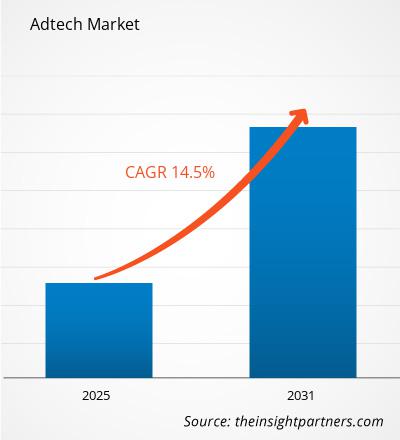
The adtech market was valued at US$ 864.63 Billion in 2025 and is projected to reach US$ 2,751.06 Billion by 2034, expanding at a CAGR of 13.72% during 2026–2034. The rise in digital media usage, the growth in the use of programmatic advertising, the increase in the connected television inventory, and the adoption of artificial intelligence in campaign optimization have been contributing to changes in the advertising technology industry. The market players are now working to increase intelligence, automation, and measurement within advertising technologies.
Across North America, digital advertising expenditure continues to shift toward automated buying environments supported by first-party data strategies and privacy-centric targeting methods. The adtech market size across the region is driven by a good level of adoption of cloud infrastructure, well-developed digital commerce ecosystem, and high advertiser spend intensity. The regional growth is forecast to be in the CAGR range of 11.8 to 13.2% until 2034 thanks to connected TV monetization and retail media network growth.
Adtech Market Assessment and Insights
- North America: Accounted for an estimated 36–40% share in 2025 and is anticipated to grow at a CAGR of 11.8–13.2% during 2026–2034. Strong digital advertising budgets, advanced retail media adoption, and widespread AI integration support continued regional leadership.
- US: Represented approximately 78–82% of North America in 2025 and is projected to expand at a CAGR of 11.5–13.0% during 2026–2034. Demand remains driven by programmatic advertising, connected TV inventories, and commerce media platforms.
- Europe: Held an estimated 24–28% share in 2025 and is expected to register a CAGR of 12.0–13.5% during 2026–2034. Germany, the UK, and France remain leading contributors supported by digital transformation initiatives and advanced advertising measurement frameworks.
- Asia Pacific: Accounted for approximately 28–32% share in 2025 and is forecast to grow at a CAGR of 15.0–16.5% during 2026–2034. China, India, Japan, South Korea, and Australia continue to attract investments in advertising automation and retail media.
- Largest Segment: Programmatic Advertising captured an estimated 34–38% market share in 2025 and is projected to expand at a CAGR of 14.0–15.5% during 2026–2034 owing to automated media buying efficiencies and advanced audience targeting capabilities.
- High Growth Segment: Retail and Consumer Goods Vertical represented approximately 16–20% market share in 2025 and is expected to register a CAGR of 15.5–17.0% during 2026–2034, supported by omnichannel commerce and retail media monetization initiatives.
- Key companies analyzed in detail: Google LLC, Meta Platforms, Inc., Amazon.com, Inc., Adobe Inc., The Trade Desk, Inc., Criteo S.A., PubMatic, Inc., Mediaocean LLC, Equativ SAS, Adform A/S.
Source: The Insight Partners' analysis based on proprietary research, government publications, company annual reports, investor presentations, industry databases, and expert interviews.
The ad tech platforms continue evolving from simple ad delivery systems to complete ecosystems that cover all aspects of ad targeting, identity resolution, activation, optimization, measurement, and attribution. The rapid rise in activity in digital commerce, video streaming, and multi-channel marketing has intensified the need for platforms that can handle vast amounts of consumer data. AI, machine learning, and predictive analytics are now crucial to ad campaign decision-making, leading to better allocation of advertising and media efficiencies.
In terms of future trends, increased investment is anticipated in the emerging digital economies, especially in Asia Pacific, the Middle East, and some Latin American countries. The regulatory initiatives in relation to privacy, consent management, and appropriate usage of customer data have driven innovations in context-based targeting and privacy-enhancing technologies. Technology providers are set to expand on collaboration efforts, interoperability, and automation-focused solutions, as advertisers focus on measurable and efficient results.
Adtech Market Report Scope
| Report Attribute | Details |
|---|---|
| Market size in 2025 | US$ 864.63 Billion |
| Market Size by 2034 | US$ 2,751.06 Billion |
| Global CAGR (2026 - 2034) | 13.72% |
| Historical Data | 2021-2024 |
| Forecast period | 2026-2034 |
Adtech Market Analysis
The trajectory of adtech market growth continues to be influenced by the rising importance of digital engagement channels across business sectors. Increasingly, advertisers tend to spend their budget in environments which give them insight about their audience and visibility about performance. The increase in connected TV, online video, mobile apps, retail media networks, and digital commerce has increased the amount of inventory as well as the requirement for complex campaign management solutions.
In the ecosystem environment, the contribution comes from the demand side platform, the supply side platform, the data management platform, the publisher, the agency, the data provider, and the measurement firm. Market growth in this scenario is also driven by the increased availability of cloud computing, better analytical framework, and improved identity management technology.
Comprehensive adtech market analysis indicates that competitive positioning in the market now hinges on data assets, AI abilities, and omnichannel activation technologies. Big platform players rely on their large user ecosystems, while technology companies play to their strengths of workflow optimization and industry targeting abilities. Performance measurement and privacy-friendly audience activation have become the differentiators.
Participants like Google LLC, Meta Platforms, Inc., Amazon.com, Inc., Adobe Inc., The Trade Desk, Inc., Criteo S.A., PubMatic, Inc., Mediaocean LLC, Equativ SAS, and Adform A/S are still key players within various tiers of the value chain. Investors in market players have been increasingly focused on building capabilities related to connected TV and retail media, as well as environments for data collaboration aimed at retaining advertisers. Consolidations and partnerships are still expected to be frequent occurrences within this domain.
● REPORT CUSTOMIZATION
Tailor This Report To Align With Your Specific Business Requirements
This report can be customized to align precisely with your business objectives, scope, and target markets. Customization options include tailored segmentation, geography, competitive analysis, and strategic insights to support informed decision-making.
Customize This Report →WHAT YOU CAN ADJUST
- ● Segmentations
- ● Geography
- ● Competitive Analysis
- ● Language Preferences
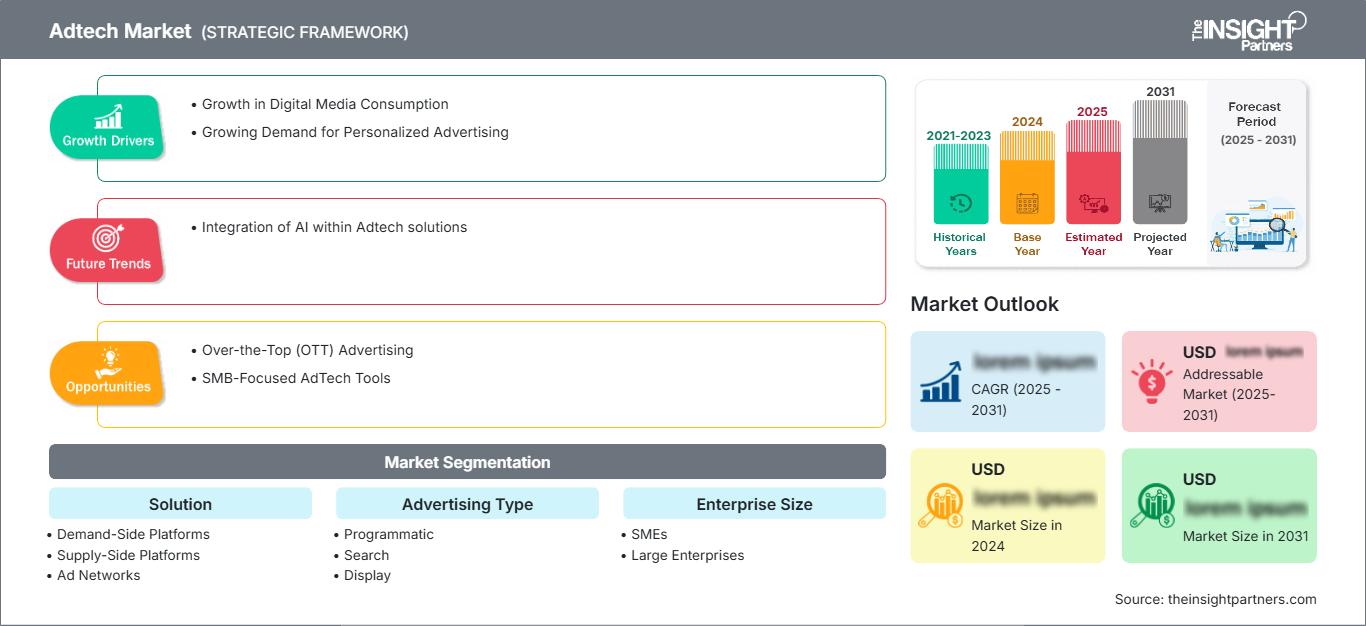
Adtech Market: Strategic Insights
Regional Insights
North America Adtech Market
North America remained the largest regional contributor, accounting for approximately 36–40% of the global adtech market share in 2025. Further migration of ad spend to the programmatic route, connected TV ecosystem, commerce media, and measurement systems will be key drivers for sustainable growth in the marketplace. Data-driven marketing is gaining traction among companies in retail, finance, healthcare, telecommunications, and media industries owing to their increasing focus on improving ROI. The region is anticipated to grow at a CAGR of 11.8–13.2% from 2026 to 2034.
Innovation in technology is one of the key features of the regional ecosystem. The use of customer data platforms, AI-based bidding algorithms, and retail media networks is making the targeting process even more precise. Heavy investments from major technology providers and advertisers make the platforms more sophisticated, and privacy rules motivate the use of contextual targeting and other identity solutions.
U.S. Adtech Market
The United States represented approximately 78–82% of the North American market in 2025, reflecting the presence of major digital media companies, extensive advertiser spending, and broad adoption of programmatic technologies. Demand within the market is aided by the maturity in digital commerce practices along with increased spending on connected TV advertising. The growth in retail media and video advertising ecosystem has attracted high levels of enterprise participation. The US market is projected to record a CAGR of 11.5 – 13.0% over the period 2026 – 2034.
The competition amongst the various players in terms of platforms leads to consistent innovations in campaign optimization, data activation, and measurement. Increasing demand for unified advertising platforms that can enable omnichannel customer engagement is becoming common. The presence of companies such as Google LLC, Meta Platforms, Inc., Amazon.com, Inc., Adobe Inc., and The Trade Desk, Inc. is aiding the technological and market maturity.
Europe Adtech Market
Europe accounted for an estimated 24–28% share in 2025 and is projected to expand at a CAGR of 12.0–13.5% during 2026–2034. Regional market development is supported by increasing adoption of digital advertising, stronger retail media investments, and continued growth in online video consumption. The United Kingdom remains one of the most mature advertising technology markets owing to high programmatic adoption rates, sophisticated agency networks, and strong demand for performance-driven digital marketing solutions.
Germany leads continental Europe through its substantial enterprise sector and strong digital transformation investments. French advertisers continue to expand omnichannel marketing deployments, while Italy and Spain increasingly adopt automated media buying technologies to improve campaign performance. Regulatory emphasis on privacy and data governance continues to influence technology strategies throughout Europe. Despite evolving compliance requirements, the region remains attractive for innovation in contextual advertising, identity solutions, and advanced analytics.
APAC Adtech Market
Asia Pacific accounted for approximately 28–32% of global revenues in 2025 and is anticipated to register the fastest regional expansion with a CAGR of 15.0–16.5% during 2026–2034. China remains the largest regional contributor, supported by extensive digital commerce activity and advanced advertising platforms.
India, Japan, South Korea, and Australia continue to experience growth in mobile advertising, online video monetization, and retail media investments. Expanding internet penetration, rising digital consumption, and government-supported digital economy initiatives create favorable conditions for long-term adtech market development throughout the region.
Middle East & Africa Adtech Market
The Middle East and Africa market is developing steadily, supported by expanding internet connectivity, increasing smartphone adoption, and digital transformation programs. Saudi Arabia and the United Arab Emirates remain primary growth centers as enterprises accelerate investments in digital engagement and data-driven marketing technologies.
The region is expected to grow at a CAGR of 13.0–14.5% during 2026–2034. South Africa continues to serve as a significant adtech market within Africa, while ongoing infrastructure development and digital economy initiatives support broader regional adoption of advertising technology solutions.
Segmentation Analysis
Solution
The Solution segment is projected to expand at a CAGR of 13.5–14.5% during 2026–2034. Growth is driven by increasing adoption of integrated advertising technology platforms that improve audience targeting, inventory optimization, and campaign measurement. As advertisers seek greater transparency and efficiency across omnichannel environments, investments in demand-side, supply-side, and data-driven activation technologies continue to rise. The adtech market scope within this segment continues to broaden as privacy-focused identity solutions and AI-powered optimization capabilities become increasingly important.
- Demand-Side Platforms (DSPs): Demand-Side Platforms enable advertisers to automate media buying, optimize bidding decisions, and improve audience targeting across multiple channels. Their strategic importance continues to increase with the growing emphasis on performance-driven advertising campaigns.
- Supply-Side Platforms (SSPs): Supply-Side Platforms help publishers maximize inventory monetization through automated transactions and real-time bidding environments. Growing digital content consumption and connected television inventory expansion support sustained demand for these platforms.
- Ad Networks: Ad Networks continue to facilitate inventory aggregation and advertiser access to diverse publisher ecosystems. They remain important for campaign scale, particularly among organizations seeking broad digital reach and simplified media procurement.
- Data Management Platforms (DMPs): Data Management Platforms support audience segmentation, behavioral insights, and campaign personalization initiatives. Their value remains significant as enterprises pursue data-driven advertising strategies and stronger customer intelligence capabilities.
Advertising Type
The Advertising Type segment is anticipated to grow at a CAGR of 14.0–15.0% during 2026–2034. Increasing digital media consumption, expanding online video engagement, and rapid growth in mobile connectivity continue to reshape channel allocation strategies. Organizations increasingly balance performance marketing objectives with brand-building initiatives, creating demand for advertising formats that provide measurable outcomes and scalable audience engagement.
- Programmatic: Programmatic advertising remains the dominant format due to automation capabilities, real-time optimization, and improved targeting accuracy. Its strong adtech market position reflects advertiser preference for efficiency and data-driven decision-making across digital channels.
- Search: Search advertising continues to attract significant budget allocation owing to intent-based targeting and measurable conversion performance. It remains a core component of digital customer acquisition strategies across industries.
- Display: Display Advertising supports brand awareness and audience engagement objectives through visual formats deployed across websites, applications, and digital media properties. Continued innovation in creative optimization enhances campaign effectiveness.
- Mobile: Mobile advertising benefits from widespread smartphone adoption and increasing application usage. Advertisers prioritize mobile-first strategies to reach consumers throughout daily digital interactions and commerce activities.
- Email: Email advertising remains relevant for customer retention, personalization, and direct engagement. Integration with customer relationship management platforms enhances targeting precision and campaign performance.
- Native: Native advertising aligns promotional content with user experiences, improving engagement and reducing disruption. Increasing emphasis on contextual relevance continues to support adoption among advertisers and publishers.
Enterprise Size
The Enterprise Size segment is forecast to register a CAGR of 13.2–14.2% during 2026–2034. Digital transformation initiatives, cloud-based deployment models, and accessible advertising platforms are expanding adoption across organizations of all sizes. Enterprises increasingly seek scalable technologies that support audience acquisition, campaign optimization, and performance measurement within evolving privacy and compliance environments.
- SMEs: SMEs increasingly utilize automated advertising platforms to enhance customer acquisition and brand visibility. Lower entry barriers, self-service tools, and performance-based spending models have strengthened adoption among smaller organizations.
- Large Enterprises: Large Enterprises maintain significant investment levels due to extensive advertising budgets, complex customer journeys, and omnichannel engagement requirements. Their demand supports innovation in analytics, measurement, and audience orchestration capabilities.
Vertical
The Vertical segment is expected to expand at a CAGR of 14.5–15.5% during 2026–2034. Industry-specific requirements increasingly influence platform functionality and campaign strategies. Growing emphasis on personalization, customer experience optimization, and measurable outcomes supports broader adoption across diverse end-user sectors.
- BFSI: BFSI organizations utilize advanced targeting technologies to improve customer acquisition, retention, and financial product promotion while maintaining compliance with regulatory and privacy requirements.
- Media and Entertainment: Media and Entertainment companies rely heavily on audience engagement analytics, content monetization solutions, and digital campaign optimization to maximize viewership and advertising effectiveness.
- Education: Education institutions increasingly adopt digital advertising solutions to support student recruitment, awareness campaigns, and personalized engagement across digital channels and platforms.
- Retail and Consumer Goods: Retail and Consumer Goods organizations leverage advertising technology for commerce media, customer targeting, and omnichannel engagement. Strong e-commerce growth enhances the strategic importance of this vertical.
- IT & Telecom: IT & Telecom companies utilize advanced advertising platforms to promote digital services, strengthen customer relationships, and improve campaign measurement across highly competitive markets.
- Healthcare: Healthcare organizations increasingly apply digital advertising tools for patient engagement, awareness initiatives, and service promotion while adhering to industry-specific compliance requirements.
Opportunity Snapshot
| Vertical | Revenue Contribution | Trend Tag | Adoption Stage |
|---|---|---|---|
| BFSI | High | Fintech Media | Mature |
| Media and Entertainment | High | CTV Growth | Mature |
| Education | Medium | Digital Enrollment | Scaling |
| Retail and Consumer Goods | High | Retail Media | Scaling |
| IT & Telecom | High | AI Targeting | Mature |
| Healthcare | Medium | Patient Outreach | Scaling |
| Others | Low | Contextual Ads | Emerging |
Adtech Market Growth Drivers and Impact Analysis
Expansion of Programmatic and Automated Media Buying
The increasing shift toward automated media purchasing continues to be one of the most influential growth drivers across the global advertising technology ecosystem. Advertisers seek improved efficiency, greater campaign transparency, and more accurate audience targeting capabilities, driving investment in programmatic solutions. Automated buying environments support real-time bidding, dynamic budget allocation, and continuous optimization based on performance metrics. As digital inventory volumes increase across mobile, video, display, and connected television channels, manual campaign management becomes less practical. This transition encourages greater adoption of demand-side and supply-side technologies capable of handling large-scale advertising operations. The resulting improvements in media efficiency, audience segmentation, and attribution accuracy contribute significantly to long-term adtech market expansion and platform innovation.
Growing Adoption of Retail Media Networks
Retail media networks are becoming increasingly important as brands seek direct access to high-intent consumer audiences. Retailers increasingly monetize first-party customer data and digital properties to create valuable advertising inventory. This approach enables advertisers to reach consumers close to purchase decisions while benefiting from measurable campaign outcomes. Strong growth in e-commerce activity further strengthens the attractiveness of retail media ecosystems, encouraging investment from consumer goods manufacturers, technology providers, and advertising agencies. The convergence of commerce and advertising is reshaping budget allocation strategies and expanding opportunities for advanced audience targeting. As more retailers establish advertising platforms, demand for scalable campaign management technologies and analytics capabilities continues to increase across the adtech market.
Artificial Intelligence Integration Across Advertising Workflows
Artificial intelligence is transforming advertising operations by improving campaign planning, audience discovery, bidding optimization, creative personalization, and performance measurement. Organizations increasingly utilize machine learning algorithms to process large data volumes and generate actionable insights in real time. These capabilities support more efficient budget utilization and stronger campaign outcomes across digital channels. AI-driven tools also assist advertisers in navigating privacy changes by identifying alternative targeting approaches and contextual signals. As competition intensifies, enterprises continue investing in intelligent automation to strengthen customer engagement and marketing effectiveness. The widespread deployment of AI-enhanced advertising solutions is expected to remain a major catalyst for innovation, productivity improvements, and future revenue growth.
Adtech Market Future Trends
Rising Adoption of Privacy-Enhancing Advertising Technologies
The evolution of global data privacy regulations is encouraging broader adoption of privacy-enhancing technologies across digital advertising environments. Organizations increasingly invest in consent management frameworks, clean-room solutions, contextual intelligence platforms, and alternative identity approaches that reduce dependence on traditional tracking mechanisms. Adtech market trends indicate that advertisers are prioritizing compliance while maintaining targeting effectiveness and campaign measurement capabilities. Future platform development is expected to focus on secure collaboration, anonymized data activation, and privacy-centric analytics. These innovations will help organizations address regulatory expectations while maintaining audience reach, operational efficiency, and measurable business outcomes in increasingly complex digital ecosystems.
Connected Television Becoming a Core Advertising Channel
Connected television is expected to emerge as one of the most influential digital advertising channels over the coming decade. Growing consumer preference for streaming content, combined with improvements in measurement and automation technologies, is accelerating advertiser participation. Advanced targeting capabilities allow brands to reach highly specific audiences while maintaining the premium experience associated with television content. Increasing inventory availability across streaming services further improves scalability and campaign effectiveness. As advertising budgets continue shifting from traditional television toward digital video environments, connected television is projected to become a central component of omnichannel marketing strategies and long-term platform innovation.
Adtech Market Opportunities
Expansion of Retail Media Monetization Platforms
Retail media ecosystems continue to create substantial investment opportunities across the digital advertising value chain. Retailers increasingly recognize the revenue potential associated with monetizing customer engagement data, digital storefronts, and commerce platforms. As advertisers prioritize measurable outcomes and purchase-intent targeting, demand for integrated retail media technologies is expected to rise significantly. Adtech market Forecasts indicate sustained investment in data collaboration environments, campaign automation tools, and commerce-driven audience activation capabilities. Technology providers capable of enabling transparent measurement, inventory optimization, and omnichannel execution stand to benefit from increasing retailer participation. The growing convergence of advertising, commerce, and analytics also creates opportunities for partnerships, acquisitions, and platform expansion strategies.
Emerging Digital Advertising Ecosystems in Developing Economies
Developing economies across Asia Pacific, the Middle East, and Africa present attractive opportunities due to rapid internet adoption, expanding smartphone penetration, and improving digital infrastructure. Increasing consumer engagement with digital platforms is encouraging enterprises to shift marketing investments toward measurable online channels. Local publishers, advertisers, and technology providers are investing in automation capabilities to enhance audience reach and campaign efficiency. As regulatory frameworks mature and digital commerce activity accelerates, demand for scalable advertising technology solutions is expected to expand. Organizations that establish localized platforms, strategic partnerships, and region-specific targeting capabilities can capitalize on significant long-term growth potential while strengthening competitive positioning in emerging digital markets.
Frequently Asked Questions

- Comprehensive Market Sizing and Forecast Analysis
- Detailed Segmentation Analysis
- In-Depth Market Dynamics Assessment
- Regional and Country-Level Insights
- Competitive Landscape and Company Benchmarking
- Strategic Business Intelligence
Recent Reports
Testimonials

The Insight Partners provided valuable market intelligence that supported our global go-to-market strategy. Their team was professional, responsive, and attentive to our feedback, providing thoughtful analysis and helpful methodological clarifications throughout the project.
Junmo Kim Chief Financial Officer (CFO), Enertech Co., Ltd.
The Insight Partners' SCADA System Market report is comprehensive, with valuable insights on current trends and future forecasts. The team was highly professional, responsive, and supportive throughout. We are very satisfied and highly recommend their services.
RAN KEDEM Partner, Reali Technologies LTDs
I requested a report on a very specific software market and the team produced the report in a few days. The information was very relevant and well presented. I then requested some changes and additions to the report. The team was again very responsive and I got the final report in less than a week.
JEAN-HERVE JENN Chairman, Future Analytica
We worked with The Insight Partners for an important market study and forecast. They gave us clear insights into opportunities and risks, which helped shape our plans. Their research was easy to use and based on solid data. It helped us make smart, confident decisions. We highly recommend them.
PIYUSH NAGPAL Sr. Vice President, High Beam Global
The Insight Partners delivered insightful, well-structured market research with strong domain expertise. Their team was professional and responsive throughout. The user-friendly website made accessing industry reports seamless. We highly recommend them for reliable, high-quality research services
YUKIHIKO ADACHI CEO, Deep Blue, LLC.
This is the first time I have purchased a market report from The Insight Partners.While I was unsure at first, I visited their web site and felt more comfortable to take the risk and purchase a market report.I am completely satisfied with the quality of the report and customer service. I had several questions and comments with the initial report, but after a couple of dialogs over email with their analyst I believe I have a report that I can use as input to our strategic planning process.Thank you so much for taking the extra time and making this a positive experience.I will definitely recommend your service to others and you will be my first call when we need further market data.
JOHN SUZUKI President and Chief Executive Officer, Board Director, BK Technologies
I wish to appreciate your support and the professionalism you displayed in the course of attending to my request for information regarding to infectious disease IVD market in Nigeria. I appreciate your patience, your guidance, and the fact that you were willing to offer a discount, which eventually made it possible for us to close a deal. I look forward to engaging The Insight Partners in the future, all thanks to the impression you have created in me as a result of this first encounter.
DR CHIJIOKE ONYIA MANAGING DIRECTOR, PineCrest Healthcare Ltd.Reason to Buy
- Informed Decision-Making
- Understanding Market Dynamics
- Competitive Analysis
- Identifying Emerging Markets
- Customer Insights
- Market Forecasts
- Risk Mitigation
- Boosting Operational Efficiency
- Strategic Planning
- Investment Justification
- Tracking Industry Innovations
- Aligning with Regulatory Trends





 Get Free Sample for