
Advanced Gear Shifter System Market Size, Share & Growth Opportunities by 2034
Coverage: By Technology (Automatic shifter, Shift-by-wire); Component (Can module, Electronic control unit, Solenoid actuator); Vehicle Type (Light-duty, Commercial); Electric vehicle (Battery, Fuel cell, Plug-in hybrid); Component (Can module, Electronic control unit, Solenoid actuator) , and Geography (North America, Europe, Asia Pacific, and South and Central America)
- Status : Data Released
- Report Code : TIPEL00002277
- Category : Electronics and Semiconductor
- No. of Pages : 150
- Available Report Formats :


- Last update date : July 09, 2026


2025 Market Size
US$ 17.31 Bn
Base year value
2034 Forecast
US$ 34.07 Bn
Projected by 2034
CAGR 2026-2034
7.81 %
Growth rate
Addressable Market
US$ 231.20 Bn
(2026-2034)
The Advanced Gear Shifter System Market was valued at US$ 17.31 Billion in 2025 and is projected to reach US$ 34.07 Billion by 2034, growing at a CAGR of 7.81% from 2026 to 2034. The market is expanding as automatic shifters, shift-by-wire interfaces, ECUs, CAN modules, and solenoid actuators become integral to light-duty, commercial, and electric vehicle platforms.
North America is positioned to grow at a 7.0%–8.0% CAGR during 2026–2034, supported by high automatic transmission penetration, premium pickup and SUV demand, and accelerated electronic cockpit redesign. The region’s suppliers are aligning shifter modules with functional safety, vehicle networking, and electrified drivetrain requirements. The Advanced Gear Shifter System Market report highlights that fleet modernization and hybrid model launches are further strengthening growth prospects across North America.
Advanced Gear Shifter System Market Assessment and Insights
- North America: Share in 2025 is estimated at 23%–27%, growing at a CAGR between 2026–2034 of 7.0%–8.0%, driven by automatic transmission saturation, EV cockpit redesign, and commercial fleet automation.
- US: Share in 2025 represents 70%–75% of North America, growing at a CAGR between 2026–2034 of 7.5%–8.5%, supported by pickup, SUV, hybrid, and BEV programs.
- Europe: Share in 2025 is estimated at 22%–27%, growing at a CAGR between 2026–2034 of 6.5%–7.5%; Germany leads, followed by the UK, France, Italy, and Spain.
- Asia Pacific: Share in 2025 is estimated at 38%–44%, growing at a CAGR between 2026–2034 of 8.0%–9.0%; China leads, with Japan, South Korea, India, and Australia contributing.
- Largest Segment: Light-duty vehicles hold 64%–69% market share in 2025 and grow at a CAGR of 7.0%–8.0% between 2026–2034 due to high passenger vehicle volumes.
- High Growth Segment: Electric vehicle applications hold 18%–23% market share in 2025 and grow at a CAGR of 9.0%–10.0% between 2026–2034 as EV platforms standardize electronic selectors.
- Key companies analyzed in detail: Motherson Atsumitec Automotive System Company Limited, Delta Kogyo Co., Ltd., Eissmann Group Automotive GmbH, Fuji Kiko Co., Ltd., GHSP, Inc., Kongsberg Automotive ASA, Leopold Kostal GmbH & Co. KG, M&T Allied Technologies Co., Ltd., Orscheln Products LLC, Silatech S.r.l., ZF Friedrichshafen AG, DURA Automotive Systems LLC.
Source: The Insight Partners' analysis based on proprietary research, government publications, company annual reports, investor presentations, industry databases, and expert interviews.
The market has developed from mechanical linkage of selector assemblies to electronic control systems, which integrate user input, actuation, diagnostic capability, and networking capability. The production process is moving away from single-use shifting families towards modular shifter families that have the flexibility of use on combustion engines, hybrid systems, and battery systems without any major modification. Thus, the proportion of the Advanced Gear Shifter System market is moving towards suppliers who integrate mechanics with electronics.
Forward demand will be shaped by EV localization, premium cockpit simplification, and regulatory pressure for safer electronic controls. The International Energy Agency reported more than 17 million electric car sales in 2024, with over one-fifth of new cars sold globally being electric, reinforcing the drivetrain-electronics shift. Emerging manufacturing hubs in China, India, Southeast Asia, and North America are expected to attract investment in CAN modules, ECUs, solenoid actuators, and shift-by-wire validation. The Advanced Gear Shifter System Market size is expected to benefit from these trends as vehicle electrification and electronic control integration continue to accelerate worldwide.
Advanced Gear Shifter System Market Report Scope
| Report Attribute | Details |
|---|---|
| Market size in 2025 | US$ 17.31 Billion |
| Market Size by 2034 | US$ 34.07 Billion |
| Global CAGR (2026 - 2034) | 7.81% |
| Historical Data | 2021-2024 |
| Forecast period | 2026-2034 |
Advanced Gear Shifter System Market Analysis
Demand is led by the transition from manual gear selection to automatic and semi-automatic transmission control, particularly in urban light-duty vehicles, where comfort and ease of use influence purchasing. The Advanced Gear Shifter System Market also benefits from EV architecture, because battery and fuel-cell platforms require electronic drive selection rather than traditional linkage. Vehicle makers are using compact shifters to release console space, reduce mechanical complexity, and align user interfaces with digital cockpits.
The ecosystem includes actuator producers, ECU developers, CAN module suppliers, transmission system specialists, HMI designers, and OEM platform teams. Supply dynamics are becoming more electronics-led as shifters connect with braking, parking lock, ADAS, and cybersecurity layers. The Advanced Gear Shifter System Market forecast indicates that suppliers with embedded software, validation laboratories, and multi-region manufacturing can better manage longer OEM program cycles and reduce risk from component shortages.
There is fragmentation in the competitive environment, but at the same time, it is technologically intensive. These companies include Motherson Atsumitec Automotive System Company Limited, Delta Kogyo Co., Ltd., Fuji Kiko Co., Ltd., GHSP, Inc., Kongsberg Automotive ASA, Leopold Kostal GmbH & Co. KG, Silatech S.r.l., and ZF Friedrichshafen AG. Eissmann Group Automotive GmbH, M&T Allied Technologies Co., Ltd., Orscheln Products LLC, and DURA Automotive Systems LLC support the wider pool of suppliers. The Advanced Gear Shifter System Market share remains influenced by suppliers' ability to deliver reliable electronic architectures, scalable platform solutions, and strong OEM relationships.
The focus of investment is on shift-by-wire, haptic technology, small-form-factor levers, and dedicated EV select switches. Positioning strategy lies in being able to meet global platform needs but still customize according to regional OEMs' cost, design, and validation needs. The development path of the AGSS will benefit those companies that can integrate electronics and manufacturable designs, since shifter systems are now considered safety-relevant control points.
● REPORT CUSTOMIZATION
Tailor This Report To Align With Your Specific Business Requirements
This report can be customized to align precisely with your business objectives, scope, and target markets. Customization options include tailored segmentation, geography, competitive analysis, and strategic insights to support informed decision-making.
Customize This Report →WHAT YOU CAN ADJUST
- ● Segmentations
- ● Geography
- ● Competitive Analysis
- ● Language Preferences
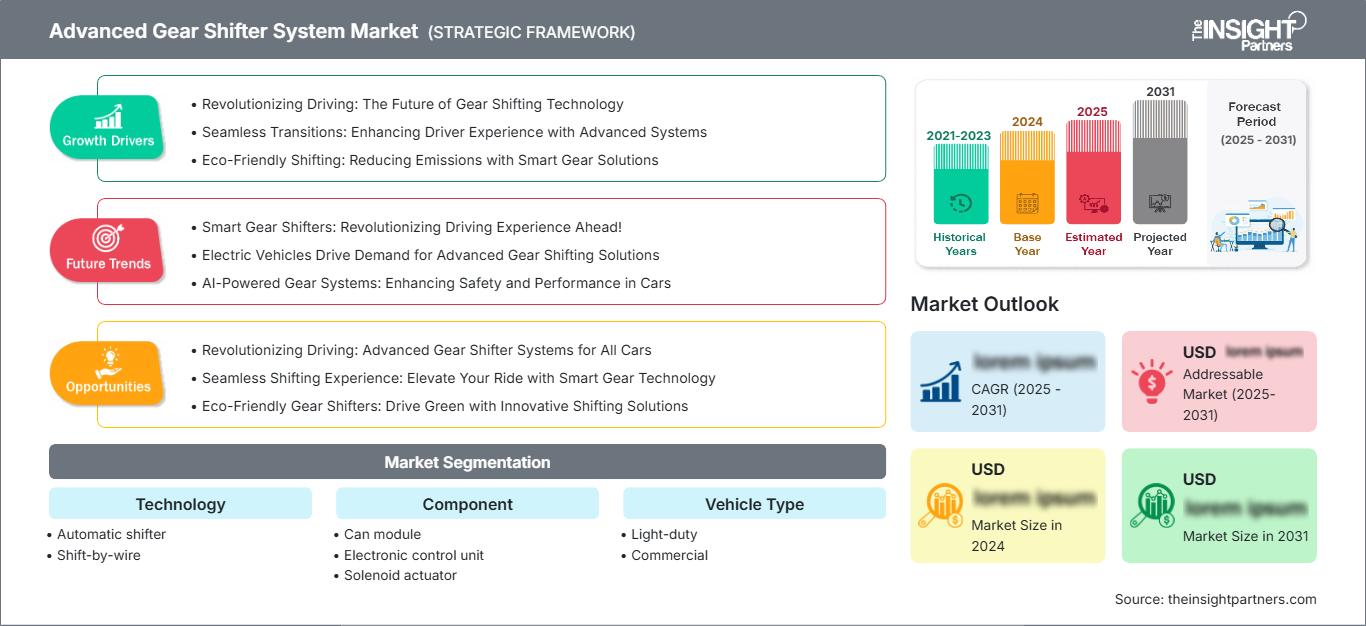
Advanced Gear Shifter System Market: Strategic Insights
Regional Insights
North Advanced Gear Shifter System Market
North America holds a 23%–27% share in 2025 and is expected to expand at a 7.0%–8.0% CAGR during 2026–2034. Demand is anchored in automatic transmission penetration, premium pickup and SUV platforms, and electronic cabin controls. Suppliers benefit from OEM requirements for compact selectors, fail-safe actuation, and integration with parking locks, braking logic, and hybrid powertrain management.
Advanced Gear Shifter System market trends in the region are reinforced by fleet automation and growing EV introductions. Both U.S. and Canada are ramping up efforts on the development of ECUs, CAN modules, and shift-by-wire redundancy. The focus on vehicular safety by the National Highway Traffic Safety Administration is an enabler for electronic validation, along with local manufacturing, reducing lead time risks.
U.S. Advanced Gear Shifter System Market
The U.S. accounts for 70%–75% of North American demand in 2025 and is projected to grow at a 7.5%–8.5% CAGR. Light-duty trucks, SUVs, hybrid models, and battery electric vehicles drive demand for electronic selectors. Domestic OEMs increasingly require shifters that support user confirmation, park-by-wire coordination, and diagnostic communication across software-defined vehicle architectures.
The presence of the company is seen through GHSP, Inc., Orscheln Products LLC, DURA Automotive Systems LLC, ZF Friedrichshafen AG, and foreign companies supplying components for US assembly programs. The Advanced Gear Shifter System Market comprises an increased use of rotary selectors, push-button, small lever, and shift-by-wire systems used in hybrid and BEV applications. Transmission systems of commercial vehicles generate the demand for durable actuators and ECUs.
Europe Advanced Gear Shifter System Market
Europe holds a 22%–27% share in 2025 and is projected to grow at a 6.5%–7.5% CAGR. Germany is the leading country because premium OEM platforms, transmission engineering depth, and supplier concentration support early electronic selector adoption. Functional safety requirements and EU emissions policy continue to push automakers toward lighter, digitally coordinated drivetrain interfaces.
The UK market is shaped by premium imports, electrified fleet transition, and strong demand for intuitive cockpit controls. Shift-by-wire adoption is supported by luxury vehicle penetration and technology-rich model launches. The Advanced Gear Shifter System Market growth is supported by engineering collaboration with European OEMs, especially where interior design, tactile quality, and electronics integration influence procurement.
France, Italy, and Spain add scale through compact vehicle production, hybrid model expansion, and regional sourcing of transmission and interior modules. Germany remains the strongest country, while France contributes through mass-market electrification programs. Italy and Spain support supplier demand through small-car platforms, light commercial vehicles, and assembly networks tied to pan-European OEM strategies.
Across Europe, the Advanced Gear Shifter System Market is broadening as EV interiors adopt compact controls and automatic transmissions expand in smaller models. Suppliers with ECU integration, tactile design, and cybersecure communication capabilities are positioned to benefit from platform consolidation across multiple vehicle brands.
APAC Advanced Gear Shifter System Market
APAC leads with a 38%–44% share in 2025 and is forecast to grow at an 8.0%–9.0% CAGR. China is the leading country, supported by high vehicle production, rapid EV scale-up, and strong electronics manufacturing. IEA data showing China’s EV leadership reinforces demand for electronic selector systems in battery platforms.
The contributions of Japan and South Korea include precision engineering, compact actuator design, and OEM-supplier cooperation. These regions have their preference for noise-free gears, durability, and smooth shifting. The Advanced Gear Shifter System Market gains advantage from the well-established presence of companies like Fuji Kiko Co., Ltd., Motherson Atsumitec Automotive System Company Limited, and Delta Kogyo Co., Ltd. to increase the capabilities of shifters and interior control mechanisms.
India and Australia are not very big in terms of market size, but they are strategically important for the industry. India will increase the demand for affordable gear shifters due to its adoption of automatic transmissions, supportive electric vehicle policies, and the use of locally sourced components. Australia will have to rely on foreign advanced vehicles and commercial applications.
Middle East & Africa Advanced Gear Shifter System Market
The Middle East & Africa is expected to grow at a 5.5%–6.5% CAGR, with Saudi Arabia leading regional demand. Premium vehicle imports, logistics fleet upgrades, and infrastructure-led mobility investment support the Advanced Gear Shifter System Market. Electronic shifters are most relevant in high-end passenger cars, commercial vehicles, and emerging EV fleets.
Saudi Arabia and the UAE are adopting advanced vehicles within tourism, logistics, government fleet, and smart-city programs. Energy diversification strategies and charging infrastructure plans indirectly support EV-compatible selectors. South Africa adds demand through premium passenger cars and commercial applications, though affordability and service support remain important constraints. The Advanced Gear Shifter System Market is expected to benefit from these developments as vehicle modernization and electrification initiatives expand across the region.
The rest of the MEA demand is gradual and dependent on imports. Design requirements for suppliers include toughness of design, flexibility of specification, and cost controls since operating conditions differ significantly due to differences in road conditions, weather, and post-sales services capabilities. Solenoid actuator durability and ECU reliability will probably have an edge over expensive customization.
Segmentation Analysis
Technology
The technology segment is expected to grow at a 7.5%–8.5% CAGR during 2026–2034 as OEMs migrate from mechanical shifters to electronic selector architectures. Demand is influenced by transmission automation, EV platform packaging, and the need for safer software-mediated commands. Automatic shifters remain volume-led, while shift-by-wire systems carry stronger strategic value in premium, hybrid, and battery electric models.
- Automatic shifter systems maintain the broadest installed base because they support comfort-focused driving, high-volume passenger vehicles, and predictable transmission behavior across urban and highway use cases.
- Shift-by-wire systems are strategically important because they remove mechanical linkage, improve interior flexibility, and integrate with electronic parking, ADAS, EV propulsion, and software-defined vehicle functions.
Component
The component segment is projected to grow at a 7.0%–8.0% CAGR during 2026–2034 as shifter assemblies become more electronics-intensive. ECUs, CAN modules, and solenoid actuators are increasingly procured as coordinated systems rather than separate parts. OEM expectations now include diagnostics, functional safety readiness, compact packaging, and compatibility with multiple drivetrain platforms.
- CAN modules enable reliable communication between the shifter, transmission controller, ECU, and safety systems, making them essential as connected vehicle networks become more complex.
- Electronic control units process driver inputs, validate safety conditions, and coordinate shift commands, supporting diagnostics, functional safety, and drivetrain logic across combustion, hybrid, and electric vehicles.
- Solenoid actuators provide controlled mechanical movement for engagement and disengagement, offering fast response, durability, and compatibility with automatic and semi-automatic transmission systems.
Vehicle Type
The vehicle type segment is expected to grow at a 7.2%–8.2% CAGR during 2026–2034. Light-duty vehicles dominate because passenger cars, SUVs, and pickups absorb most automatic and electronic shifter demand. Commercial vehicles are gaining relevance as fleet operators seek ergonomic controls, reduced driver fatigue, and more consistent transmission operation in delivery, logistics, and bus applications.
- Light-duty vehicles lead demand due to passenger car volumes, SUV growth, automatic transmission penetration, and customer preference for compact, smooth, and digitally integrated selector interfaces.
- Commercial vehicles use advanced shifter systems to improve ergonomics, reduce fatigue, and support automated transmission operation across delivery fleets, buses, and medium-duty platforms.
Electric vehicle
The electric vehicle segment is expected to grow at a 9.0%–10.0% CAGR during 2026–2034, making it the fastest-growing application area. Battery, fuel cell, and plug-in hybrid platforms depend on electronic drive selection, safety interlocks, and powertrain coordination. As EV interiors become more minimalistic, shifter systems are evolving into compact software-linked control interfaces.
- Battery electric cars use electronic shifting systems extensively due to their need for simpler drivelines, regenerative braking control, and space-efficient interiors.
- Fuel cell cars need strong electronic shifting systems due to the need to be compatible with electric drive setups and safe shifting operations.
- Plug-in hybrid cars require systems that synchronize engine, motor, and transmission functions, providing seamless shifts between modes.
Opportunity Snapshot
| Vehicle Type | Revenue Contribution | Trend Tag | Adoption Stage |
| Light-duty | High | Digital Cockpit | Mature |
| Commercial | Medium | Fleet Automation | Scaling |
Advanced Gear Shifter System Market Growth Drivers and Impact Analysis
Automatic Transmission Penetration Reshaping Vehicle Demand
The growing use of automatic transmission is broadening the potential user base of the Advanced Gear Shifter System Market through the incorporation of electronic selector parts in medium-tier vehicles and not just luxury ones. The reasons behind this trend include urban traffic conditions, higher comfort demands, and decreased driver fatigue among passenger cars and SUVs. At the same time, fleets seek consistent performance and reduced training effort. What results from that is a change in the supplier’s focus from simple mechanical levers to module parts with built-in actuators, ECUs, and interfaces. The suppliers benefit from the possibility of creating a platform for different types of vehicles, including combustion engine, hybrid, and electric ones.
Shift-by-Wire Adoption Supporting Software-Defined Vehicles
The use of shift-by-wire systems will emerge as a key driving factor as more vehicles integrate electronics into the control of their drivetrain, braking, parking, and driver assistance systems. Through the elimination of the mechanical connection, the technology helps remove constraints related to packaging and enables validation of gears through software in conjunction with vehicle speed, braking status, and other factors. The benefit is particularly pronounced for electric and hybrid vehicles, which already have electronic configurations of their drivetrains and can thus benefit from compact gearing for increased interior space utilization. The suppliers will need to ensure redundancy, communication, diagnosis, and actuation for such platforms.
Electrified Powertrains Increasing Electronic Control Needs
Electric drives are changing the function of gear selector controls due to their demand for synchronous control of drive, reverse, neutral, and park modes. In light of the 2024 electric vehicle sales figures by IEA, the reality of the extent of electrification makes it necessary to have electronic shifter systems capable of communicating with the drive control units and safety systems. The effect will be on the design of shift control units based on software control and electronics architecture. The suppliers providing electric vehicle platforms with flexible interface capabilities stand to win lifecycle agreements, while OEMs will benefit from simplified interior layouts and reduced mechanical complexity.
Advanced Gear Shifter System Market Future Trends
Haptic and Minimalist Shifter Interfaces Moving Mainstream
Future Advanced Gear Shifter System Market development will be shaped by haptic controls, rotary dials, push-button selectors, and compact electronic levers that align with cleaner digital interiors. As premium features migrate into upper mass-market models, suppliers will need modular designs that let OEMs customize appearance without redesigning the control core. Haptic feedback will become more important where drivers need confirmation during automated parking, EV mode selection, or semi-autonomous operation. The trend supports higher electronics content, better perceived quality, and stronger differentiation through tactile response, illumination, and intuitive movement logic.
Integrated Safety Logic Becoming a Core Design Priority
Competitiveness in the future would depend on integrated safety logic as shift command becomes electronic. There has to be avoidance of unintentional gear shifts, coordination of park lock operation, detection of problems, and security of communication with braking and driver assistance systems. Original equipment manufacturers will need to perform a stricter selection of suppliers through testing of the reliability of the hardware, software behavior, diagnostics, and cybersecurity features. This could mean an advantage for bigger companies or those with technical specialization, while promoting collaboration between mechanical shifter manufacturers and electronics manufacturers.
Advanced Gear Shifter System Market Opportunities
EV Platform-Specific Shifter Module Development
The EV platform will provide an opening for small, light, and software-driven shifter modules. The requirement for battery-electric vehicles, fuel cell vehicles, and plug-in hybrids includes a drive selector module that will interact with the propulsion control module, parking lock module, battery management module, and safety modules. For the suppliers, there is an opportunity to develop standardized electronic modules that come with customizable exteriors depending on the interiors of the OEMs. There is especially a good opportunity for suppliers who can prove their competence in validating low-power electronics, redundant communications, and software diagnostic tools in various regions.
Localization for High-Growth Automotive Manufacturing Hubs
The Asia Pacific region, along with selected emerging markets, provides a real-world opportunity for localized manufacture of the Advanced Gear Shifter System. There is increasing adoption by automotive manufacturers in China, India, South Korea, and Southeast Asia of both automatic transmissions and electric vehicles. This provides a market demand for selector mechanisms that are dependable and competitively priced. Locally based production can minimize logistics vulnerability, provide greater flexibility, and ensure adaptability to regional pricing levels. The emphasis of suppliers should be on solenoid actuators, CAN modules, and ECUs because of cost and availability issues.
Recent Developments
- June 2026: Lumax Auto Technologies Limited — secured start-of-production agreements for three vehicle platforms as e-shifter and shift-by-wire adoption accelerated in India. The update highlighted demand for sensor-based and CAN-based architectures, reinforcing OEM movement toward electronic gear selectors, mechatronics-led transmission interfaces, and platform-level supply opportunities.
- February 2025: NIO Inc. — advanced a technology partnership with ZF Friedrichshafen AG through serial production of ZF steer-by-wire technology in the NIO ET9 SkyRide chassis. Although focused on steering, the deployment validates broader by-wire architectures, redundant actuator systems, and software-defined control principles that support future shift-by-wire gear selector adoption.
- February 2024: ZF announced that the first PowerLine 8-speed automatic transmissions rolled off the production line in late 2023 at its Gray Court, South Carolina, manufacturing facility. As part of a $200 million investment announced in 2021, ZF is now ramping up production to 200,000 transmissions per year by 2025 to satisfy demand from US commercial vehicle manufacturers, including three US-based customers.
Frequently Asked Questions

- Comprehensive Market Sizing and Forecast Analysis
- Detailed Segmentation Analysis
- In-Depth Market Dynamics Assessment
- Regional and Country-Level Insights
- Competitive Landscape and Company Benchmarking
- Strategic Business Intelligence
Recent Reports
Testimonials

The Insight Partners' SCADA System Market report is comprehensive, with valuable insights on current trends and future forecasts. The team was highly professional, responsive, and supportive throughout. We are very satisfied and highly recommend their services.
RAN KEDEM Partner, Reali Technologies LTDs
I requested a report on a very specific software market and the team produced the report in a few days. The information was very relevant and well presented. I then requested some changes and additions to the report. The team was again very responsive and I got the final report in less than a week.
JEAN-HERVE JENN Chairman, Future Analytica
We worked with The Insight Partners for an important market study and forecast. They gave us clear insights into opportunities and risks, which helped shape our plans. Their research was easy to use and based on solid data. It helped us make smart, confident decisions. We highly recommend them.
PIYUSH NAGPAL Sr. Vice President, High Beam Global
The Insight Partners delivered insightful, well-structured market research with strong domain expertise. Their team was professional and responsive throughout. The user-friendly website made accessing industry reports seamless. We highly recommend them for reliable, high-quality research services
YUKIHIKO ADACHI CEO, Deep Blue, LLC.
This is the first time I have purchased a market report from The Insight Partners.While I was unsure at first, I visited their web site and felt more comfortable to take the risk and purchase a market report.I am completely satisfied with the quality of the report and customer service. I had several questions and comments with the initial report, but after a couple of dialogs over email with their analyst I believe I have a report that I can use as input to our strategic planning process.Thank you so much for taking the extra time and making this a positive experience.I will definitely recommend your service to others and you will be my first call when we need further market data.
JOHN SUZUKI President and Chief Executive Officer, Board Director, BK Technologies
I wish to appreciate your support and the professionalism you displayed in the course of attending to my request for information regarding to infectious disease IVD market in Nigeria. I appreciate your patience, your guidance, and the fact that you were willing to offer a discount, which eventually made it possible for us to close a deal. I look forward to engaging The Insight Partners in the future, all thanks to the impression you have created in me as a result of this first encounter.
DR CHIJIOKE ONYIA MANAGING DIRECTOR, PineCrest Healthcare Ltd.Reason to Buy
- Informed Decision-Making
- Understanding Market Dynamics
- Competitive Analysis
- Identifying Emerging Markets
- Customer Insights
- Market Forecasts
- Risk Mitigation
- Boosting Operational Efficiency
- Strategic Planning
- Investment Justification
- Tracking Industry Innovations
- Aligning with Regulatory Trends





 Get Free Sample for