
Aerospace Microwave Devices Market Size, Growth & Demand by 2034
Coverage: by Component (Filters and Duplexers, Isolators and Circulators, Couplers, Adapters, Others); Application (Commercial, Military) , and Geography (North America, Europe, Asia Pacific, and South and Central America)
- Status : Data Released
- Report Code : TIPRE00010507
- Category : Electronics and Semiconductor
- No. of Pages : 150
- Available Report Formats :


- Last update date : July 09, 2026


2025 Market Size
US$ 9.28 Bn
Base year value
2034 Forecast
US$ 15.25 Bn
Projected by 2034
CAGR 2026-2034
5.68 %
Growth rate
Addressable Market
US$ 111.22 Bn
(2026-2034)
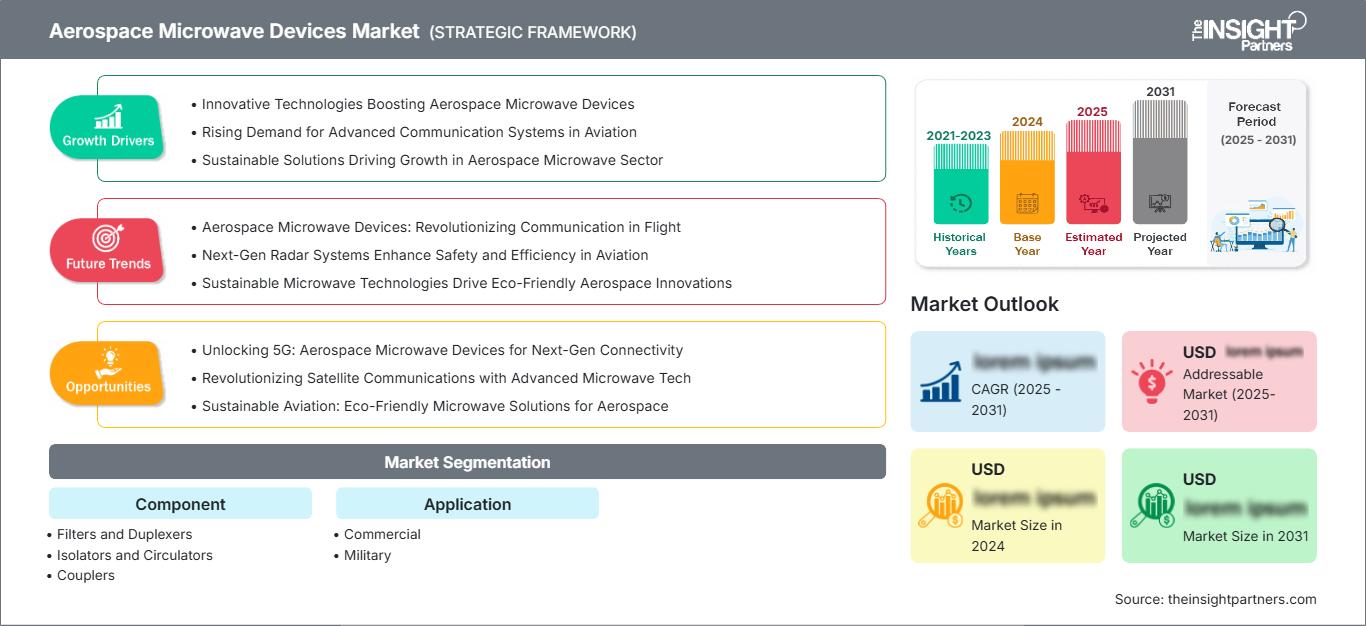
The Aerospace Microwave Devices Market was valued at US$ 9.28 Billion in 2025 and is projected to reach US$ 15.25 Billion by 2034, growing at a CAGR of 5.68% during 2026–2034. The market supports aircraft, satellites, radar, electronic warfare, secure communications, and navigation systems through filters, duplexers, isolators, circulators, couplers, and adapters designed for high-frequency reliability.
North America is expected to grow at a CAGR range of 5.3–5.7% during 2026–2034 as defense radar modernization, satellite communications upgrades, and commercial fleet avionics refresh cycles raise demand for qualified microwave devices. The region benefits from established aerospace primes, defense electronics production, FAA-linked surveillance modernization, and a supplier base capable of meeting stringent environmental, screening, and traceability requirements.
Aerospace Microwave Devices Market Assessment and Insights
- North America: The region holds 34–38% share in 2025 and grows at a CAGR of 5.3–5.7% during 2026–2034, supported by radar recapitalization, protected communications, and space payload demand.
- US: The country represents 82–86% of North America in 2025 and grows at a CAGR of 5.4–5.8% during 2026–2034, led by defense programs and satellite electronics.
- Europe: The region accounts for 21–25% share in 2025 and grows at a CAGR of 5.0–5.4% during 2026–2034, with the UK, Germany, France, Italy, and Spain leading aerospace electronics demand.
- Asia Pacific: The region holds 24–28% share in 2025 and grows at a CAGR of 6.0–6.4% during 2026–2034, led by China, Japan, South Korea, India, and Australia across aircraft, space, and defense programs.
- Largest Segment: Filters and Duplexers hold 36–40% market share in 2025 and grow at a CAGR of 5.2–5.6% during 2026–2034 because frequency selectivity remains fundamental to radar, satcom, and avionics.
- High Growth Segment: Military holds 58–62% market share in 2025 and grows at a CAGR of 6.1–6.5% during 2026–2034 as electronic warfare, AESA radar, and secure links expand.
- Key companies analyzed in detail: Spectrum Control, Inc.; CAES Systems LLC; Crane Company; L3Harris Technologies, Inc.; Mercury Systems, Inc.; Pasquali Microwave Systems S.r.l.; Qorvo, Inc.; Radiall S.A.; Teledyne Technologies Incorporated; TRM Microwave, Inc.
Source: The Insight Partners' analysis based on proprietary research, government publications, company annual reports, investor presentations, industry databases, and expert interviews.
Aerospace microwave design has shifted from discrete, board-level assemblies toward compact, qualified modules that combine low loss, high isolation, thermal stability, and repeatable performance across harsh altitude, vibration, and temperature profiles. Production dynamics are shaped by specialty substrates, precision machining, plating controls, hermetic sealing, and screening documentation. The Aerospace Microwave Devices Market trends also reflect wider adoption of gallium nitride power chains, phased-array architectures, and smaller line-replaceable units.
The demand for forward will increase in India, South Korea, the Gulf countries, and Eastern Europe, where there will be increased development in their aerospace industries, satellites, and air defense capabilities. Some of the regulatory headwinds are spectrum management, export control supply chain, airworthiness certification, and secure communication needs. The market scope of Aerospace Microwave Devices Market has thus been growing from purchasing parts to lifecycle-tested RF chains.
Aerospace Microwave Devices Market Report Scope
| Report Attribute | Details |
|---|---|
| Market size in 2025 | US$ 9.28 Billion |
| Market Size by 2034 | US$ 15.25 Billion |
| Global CAGR (2026 - 2034) | 5.68% |
| Historical Data | 2021-2024 |
| Forecast period | 2026-2034 |
Aerospace Microwave Devices Market Analysis
Demand is driven by commercial aircraft connectivity, weather radar, satellite payloads, navigation receivers, and military sensor upgrades that require stable microwave signal routing. IATA has reported record passenger demand and continuing airline capacity pressure, which supports avionics retrofit activity and longer aircraft utilization. In parallel, SIPRI has documented sustained military expenditure growth, reinforcing procurement momentum for radar, electronic support measures, and secure communications. The Aerospace Microwave Devices Market forecast indicates continued growth opportunities as commercial aviation expansion, defense modernization programs, and satellite communications investments increase demand for advanced microwave technologies.
The value chain includes RF semiconductor suppliers, ceramic and cavity filter specialists, connector and adapter manufacturers, module integrators, test laboratories, aerospace primes, and government qualification bodies. Supply dynamics remain constrained by long screening cycles, export compliance, small-batch customization, and high-reliability material sourcing. Aerospace Microwave Devices Market analysis indicates that lead-time certainty, documentation quality, and environmental qualification often influence sourcing as strongly as electrical performance.
The competitive environment consists of fragmented players with advanced technical skills. Qorvo, Inc. focuses on GaN, GaAs, RF control, and radar front-end technology, whereas Teledyne Technologies Incorporated encompasses RF, microwave, interconnect, sensing, and space-grade electronics. L3Harris Technologies, Inc. offers mission systems and secure communication solutions, and Mercury Systems, Inc. provides trusted processing and RF subsystems for defense programs.
Spectrum Control, Inc., CAES Systems LLC, Crane Company, Pasquali Microwave Systems S.r.l., Radiall S.A., and TRM Microwave, Inc. compete on qualifications, custom engineering, interconnect technologies, and program management continuity. Investments into R&D are directed to high-frequency automated testing, radiation-hardened parts, additive fabrication of RF components, and domestically secure production. The strategic position is based on certified production, application engineering, and the capability of sustaining long aerospace production cycles.
● REPORT CUSTOMIZATION
Tailor This Report To Align With Your Specific Business Requirements
This report can be customized to align precisely with your business objectives, scope, and target markets. Customization options include tailored segmentation, geography, competitive analysis, and strategic insights to support informed decision-making.
Customize This Report →WHAT YOU CAN ADJUST
- ● Segmentations
- ● Geography
- ● Competitive Analysis
- ● Language Preferences
Aerospace Microwave Devices Market: Strategic Insights
Regional Insights
North America Aerospace Microwave Devices Market
North America holds 34–38% share in 2025 and is projected to grow at a CAGR of 5.3–5.7% during 2026–2034. Demand is supported by airborne radar upgrades, protected tactical communications, space payload electronics, and modernization of air-traffic surveillance systems. The Aerospace Microwave Devices Market share in the region reflects deep defense procurement, prime contractor concentration, and qualified component manufacturing.
Commercial applications benefit from fleet utilization, cabin connectivity, weather radar replacement, and avionics retrofits. Military requirements remain structurally stronger because microwave devices are embedded in AESA radar, electronic warfare receivers, missile seekers, and satellite links. Suppliers with AS9100 processes, domestic screening capacity, and export-control discipline retain sourcing advantages.
U.S. Aerospace Microwave Devices Market Market
The U.S. represents 82–86% of North America in 2025 and grows at a CAGR of 5.4–5.8% during 2026–2034. The country benefits from major defense electronics programs, satellite payload integration, space launch activity, and commercial aviation aftermarket demand. L3Harris Technologies, Inc., Qorvo, Inc., Mercury Systems, Inc., Teledyne Technologies Incorporated, CAES Systems LLC, and Spectrum Control, Inc. support the domestic ecosystem. The Aerospace Microwave Devices Market report highlights the country's strong position, driven by sustained investments in defense modernization, aerospace innovation, and advanced communications infrastructure.
Application trends are strongest in radar front ends, electronic warfare receivers, secure SATCOM, air-traffic surveillance, and avionics test equipment. Procurement favors suppliers that can provide traceable materials, repeatable RF performance, and lifecycle support. The Aerospace Microwave Devices Market size in the U.S. is also reinforced by reshoring priorities and trusted microelectronics programs.
Europe Aerospace Microwave Devices Market Market
Europe accounts for 21–25% share in 2025 and is forecast to grow at a CAGR of 5.0–5.4% during 2026–2034. The UK leads through radar, electronic warfare, space communications, and defense avionics programs supported by specialist microwave engineering and test capability.
Contributions from Germany include airborne electronics, RF precision for industries, defense modernization, and aircraft systems. France’s support includes space payload, military aircraft, secure communication, and missile electronics, with national procurement programs encouraging European suppliers and part traceability.
Support from Italy and Spain comes via avionics, naval radar, satellite communications, and NATO-oriented modernization. Growth in Europe’s Aerospace Microwave Devices Market depends on increased military expenditure, air defense investment, and the technology requirements of countries favoring local design and maintenance.
APAC Aerospace Microwave Devices Market Market
Asia Pacific holds 24–28% share in 2025 and grows at a CAGR of 6.0–6.4% during 2026–2034. China leads regional volume through defense electronics, commercial aircraft ambitions, satellite programs, and domestic RF component substitution.
Japan and South Korea support advanced radar, space, and communications applications, while India is scaling aerospace manufacturing, missile systems, and satellite payload activity under national industrial policies.
Australia remains smaller but strategically important for defense surveillance, space cooperation, and secure communications. APAC demand is reinforced by air-defense spending, civil aviation growth, local manufacturing incentives, and rising requirements for qualified microwave modules.
Middle East & Africa Aerospace Microwave Devices Market Market
The Middle East & Africa is projected to grow at a CAGR of 4.7–5.1% during 2026–2034. Saudi Arabia is the leading country in air-defense, space, and localization programs, increasing demand for qualified RF and microwave electronics.
Demand is stimulated through aviation infrastructure, satellite communication, surveillance equipment, and aerospace services in the UAE. South Africa’s contribution includes defense electronics, radar technology, mining industry communication equipment, and maintenance services.
The rest of MEA is demand-driven imports, demand mainly driven by airport upgrades, military communication equipment, and border surveillance needs. Growth factors include offset deals, partnering suppliers, test capability, and sustained performance in difficult environments.
Segmentation Analysis
Component
The segment of components is expected to register a CAGR of 5.4–5.8% over 2026-2034. The requirements for the demand are based on increased operating frequency, reduced insertion loss tolerance, wider bandwidth, and the ability to withstand thermal shock, vibration, and radiation. The filters and duplexers will continue to play an important role in the management of the spectrum, and isolators, circulators, couplers, and adapters are also necessary for the signaling process.
- Filters and Duplexers: This sub-segment leads demand because aerospace systems require precise frequency selection, interference rejection, and transmit-receive separation across crowded radar, communication, and navigation bands.
- Isolators and Circulators: These devices protect sensitive RF chains from reflected power and enable directional signal flow, making them strategically important in radar transmitters, satellite payloads, and high-power communication systems.
- Couplers: Couplers support signal sampling, monitoring, power measurement, and feedback functions, helping aerospace engineers validate performance, manage calibration, and improve reliability in compact microwave assemblies.
- Adapters: Adapters serve as critical interconnection elements where legacy equipment, test systems, and qualified aerospace subsystems must connect without compromising impedance, shielding, or mechanical durability.
Application
The application segment is expected to grow at a CAGR of 5.7–6.1% during 2026–2034. Commercial aviation uses microwave devices in weather radar, satellite connectivity, navigation, transponders, and avionics test systems. Military applications show stronger growth because radar modernization, electronic warfare, missile guidance, and secure communications require higher power handling, wider bandwidth, lower noise, and rugged qualification.
- Commercial: Demand is linked to avionics retrofits, passenger connectivity, weather radar upgrades, aircraft production recovery, and maintenance cycles that require qualified components with predictable service availability.
- Military: This sub-segment is strategically important because active electronically scanned arrays, electronic support measures, missile seekers, and secure SATCOM platforms require specialized microwave performance under harsh conditions.
Opportunity Snapshot
| Application | Revenue Contribution | Trend Tag | Adoption Stage |
| Commercial | Medium | Connected Aircraft | Scaling |
| Military | High | AESA Radar | Mature |
Aerospace Microwave Devices Market Growth Drivers and Impact Analysis
Radar Modernization Across Airborne and Space Platforms
Radar technology in today’s times calls for microwave devices offering better loss behavior, phase stability, isolation, and operation within large temperature limits. Active Electronically Scanned Arrays (AESAs) involve many transceiver paths, which result in more demand for compact filters, couplers, circulators, and adapters that can be mass-produced and qualified through rigorous processes. Maximum commercial effects can be seen in fighter jets, maritime patrol aircraft, unmanned systems, air defense radars, and satellites. Suppliers who can offer small size, light weight, low power consumption, and screening data will benefit in terms of program awards and design-in value.
Secure Communications and SATCOM Capacity Expansion
Modern aircraft, satellites, and defense systems need strong connections that can work effectively through contested, congested, and high-frequency environments. Microwave filters, duplexer, isolator, and coupler play a vital role in maintaining the quality of the signal, protecting the transmit chain, and separating bands within the terminal. In practical terms, there is a growing need for the use of components in satellite communications from aircraft, tactical data links, telemetry, electronic support systems, and multi-orbit operations. As the demand increases in both commercial and military organizations, there are more chances for certified microwave component manufacturers.
Longer Aircraft Utilization and Avionics Retrofit Demand
Commercial airlines are extending the lifespan of their aircraft due to delays in deliveries and constraints in maintaining their aircraft, which makes aircraft renewal difficult. This operational trend creates higher demand for avionics upgrades, connectivity upgrades, maintenance of weather radars, and testing equipment that incorporates microwave devices. Impact of Growth of Aerospace Microwave Devices Market on the Industry. The growth in the aerospace microwave devices market will be quite practical since there will be a need for compatible, certified, and readily available microwave devices by airlines and maintenance companies.
Aerospace Microwave Devices Market Future Trends
Higher-Frequency Integration for Compact Payloads
Future aerospace payloads will increasingly move toward higher-frequency bands and more integrated RF front ends as platforms require more bandwidth, better resolution, and smaller electronics bays. This shift will favor microwave devices with lower insertion loss, improved thermal behavior, tighter tolerances, and compatibility with advanced packaging. The trend is expected to influence satellite terminals, radar seekers, unmanned aircraft payloads, and aircraft communications. Component makers that combine RF design, materials science, and miniature packaging will be better positioned than suppliers focused only on catalog parts.
Digital Engineering and Automated RF Test Qualification
Digital engineering will become more important as aerospace buyers expect faster qualification without compromising reliability. Microwave device suppliers are likely to use simulation, model-based design, automated vector-network analysis, and digital thread documentation to reduce iteration cycles. This trend can improve first-pass yield, support configuration control, and shorten design-to-production transitions for customized filters, couplers, isolators, and adapters. Buyers will increasingly value suppliers that can provide verified performance data, environmental history, and traceability in formats that integrate with program-level engineering systems.
Aerospace Microwave Devices Market Opportunities
Qualified Domestic RF Supply Chains
National security buyers are placing greater emphasis on trusted sourcing, export compliance, and continuity of supply for mission-critical electronics. This creates an opportunity for microwave device manufacturers to expand domestic screening, plating, machining, ceramic processing, and automated test capacity. The action path includes qualification investment, second-source readiness, and collaboration with aerospace primes during early design. Companies that document material provenance, maintain stable process controls, and support long program lifecycles can capture premium positions in defense, space, and regulated commercial aerospace supply chains.
Custom Microwave Modules for Multi-Function Systems
Aerospace platforms are consolidating radar, communications, navigation, identification, and electronic support functions into smaller multi-function apertures. This creates investment opportunities in custom microwave modules that combine filters, couplers, switches, isolators, adapters, and interconnects into qualified assemblies. Suppliers can differentiate by reducing integration burden, improving repeatability, and supporting thermal and mechanical co-design. The opportunity is strongest where customers need fewer interfaces, faster qualification, lower weight, and reliable performance under shock, vibration, altitude, and high-duty-cycle operation.
Recent Developments
- May 2026: Microwave Products Group (MPG), part of Dover, announced that it will unveil three new products designed to help Aerospace & Defense customers make faster, more informed radio frequency (RF) spectrum decisions at AOC Europe 2026, a premier defense event and exhibition, on May 19-21 in Helsinki, Finland. MPG will also highlight its broader expertise in artificial intelligence (AI)-enabled signals intelligence (SIGINT) and radio frequency machine learning (AI/RFML) capabilities at the event.
- June 2026: MACOM Technology Solutions Inc. (“MACOM”), a leading supplier of semiconductor products, today announced a new suite of high-performance RF solutions designed to meet the demanding requirements of aerospace and defense (A&D).
- February 2026: Airbus Defense and Space and Greenerwave announce the strengthening of their strategic partnership through the expansion of their collaboration. This new milestone is marked by the signing of two additional contracts with a total value of several million euros, further reinforcing and broadening the cooperation between the two companies. These agreements reflect their mutual trust and shared commitment to developing cutting-edge technological solutions for the benefit of their end customers, notably the French Armed Forces.
Frequently Asked Questions

- Comprehensive Market Sizing and Forecast Analysis
- Detailed Segmentation Analysis
- In-Depth Market Dynamics Assessment
- Regional and Country-Level Insights
- Competitive Landscape and Company Benchmarking
- Strategic Business Intelligence
Recent Reports
Testimonials

The Insight Partners provided valuable market intelligence that supported our global go-to-market strategy. Their team was professional, responsive, and attentive to our feedback, providing thoughtful analysis and helpful methodological clarifications throughout the project.
Junmo Kim Chief Financial Officer (CFO), Enertech Co., Ltd.
The Insight Partners' SCADA System Market report is comprehensive, with valuable insights on current trends and future forecasts. The team was highly professional, responsive, and supportive throughout. We are very satisfied and highly recommend their services.
RAN KEDEM Partner, Reali Technologies LTDs
I requested a report on a very specific software market and the team produced the report in a few days. The information was very relevant and well presented. I then requested some changes and additions to the report. The team was again very responsive and I got the final report in less than a week.
JEAN-HERVE JENN Chairman, Future Analytica
We worked with The Insight Partners for an important market study and forecast. They gave us clear insights into opportunities and risks, which helped shape our plans. Their research was easy to use and based on solid data. It helped us make smart, confident decisions. We highly recommend them.
PIYUSH NAGPAL Sr. Vice President, High Beam Global
The Insight Partners delivered insightful, well-structured market research with strong domain expertise. Their team was professional and responsive throughout. The user-friendly website made accessing industry reports seamless. We highly recommend them for reliable, high-quality research services
YUKIHIKO ADACHI CEO, Deep Blue, LLC.
This is the first time I have purchased a market report from The Insight Partners.While I was unsure at first, I visited their web site and felt more comfortable to take the risk and purchase a market report.I am completely satisfied with the quality of the report and customer service. I had several questions and comments with the initial report, but after a couple of dialogs over email with their analyst I believe I have a report that I can use as input to our strategic planning process.Thank you so much for taking the extra time and making this a positive experience.I will definitely recommend your service to others and you will be my first call when we need further market data.
JOHN SUZUKI President and Chief Executive Officer, Board Director, BK Technologies
I wish to appreciate your support and the professionalism you displayed in the course of attending to my request for information regarding to infectious disease IVD market in Nigeria. I appreciate your patience, your guidance, and the fact that you were willing to offer a discount, which eventually made it possible for us to close a deal. I look forward to engaging The Insight Partners in the future, all thanks to the impression you have created in me as a result of this first encounter.
DR CHIJIOKE ONYIA MANAGING DIRECTOR, PineCrest Healthcare Ltd.Reason to Buy
- Informed Decision-Making
- Understanding Market Dynamics
- Competitive Analysis
- Identifying Emerging Markets
- Customer Insights
- Market Forecasts
- Risk Mitigation
- Boosting Operational Efficiency
- Strategic Planning
- Investment Justification
- Tracking Industry Innovations
- Aligning with Regulatory Trends





 Get Free Sample for