
AI in the Drone Market Share, Size & Demand by 2034
AI in the Drone Market Size and Forecast (2021 - 2034), Global and Regional Share, Trend, and Growth Opportunity Analysis Report Report Coverage : by Technology (Machine learning, Computer vision, Natural language learning, Robotics and automation), Organization type (SME and Large enterprise), Deployment (Cloud and On-premise) and Geography
- Status : Data Released
- Report Code : TIPRE00042040
- Category : Technology, Media and Telecommunications
- No. of Pages : 150
- Available Report Formats :


- Last update date : December 02, 2025


2025 Market Size
US$ 15.20 Bn
Base year value
2034 Forecast
US$ 61.34 Bn
Projected by 2034
CAGR 2026-2034
16.77 %
Growth rate
Addressable Market
US$ 321.35 Bn
(2026-2034)
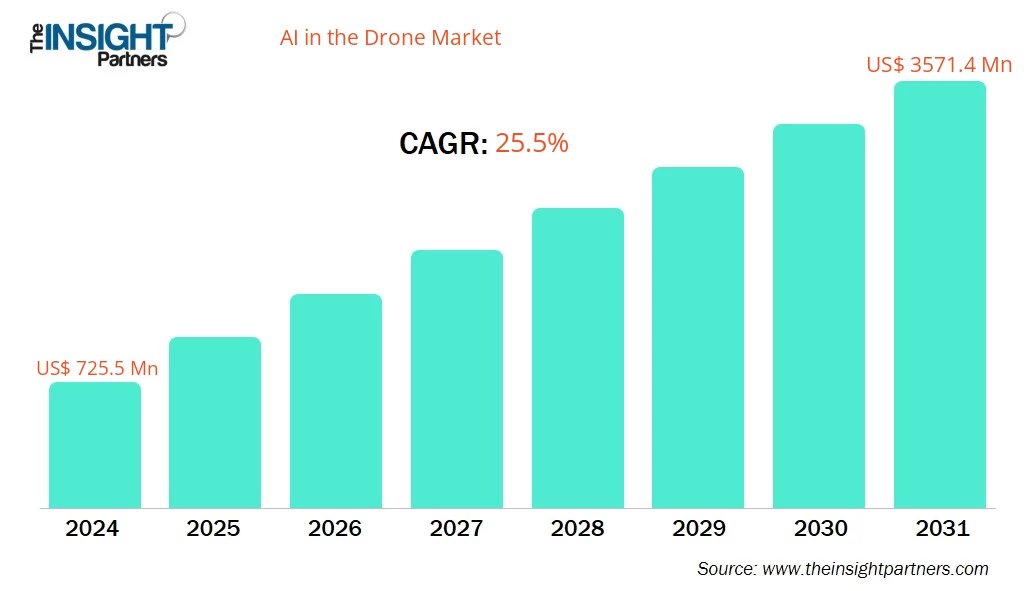
AI in the Drone market size is expected to reach US$ 61.34 Billion by 2034 from US$ 15.20 Billion in 2025. The market is anticipated to register a CAGR of 16.77% during the forecast period 2026–2034.
AI in Drone Market Analysis
The forecast for the AI in drone market signals strong growth due to the increasing integration of artificial intelligence into unmanned aerial vehicle systems among defense, commercial, and civil uses. Primary drivers for growth are increasing demand for autonomous aerial actions, real-time data processing, and intelligent operations for navigation.
Market growth is reinforced by developments in edge computing, sensor fusion, and onboard AI accelerators, which reduce reliance and demand for cloud connectivity. Moreover, increasing adoption of drones powered by artificial intelligence for smart city use cases, precision agriculture models, infrastructure monitoring, and last-mile delivery are all accelerating the demand for scalable, intelligent aerial systems.
AI in the Drone Market Overview
AI in drone market involves the use of machine learning, computer vision, and data processing abilities for improved autonomy, precision, and intelligence for unmanned aerial vehicles (UAVs). You can have autonomous drone systems that can complete goals requiring complex operations, such as navigating in real-time, storing data, mission planning, and object detection and classification, without the need for constant human control.
Drone AI systems are widely used in the defense, commercial, and civilian sectors for applications such as surveillance, agriculture, logistics, infrastructure inspection, and disaster response. AI drones provide advantages to their users by improving decision-making speed, lowering operational costs, and increasing the success rate of missions. AI-powered drones are becoming indispensable tools in transforming industries and shaping the future of autonomous aerial operations.
Market Research Highlights
- Global market for AI in the Drone was valued at US$ 15.20 Billion in 2025
- Annual market size is expected to reach US$ 61.34 Billion by 2034
- Total addressable market (TAM) during 2026-2034 is projected to reach approximately US$ 321.35 Billion
- Market is anticipated to register a CAGR of 16.77% during the forecast period
- The United States represents a key market, supported by Growing Demand for Aerial Operations with Autonomous Capabilities, Spending Growth in Defense and Security, Development of Smart Cities and Urban Air Mobility, as well as evolving industry dynamics
- Market analysis covers North America, Europe, Asia-Pacific, South and Central America, Middle East and Africa, with growth evaluated across the forecast period
- Market opportunities such as Autonomous swarms of drones, sophisticated AI-based surveillance, Processing geospatial information in real-time during defense and commercial operations are expected to influence market dynamics and addressable market
- Report profiles industry participants, including DJI - China, DroneDeploy - United States, Teledyne FLIR LLC - United States, Skydio Inc. - United States, Shield AI - United States, IdeaForge Technology Ltd. - India, Aerovironment, Inc. - United States, Pix4D SA - Switzerland, Draganfly - Canada, Dedrone - United States, Percepto Ltd. - United States, Qualcomm Technologies, Inc. - United States, Honeywell International Inc. - United States, while analyzing competitive strategies and innovation developments
-
Source: The Insight Partners' analysis based on proprietary research, government publications, company annual reports, investor presentations, industry databases, and expert interviews.
● REPORT CUSTOMIZATION
Tailor This Report To Align With Your Specific Business Requirements
This report can be customized to align precisely with your business objectives, scope, and target markets. Customization options include tailored segmentation, geography, competitive analysis, and strategic insights to support informed decision-making.
Customize This Report →WHAT YOU CAN ADJUST
- ● Segmentations
- ● Geography
- ● Competitive Analysis
- ● Language Preferences
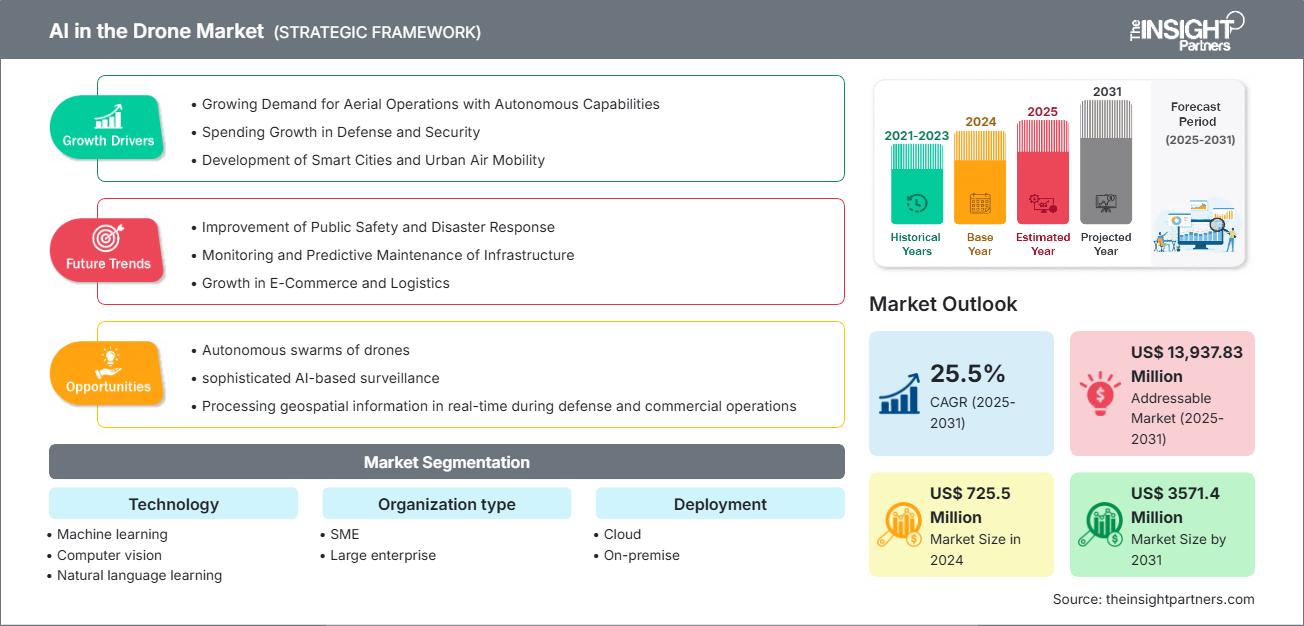
AI in the Drone Market: Strategic Insights
-
Get Top Key Market Trends of this report.This FREE sample will include data analysis, ranging from market trends to estimates and forecasts.
Market Drivers:
- Growing Demand for Aerial Operations with Autonomous Capabilities: Many industries are adopting AI-enabled drones in order to execute complex missions such as surveillance, mapping, and delivery, allowing for human awareness but not involvement. The need for faster, safer, and cheaper operations is driving the need to include AI in UNVs.
- Spending Growth in Defense and Security: Governments across the world are increasing budgets for drone technologies, being driven by AI for border monitoring, intelligence, and autonomous combat. These efforts are rapidly increasing the adoption of AI in defense-grade drones.
- Development of Smart Cities and Urban Air Mobility: The adoption of smart city infrastructure and urban air mobility ecosystems will drive demand for AI-enabled drones that manage aerial traffic (like air taxis), last-mile logistics, and real-time tracking.
Market Opportunities:
- Improvement of Public Safety and Disaster Response: Autonomous AI drones are being used more often for emergency response, search and rescue, and disaster management to enhance situational awareness and operational effectiveness in emergency situations.
- Monitoring and Predictive Maintenance of Infrastructure: Industries such as energy, transportation, and construction are using AI drones to inspect assets in inaccessible locations, to find defects, and to carry out predictive maintenance, all by means of analytics and machine learning.
- Growth in E-Commerce and Logistics: AI integration in delivery drones is optimizing route planning, traffic avoidance, and payload management, supporting the rise of contactless and rapid last-mile delivery solutions across urban and rural regions.
AI in Drone Market Report Segmentation Analysis
The AI in the drone market share is analyzed across various segments to provide a clearer understanding of its structure, growth potential, and key trends. Below is the standard segmentation approach used in most industry reports:
By Solution:
- Infrastructure: Infrastructure consists of hardware and embedded AI platforms that support the foundation on which intelligent drone operations are based. This category will encompass systems that integrate computing modules, sensors, and communication interfaces to strategically facilitate autonomous flight and real-time analytics.
- Software: AI drone software encompasses mission planning, computer vision algorithms, navigation smarts, and analytics platforms. Software plays a critical role in real-time decision-making, data processing, and system controls for both defense and commercial uses.
- Services: The services sector includes deployment, upkeep, training, and analytic support. The services sector is integral to enabling the application of AI drone solutions and the subsequent handling of their lifecycle by end-users in any application sector.
By Function:
- Flight Operations: This encompasses AI functionality for autonomous take-off, route optimization, obstacle avoidance, and landing. This enables drones to perform missions without constant human intervention, thus enhancing safety and efficiency.
- Maintenance: AI-based predictive maintenance software monitors components and systems to spot anomalies, plan repairs, and minimize downtime.
- Ground Control: AI-powered ground control stations integrate with drone systems to provide enhanced mission oversight, path adjustment, and real-time situational awareness.
- Asset Health: This group of function utilizes AI for drone and payload health monitoring to support mission performance by early detection of failures and assurance of assets' reliability.
- Simulation: AI simulation environments are used to train drones for various mission scenarios, enabling system learning, testing, and validation without the need for physical flight.
- Revenue Optimization: AI allows for operational cost efficiency during each mission through route analysis, fuel usage estimates, and trip planning when considering commercial and delivery drone applications.
By Technology:
- Machine Learning: Machine learning holds the largest share in this segment, allowing drones to learn from environmental inputs and make their operations better over time without programming them.
- Deep Learning: Deep learning is used for complex pattern recognition and allows drones to understand large datasets, such as images or video feeds, to assist, assess, and interpret object detection and provide high-level decision making.
- Computer Vision: Computer vision enables drones to interpret and comprehend their environment visually, which is crucial for navigation, reconnaissance, and obstacle avoidance.
- Natural Language Processing (NLP): Though niche, NLP is emerging in drone systems that interact with human operators via voice commands or textual mission briefings.
By End User:
- Commercial: The commercial segment is the largest end-user segment of AI drones, which utilize the technology for multiple sectors, such as agriculture, logistics, real estate, and energy, in applications of inspection, monitoring, and delivery.
- Defense: Defense agencies utilize AI-enabled drones for surveillance, reconnaissance, combat support, and autonomous targeting. AI increases the strategic and tactical value of UAVs in military operations.
- Civil: Civil applications include law enforcement, disaster response, environmental monitoring, and infrastructure inspection. AI enhances public safety and emergency responsiveness.
By Geography:
- North America
- Europe
- Asia Pacific
- South & Central America
- Middle East & Africa
The AI market in the drone sector in the Asia Pacific is expected to witness the fastest growth during the forecast period, driven by increasing defense budgets, smart city developments, and the rising adoption of drone technologies in countries such as China, India, and Japan.
AI in the Drone Market Report Scope
| Report Attribute | Details |
|---|---|
| Market size in 2025 | US$ 15.20 Billion |
| Market Size by 2034 | US$ 61.34 Billion |
| Global CAGR (2026 - 2034) | 16.77% |
| Historical Data | 2021-2024 |
| Forecast period | 2026-2034 |
| Segments Covered |
By Technology
|
| Regions and Countries Covered |
North America
|
| Market leaders and key company profiles |
|
AI in the Drone Market Players Density: Understanding Its Impact on Business Dynamics
The AI in the Drone Market is growing rapidly, driven by increasing end-user demand due to factors such as evolving consumer preferences, technological advancements, and greater awareness of the product's benefits. As demand rises, businesses are expanding their offerings, innovating to meet consumer needs, and capitalizing on emerging trends, which further fuels market growth.
AI in Drone Market Share Analysis by Geography
The Asia Pacific is expected to grow at the fastest rate in the coming years. Emerging markets in South & Central America, the Middle East, and Africa also present untapped opportunities for AI-powered drone solution providers to expand.
The AI in the drone market has varied growth patterns in different regions based on country-specific regulatory environments, defense spending, technology infrastructures, and industrial automation needs. Below is an overview of market share and trends by region:
1. North America
- Market Share: Holds the largest market share due to robust government funding and regulatory support; also contains leading drone and AI companies.
- Key Drivers:
- Strong defense, R&D, and military expenditure
- FAA-approved commercial drone regulation
- Strong adoption of AI in logistics, infrastructure, and security.
- Trends: Autonomous swarms of drones, sophisticated AI-based surveillance, and processing geospatial information in real-time during defense and commercial operations.
2. Europe
- Market Share: Significant market share fueled by public-private programs in smart mobility, security, and counter-drone technologies.
- Key Drivers:
- EU innovation funds to support drone and AI integration
- Significant demand for AI-enabled systems for border surveillance and defense
- Intensifying interest in smart infrastructure inspection and sustainability
- Trends: The increasing number of AI-enabled UAVs for monitoring weather/survival conditions, counter-UAV systems, and integration with European air traffic management systems.
3. Asia Pacific
- Market Share: Fastest-growing region due to increasing defense capabilities, smart city programs, and accelerating industrialization.
- Key Drivers:
- High drone adoption in agriculture and public safety in China and India
- Government-backed AI and robotics innovation policies
- Surge in startups and manufacturing hubs developing UAV technologies
- Trends: Widespread application of AI drones for crop monitoring, power line inspections, and autonomous delivery in high-density urban areas.
4. South and Central America
- Market Share: Emerging market with growing applications of drones in agriculture, mining, and emergency response.
- Key Drivers:
- Increasing interest in autonomous monitoring for large agricultural zones
- Need for cost-effective disaster response tools
- Expansion of telecom and energy infrastructure requiring aerial oversight
- Trends: Adoption of AI-enabled drones for precision farming, forest monitoring, and post-disaster aerial assessment in rural and underserved regions.
5. Middle East and Africa
- Market Share: Developing market with rising potential fueled by security needs and infrastructure growth.
- Key Drivers:
- National investments in autonomous defense technologies
- Infrastructure development and oil & gas sector demand
- Rising interest in smart city solutions and logistics automation
- Trends: Implementation of AI-powered drones in border security, oil field inspections, and civil surveillance as part of broader digital transformation strategies.
AI in Drone Market Players Density: Understanding Its Impact on Business Dynamics
High Market Density and Competition
The AI in the drone market is experiencing intense competition due to the presence of major global players, such as DJI, Teledyne FLIR LLC, and Qualcomm Technologies Inc. Regional leaders, including ideaForge (India) and Draganfly (Canada), also contribute to the competitive landscape.
This crowded market pushes vendors to differentiate through:
- AI-powered innovative flight autonomy and swarm intelligence solutions
- Edge-based, cloud-minimizing computing platforms that are scalable
- Real-time analysis for defense and commercial mission-critical applications
- Integration of geospatial intelligence and data visualization tools into the system
Opportunities and Strategic Moves
- Collaborate with defense authorities, farm business enterprises, and infrastructure service operators to optimize aerial intelligence and autonomy
- Leverage cutting-edge machine learning and sensor fusion for target detection, navigation, and obstacle avoidance
- Create vertically tailored AI applications in areas such as logistics, energy, and public safety
Major Companies operating in the AI in Drone Market are:
- DJI – China
- DroneDeploy – United States
- Teledyne FLIR LLC – United States
- Skydio Inc. – United States
- Shield AI – United States
- IdeaForge Technology Ltd. – India
- Aerovironment, Inc. – United States
- Pix4D SA – Switzerland
- Draganfly – Canada
- Dedrone – United States
- Percepto Ltd. – United States
- Qualcomm Technologies, Inc. – United States
- Honeywell International Inc. – United States
Disclaimer: The companies listed above are not ranked in any particular order.
AI in Drone Market News and Recent Developments
- In June 2025, DJI unveiled the Matrice 400, a long-endurance drone equipped with mmWave radar, LiDAR, and AI-powered obstacle sensing, designed for industrial and emergency missions.
- In July 2025, DroneDeploy unveiled Progress AI, a vision-language agent that automates construction site tracking using data from drones and 360° cameras.
- In September 2025, Teledyne FLIR LLC introduced the Vue TV128+ payload for its SIRAS drone, which combines thermal and visible sensors for industrial inspections and public safety applications.
- In September 2025, Dedrone launched the DedroneDefender 2, an AI-powered smart jammer using neural networks for advanced counter-drone operations.
- In September 2025, Draganfly was selected by the U.S. Army to supply Flex FPV drones, enhancing tactical capabilities for defense operations.
AI in Drone Market Report Coverage and Deliverables
The "AI in Drone Market Size and Forecast (2025–2031)" report provides a comprehensive analysis of the market across various dimensions and includes the following deliverables:
- AI in the Drone Market size and forecast at global, regional, and country levels for all the key market segments covered under the scope
- AI in Drone Market trends, as well as market dynamics such as drivers, restraints, and key opportunities
- Detailed PEST and SWOT analysis to evaluate the market's external and internal influencing factors
- AI in Drone Market analysis covering major industry trends, market structure, competitive landscape, global and regional frameworks, regulatory insights, and recent developments
- Industry landscape and competition analysis, including market concentration, heat map analysis, prominent players, and strategic moves shaping the competitive environment
- Detailed company profiles of key players and innovators, focusing on product offerings, financials, strategic initiatives, and AI capabilities in drone technologies
Frequently Asked Questions

- Comprehensive Market Sizing and Forecast Analysis
- Detailed Segmentation Analysis
- In-Depth Market Dynamics Assessment
- Regional and Country-Level Insights
- Competitive Landscape and Company Benchmarking
- Strategic Business Intelligence
Recent Reports
Testimonials

The Insight Partners' SCADA System Market report is comprehensive, with valuable insights on current trends and future forecasts. The team was highly professional, responsive, and supportive throughout. We are very satisfied and highly recommend their services.
RAN KEDEM Partner, Reali Technologies LTDs
I requested a report on a very specific software market and the team produced the report in a few days. The information was very relevant and well presented. I then requested some changes and additions to the report. The team was again very responsive and I got the final report in less than a week.
JEAN-HERVE JENN Chairman, Future Analytica
We worked with The Insight Partners for an important market study and forecast. They gave us clear insights into opportunities and risks, which helped shape our plans. Their research was easy to use and based on solid data. It helped us make smart, confident decisions. We highly recommend them.
PIYUSH NAGPAL Sr. Vice President, High Beam Global
The Insight Partners delivered insightful, well-structured market research with strong domain expertise. Their team was professional and responsive throughout. The user-friendly website made accessing industry reports seamless. We highly recommend them for reliable, high-quality research services
YUKIHIKO ADACHI CEO, Deep Blue, LLC.
This is the first time I have purchased a market report from The Insight Partners.While I was unsure at first, I visited their web site and felt more comfortable to take the risk and purchase a market report.I am completely satisfied with the quality of the report and customer service. I had several questions and comments with the initial report, but after a couple of dialogs over email with their analyst I believe I have a report that I can use as input to our strategic planning process.Thank you so much for taking the extra time and making this a positive experience.I will definitely recommend your service to others and you will be my first call when we need further market data.
JOHN SUZUKI President and Chief Executive Officer, Board Director, BK Technologies
I wish to appreciate your support and the professionalism you displayed in the course of attending to my request for information regarding to infectious disease IVD market in Nigeria. I appreciate your patience, your guidance, and the fact that you were willing to offer a discount, which eventually made it possible for us to close a deal. I look forward to engaging The Insight Partners in the future, all thanks to the impression you have created in me as a result of this first encounter.
DR CHIJIOKE ONYIA MANAGING DIRECTOR, PineCrest Healthcare Ltd.Reason to Buy
- Informed Decision-Making
- Understanding Market Dynamics
- Competitive Analysis
- Identifying Emerging Markets
- Customer Insights
- Market Forecasts
- Risk Mitigation
- Boosting Operational Efficiency
- Strategic Planning
- Investment Justification
- Tracking Industry Innovations
- Aligning with Regulatory Trends





 Get Free Sample for