
AI Sales Assistant Software Market Growth, Share & Trends by 2034
Coverage: By Component (Solution, Services); Organization Size (Small and Medium Enterprises, Large Rnterprises); End-User (BFSI, Food and Beverage, Media and Entertainment, Travel and Hospitality, Retail and Consumer Goods, Marketing and Advertising, IT and Telecom, Others) , and Geography (North America, Europe, Asia Pacific, and South and Central America)
- Status : Data Released
- Report Code : TIPRE00019388
- Category : Technology, Media and Telecommunications
- No. of Pages : 150
- Available Report Formats :


- Last update date : August 11, 2026


2025 Market Size
US$ 27.52 Bn
Base year value
2034 Forecast
US$ 69.04 Bn
Projected by 2034
CAGR 2026-2034
10.76 %
Growth rate
Addressable Market
US$ 427.38 Bn
(2026-2034)
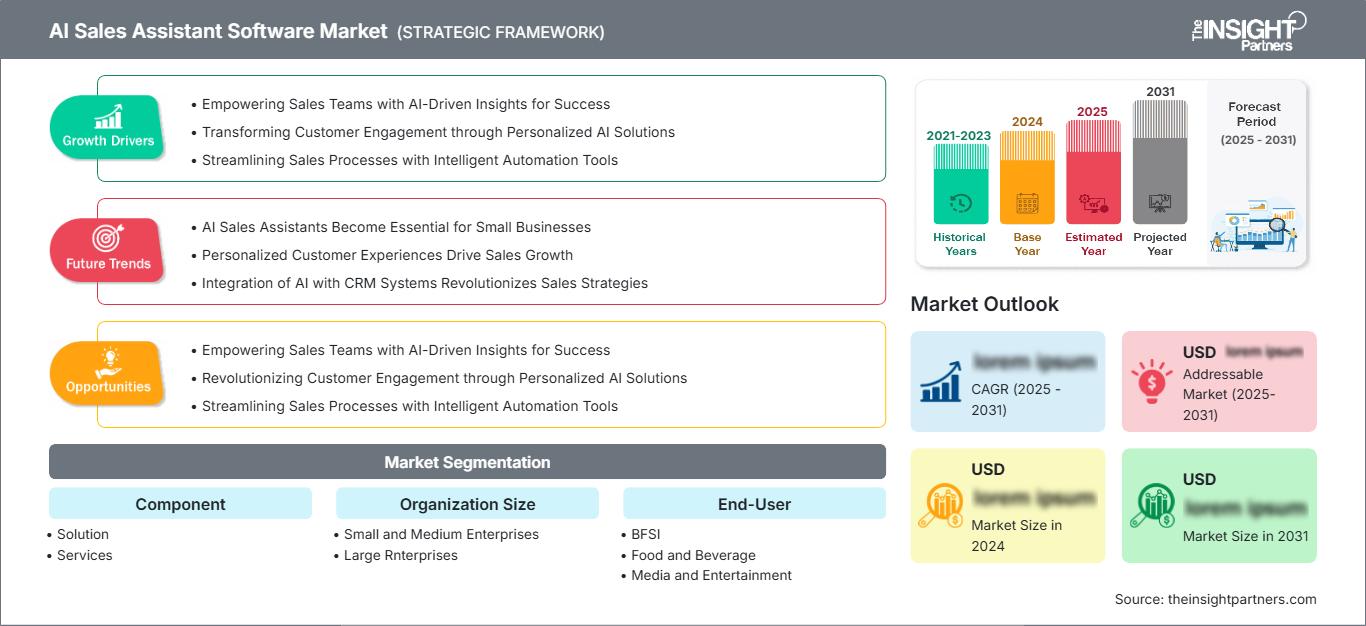
The global AI Sales Assistant Software market was valued at US$ 27.52 billion in 2025 and is expected to reach US$ 69.04 billion by 2034; it is estimated to record a CAGR of 10.76% during 2026-2034.
AI Sales Assistant Software Market Assessment and Insights
- North America: Strong adoption across enterprise sales ecosystems, supported by AI-enabled CRM investments and revenue intelligence platforms. Share in 2025: 38–42%. CAGR between 2026–2034: 11.5–13.5%.
- US: Largest national market due to concentration of software vendors and AI spending. Share in 2025: 78–82% of North America. CAGR between 2026–2034: 11.8–13.8%.
- Europe: Demand is led by the UK, Germany, and France, where AI-enabled customer engagement technologies are rapidly scaling. Share in 2025: 25–29%. CAGR between 2026–2034: 10.5–12.5%.
- Asia Pacific: Fast expansion across China, India, Japan, South Korea, and Australia, supported by cloud adoption and digital commerce growth. Share in 2025: 22–26%. CAGR between 2026–2034: 13.5–15.5%.
- Largest Segment: Solution segment dominates due to broad deployment of AI copilots, conversation intelligence, and automated lead management. Market share in 2025: 68–72%. CAGR 2026–2034: 11.5–13.5%.
- High Growth Segment: Small and Medium Enterprises benefit from SaaS-based AI tools with lower implementation complexity. Market share in 2025: 38–42%. CAGR 2026–2034: 13.5–15.5%.
- Key companies analyzed in detail: Acuvate, AffectLayer, Inc. (Chorus), Affinity, Applicate IT Solutions Pvt. Ltd., Bigtincan Holdings Limited, Cience Technologies, Clari Inc., Salesforce, Inc., Zoho Corporation Pvt. Ltd., SalesDirector.ai, Inc.
Source: The Insight Partners' analysis based on proprietary research, government publications, company annual reports, investor presentations, industry databases, and expert interviews.
Advances in large language models, predictive analytics, and conversational AI are reshaping sales technology ecosystems. Vendors are increasingly moving from rule-based automation toward intelligent assistants capable of identifying opportunities, generating responses, summarizing meetings, and recommending next actions. Integration with CRM, customer data platforms, and communication tools is creating unified sales intelligence environments that improve pipeline visibility and decision quality.
Looking ahead, investments are expected to accelerate across emerging digital economies where enterprises are prioritizing productivity-centric AI deployments. Regulatory efforts focusing on trustworthy AI, combined with growing cloud accessibility, are encouraging wider implementation. Industry participants are also expanding multilingual capabilities and vertical-specific solutions, creating new avenues for commercial adoption across global markets.
AI Sales Assistant Software Market Report Scope
| Report Attribute | Details |
|---|---|
| Market size in 2025 | US$ 27.52 Billion |
| Market Size by 2034 | US$ 69.04 Billion |
| Global CAGR (2026 - 2034) | 10.76% |
| Historical Data | 2021-2024 |
| Forecast period | 2026-2034 |
AI Sales Assistant Software Market Analysis
The AI sales assistant software market growth trajectory is supported by rising pressure on organizations to improve sales efficiency while managing increasingly complex customer journeys. AI assistants help automate repetitive tasks such as lead qualification, email generation, meeting scheduling, call documentation, and forecasting. As organizations pursue revenue optimization strategies, integration between AI assistants and CRM ecosystems is becoming a critical component of modern sales operations.
Another key factor is the development of interconnected sales technology ecosystems. Cloud infrastructure providers, CRM vendors, conversation intelligence platforms, and analytics companies are creating integrated solutions that enable real-time sales recommendations. This improves visibility across the value chain and allows organizations to transform customer interactions into actionable insights. Demand remains particularly strong among enterprises seeking scalable revenue intelligence capabilities.
The AI sales assistant software market analysis indicates that competition is increasingly centered on platform depth, workflow integration, and AI model performance. Companies such as Salesforce, Clari, Zoho Corporation, Affinity, and Bigtincan continue investing in predictive insights, conversational intelligence, and agentic AI capabilities. Meanwhile, specialists such as SalesDirector.ai and AffectLayer focus on targeted automation and sales coaching functionalities.
Investment activity remains robust as enterprises seek measurable productivity gains from AI-enabled selling. Strategic priorities include expansion of multilingual assistants, development of industry-specific models, and acquisition of complementary capabilities across engagement, forecasting, and customer intelligence. Market participants are also strengthening governance features to address enterprise concerns around transparency, privacy, and responsible AI deployment.
● REPORT CUSTOMIZATION
Tailor This Report To Align With Your Specific Business Requirements
This report can be customized to align precisely with your business objectives, scope, and target markets. Customization options include tailored segmentation, geography, competitive analysis, and strategic insights to support informed decision-making.
Customize This Report →WHAT YOU CAN ADJUST
- ● Segmentations
- ● Geography
- ● Competitive Analysis
- ● Language Preferences
AI Sales Assistant Software Market: Strategic Insights
Regional Insights
North America AI sales assistant software market
North America accounted for approximately 38–42% AI sales assistant software market share in 2025 and is expected to expand at a CAGR of 11.5–13.5% through 2034. The region benefits from strong enterprise technology spending, advanced CRM adoption, and a highly developed cloud ecosystem. Large organizations continue integrating AI assistants into customer acquisition, account management, and sales forecasting processes.
The regional landscape is supported by a concentration of technology innovators, venture investment activity, and mature digital infrastructure. Adoption is particularly strong in BFSI, retail, telecommunications, and marketing sectors where revenue teams rely on data-driven customer engagement. Growing interest in generative AI and autonomous workflow automation is expected to further strengthen implementation levels across the region.
U.S. AI sales assistant software market
The U.S. represented approximately 78–82% of North American revenue in 2025 and is anticipated to record a CAGR of 11.8–13.8% through 2034. High spending on enterprise software, extensive CRM penetration, and rapid adoption of revenue intelligence platforms support market expansion. Organizations increasingly incorporate AI assistants into prospecting, pipeline management, and sales enablement workflows.
Presence of industry leaders, including Salesforce and Clari, continues to stimulate innovation and commercial deployment. Demand is expanding beyond large enterprises toward mid-sized organizations seeking productivity enhancements. Applications involving automated communications, call analysis, opportunity scoring, and forecasting are becoming standard components of modern sales technology stacks.
Europe AI sales assistant software market
Europe accounted for 25–29% of global revenue in 2025 and is projected to grow at a CAGR of 10.5–12.5% through 2034. Adoption is supported by enterprise digitalization initiatives and increasing interest in trusted AI frameworks. The UK remains a leading market due to strong software adoption, mature financial services activity, and expanding use of customer intelligence platforms across commercial organizations.
Germany benefits from industrial digitalization and growing implementation of AI solutions within manufacturing, technology, and business services environments. France is experiencing rising adoption across retail and financial services, while Italy and Spain continue investing in digital customer engagement capabilities. Regulatory attention to transparent AI deployment is encouraging development of governance-focused solutions throughout the region.
APAC AI sales assistant software market
Asia Pacific region is anticipated to account for about 22–26% of total worldwide revenue in 2025 and is expected to grow at a CAGR of 13.5–15.5%. The largest regional market is China, while India is considered one of the fastest-growing markets in this industry.
Japan, South Korea, and Australia continue investing in AI-enabled enterprise applications to improve sales productivity and customer engagement. Government support for digital transformation and increasing adoption of cloud infrastructure are strengthening demand across multiple industries throughout the region.
Middle East & Africa AI sales assistant software market
The Middle East and Africa market is experiencing steady growth driven by initiatives to modernize enterprises and the growing adoption of cloud solutions. The expected growth rate of this market would be between 10.0% and 12.0% CAGR through 2034, with Saudi Arabia and the UAE as the key drivers of demand.
Initiatives towards diversifying energy sources, smart-city projects, and the modernization of business processes are driving the adoption of CRM. South Africa remains one of the major markets in Africa, along with regional demand driven by automation and data-driven sales management.
Segmentation Analysis
Component
Component segment growth rate will be between 11.8% and 13.8% from 2026 to 2034. The scope of the AI sales assistant software market continues to grow as companies seek platforms that integrate automation, analytics, and customer engagement capabilities. The demand will depend on the need for scalability, deployment assistance, and optimization of the AI-enabled sales processes.
- Solution: Dominant category supporting lead management, conversational intelligence, predictive forecasting, sales coaching, and automated engagement. Organizations prioritize integrated platforms that deliver measurable revenue productivity improvements across distributed sales teams.
- Services: Includes consulting, deployment, customization, integration, and ongoing support. Service demand rises as enterprises seek effective alignment between AI assistants, CRM environments, governance frameworks, and business-specific sales processes.
Organization Size
The organization size segment is projected to register a CAGR of 12.5–14.5% through 2034. Adoption patterns differ according to budget, technology maturity, and operational complexity. Cloud delivery models increasingly enable both large organizations and smaller businesses to deploy sophisticated AI sales capabilities.
- Small and Medium Enterprises: Rapidly adopting subscription-based platforms to automate prospecting, customer communication, and sales analytics while minimizing internal infrastructure requirements and implementation costs.
- Large Enterprises: Focus on enterprise-scale deployments integrating multiple data sources, advanced forecasting, multilingual support, governance controls, and extensive workflow automation capabilities across global sales operations.
End-User
The end user segment is expected to grow at a CAGR of 12.8%–14.8%. Use cases across industry segments will further drive demand as companies seek specialized AI models to support customer acquisition, engagement, and conversion.
- BFSI: Leverages AI assistants for lead prioritization, relationship management, cross-selling support, and compliance-aware customer engagement activities across banking and insurance networks.
- Food and Beverage: Uses predictive insights and automated communication tools to manage distributor relationships, customer outreach, and commercial account development initiatives.
- Media and Entertainment: Applies AI-driven engagement capabilities to advertising sales, subscriber acquisition, and customer retention strategies supported by behavioral data analytics.
- Travel and Hospitality: Utilizes conversational AI to improve customer acquisition, booking engagement, loyalty initiatives, and sales coordination across multiple distribution channels.
- Retail and Consumer Goods: Implements sales intelligence platforms to optimize customer engagement, opportunity identification, and account management within omnichannel commerce environments.
- Marketing and Advertising: Employs AI assistants for campaign selling, lead qualification, prospect communication, and performance-driven customer acquisition programs.
- IT and Telecom: Adopts AI-powered recommendations, customer analytics, and forecasting tools to enhance enterprise account management and complex solution-selling activities.
Opportunity Snapshot
| End-User | Revenue Contribution | Trend Tag | Adoption Stage |
| BFSI | High | Revenue AI | Mature |
| Food and Beverage | Medium | Distributor Analytics | Scaling |
| Media and Entertainment | Medium | Ad Intelligence | Scaling |
| Travel and Hospitality | Medium | Booking Automation | Scaling |
| Retail and Consumer Goods | High | Omnichannel Selling | Mature |
| Marketing and Advertising | High | Campaign Insights | Mature |
| IT and Telecom | High | Account Intelligence | Mature |
AI Sales Assistant Software Market Growth Drivers and Impact Analysis
Expansion of Generative AI Across Sales Functions
AI-driven technology is revolutionizing sales operations by automating content creation, customer communication, proposal building, and interaction summary creation. Firms are increasingly relying on AI assistants to reduce administrative burden and enable sales teams to focus on value-added tasks. The ability to offer context-driven recommendations based on customer interactions enhances the quality of engagement and accelerates decision-making. With increased accuracy and transparency of AI algorithms, firms are expanding the use of AI to prospecting, relationship management, and revenue forecasting processes.
Growing Demand for Revenue Intelligence Platforms
There is increased focus on understanding pipeline performance and revenue results. There is increasing adoption of AI sales assistants in revenue intelligence platforms that integrate data from CRM, communications, opportunities, and predictions. The integration allows for early risk identification and more efficient resource allocation. More accurate forecasting decreases uncertainty and improves strategic planning. The growing pressure in business environments is driving more investment in technologies that can transform raw operational data into valuable business intelligence.
Broader Adoption of Cloud-Based Sales Ecosystems
Cloud deployment models have facilitated implementation and enabled scalability for AI-enabled sales technologies. Companies can deploy the assistants without making major infrastructure investments. Continuous upgrades, ease of integration, and subscription-based pricing have increased access for both SMEs and large organizations. The availability of cloud-native CRM and collaboration solutions is adding even more interoperability to the picture. Cloud-based AI assistants have become an integral part of sales transformation initiatives.
AI Sales Assistant Software Market Future Trends
Rise of Autonomous Revenue Agents
The AI sales assistant software market trends are slowly gravitating towards revenue robots that can take action rather than simply make recommendations. In the future, such programs will be able to schedule meetings, screen prospects, draft communications, maintain data, and handle sales processes without requiring much human intervention. Advancements in reasoning algorithms and context will enable the assistant software to become true digital teammates. Companies are predicted to adopt a hybrid approach, in which humans manage strategic processes while robots perform the grunt work.
Vertical-Specific AI Model Development
In the future, competition is expected to become increasingly specialized through domain-specific solutions built around industry-specific sales processes and regulatory guidelines. Vendors will increasingly build vertical models for industries such as BFSI, telecommunications, healthcare, and retail. Such models have greater potential for higher predictive performance, situational understanding, and process relevance. As organizations seek ROI, there will be greater demand for configurable vertical AI assistants than for generic platforms.
AI Sales Assistant Software Market Opportunities
Expansion into Emerging Digital Economies
AI sales assistant software market forecasts reveal immense possibilities in emerging economies, where spending on digital transformation is steadily rising. The vendors have room to leverage rising cloud usage, rising internet penetration, and the growing need for customer engagement solutions. There is an opportunity to localize languages, foster regional collaborations, and develop pricing strategies to target underpenetrated commercial markets. Early market entry into these regions can provide a competitive advantage as markets mature.
Development of Industry-Focused AI Ecosystems
There are significant opportunities for those who offer AI assistants combined with industry-specific analytics, compliance functions, and process automation features. There is a clear preference among organizations for integrated solutions rather than individual products. Companies that can provide industry-specific ecosystems will be able to secure larger contracts and retain their customers.
Frequently Asked Questions

- Comprehensive Market Sizing and Forecast Analysis
- Detailed Segmentation Analysis
- In-Depth Market Dynamics Assessment
- Regional and Country-Level Insights
- Competitive Landscape and Company Benchmarking
- Strategic Business Intelligence
Recent Reports
Testimonials

The Insight Partners' SCADA System Market report is comprehensive, with valuable insights on current trends and future forecasts. The team was highly professional, responsive, and supportive throughout. We are very satisfied and highly recommend their services.
RAN KEDEM Partner, Reali Technologies LTDs
I requested a report on a very specific software market and the team produced the report in a few days. The information was very relevant and well presented. I then requested some changes and additions to the report. The team was again very responsive and I got the final report in less than a week.
JEAN-HERVE JENN Chairman, Future Analytica
We worked with The Insight Partners for an important market study and forecast. They gave us clear insights into opportunities and risks, which helped shape our plans. Their research was easy to use and based on solid data. It helped us make smart, confident decisions. We highly recommend them.
PIYUSH NAGPAL Sr. Vice President, High Beam Global
The Insight Partners delivered insightful, well-structured market research with strong domain expertise. Their team was professional and responsive throughout. The user-friendly website made accessing industry reports seamless. We highly recommend them for reliable, high-quality research services
YUKIHIKO ADACHI CEO, Deep Blue, LLC.
This is the first time I have purchased a market report from The Insight Partners.While I was unsure at first, I visited their web site and felt more comfortable to take the risk and purchase a market report.I am completely satisfied with the quality of the report and customer service. I had several questions and comments with the initial report, but after a couple of dialogs over email with their analyst I believe I have a report that I can use as input to our strategic planning process.Thank you so much for taking the extra time and making this a positive experience.I will definitely recommend your service to others and you will be my first call when we need further market data.
JOHN SUZUKI President and Chief Executive Officer, Board Director, BK Technologies
I wish to appreciate your support and the professionalism you displayed in the course of attending to my request for information regarding to infectious disease IVD market in Nigeria. I appreciate your patience, your guidance, and the fact that you were willing to offer a discount, which eventually made it possible for us to close a deal. I look forward to engaging The Insight Partners in the future, all thanks to the impression you have created in me as a result of this first encounter.
DR CHIJIOKE ONYIA MANAGING DIRECTOR, PineCrest Healthcare Ltd.Reason to Buy
- Informed Decision-Making
- Understanding Market Dynamics
- Competitive Analysis
- Identifying Emerging Markets
- Customer Insights
- Market Forecasts
- Risk Mitigation
- Boosting Operational Efficiency
- Strategic Planning
- Investment Justification
- Tracking Industry Innovations
- Aligning with Regulatory Trends





 Get Free Sample for