
Apparel Design Software Market Demand, Trends & Forecast by 2034
Coverage: By Type (Cloud Based, Web Based); Application (Fashion Designers, Clothing Manufacturers) , and Geography (North America, Europe, Asia Pacific, and South and Central America)
- Status : Data Released
- Report Code : TIPRE00024207
- Category : Technology, Media and Telecommunications
- No. of Pages : 150
- Available Report Formats :


- Last update date : August 26, 2026


2025 Market Size
US$ 2.19 Bn
Base year value
2034 Forecast
US$ 5.06 Bn
Projected by 2034
CAGR 2026-2034
9.75 %
Growth rate
Addressable Market
US$ 32.30 Bn
(2026-2034)
The apparel design software market is expected to grow from US$ 2.19 Billion in 2025 to US$ 5.06 Billion by 2034, registering a CAGR of 9.75% during 2026–2034. Demand is being shaped by faster product-development cycles, wider adoption of virtual prototyping, and the shift from isolated design tools to connected digital workflows used by fashion designers and clothing manufacturers.
North America remains a significant adoption hub, supported by fashion brand digitization, strong software spending, and growing use of cloud collaboration across design, merchandising, and sourcing teams. The apparel design software market size in the region continues to benefit from advanced retail infrastructure, early 3D sampling adoption, and pressure to reduce physical sample costs.
Apparel Design Software Market Assessment and Insights
- North America accounted for an estimated 33–36% share in 2025 and is expected to grow at a CAGR of 9.2–9.8% during 2026–2034, driven by enterprise deployment and virtual sampling adoption.
- US represented about 74–78% of North America in 2025 and is projected to grow at a CAGR of 9.3–9.9% through 2034.
- Europe held an estimated 27–30% share in 2025, led by the UK, Germany, France, Italy, and Spain, with a CAGR range of 8.8–9.4%.
- Asia Pacific accounted for around 24–27% share in 2025 and is expected to grow at a CAGR of 10.4–11.2%, supported by China, India, Japan, and South Korea.
- Largest Segment: Cloud Based solutions held an estimated 58–62% market share in 2025 and are projected to grow at a CAGR of 10.1–10.8% during 2026–2034.
- High Growth Segment: Clothing Manufacturers held an estimated 46–50% share in 2025 and are expected to grow at a CAGR of 10.3–11.0%.
- Key companies analyzed in detail: Crea Create, DigiFab, Digital Fashion Pro, iDesigniBuy, InkSoft, NedGraphics, Patternsmith, SmartDesigner, Telestia Creator, T-Shirt Design Software, CLO Virtual Fashion, Browzwear, Lectra, Optitex, and Style3D.
Source: The Insight Partners' analysis based on proprietary research, government publications, company annual reports, investor presentations, industry databases, and expert interviews.
The market has moved from basic sketching and pattern digitization toward integrated design environments that combine 2D CAD, 3D garment simulation, textile visualization, collaboration, and production handoff. Historically fragmented design workflows are being consolidated as brands attempt to shorten development cycles, reduce sample dependency, and align style decisions with sourcing and manufacturing requirements. This transition is strengthening apparel design software market growth across both designer-led studios and factory-integrated production teams.
Future needs would be influenced by scalable cloud connectivity, AI-powered pattern creation, digitized fabric library, and integration with enterprise software such as PLM and e-commerce platforms. The rising number of manufacturing bases in the Asia Pacific region has increased the use of software to ensure accuracy, minimize errors, and export apparel products. In addition, there is an increased need for virtual prototypes due to the growing need for waste reduction.
Apparel Design Software Market Report Scope
| Report Attribute | Details |
|---|---|
| Market size in 2025 | US$ 2.19 Billion |
| Market Size by 2034 | US$ 5.06 Billion |
| Global CAGR (2026 - 2034) | 9.75% |
| Historical Data | 2021-2024 |
| Forecast period | 2026-2034 |
Apparel Design Software Market Analysis
Demand in the apparel design software market is driven by the need to compress concept-to-production timelines while improving fit, visualization, and manufacturing readiness. Fashion designers increasingly use digital tools to test silhouettes, colorways, trims, and fabrics before physical sampling. Clothing manufacturers benefit from cleaner pattern data, fewer manual revisions, and better coordination between design intent and factory execution.
Ecosystems for digital fashion products are growing to include other design applications. Designers are integrating applications for design, pattern engineering, virtual samples, marker making, and order preparation into a single process. Branding companies prefer digital product ecosystems offering the ability to collaborate remotely, perform realistic simulations, and produce exportable technical documents, whereas the suppliers are keen on file compatibility and accuracy of the patterns created in multiple customer ecosystems.
The differentiation is becoming more specialized in terms of user friendliness, accuracy of simulation, cloud-based delivery, or manufacturing processes. For example, CLO Virtual Fashion and Browzwear are considered leading players in the 3D visualization and virtual sampling area, whereas Lectra and Optitex maintain leadership in production-ready CAD and pattern processes. Specialists such as InkSoft, iDesigniBuy, Patternsmith, and Telestia Creator are solving specific problems.
Investment is increasingly directed toward AI-assisted design, digital material management, and browser-based collaboration. The apparel design software market report highlights that vendors able to bridge creativity and production execution will gain stronger retention. Buyers are also assessing total workflow value rather than single-feature capability, especially where design teams need to connect concept creation with sourcing, fit validation, and factory-ready documentation.
● REPORT CUSTOMIZATION
Tailor This Report To Align With Your Specific Business Requirements
This report can be customized to align precisely with your business objectives, scope, and target markets. Customization options include tailored segmentation, geography, competitive analysis, and strategic insights to support informed decision-making.
Customize This Report →WHAT YOU CAN ADJUST
- ● Segmentations
- ● Geography
- ● Competitive Analysis
- ● Language Preferences
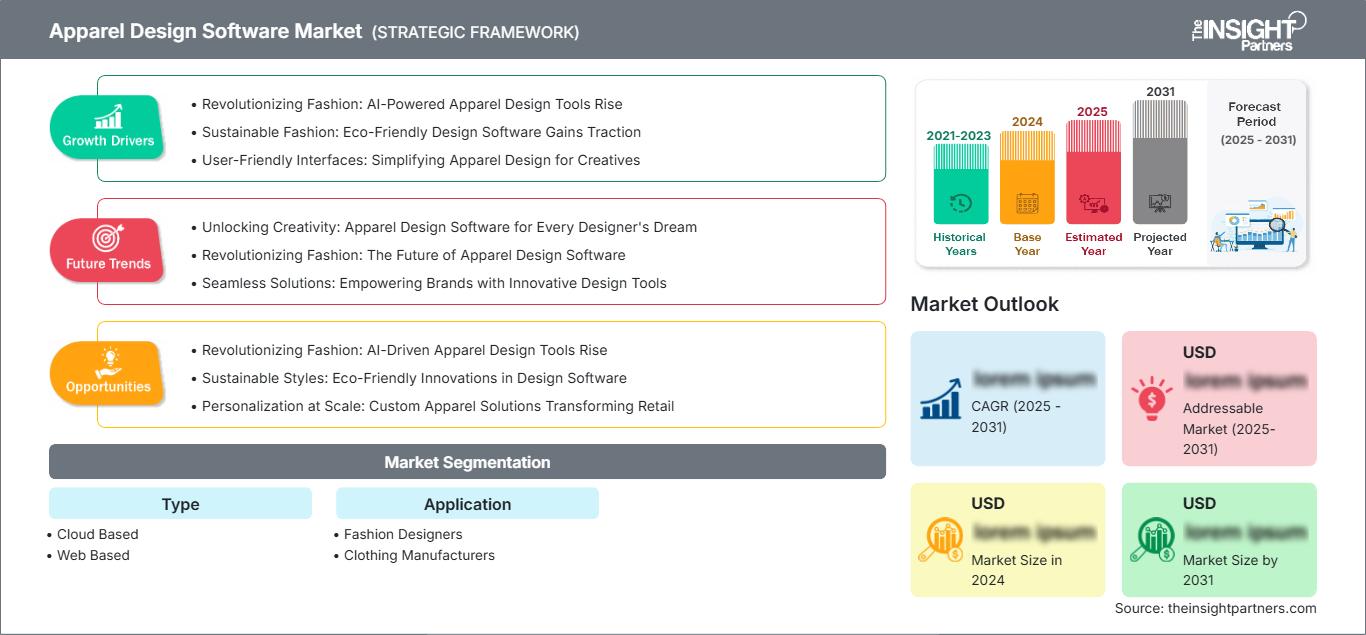
Apparel Design Software Market: Strategic Insights
Regional Insights
North America apparel design software market
North America held an estimated 33–36% apparel design software market share in 2025. Adoption is supported by advanced retail technology spending, strong use of cloud-based collaboration, and brand investments in digital product creation. The region is expected to grow at a CAGR of 9.2–9.8% during 2026–2034 as companies reduce sample rounds and integrate design tools with merchandising and sourcing workflows.
US brands are particularly active in virtual prototyping, online customization, and digital asset creation for e-commerce. Large retailers and mid-market labels are using design software to shorten seasonal calendars, improve fit consistency, and support faster assortment decisions. Canada is growing steadily through smaller design studios, technical apparel developers, and manufacturing-linked design service providers.
U.S. apparel design software Market
The US represented approximately 74–78% of North America in 2025 and is expected to grow at a CAGR of 9.3–9.9% through 2034. Demand is concentrated among apparel brands, custom clothing platforms, print-on-demand operators, and manufacturers serving fast-turn design requirements. Enterprise buyers increasingly prefer integrated tools that combine design visualization, pattern refinement, and collaboration.
Company presence and application diversity continue to support adoption. Fashion designers use software for collection development and digital presentation, while manufacturers focus on technical accuracy, grading, and production-ready outputs. The market is also benefiting from the rise of digital sampling for wholesale previews, direct-to-consumer customization, and product testing before physical inventory commitments.
Europe apparel design software Market
Europe accounted for an estimated 27–30% share in 2025 and is projected to grow at a CAGR of 8.8–9.4% during 2026–2034. The region is led by the UK, Germany, France, Italy, and Spain, where fashion heritage, technical apparel production, and sustainability expectations support digital design investment.
The UK shows strong adoption among independent labels, fashion schools, and digital-first studios. Germany emphasizes engineering precision, PLM integration, and manufacturing workflows. France and Italy focus on premium design visualization, sample reduction, and fabric representation, while Spain benefits from agile retail models and faster product refresh cycles.
APAC apparel design software Market
APAC held around 24–27% share in 2025 and is forecast to grow at a CAGR of 10.4–11.2% during 2026–2034. China leads regional demand due to large apparel manufacturing capacity, export orientation, and increasing use of digital design for speed and quality control.
Japan and South Korea are adopting advanced 3D and visualization tools for technical fashion, performance wear, and digital retail experiences. India is an emerging high-growth market as manufacturers modernize design and pattern operations. Australia contributes through active startup, sustainable fashion, and custom-apparel ecosystems.
Middle East & Africa apparel design software Market
The Middle East & Africa market is smaller but expanding, with a projected CAGR of 8.5–9.2% during 2026–2034. The UAE and Saudi Arabia are supporting fashion entrepreneurship, e-commerce, and customization models, while South Africa shows demand from local apparel production and design education.
Regional growth is connected to retail modernization, modest fashion design, and digital commerce. Software adoption is strongest where brands require faster visual approvals, made-to-measure workflows, and reduced dependency on imported physical samples. Broader uptake will depend on training access, cloud affordability, and integration with local production networks.
Segmentation Analysis
Type
Type segmentation includes Cloud Based and Web Based solutions. Cloud Based software is the larger category, supported by remote collaboration, lower infrastructure needs, and centralized asset management. The apparel design software market scope is expanding as teams seek shared access to patterns, digital fabrics, comments, and approvals across brand offices and manufacturing partners. The Type segment is expected to grow at a CAGR of 9.7–10.5% during 2026–2034.
- Cloud Based solutions lead adoption because they enable distributed design teams, real-time review, scalable storage, and easier updates without heavy local installation requirements.
- Web Based tools are important for smaller teams, online customization workflows, and users requiring browser access for design visualization, basic editing, or customer-facing configuration.
Application
Application segmentation includes Fashion Designers and Clothing Manufacturers. Fashion Designers use platforms for ideation, collection planning, drape simulation, and presentation, while Clothing Manufacturers rely on accurate patterns, grading, material planning, and production handoff. The Application segment is projected to grow at a CAGR of 9.8–10.6% during 2026–2034 as collaboration between design and manufacturing becomes more data-driven.
- Fashion Designers represent a core user base, using software to explore style variation, accelerate creative decisions, improve communication, and reduce dependence on early physical samples.
- Clothing Manufacturers are the high-growth application group, adopting tools to improve pattern accuracy, reduce rework, support technical packages, and align factory output with brand requirements.
Opportunity Snapshot
| Application | Revenue Contribution | Trend Tag | Adoption Stage |
| Fashion Designers | High | Virtual Samples | Scaling |
| Clothing Manufacturers | Medium | Factory CAD | Scaling |
Apparel Design Software Market Growth Drivers and Impact Analysis
Shift from Physical Sampling to Virtual Product Development
Virtual development has become an integral aspect of the product development process due to the efforts by companies to cut down sample costs, decrease the time needed to obtain approvals, and minimize waste of materials. Virtual garments provide teams with opportunities to evaluate fit, proportion, color, and material properties before developing a physical prototype. This is particularly useful when the design team, suppliers, and purchasers operate in various countries. As more clothing companies embrace the practice of digital sampling, software solutions evolve into systems used for controlling margins and speeding up processes. Moreover, through 3D visualization techniques, designers and other project stakeholders can evaluate products at an earlier stage of their development, thus avoiding numerous revisions.
Cloud Collaboration Across Global Apparel Supply Chains
Fashion design processes commonly involve interaction between fashion designers, pattern makers, fashion merchandisers, factory workers and buyers, among others, operating in different time zones. Using the cloud and web-based systems increases visibility of design documents, comments, and modifications by having all those in one accessible place. This minimizes the risk of confusion and makes decisions easier to make. In cases of clothing brands, cloud access makes it possible for factory capacities to match brand requirements early on in the design process, which results in accurate samples without wasting effort in revising errors.
Rising Need for Customization and Faster Product Refresh
There is more emphasis on style options, personalized garments, and rapid trend response. Fashion apparel software assists firms in experimenting with novel ideas without the need to invest in physical samples. Custom fashion, print on demand, and made-to-measure designs also call for design assets that can easily be modified. Such a driver is contributing to higher demand for solutions integrating visual design, alterations, previews online, and ready-for-production information. Furthermore, fashion brands have started to embrace agile product development approaches to cope with changing consumer preferences and seasonal trends. With such advanced design platforms, companies can modify designs quickly, improve the accuracy of design, and customize products.
Apparel Design Software Market Future Trends
AI-Assisted Pattern and Fit Intelligence
Apparel design software market trends increasingly point toward AI-assisted workflows that shorten repetitive technical steps. Pattern suggestions, automated grading support, fabric behavior prediction, and fit risk alerts are expected to become more common. These features will not replace designers or pattern specialists, but they can reduce manual iteration and help teams identify technical problems earlier. Vendors that combine AI with accurate garment physics and editable production outputs will be better positioned for enterprise adoption. Furthermore, AI-driven design assistance can help brands accelerate product development cycles, improve consistency across collections, and reduce sampling costs. As competitive pressures increase, manufacturers and fashion brands are expected to invest in intelligent tools that enhance design efficiency while maintaining creative flexibility and product quality.
Digital Materials and 3D Asset Reuse
Digitized material libraries will gain increasing importance as brands begin to standardize fabric scanning, trims, color data, and avatars used for fit. Reusable 3D assets will be able to be used in design review sessions, sales presentations, e-commerce, and supplier communication all using the same source file. This is another way that brands get increased ROI on their investment in software, since each digital garment will have the ability to do multiple things outside of just being an approved design. In addition, having digital assets centrally managed allows brands to have increased collaboration between design, merchandising, sourcing, and manufacturing departments.
Apparel Design Software Market Opportunities
Expansion Among Small and Mid-Sized Apparel Brands
The strongest apparel design software market forecasts include wider adoption among small and mid-sized brands that previously relied on manual sketches, outsourced pattern work, or basic illustration tools. Subscription pricing, web access, and simplified interfaces are lowering entry barriers. Vendors can capture this opportunity by offering modular packages, onboarding support, templates, and integrations with print-on-demand, e-commerce, and freelance production networks. Additionally, growing competition in the fashion industry is encouraging smaller brands to adopt digital design technologies that improve efficiency and shorten product development cycles. User-friendly platforms with flexible pricing models can help emerging businesses access professional-grade design capabilities while reducing operational costs and accelerating market entry.
Integration with Manufacturing and PLM Systems
A major opportunity lies in connecting creative design with production execution. Buyers increasingly want software that transfers design data into PLM, CAD, grading, marker making, and supplier-management systems without repeated manual entry. Vendors that offer open integrations, reliable file standards, and production-ready outputs can become embedded in daily workflows. This creates stronger customer retention and supports premium pricing where software directly reduces sample errors and production delays. Furthermore, seamless integration enables better collaboration across design, sourcing, production, and quality management teams, helping organizations improve supply chain visibility and operational efficiency. As manufacturers pursue digital transformation initiatives, demand for connected workflows that reduce redundancy and enhance production accuracy is expected to increase steadily.
Frequently Asked Questions

- Comprehensive Market Sizing and Forecast Analysis
- Detailed Segmentation Analysis
- In-Depth Market Dynamics Assessment
- Regional and Country-Level Insights
- Competitive Landscape and Company Benchmarking
- Strategic Business Intelligence
Recent Reports
Testimonials

The Insight Partners' SCADA System Market report is comprehensive, with valuable insights on current trends and future forecasts. The team was highly professional, responsive, and supportive throughout. We are very satisfied and highly recommend their services.
RAN KEDEM Partner, Reali Technologies LTDs
I requested a report on a very specific software market and the team produced the report in a few days. The information was very relevant and well presented. I then requested some changes and additions to the report. The team was again very responsive and I got the final report in less than a week.
JEAN-HERVE JENN Chairman, Future Analytica
We worked with The Insight Partners for an important market study and forecast. They gave us clear insights into opportunities and risks, which helped shape our plans. Their research was easy to use and based on solid data. It helped us make smart, confident decisions. We highly recommend them.
PIYUSH NAGPAL Sr. Vice President, High Beam Global
The Insight Partners delivered insightful, well-structured market research with strong domain expertise. Their team was professional and responsive throughout. The user-friendly website made accessing industry reports seamless. We highly recommend them for reliable, high-quality research services
YUKIHIKO ADACHI CEO, Deep Blue, LLC.
This is the first time I have purchased a market report from The Insight Partners.While I was unsure at first, I visited their web site and felt more comfortable to take the risk and purchase a market report.I am completely satisfied with the quality of the report and customer service. I had several questions and comments with the initial report, but after a couple of dialogs over email with their analyst I believe I have a report that I can use as input to our strategic planning process.Thank you so much for taking the extra time and making this a positive experience.I will definitely recommend your service to others and you will be my first call when we need further market data.
JOHN SUZUKI President and Chief Executive Officer, Board Director, BK Technologies
I wish to appreciate your support and the professionalism you displayed in the course of attending to my request for information regarding to infectious disease IVD market in Nigeria. I appreciate your patience, your guidance, and the fact that you were willing to offer a discount, which eventually made it possible for us to close a deal. I look forward to engaging The Insight Partners in the future, all thanks to the impression you have created in me as a result of this first encounter.
DR CHIJIOKE ONYIA MANAGING DIRECTOR, PineCrest Healthcare Ltd.Reason to Buy
- Informed Decision-Making
- Understanding Market Dynamics
- Competitive Analysis
- Identifying Emerging Markets
- Customer Insights
- Market Forecasts
- Risk Mitigation
- Boosting Operational Efficiency
- Strategic Planning
- Investment Justification
- Tracking Industry Innovations
- Aligning with Regulatory Trends





 Get Free Sample for