
Airbag Sensors Market Overview, Growth, and Forecasts till 2034
Coverage: by Airbag Type (Rear Airbag, Front Airbag, Knee Airbag and Side Airbag); Sensors (Brake sensors, Gyroscopes, Accelerometer, Tachometers and Others); Application (Automotive, Aerospace, Military and Others), and Geography (North America, Europe, Asia Pacific, and South and Central America)
- Status : Data Released
- Report Code : TIPAT00002416
- Category : Automotive and Transportation
- No. of Pages : 150
- Available Report Formats :


- Last update date : August 27, 2026


2025 Market Size
US$ 8.34 Bn
Base year value
2034 Forecast
US$ 15.20 Bn
Projected by 2034
CAGR 2026-2034
6.9 %
Growth rate
Addressable Market
US$ 106.35 Bn
(2026-2034)
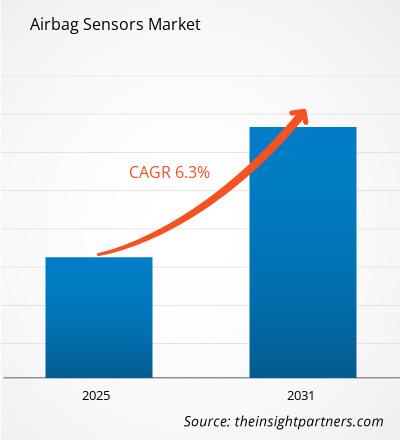
The airbag sensors market is projected to grow from US$ 8.34 Billion in 2025 to US$ 15.20 Billion by 2034, recording a CAGR of 6.9% during 2026–2034. Growth is supported by rising installation of multi-airbag systems, stricter occupant safety norms, and wider use of accelerometer, gyroscope, brake sensor, and tachometer-based restraint sensing architectures across vehicles, aerospace platforms, and defense mobility applications.
North America continues to represent a high-value demand base as automakers integrate advanced crash detection, side-impact sensing, and rollover protection systems into passenger cars, SUVs, and light trucks. The regional airbag sensors market size is supported by steady replacement demand, high safety-feature penetration, and regulatory emphasis on frontal, side, knee, and curtain airbag performance across new vehicle platforms.
Airbag Sensors Market Assessment and Insights
- North America: The region accounted for 29–32% share in 2025 and is expected to grow at a CAGR of 6.2–6.7% during 2026–2034, driven by premium vehicle safety content and advanced restraint electronics.
- US: The US represented 78–82% of North America demand in 2025 and is projected to expand at a CAGR of 6.1–6.6% during 2026–2034.
- Europe: Europe held 24–27% share in 2025, with Germany, France, the UK, Italy, and Spain leading adoption. The region is expected to post a CAGR of 5.9–6.4% during 2026–2034.
- Asia Pacific: Asia Pacific accounted for 31–34% share in 2025 and is forecast to record a CAGR of 7.4–8.1% during 2026–2034, led by China, Japan, South Korea, and India.
- Largest Segment: Front airbag sensors held 39–42% market share in 2025 and are expected to grow at a CAGR of 6.3–6.8% during 2026–2034.
- High Growth Segment: Side airbag sensors held 23–26% share in 2025 and are expected to expand at a CAGR of 7.6–8.3% during 2026–2034.
- Key companies analyzed in detail: ZF Friedrichshafen AG, Aptiv PLC, Joyson Safety Systems, Nihon Plast Co., Ltd., Hyundai Mobis Co., Ltd., Ashimori Industry Co., Ltd., Autoliv Inc., Toyoda Gosei Co., Ltd., Robert Bosch GmbH, Continental AG, DENSO Corporation, and Infineon Technologies AG.
Source: The Insight Partners' analysis based on proprietary research, government publications, company annual reports, investor presentations, industry databases, and expert interviews.
Vehicle safety electronics have evolved from basic collision-triggered modules into coordinated sensing networks that evaluate impact direction, deceleration severity, occupant position, and restraint timing within milliseconds. The airbag sensors market growth reflects this transition as automakers move from minimum compliance architectures toward adaptive systems that reduce false deployment and improve protection in frontal, side-impact, rollover, and offset-crash scenarios.
Looking ahead, regional expansion will be shaped by vehicle production recovery, higher airbag counts per model, and growing safety expectations in emerging economies. Investment is expected to concentrate on MEMS-based accelerometers, integrated restraint control units, and multi-axis sensing solutions that support electric vehicle packaging, lightweight interiors, and connected safety architectures. These trends are expected to strengthen long-term growth prospects for the Airbag Sensors Market report.
Airbag Sensors Market Report Scope
| Report Attribute | Details |
|---|---|
| Market size in 2025 | US$ 8.34 Billion |
| Market Size by 2034 | US$ 15.20 Billion |
| Global CAGR (2026 - 2034) | 6.9% |
| Historical Data | 2021-2024 |
| Forecast period | 2026-2034 |
Airbag Sensors Market Analysis
Airbag sensors market growth is closely linked to rising passive safety content per vehicle, especially in SUVs, crossovers, and premium passenger cars. The modern platforms rely increasingly on the fusion of sensors for accelerometers, pressure, gyroscopes, and restraint control units to identify the crash pulse, impact zone, and occupant safety threat. The need for this has created a need in the OEM supply chains where reliability, validation cycles, and compliance are crucial procurement criteria.
The dynamics of the market depend upon the availability of semiconductors, tests in automotive applications, and the capability of Tier 1 to integrate. Sensor suppliers have to manage cost pressure due to volume requirements for vehicles, along with precision requirements in milliseconds for deployment.
Airbag sensors market analysis shows a consolidated competitive landscape, with global safety suppliers competing on reliability, vehicle platform integration, regional manufacturing proximity, and safety-system engineering depth. Autoliv Inc., Robert Bosch GmbH, ZF Friedrichshafen AG, Hyundai Mobis Co., Ltd., Continental AG, DENSO Corporation, and Aptiv PLC remain central to OEM sourcing strategies because restraint sensing requires validated performance across multiple crash conditions.
The positioning of suppliers for strategic advantage has become influenced heavily by the trend towards electric vehicles, software-defined vehicle architectures, and occupant safety design. The suppliers are developing small MEMS components, fast signal processing, and control platforms in order to facilitate multiple airbag deployment strategies. The collaborations of suppliers with automakers will focus on reliability and ADAS integration.
● REPORT CUSTOMIZATION
Tailor This Report To Align With Your Specific Business Requirements
This report can be customized to align precisely with your business objectives, scope, and target markets. Customization options include tailored segmentation, geography, competitive analysis, and strategic insights to support informed decision-making.
Customize This Report →WHAT YOU CAN ADJUST
- ● Segmentations
- ● Geography
- ● Competitive Analysis
- ● Language Preferences
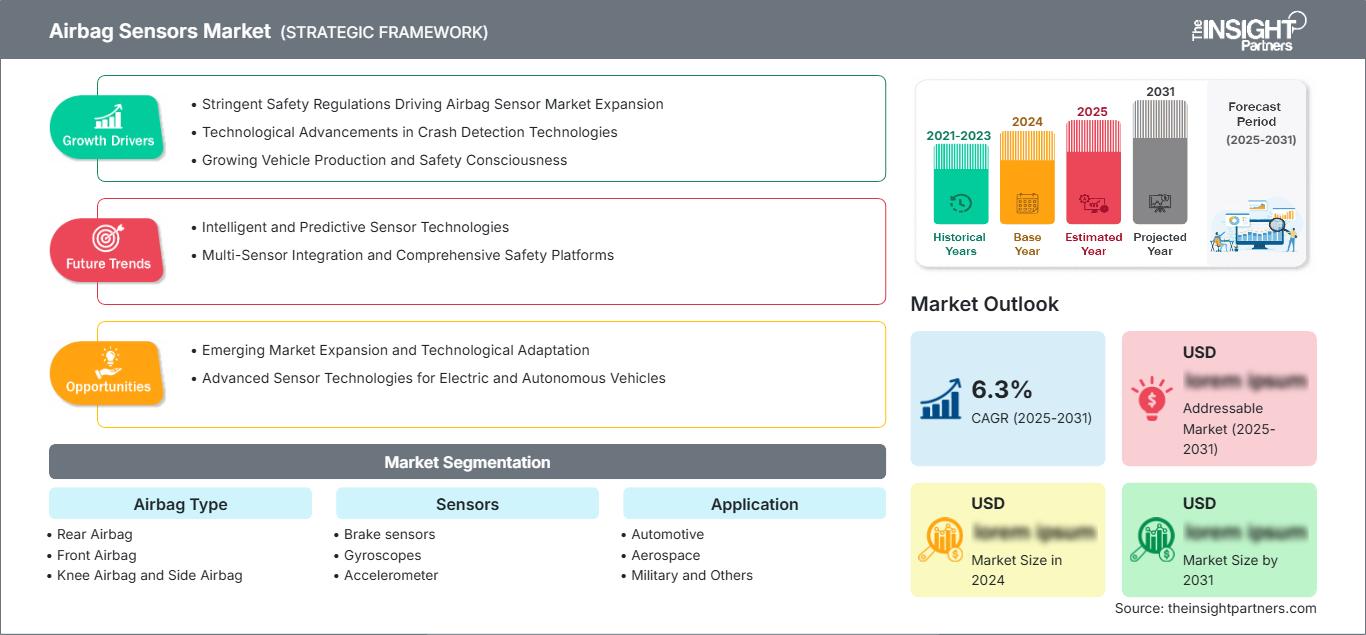
Airbag Sensors Market: Strategic Insights
Regional Insights
North America airbag sensors market
North America held 29–32% of global revenue in 2025 and is projected to grow at a CAGR of 6.2–6.7% through 2034. Demand is supported by high vehicle safety-feature penetration, a strong SUV and pickup base, and continued replacement of older restraint control modules in aftermarket channels.
The region’s airbag sensors market share is reinforced by OEM programs that prioritize side-impact, rollover, and advanced frontal crash protection. Suppliers benefit from proximity to US and Mexican vehicle assembly hubs, while safety regulations and consumer rating systems sustain demand for more precise crash sensing and adaptive deployment logic.
U.S. airbag sensors Market
The US accounted for 78–82% of North America demand in 2025 and is expected to grow at a CAGR of 6.1–6.6% during 2026–2034. Large annual vehicle sales, high SUV penetration, and strong demand for advanced occupant protection systems keep sensor content per vehicle above regional averages.
Company presence is broad, with Robert Bosch GmbH, Autoliv Inc., ZF Friedrichshafen AG, Aptiv PLC, and Continental AG supporting OEM engineering, validation, and manufacturing networks. Application growth is strongest in side-impact sensing, rollover detection, and integrated airbag control modules for electrified and premium vehicle platforms.
Europe airbag sensors Market
Europe represented 24–27% of the global Airbag Sensors Market in 2025 and is forecast to expand at a CAGR of 5.9–6.4% during 2026–2034. Germany remains the leading country in the market due to its strong premium OEM production base, deep safety engineering expertise, and early adoption of advanced restraint technologies across high-value vehicle platforms.
The UK and France are supported by safety-focused vehicle replacement cycles and growing electrified model launches. Italy and Spain contribute through compact vehicle assembly and component supply networks, while regional testing protocols continue to raise expectations for frontal, side, and pedestrian-related safety performance.
APAC airbag sensors Market
Asia Pacific held 31–34% share in 2025 and is expected to grow at a CAGR of 7.4–8.1% during 2026–2034. China leads regional demand due to large vehicle output, expanding domestic brands, and rising safety-content requirements across mid-range and electric vehicles.
Japan and South Korea remain advanced technology centers for compact MEMS sensors, airbag modules, and vehicle safety electronics. India and Australia add growth through stricter safety norms, higher consumer awareness, and increasing airbag fitment across small cars, SUVs, and commercial mobility applications.
Middle East & Africa airbag sensors Market
The Middle East & Africa is expected to record a CAGR of 5.4–5.9% during 2026–2034. Saudi Arabia and the UAE lead premium vehicle demand, while South Africa supports regional assembly and replacement markets for restraint electronics.
Growth is supported by infrastructure development, fleet modernization, and rising adoption of safety-equipped vehicles. The region remains smaller than North America, Europe, and the Asia Pacific, but expanding imports of advanced SUVs and commercial vehicles should strengthen demand for crash sensing and airbag deployment systems.
Segmentation Analysis
Airbag Type
Airbag Type is expected to grow at a CAGR of 6.5–7.1% during 2026–2034 as automakers deploy more restraint zones across the cabin. The airbag sensors market scope is widening beyond frontal protection toward side, knee, and rear systems that require distributed sensing and more complex deployment logic.
- Rear Airbag: Rear airbag sensors are gaining importance in premium vehicles and family-oriented models where second-row occupant safety is becoming a stronger purchasing and rating consideration.
- Front Airbag: Front airbag sensors remain the largest sub-segment because frontal crash protection is required across most passenger vehicles and is central to occupant safety compliance.
- Knee Airbag: Knee airbag sensors support lower-body injury mitigation in frontal collisions, particularly in premium and safety-focused vehicles designed for stronger crash-test performance.
- Side Airbag: Side airbag sensors are expanding quickly as automakers improve protection in side-impact and pole-impact events, especially across SUVs and electric vehicles.
Sensors
The Sensors segment of the Airbag Sensors Market is projected to grow at a CAGR of 6.7–7.3% during 2026–2034 as vehicle safety systems increasingly combine multiple sensing inputs for more accurate restraint activation. Accelerometers continue to dominate deployment logic within the Airbag Sensors Market, while gyroscopes and brake sensors enhance contextual understanding of collision dynamics and vehicle motion. The growing integration of advanced sensing technologies is expected to improve occupant protection performance and support continued expansion of the Airbag Sensors Market.
- Brake sensors: Brake sensors provide pre-crash and deceleration context that helps restraint systems interpret vehicle behavior before impact and support coordinated safety responses.
- Gyroscopes: Gyroscopes are important for rollover and angular movement detection, especially in SUVs, off-road vehicles, and platforms with higher center-of-gravity risk.
- Accelerometer: Accelerometers are core crash detection devices because they measure sudden deceleration and impact forces needed for rapid airbag deployment decisions.
- Tachometers: Tachometers support vehicle motion assessment and system diagnostics by helping safety electronics interpret operating conditions during high-speed events.
Application
Application is expected to grow at a CAGR of 6.4–7.0% during 2026–2034, led by automotive platforms but supported by aerospace and military safety requirements. Automotive remains dominant because passenger cars and commercial vehicles require scalable, validated, and cost-efficient restraint sensing systems.
- Automotive: Automotive demand is driven by mandatory airbags, growing sensor counts per vehicle, and stronger adoption of side, curtain, knee, and adaptive deployment systems.
- Aerospace: Aerospace applications use restraint sensing in specialized seating, cockpit safety, and emergency protection systems where reliability and certification are essential.
- Military: Military applications require ruggedized crash and blast-related occupant protection technologies for tactical vehicles, protected mobility platforms, and specialized transport systems.
Opportunity Snapshot
| Application | Revenue Contribution | Trend Tag | Adoption Stage |
| Automotive | High | Safety Electronics | Mature |
| Aerospace | Medium | Certified Restraints | Scaling |
| Military | Medium | Rugged Safety | Scaling |
Airbag Sensors Market Growth Drivers and Impact Analysis
Rising Safety Regulations and Occupant Protection Standards
Safety requirements of government bodies and consumer crash tests are driving up the minimum standards for performance expected of restraint systems. Car manufacturers are increasing the number of sensors to provide protection against front collisions, side collisions, rollovers, and so forth, especially in regions where the safety rating affects purchases. This factor is creating a continuing demand for dependable sensors and control units that are able to detect the kind of collision that has occurred. The effect is most pronounced on passenger cars due to their higher production volumes.
Growth of Electric and Software-Defined Vehicle Platforms
Electric cars provide novel configurations and packaging of batteries and occupant compartments that affect the deployment of airbags. The software-defined architecture makes it more appealing to integrate restraint control units, body ECU, and ADAS. MEMS-based sensor manufacturers are adapting by providing compact sensing devices, better diagnostic capabilities, and increased processing speed that enable platform reuse in multiple vehicles. This creates a compelling argument for sustained demand as electric car manufacturers will need validated crash sensor technologies that take into account occupants and the battery.
Increasing Airbag Content Per Vehicle
The auto industry is going beyond dual front airbags to include side, curtain, knee, rear, and center airbags, particularly for SUVs, luxury cars, and family cars focused on safety. Every new restraint zone will entail sensing, calibration, and control algorithms, thereby increasing the sensor content per car. The commercial significance of this lies in the fact that even an increase in just a few airbags creates the need for accelerometers, impact sensors, wiring, and ECU content.
Airbag Sensors Market Future Trends
Shift Toward Sensor Fusion and Adaptive Deployment
Airbag sensors market trends indicate a gradual shift from isolated crash triggers toward sensor fusion systems that interpret multiple signals before deployment. Next-generation systems will use accelerometers, pressure sensors, gyros, seat positions, and occupant classification to fine-tune the inflation time and force. These new systems will help limit accidental deployments, provide better protection for various occupant sizes, and account for more advanced collision situations. With further centralization of automotive electronics, supplier companies that are able to combine hardware, software, and algorithms will get an increasingly important say in platform design.
Miniaturized MEMS Sensors for Distributed Safety Networks
MEMS sensors, which will shrink further, will get more popular as car makers will scatter sensors throughout vehicle construction. Smaller sensors will be able to get close to doors, pillars, battery casings, crash areas, and so on, thus allowing for better signals and faster responses. Shrinking of costs due to shrinking semiconductors will make it possible to equip mid-range and economy cars with safety systems that used to cost more before.
Airbag Sensors Market Opportunities
Localized Supply for High-Growth Vehicle Manufacturing Hubs
Airbag sensors market Forecasts point to opportunities in localized production near fast-growing vehicle assembly hubs in China, India, Mexico, and Southeast Asia. OEMs increasingly value regional sourcing to reduce logistics risk, manage cost, and comply with local content expectations. Suppliers that invest in manufacturing, testing, and engineering support close to these hubs can win platform contracts and aftermarket relationships. Localized capability is particularly relevant for safety components because automakers require fast validation support, traceability, and consistent quality performance across large production volumes.
Aftermarket Replacement and Safety System Diagnostics
The installed base of vehicles with aging restraint control systems creates a growing opportunity for replacement sensors, diagnostic tools, and service-ready safety modules. Older vehicles may require crash sensor replacement after accidents, electrical faults, or control-unit warnings, while stricter inspection practices can increase demand for certified parts. Suppliers and distributors can capture value by offering validated aftermarket components, training, and diagnostic support. This opportunity is strongest in North America and Europe but is expanding in emerging markets as vehicle parc size and safety awareness rise.
Frequently Asked Questions

- Comprehensive Market Sizing and Forecast Analysis
- Detailed Segmentation Analysis
- In-Depth Market Dynamics Assessment
- Regional and Country-Level Insights
- Competitive Landscape and Company Benchmarking
- Strategic Business Intelligence
Recent Reports
Testimonials

The Insight Partners' SCADA System Market report is comprehensive, with valuable insights on current trends and future forecasts. The team was highly professional, responsive, and supportive throughout. We are very satisfied and highly recommend their services.
RAN KEDEM Partner, Reali Technologies LTDs
I requested a report on a very specific software market and the team produced the report in a few days. The information was very relevant and well presented. I then requested some changes and additions to the report. The team was again very responsive and I got the final report in less than a week.
JEAN-HERVE JENN Chairman, Future Analytica
We worked with The Insight Partners for an important market study and forecast. They gave us clear insights into opportunities and risks, which helped shape our plans. Their research was easy to use and based on solid data. It helped us make smart, confident decisions. We highly recommend them.
PIYUSH NAGPAL Sr. Vice President, High Beam Global
The Insight Partners delivered insightful, well-structured market research with strong domain expertise. Their team was professional and responsive throughout. The user-friendly website made accessing industry reports seamless. We highly recommend them for reliable, high-quality research services
YUKIHIKO ADACHI CEO, Deep Blue, LLC.
This is the first time I have purchased a market report from The Insight Partners.While I was unsure at first, I visited their web site and felt more comfortable to take the risk and purchase a market report.I am completely satisfied with the quality of the report and customer service. I had several questions and comments with the initial report, but after a couple of dialogs over email with their analyst I believe I have a report that I can use as input to our strategic planning process.Thank you so much for taking the extra time and making this a positive experience.I will definitely recommend your service to others and you will be my first call when we need further market data.
JOHN SUZUKI President and Chief Executive Officer, Board Director, BK Technologies
I wish to appreciate your support and the professionalism you displayed in the course of attending to my request for information regarding to infectious disease IVD market in Nigeria. I appreciate your patience, your guidance, and the fact that you were willing to offer a discount, which eventually made it possible for us to close a deal. I look forward to engaging The Insight Partners in the future, all thanks to the impression you have created in me as a result of this first encounter.
DR CHIJIOKE ONYIA MANAGING DIRECTOR, PineCrest Healthcare Ltd.Reason to Buy
- Informed Decision-Making
- Understanding Market Dynamics
- Competitive Analysis
- Identifying Emerging Markets
- Customer Insights
- Market Forecasts
- Risk Mitigation
- Boosting Operational Efficiency
- Strategic Planning
- Investment Justification
- Tracking Industry Innovations
- Aligning with Regulatory Trends





 Get Free Sample for