
Aircraft Electrical Power Distribution Systems Market Growth, Demand & Size by 2034
Coverage: By Type (PEPDS (Primary Electrical Power Distribution System), SPDS (Secondary Power Distribution System)); Application (Commercial Aviation, Military Aviation) , and Geography (North America, Europe, Asia Pacific, and South and Central America)
- Status : Data Released
- Report Code : TIPRE00022711
- Category : Electronics and Semiconductor
- No. of Pages : 150
- Available Report Formats :


- Last update date : July 15, 2026


2025 Market Size
US$ 5.2 Bn
Base year value
2034 Forecast
US$ 8.82 Bn
Projected by 2034
CAGR 2026-2034
6.05 %
Growth rate
Addressable Market
US$ 63.50 Bn
(2026-2034)
The Aircraft Electrical Power Distribution Systems market was valued at US$ 5.2 billion in 2025 and is expected to reach US$ 8.82 billion by 2034; it is estimated to record a CAGR of 6.05% during 2026-2034.
Aircraft Electrical Power Distribution Systems Market Assessment and Insights
- North America held 34–37% share in 2025 and is projected to grow at a 6.2–6.6% CAGR during 2026–2034, supported by OEM concentration, high defense electronics content, and mature certification ecosystems.
- US accounted for 78–82% of North America in 2025 and is expected to grow at a 6.3–6.7% CAGR during 2026–2034, led by military modernization and commercial avionics demand.
- Europe represented 25–28% share in 2025 and should grow at a 5.8–6.2% CAGR, with France, Germany, and the UK leading through Airbus supply chains and defense aircraft programs.
- Asia Pacific captured 22–25% share in 2025 and is forecast to expand at a 7.3–7.8% CAGR, led by China, India, Japan, and South Korea fleet additions and local aerospace manufacturing.
- Largest Segment Commercial Aviation held 68–72% market share in 2025, growing at a 6.5–6.9% CAGR, driven by aircraft deliveries, cabin electrification, and airline reliability upgrades.
- High Growth Segment SPDS held 42–46% market share in 2025 and is projected to grow at a 7.4–7.9% CAGR as distributed loads require smarter protection and monitoring.
- Key companies analyzed in detail: Crane Aerospace & Electronics, Inc.; Safran S.A.; Astronics Corporation; Amphenol Corporation; Liebherr-International AG; AMETEK, Inc.; Hutchinson S.A.; Honeywell International Inc.; GE Aerospace; Thales S.A.
Source: The Insight Partners' analysis based on proprietary research, government publications, company annual reports, investor presentations, industry databases, and expert interviews.
The transition is occurring from electromechanical breaker panels to digitally-controlled solid-state distribution systems that decrease wiring weight and enhance fault isolation capabilities. The more-electric aircraft initiatives drive higher electrical loads associated with flight controls, environmental control systems, avionics, and cabin systems. Hence, the providers are incorporating contactors, relays, power controllers, sensors, and software into modular units, which accelerate the installation process and enhance the energy management capabilities of the platform.
The focus of investments will be placed upon voltage capability, thermal management, and certification electronics for next-generation aircraft. The nascent aerospace production in Asia-Pacific and Middle East regions brings new supply lines, whereas the policies of reducing emissions and modernizing the fleets support the market growth in mature regions. Reliability, redundancy, and component qualification will remain the key aspects of regulation.
Aircraft Electrical Power Distribution Systems Market Report Scope
| Report Attribute | Details |
|---|---|
| Market size in 2025 | US$ 5.2 Billion |
| Market Size by 2034 | US$ 8.82 Billion |
| Global CAGR (2026 - 2034) | 6.05% |
| Historical Data | 2021-2024 |
| Forecast period | 2026-2034 |
Aircraft Electrical Power Distribution Systems Market Analysis
Aircraft Electrical Power Distribution Systems Market growth is driven by rising electrical load density across commercial and military platforms. According to the IATA long-term forecast, there will be continuous demand for passengers, leading to increased aircraft usage, fleet replacement, and cabin power enhancement. Since the aircraft operators need light and reliable systems, the vendors are opting for distributed switching technology, load shedding, and health management of the electrical systems instead of central mechanical protection.
The ecosystem comprises aircraft OEMs, tier one electrical system integration companies, component vendors, certifiers, maintenance service providers, and defense departments. The supply chain is driven by the long qualification process, semiconductors, high-reliability connectors, and software-based controls. It gives the established aerospace electronics vendors an edge in the industry, whereas specialist companies have a niche in solid state switches, lightweight cabling, and distribution systems.
Certification experience, platform penetration, aftermarket capability, and integration of power electronics with aircraft health management define competitive positioning in the Aircraft Electrical Power Distribution Systems Market. Complete electrical architectures form the competitive positioning for Safran S.A., Honeywell International Inc., GE Aerospace, and Thales S.A., whereas Astronics Corporation and Crane Aerospace & Electronics, Inc. compete in distribution and conversion technologies.
Investments are being made in modular power tiles, high-voltage battery connections, intelligent secondary distribution systems, and thermal protection. The players involved in providing connectors, sensors, electromechanical devices, and insulation include Amphenol Corporation, AMETEK, Inc., Liebherr-International AG, and Hutchinson S.A. The strategic competitive positioning lies in co-developing technology with aircraft original equipment manufacturers before the freezing of the platform architecture.
● REPORT CUSTOMIZATION
Tailor This Report To Align With Your Specific Business Requirements
This report can be customized to align precisely with your business objectives, scope, and target markets. Customization options include tailored segmentation, geography, competitive analysis, and strategic insights to support informed decision-making.
Customize This Report →WHAT YOU CAN ADJUST
- ● Segmentations
- ● Geography
- ● Competitive Analysis
- ● Language Preferences
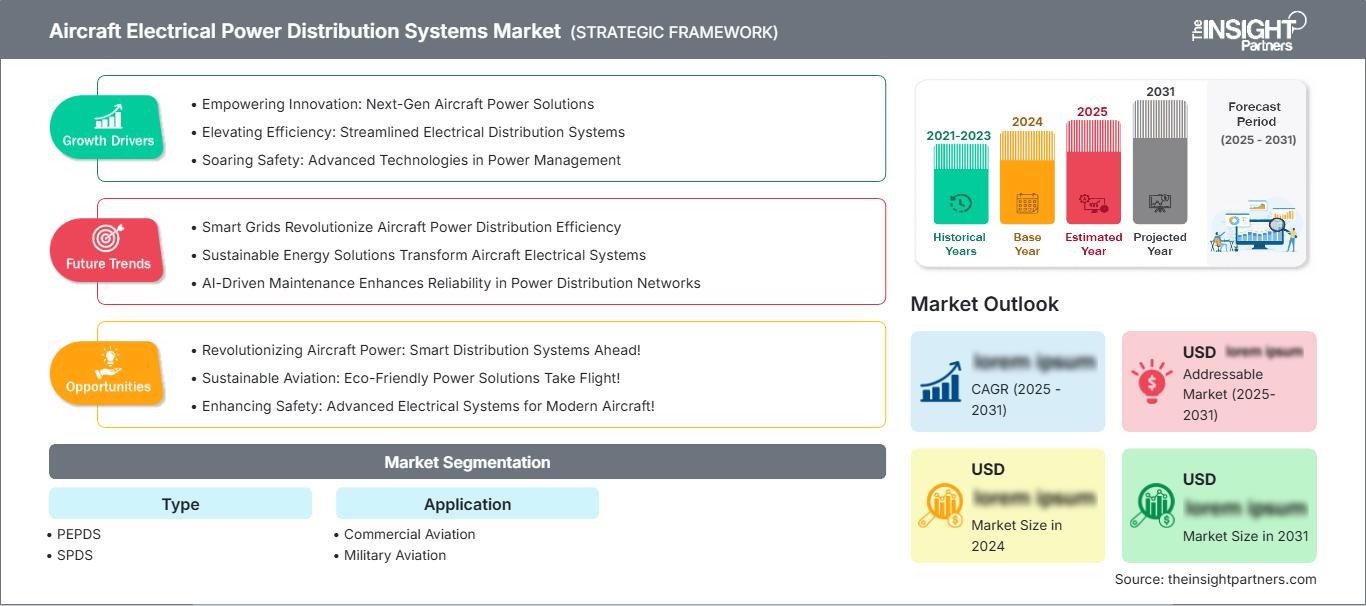
Aircraft Electrical Power Distribution Systems Market: Strategic Insights
Regional Insights
North America Aircraft Electrical Power Distribution Systems Market
North America accounted for 34–37% of global revenue in 2025 and is expected to register a 6.2–6.6% CAGR through 2034. The Aircraft Electrical Power Distribution Systems Market share is supported by Boeing supply chains, U.S. defense aircraft upgrades, and a dense base of certified aerospace electronics suppliers.
Regional demand is strongest in commercial narrowbody, business aviation, rotorcraft, and military mission systems, where reliability and weight reduction are procurement priorities. Airlines are adding power-hungry cabin connectivity and passenger electronics, while defense programs require resilient load management for sensors, communications, and electronic warfare systems.
U.S. Aircraft Electrical Power Distribution Systems Market
The U.S. represented 78–82% of North American demand in 2025 and is projected to grow at a 6.3–6.7% CAGR from 2026 to 2034. Fleet presence, defense acquisitions, and aircraft electronic equipment production ensure that the country is the regional hub for primary and secondary distribution system requirements.
Crane Aerospace & Electronics, Inc., Astronics Corporation, Honeywell International Inc., GE Aerospace, and AMETEK, Inc. are all major players in the United States with regard to power conversion, distribution, connectors, and sensing equipment. Current application trends involve solid-state protection on business jet applications and mission aircraft retrofitting and commercial cabin power conversion.
Europe Aircraft Electrical Power Distribution Systems Market
Europe held 25–28% share in 2025 and is forecast to grow at a 5.8–6.2% CAGR. France dominates regional demand via Airbus-related electrical systems, Safran S.A., Thales S.A., and military aircraft electronics. Germany boosts regional demand by providing aerospace manufacturing, cabin systems, and high-reliability industrial electronics.
The United Kingdom contributes to regional demand via avionics integration, military aircraft support, and systems engineering for future platforms. Italy and Spain drive regional demand via aero structures, defense projects, and MRO. Decarbonization policies across Europe are fostering more electric architectures; however, stringent certification and lengthy aircraft development periods prevent rapid conversion.
APAC Aircraft Electrical Power Distribution Systems Market
Asia Pacific represented 22–25% share in 2025 and is expected to expand at a 7.3–7.8% CAGR, the fastest regional pace. China is the top country because of its domestic aircraft production, increased airlift capability, and localization of the aerospace supply chain.
The involvement of Japan and South Korea comes from the area of electronics, connectors, and military aircraft modernization. India is growing in terms of airlift induction and indigenous military aircraft, while Australia ensures requirements due to defense sustainment.
Middle East & Africa Aircraft Electrical Power Distribution Systems Market
The Middle East & Africa is projected to grow at a 5.9–6.4% CAGR through 2034. UAE is the leader in regional adoption with wide-body fleets, premium cabin electrification, and maintenance capabilities, whereas Saudi Arabia has a broader aircraft purchase strategy driven by airport and carrier development.
South Africa drives demand via defense sustainment and regional maintenance support, while the rest of MEA is based on fleet upgrades and infrastructure improvement. Oil-based countries have enough money for aviation infrastructure development; however, the lack of local certification regimes forces the region to heavily rely on foreign manufacturers.
Segmentation Analysis
Type
The type segment is projected to grow at a 6.8–7.2% CAGR during 2026–2034. The Aircraft Electrical Power Distribution Systems Market scope is widening as OEMs adopt primary architectures for high-load routing and secondary systems for distributed equipment. Certification readiness, thermal design, and digital fault isolation shape supplier selection across both categories.
- PEPDS remains essential for generator-to-busbar routing, high-current protection, and mission-critical loads, making it central to aircraft safety, redundancy planning, and power architecture validation.
- SPDS is gaining strategic importance as distributed electrical loads multiply across cabins, avionics, sensors, and actuation systems, increasing demand for solid-state switching and software-controlled monitoring.
Application
The application segment is expected to grow at a 6.6–7.0% CAGR during 2026–2034. Commercial Aviation dominates volume because fleet renewal, passenger connectivity, and cabin electrification create repeat demand. Military Aviation remains strategically important because advanced sensors, electronic warfare, and mission computing require robust power quality and fault-tolerant distribution.
- Commercial Aviation drives the greatest installed demand as airlines prioritize operational reliability, cabin power availability, and lighter electrical architectures that support higher utilization and lower maintenance exposure.
- Military Aviation requires ruggedized distribution systems that manage mission electronics, sensors, and communications loads under harsh operating conditions, making reliability and redundancy decisive procurement factors.
Opportunity Snapshot
| Application | Revenue Contribution | Trend Tag | Adoption Stage |
| Commercial Aviation | High | Cabin Power | Mature |
| Military Aviation | Medium | Mission Loads | Scaling |
Aircraft Electrical Power Distribution Systems Market Growth Drivers and Impact Analysis
Rising Electrical Load Density in Modern Aircraft
The number of aircraft systems being flown with electrical power has increased compared to those on previous aircraft; these include flight control systems, cabin communications systems, passenger electrical outlet systems, environmental systems, electrical actuation systems, and sensors. The effect is an increased demand for precise load management, fast fault isolation, and effective protection of both primary and secondary circuits. Commercially, this means OEMs require lightweight cables and fewer mechanical circuit breakers, whereas airlines want reduced maintenance occurrences and dispatch reliability. In the Aircraft Electrical Power Distribution Systems Market, vendors who integrate real-time diagnostics and solid-state switch technology can win greater platform content since they contribute to reducing aircraft weight and make troubleshooting easier.
Fleet Renewal and Airline Reliability Priorities
The aerospace industry is modernizing its aircraft by changing its aircraft fleets and cabins to increase their efficiency in fuel economy, passenger comfort, and profitability. The distribution system will gain from such developments since there is a need for safer routing, high-power availability, and better load monitoring capabilities due to the introduction of new platforms and upgrades for existing aircraft. Traffic recovery and growth through IATA ensure that there will be aircraft usage, hence the dispatch reliability becomes a measurable value driver. Systems with diagnostic capabilities will minimize fault identification time during routine maintenance and prevent electrical system issues, which could cause flight delays.
Defense Modernization and Mission Electronics Expansion
There is a growing number of sensors, electronic warfare systems, communication gear, and mission computer systems being fitted to military planes that require a reliable electrical distribution system in difficult operational conditions. The demands of redundancy, electromagnetic compatibility, and fast circuit isolation in case of failures are among the main priorities of defense purchasers, since failure of electrical systems may have an impact on the safety and efficiency of the mission. Modernization projects of military fighters, cargo aircraft, helicopters, and reconnaissance aircraft give additional demand not only in new planes but also in upgrades and modernization of existing systems.
Aircraft Electrical Power Distribution Systems Market Future Trends
High-Voltage Architectures for Hybrid and More-Electric Platforms
Aircraft Electrical Power Distribution Systems Market trends increasingly point toward high-voltage distribution, especially as hybrid-electric propulsion demonstrations, electric taxiing, and advanced thermal systems mature. Increased voltage can lead to lower current, lighter cables, and lower energy losses, though it poses insulation, arc, heat, and certification problems. Future products will integrate high-voltage contactors, solid-state protection, advanced connectors, and load management through software. Suppliers able to show safe operation in vibration, altitude, moisture, and electromagnetic environments will be more attractive for future aircraft programs. This will not happen overnight and will have an impact on design, materials, and suppliers until 2034.
Embedded Health Monitoring in Distribution Networks
Digital health monitoring will become an expectation in aircraft power distribution systems due to the requirement for better early detection of problems related to overheating, faults, unbalanced loads, and deterioration of components. Digital systems will send out information about the state of their components to maintenance systems on the aircraft, thus providing the possibility for the replacement of components before any disruptions take place. In addition, this development will contribute to aircraft-level energy management and make it possible to prioritize loads in abnormal conditions. AI will be implemented very carefully due to the need for explainable logic, but data analytics will help predict failures better.
Aircraft Electrical Power Distribution Systems Market Opportunities
Certification-Ready SPDS Modules for Retrofit Programs
Aircraft Electrical Power Distribution Systems Market Forecasts indicate attractive opportunities in retrofit-ready secondary distribution modules because operators are upgrading cabin systems faster than full aircraft replacement cycles. Suppliers may pursue opportunities in both line fit and aftermarket through assemblies that decrease the amount of cabling, make installations easier, and enable passenger communications, in-flight power, lights, and galleys. Such suppliers have the most to gain from selling to airlines operating narrow-body and wide-body fleets with ongoing cabin renovation programs. For these suppliers to fully realize this opportunity, they need to create adaptable product families, pursue paths to supplemental type certification, and work with MRO organizations to install products during routine maintenance inspections.
Localized Aerospace Supply Chains in Asia Pacific
The Asia Pacific region presents a viable market opportunity for businesses that are able to manufacture, test, and engineer their products while maintaining certification integrity. China, India, Japan, and South Korea have begun to increase production and development in the fields of aircraft manufacturing, defense aviation, and sourcing parts, thus presenting a need for skilled electrical distribution suppliers. Working in partnership with local manufacturers of aerospace equipment can decrease procurement time and give access to publicly funded projects. Electrical distributors should focus on assemblies, secondary distribution products, and maintenance in line with the aircraft platforms in the region.
Recent Developments
- July 2026: Safran Electrical & Power inaugurated a new electrical wiring factory in Chihuahua, Mexico. The 10,600 m² facility expands Safran’s aerospace wiring production capacity, supports next-generation aircraft programs, and is expected to create more than 800 jobs.
- 2026: Clean Aviation’s HECATE project advanced electric aviation development by delivering key technologies for high-voltage electrical systems, supporting Europe’s goal of cleaner and more efficient aircraft propulsion solutions.
- 2025: GE Aerospace successfully tested a megawatt-class hybrid electric propulsion system, demonstrating high-power electrical components and integration capabilities aimed at enabling future hybrid-electric commercial aircraft.
Frequently Asked Questions

- Comprehensive Market Sizing and Forecast Analysis
- Detailed Segmentation Analysis
- In-Depth Market Dynamics Assessment
- Regional and Country-Level Insights
- Competitive Landscape and Company Benchmarking
- Strategic Business Intelligence
Recent Reports
Testimonials

The Insight Partners' SCADA System Market report is comprehensive, with valuable insights on current trends and future forecasts. The team was highly professional, responsive, and supportive throughout. We are very satisfied and highly recommend their services.
RAN KEDEM Partner, Reali Technologies LTDs
I requested a report on a very specific software market and the team produced the report in a few days. The information was very relevant and well presented. I then requested some changes and additions to the report. The team was again very responsive and I got the final report in less than a week.
JEAN-HERVE JENN Chairman, Future Analytica
We worked with The Insight Partners for an important market study and forecast. They gave us clear insights into opportunities and risks, which helped shape our plans. Their research was easy to use and based on solid data. It helped us make smart, confident decisions. We highly recommend them.
PIYUSH NAGPAL Sr. Vice President, High Beam Global
The Insight Partners delivered insightful, well-structured market research with strong domain expertise. Their team was professional and responsive throughout. The user-friendly website made accessing industry reports seamless. We highly recommend them for reliable, high-quality research services
YUKIHIKO ADACHI CEO, Deep Blue, LLC.
This is the first time I have purchased a market report from The Insight Partners.While I was unsure at first, I visited their web site and felt more comfortable to take the risk and purchase a market report.I am completely satisfied with the quality of the report and customer service. I had several questions and comments with the initial report, but after a couple of dialogs over email with their analyst I believe I have a report that I can use as input to our strategic planning process.Thank you so much for taking the extra time and making this a positive experience.I will definitely recommend your service to others and you will be my first call when we need further market data.
JOHN SUZUKI President and Chief Executive Officer, Board Director, BK Technologies
I wish to appreciate your support and the professionalism you displayed in the course of attending to my request for information regarding to infectious disease IVD market in Nigeria. I appreciate your patience, your guidance, and the fact that you were willing to offer a discount, which eventually made it possible for us to close a deal. I look forward to engaging The Insight Partners in the future, all thanks to the impression you have created in me as a result of this first encounter.
DR CHIJIOKE ONYIA MANAGING DIRECTOR, PineCrest Healthcare Ltd.Reason to Buy
- Informed Decision-Making
- Understanding Market Dynamics
- Competitive Analysis
- Identifying Emerging Markets
- Customer Insights
- Market Forecasts
- Risk Mitigation
- Boosting Operational Efficiency
- Strategic Planning
- Investment Justification
- Tracking Industry Innovations
- Aligning with Regulatory Trends





 Get Free Sample for