
Airport Information System Market Share, Demand & Growth by 2034
Coverage: By System (Weather Monitoring System, Airport Operation Control Center (AOCC), Flight Information Display System, and Passenger Check-In & Boarding); Airport (Class A Airports, Class B Airports, Class C Airports, and Class D Airports); Application (Ground Handling, Finance & Operations, Security, Maintenance, and Others); End User (Passenger Systems, and Non-Passenger Systems), and Geography (North America, Europe, Asia Pacific, and South and Central America)
- Status : Data Released
- Report Code : TIPAD00002306
- Category : Electronics and Semiconductor
- No. of Pages : 150
- Available Report Formats :


- Last update date : July 17, 2026


2025 Market Size
US$ 14.56 Bn
Base year value
2034 Forecast
US$ 28.83 Bn
Projected by 2034
CAGR 2026-2034
7.89 %
Growth rate
Addressable Market
US$ 195.27 Bn
(2026-2034)
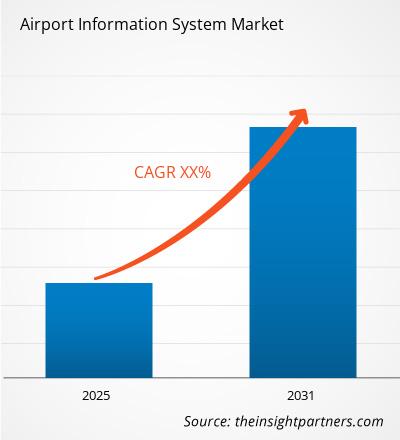
The Airport Information System Market was valued at US$ 14.56 Billion in 2025 and is projected to reach US$ 28.83 Billion by 2034, expanding at a CAGR of 7.89% from 2026 to 2034. Demand is being shaped by airport modernization, real-time passenger communication, integrated operations control, and resilient digital infrastructure across passenger-facing and non-passenger systems.
Across North America, adoption is expected to progress at a CAGR range of 7.4–8.0% through 2034 as airports prioritize cloud-enabled operations, cybersecurity, and passenger flow automation. The Airport Information System Market size in the region is supported by terminal upgrades, FAA-linked infrastructure programs, airline digital identity initiatives, and the rising use of integrated airport operational databases.
Airport Information System Market Assessment and Insights
- North America held 34–37% share in 2025 and is growing at a CAGR range of 7.4–8.0% between 2026–2034, supported by terminal modernization, air traffic resilience, cybersecurity spending, and passenger processing upgrades.
- US accounted for 78–82% of North America in 2025 and is growing at 7.5–8.1%, driven by airport grants, hub automation, and biometric trials.
- Europe represented 25–28% share in 2025 and is expanding at 7.1–7.7%, led by the UK, Germany, France, Spain, and Italy through common-use systems and airport CDM programs.
- Asia Pacific captured 23–26% share in 2025 and is growing at 8.6–9.4%, led by China, India, Japan, South Korea, and Australia as capacity expansion accelerates.
- Largest Segment Passenger Systems held 58–62% market share in 2025 and is advancing at 7.8–8.4% CAGR, reflecting self-service check-in, boarding, and information display upgrades.
- High Growth Segment Airport Operation Control Center held 18–21% market share in 2025 and is growing at 8.8–9.6% CAGR due to data-driven disruption management.
- Key companies analyzed in detail: RTX Corporation, International Business Machines Corporation, Indra Sistemas, S.A., Thales S.A., SITA, Amadeus IT Group, S.A., Ultra Electronics Holdings Limited, INFORM GmbH, Ikusi, S.L., RESA Airport Data Systems, Honeywell International Inc., Siemens AG.
Source: The Insight Partners' analysis based on proprietary research, government publications, company annual reports, investor presentations, industry databases, and expert interviews.
Airport information systems have progressed from discrete devices and local server solutions to integrated operating environments covering flights, passenger processing, baggage, security, and maintenance processes. Cloud computing, API integration, predictive analytics, and mobile passenger interaction technologies have limited reliance on manual coordination. Competitiveness among vendors is based on interoperability, cyber security and service continuity beyond pure hardware capacity, whereas airport authorities look for modular system enhancements preserving their legacy infrastructure without disrupting operations.
Investment decisions are driven by capacity growth in Asia Pacific and Middle Eastern regions, sustainability, automation of border control processes, and increased service level requirements imposed by airlines. Airport operators are going to invest more in integrated decision support software, particularly in cases when expansion of terminals is limited by space constraints. Safety and accessibility, along with passenger transparency considerations, will help drive demand for resilient airport information systems.
Airport Information System Market Report Scope
| Report Attribute | Details |
|---|---|
| Market size in 2025 | US$ 14.56 Billion |
| Market Size by 2034 | US$ 28.83 Billion |
| Global CAGR (2026 - 2034) | 7.89% |
| Historical Data | 2021-2024 |
| Forecast period | 2026-2034 |
Airport Information System Market Analysis
Airport Information System Market growth is driven by higher flight complexity, tighter turnaround targets, and passenger expectations for real-time information across check-in, boarding, baggage, and disruption events. As indicated by IATA and SITA surveys, there is increasing adoption of mobile travel, biometrics, and digital identity solutions. These factors increase the need for a reliable data exchange between airports and the common use of infrastructure.
The ecosystem consists of airport authorities, airlines, ground handling services, border control, system integrators, telecoms, and software vendors. In terms of supply side, those vendors that can develop scalable platforms that integrate airport operations databases, FIDS, resource management, billing, and cybersecurity will be preferred.
Market Analysis of the Airport Information System Market shows that there is competition based on platform depth, airport references, and integration ability. SITA and Amadeus IT Group, S.A. concentrate on passenger and airport management platforms, whereas Thales S.A., Indra Sistemas, S.A., and RTX Corporation offer capabilities in airside, security, and mission-critical systems.
The investments are geared towards cloud migration, digital twin, biometric orchestration, and predictive operations. International Business Machines Corporation, Honeywell International Inc., Siemens AG, INFORM GmbH, Ikusi, S.L., RESA Airport Data Systems, and Ultra Electronics Holdings Limited augment the vendor portfolio with analytics, automation, communication, and airport-specific software.
● REPORT CUSTOMIZATION
Tailor This Report To Align With Your Specific Business Requirements
This report can be customized to align precisely with your business objectives, scope, and target markets. Customization options include tailored segmentation, geography, competitive analysis, and strategic insights to support informed decision-making.
Customize This Report →WHAT YOU CAN ADJUST
- ● Segmentations
- ● Geography
- ● Competitive Analysis
- ● Language Preferences
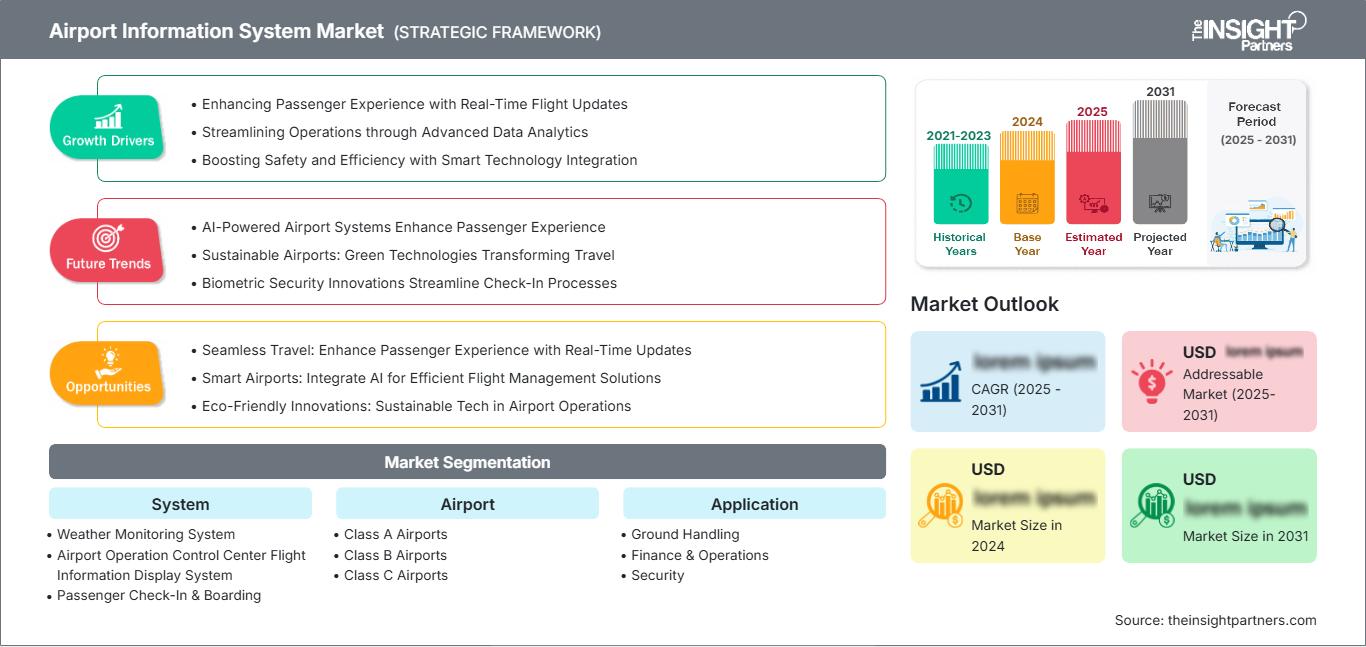
Airport Information System Market: Strategic Insights
Regional Insights
North America Airport Information System Market
North America accounted for 34–37% of global revenue in 2025, and the Airport Information System Market share is supported by dense hub networks, high airline IT maturity, and federal infrastructure funding. Expected growth for the area during 2026-2034 is projected at 7.4-8.0% CAGR, with resilience and cyber-secured common-use platforms receiving attention.
Flight information, resource management, weather services, and passenger handling technologies in the region are expanding to terminals, operations control centers, and mobile applications. The replacement cycle is supported by FAA Airport Improvement Program funding and terminal upgrades. Large US and Canadian airports deploy integrated data layers for disruption management, staff, gates, and baggage tracking.
U.S. Airport Information System Market
The U.S. represented 78–82% of North America revenue in 2025 and is projected to grow at 7.5–8.1% CAGR from 2026 to 2034. These large hub airports have improved their common passenger use system, flight display systems, airport operational databases, and maintenance processes to handle record levels of screenings, airline scheduling, and passenger self-service.
The list of vendors for these airports includes RTX Corporation, International Business Machines Corporation, Honeywell International Inc., SITA, Amadeus IT Group, S.A., and Thales S.A. Their products are used for communication, analytics, passenger processing, and security platforms. The greatest application demand is seen in the finance and operations, ground handling coordination, cybersecurity, and disruptions communication at airports with multiple airlines networks.
Europe Airport Information System Market
Europe held 25–28% share in 2025 and is expected to post 7.1–7.7% CAGR through 2034. The United Kingdom tops regional demand due to investments made at Heathrow, Gatwick, Manchester, and regional airports in passenger information, common use, and operational recovery solutions. Germany ranks next in terms of airport CDM implementations, followed by France, Italy, and Spain, which prioritize Schengen flows, baggage, and seasonal capacity management.
European adoption is influenced by sustainable reporting, slot management, border management, and passengers' expectations. Thales S.A., Indra Sistemas, S.A., Amadeus IT Group, S.A., SITA, RESA Airport Data Systems, INFORM GmbH, Siemens AG, and Ikusi, S.L. capitalize on airport modernization efforts where interoperable systems, multilingual communications, and data exchange between airlines and airport handlers and authorities play an important role.
APAC Airport Information System Market
Asia Pacific accounted for 23–26% share in 2025 and is projected to grow at 8.6–9.4% CAGR, the fastest regional pace. China is the leading country by airport scale, while India records strong procurement momentum from greenfield airports, regional connectivity, and digital public infrastructure.
Japan, South Korea, and Australia emphasize reliability, passenger experience, and advanced security integration. Industrial policy, tourism recovery, and airport capacity expansion support demand for flight information display systems, operation control centers, and passenger check-in and boarding systems. Airport Information System Market investment is therefore tied closely to terminal expansion and smart airport programs.
Middle East & Africa Airport Information System Market
MEA and Africa are predicted to register growth at a CAGR of 8.0–8.8% up until 2034, driven by UAE and Saudi Arabia, where airport development goes hand in hand with the country’s tourism, aviation hub, and energy diversification strategies. South Africa retains its status as the primary procurement location in Africa.
RoMEA will require more project-oriented solutions with an emphasis on airport security, terminal development, and passenger communication resiliency. The high transfer traffic volume at Gulf airport hubs creates opportunities for airport operations control centers, while in Africa, airports opt for scalable solutions that will enhance flight display, billing, maintenance transparency, and ground handling.
Segmentation Analysis
System
The system will see a growth of 7.7%-8.5% CAGR between 2026-2034 as airports integrate the functions of weather surveillance, operations management, flight information, and passenger services into systems. The scope of the Airport Information System market in this segment increases as the airport seeks to streamline processes through data governance and faster disruption management.
- The Weather Monitoring System is important due to the critical nature of the decisions made through the integration of weather information into airport operations, runway planning, and airline communications.
- The Airport Operation Control Center Flight Information Display System is an important system due to the way it integrates information related to flights, gates, resources, and public communication.
- Passengers benefit from self-service systems as well as biometric check-in at airports that can handle more passengers without increasing their infrastructure.
Airport
The Airport market is projected to register a CAGR of 7.3–8.1% during 2026-2034 due to the modernization of airport categories taking place at various rates of investment. Large airports will focus on integration and cybersecurity, whereas small airports will concentrate on budget-friendly flight information, billing, planning, and communication systems.
- Class A airports demonstrate the greatest technology depth by making use of the most advanced operations center, passenger system, security integration, and analytics to handle multi-airline traffic.
- Class B airports utilize a modular platform that helps improve passenger handling, flight information display, and ground handling management while remaining flexible enough for gradual terminal expansion and airline growth.
- Class C airports focus on systems that are cost-effective and scalable, thereby improving operational visibility, billing, maintenance tracking, and communication with airlines and regional passengers.
- Class D airports need nothing but reliable flight information, weather information, and operational applications that help enhance safety and service delivery without requiring extensive integration projects.
Application
Application is forecasted to grow at 7.6–8.4% CAGR from 2026 to 2034 due to the evolution of airport information systems from passenger-centric to applications in finance, operations, security, and maintenance. The growth is driven by the need to decrease turnaround delays, increase efficiency in asset management, enhance security procedures, and maintain auditable operational data.
- Ground Handling uses collaborative operational information that helps in coordinating baggage, ramp management, gates, and turnaround activities, and hence the need for accurate data for timely operations is crucial.
- Finance & Operations will benefit from automation of billing, resource allocation, and performance metrics, which will help airport authorities in achieving better revenue assurance and cost management.
- Security will use integrated information systems in connecting passenger identification, security access, incident management, and reporting.
- Maintenance becomes more important as airports become more digitized for inspection, fault reporting, and maintenance scheduling for displays, kiosks, networking, and operational equipment.
End User
The End User segment is projected to register a 7.8-8.6% CAGR between 2026 and 2034, with passenger solutions remaining the most important while non-passenger solutions becoming more critical for operations management. Airports are becoming more inclined to see both segments as integrated layers and not as two separate procurement streams.
- Passenger Systems predominate in the domain because it is crucial to provide correct information about flights, processing, boarding, baggage, and disturbances through various media.
- Non-Passenger Systems play a significant role in the operational processes of airport operation centers, maintenance services, financial services, and security services due to the necessity of having dependable data.
Opportunity Snapshot
| Segment Name | Revenue Contribution | Trend Tag | Adoption Stage |
| Passenger Systems | High | Digital ID | Scaling |
| Non-Passenger Systems | Medium | Ops Control | Scaling |
Airport Information System Market Growth Drivers and Impact Analysis
Rising Passenger Volumes and Terminal Congestion
Increasing traveler numbers are putting stress on airport authorities to accommodate growing numbers of travelers without adequate expansion of terminals. The recovery of international air traffic has been observed in IATA statistics. At the same time, high levels of passenger adoption of digital identities and mobile services have been reported by SITA Passenger research. This results in an apparent need for a flight information display system, check-in facilities, a boarding system, and disruption messaging. The Airport Information Systems Market will be positively affected as such systems would help in reducing queue time, optimizing gate utilization, and helping airlines recover from disruptions.
Airport Operations Moving Toward Integrated Control Centers
Airports are moving from isolated departmental solutions to consolidated control centers that integrate flight information, gates, stands, luggage, weather, staffing, and incident details. The benefit of this move is an increase in the speed of decision-making since disruption management requires a coordinated situational awareness among carriers, handlers, and the airport team. Information systems that allow for integration of databases and dashboards, alerts, and automated resource allocation can be used by airports to safeguard their punctuality. The business impact of such a move is high as it allows better use of gates and other ground resources, which saves money and pleases passengers.
Cybersecurity and Regulatory Accountability in Airport IT
With increasing digitalization of identity, flight, baggage, and operational processes at the airport, cyber resilience is becoming a necessary procurement consideration rather than an optional one. Information systems of the airport manage passengers' sensitive information, airline schedules, resources, and security-related information, the outage may have negative consequences for safety, earnings, and trust of the population. Today, regulators and the airport management are increasingly demanding an auditable system, controlled access, redundancy, and preparedness to respond to incidents. This factor increases investment in managed services, cloud-based hosting, network segmentation, and monitoring systems.
Airport Information System Market Future Trends
Digital Identity Becoming a Standard Passenger Layer
Airport Information System Market trends point toward digital identity becoming embedded across check-in, security, boarding, and baggage recovery rather than remaining a pilot-stage enhancement. The comfort of passengers with the use of biometrics and mobile credentials is increasing, but success will be contingent upon security, consent, and cybersecurity design. Airports must have solutions that align airline, border, and airport databases while maintaining visibility of passenger control. The next-generation platform is one that will not just show the data but also authenticate, route, and customize the experience. Companies with privacy-by-design technology and demonstrated biometric orchestration capabilities will be well-positioned for airport transformation projects.
Predictive Airport Operations and Digital Twins
Prediction-based operation will turn the information system used in airports into a decision-making machine. Digital twins, artificial intelligence, and simulations will assist airports in predicting problems related to gate allocation, queuing, baggage, weather, and a lack of staff before they affect passengers. This development is likely to lead to higher requirements for data integration in airport terminals, airside infrastructure, and airlines. Airports equipped with prediction platforms will be able to simulate operations without impacting actual operations. Eventually, procurement of solutions will depend on the ability of a vendor to integrate real-time data processing, simulation, and explanations for airport duty managers.
Airport Information System Market Opportunities
Cloud Migration for Mid-Sized and Regional Airports
Mid-size to regional airports provide a great market opportunity due to the presence of several such airports that are still using fragmented legacy systems, along with limited IT staff and locally hosted applications. Deployment on the cloud can help to cut initial infrastructure costs and update processes, besides offering managed service resilience. Software vendors can develop bundled offerings for flight information, billing, resource management, and maintenance modules as subscription services to grow along with an increase in passengers. As per the Airport Information System Market Forecasts, this particular customer segment would be looking for low implementation risk and predictable OPEX.
Integrated Data Services for Airlines and Ground Handlers
There is an inherent need for uniformity of airport information among airlines and their ground agents to ensure turnaround times, baggage tracking, staff scheduling, and customer notifications. This gives rise to a potential value proposition of the airport information system vendors to provide shared data services for connecting the operational databases of the airport with those of the airlines in departure control, ramp management, and disruption systems. The commercial offerings can go beyond software licensing to include data management, service level monitoring, and analytics subscriptions.
Recent Developments
- March 2026: Modaxo Inc., a global technology organization focused on moving the world’s people, today announced the launch of Aerivo, a new brand and organization that provides Airport Terminal Systems, acquired from ADB SAFEGATE. Aerivo is a leading provider of cloud-based systems used throughout the airport terminal ecosystem, partnering with airports around the world and dedicated to driving efficiency and reliability by optimizing airside operations.
- November 2025: NATS announced the full market launch of Intelligent Stand Manager, its groundbreaking stand allocation solution, at the International Airport Summit in Berlin. Developed in partnership with Searidge Technologies, Intelligent Stand Manager represents a major step forward in airport digitalization, enabling operators to move from reactive stand planning to proactive, data-driven optimization.
- June 2026: DXC Technology (NYSE: DXC), a leading enterprise technology and innovation partner, today announced that it has been selected by Perth Airport as Master Systems Integrator (MSI) for the new terminal development, marking a key milestone in the airport's multi-billion-dollar investment to transform its infrastructure and support Western Australia's long-term economic growth.
Frequently Asked Questions

- Comprehensive Market Sizing and Forecast Analysis
- Detailed Segmentation Analysis
- In-Depth Market Dynamics Assessment
- Regional and Country-Level Insights
- Competitive Landscape and Company Benchmarking
- Strategic Business Intelligence
Recent Reports
Testimonials

The Insight Partners' SCADA System Market report is comprehensive, with valuable insights on current trends and future forecasts. The team was highly professional, responsive, and supportive throughout. We are very satisfied and highly recommend their services.
RAN KEDEM Partner, Reali Technologies LTDs
I requested a report on a very specific software market and the team produced the report in a few days. The information was very relevant and well presented. I then requested some changes and additions to the report. The team was again very responsive and I got the final report in less than a week.
JEAN-HERVE JENN Chairman, Future Analytica
We worked with The Insight Partners for an important market study and forecast. They gave us clear insights into opportunities and risks, which helped shape our plans. Their research was easy to use and based on solid data. It helped us make smart, confident decisions. We highly recommend them.
PIYUSH NAGPAL Sr. Vice President, High Beam Global
The Insight Partners delivered insightful, well-structured market research with strong domain expertise. Their team was professional and responsive throughout. The user-friendly website made accessing industry reports seamless. We highly recommend them for reliable, high-quality research services
YUKIHIKO ADACHI CEO, Deep Blue, LLC.
This is the first time I have purchased a market report from The Insight Partners.While I was unsure at first, I visited their web site and felt more comfortable to take the risk and purchase a market report.I am completely satisfied with the quality of the report and customer service. I had several questions and comments with the initial report, but after a couple of dialogs over email with their analyst I believe I have a report that I can use as input to our strategic planning process.Thank you so much for taking the extra time and making this a positive experience.I will definitely recommend your service to others and you will be my first call when we need further market data.
JOHN SUZUKI President and Chief Executive Officer, Board Director, BK Technologies
I wish to appreciate your support and the professionalism you displayed in the course of attending to my request for information regarding to infectious disease IVD market in Nigeria. I appreciate your patience, your guidance, and the fact that you were willing to offer a discount, which eventually made it possible for us to close a deal. I look forward to engaging The Insight Partners in the future, all thanks to the impression you have created in me as a result of this first encounter.
DR CHIJIOKE ONYIA MANAGING DIRECTOR, PineCrest Healthcare Ltd.Reason to Buy
- Informed Decision-Making
- Understanding Market Dynamics
- Competitive Analysis
- Identifying Emerging Markets
- Customer Insights
- Market Forecasts
- Risk Mitigation
- Boosting Operational Efficiency
- Strategic Planning
- Investment Justification
- Tracking Industry Innovations
- Aligning with Regulatory Trends





 Get Free Sample for