
Anastomosis Device Market Size, Growth & Trends by 2034
Coverage: By Product ( Surgical Staplers, Surgical Sutures, Surgical Sealants and Adhesives ); Application ( Gastrointestinal Surgeries, Cardiovascular and Thoracic Surgeries, Other Applications ); End User ( Hospitals, Ambulatory Surgery Centers and Clinics ), and Geography (North America, Europe, Asia Pacific, and South and Central America)
- Status : Data Released
- Report Code : TIPRE00007622
- Category : Life Sciences
- No. of Pages : 150
- Available Report Formats :


- Last update date : August 04, 2026


2025 Market Size
US$ 3.68 Bn
Base year value
2034 Forecast
US$ 7.94 Bn
Projected by 2034
CAGR 2026-2034
8.91 %
Growth rate
Addressable Market
US$ 51.99 Bn
(2026-2034)
The anastomosis device market is projected to increase from US$ 3.68 Billion in 2025 to US$ 7.94 Billion by 2034, registering a CAGR of 8.91% during 2026–2034. Demand is being shaped by rising gastrointestinal, cardiovascular, thoracic, bariatric, and minimally invasive procedures where reliable tissue approximation, staple-line integrity, leak prevention, and operative efficiency are central to clinical outcomes and hospital cost control.
Across North America, the anastomosis device market size is supported by high procedural intensity, advanced surgical infrastructure, and broader adoption of powered stapling and robotic-assisted techniques. The region is expected to grow at a CAGR range of 8.2–8.8% during 2026–2034, with demand reinforced by colorectal cancer surgery, bariatric procedures, thoracic interventions, and hospital focus on reducing post-operative leak and bleeding complications.
Anastomosis Device Market Assessment and Insights
- North America held 39–42% share in 2025 and is growing at a CAGR of 8.2–8.8% between 2026–2034, supported by robotic surgery penetration, colorectal procedure volumes, and premium stapling adoption.
- US accounted for 84–87% of North America in 2025 and is growing at a CAGR of 8.3–8.9% between 2026–2034, driven by hospital capital spending and advanced surgery programs.
- Europe held 26–29% share in 2025 and is growing at a CAGR of 7.4–8.0% between 2026–2034, led by Germany, the UK, France, Italy, and Spain.
- Asia Pacific held 21–24% share in 2025 and is growing at a CAGR of 9.8–10.5% between 2026–2034, with China, Japan, India, South Korea, and Australia expanding surgical capacity.
- Largest Segment surgical staplers held 52–56% market share in 2025 and is growing at a CAGR of 9.0–9.6% between 2026–2034 due to broad open and laparoscopic use.
- High Growth Segment ambulatory surgery centers and clinics held 18–22% market share in 2025 and are growing at a CAGR of 10.2–10.9% between 2026–2034 as outpatient procedures scale.
- Key companies analyzed in detail: B. Braun Melsungen AG, Becton, Dickinson and Company, Boston Scientific Corporation, CONMED Corporation, Artivion, Inc., EndoEvolution, LLC, Intuitive Surgical, Inc., Johnson & Johnson, Medtronic plc, Smith & Nephew plc.
Source: The Insight Partners' analysis based on proprietary research, government publications, company annual reports, investor presentations, industry databases, and expert interviews.
Product evolution in the anastomosis device market has moved from manual suturing and basic mechanical stapling toward powered, intelligent, reload-specific, and robotic-compatible platforms. Productivity is driven by accurate metal forming, polymer science, sterile packaging, biologic sealant development, and product quality systems. The hospitals now measure the anastomosis devices based on tissue compression control, staple-line uniformity, reload capability, training requirements of the surgeons, and minimally invasive process suitability, rather than merely the initial cost of the devices.
Upcoming demand will be driven by surgical technology upgradation in developing countries, robotic technology usage, and performance-based regulatory focus. Capital expenditure is focusing on staplers, biologic sealants, and instrumentation that have minimal variability with respect to tissue thickness. Windfall factors for cancer surgeries, obesity procedures, and cardiology should favor the suppliers who can combine innovation with education, operating room assistance, and sterility of supplies.
Anastomosis Device Market Report Scope
| Report Attribute | Details |
|---|---|
| Market size in 2025 | US$ 3.68 Billion |
| Market Size by 2034 | US$ 7.94 Billion |
| Global CAGR (2026 - 2034) | 8.91% |
| Historical Data | 2021-2024 |
| Forecast period | 2026-2034 |
Anastomosis Device Market Analysis
The anastomosis device market growth is driven by rising procedure volumes in gastrointestinal, colorectal, bariatric, thoracic, and vascular surgery. The burden of cancer among WHO statistics, surgical activity among OECD countries, and trends in aging populations justify the need for technologies for forming secure tissue connections. Value chain participants include suppliers of components, sterile instruments, biological materials, distributors, hospitals, surgical teams, and institutions providing training.
Dynamics in the supply chain include the use of single-use reloads, hospital tenders, product recalls, and regulatory focus on the effectiveness of staplers. Reliability is important to surgical teams because of the risk of changing the surgical process due to the unavailability of devices.
The anastomosis device market analysis shows a concentrated competitive landscape anchored by global surgical technology companies and specialist innovators. Johnson & Johnson and Medtronic plc are intense competitors in stapling products, while B. Braun Melsungen AG and Becton, Dickinson and Company contribute to the market development of sutures, closure, and hospital supply collaboration. Intuitive Surgical, Inc. drives demand by developing robot-assisted surgery procedures.
Boston Scientific Corporation, CONMED Corporation, Artivion, Inc., EndoEvolution, LLC, and Smith & Nephew plc compete in the adjacent areas of surgical access, tissue management, and specialty procedures. Positioning is increasingly becoming contingent on the integration of technology into minimally invasive and robotic surgery procedures. Companies that invest in surgeon education, evidence creation, and platform integration can be expected to fare better in value-driven purchasing.
● REPORT CUSTOMIZATION
Tailor This Report To Align With Your Specific Business Requirements
This report can be customized to align precisely with your business objectives, scope, and target markets. Customization options include tailored segmentation, geography, competitive analysis, and strategic insights to support informed decision-making.
Customize This Report →WHAT YOU CAN ADJUST
- ● Segmentations
- ● Geography
- ● Competitive Analysis
- ● Language Preferences
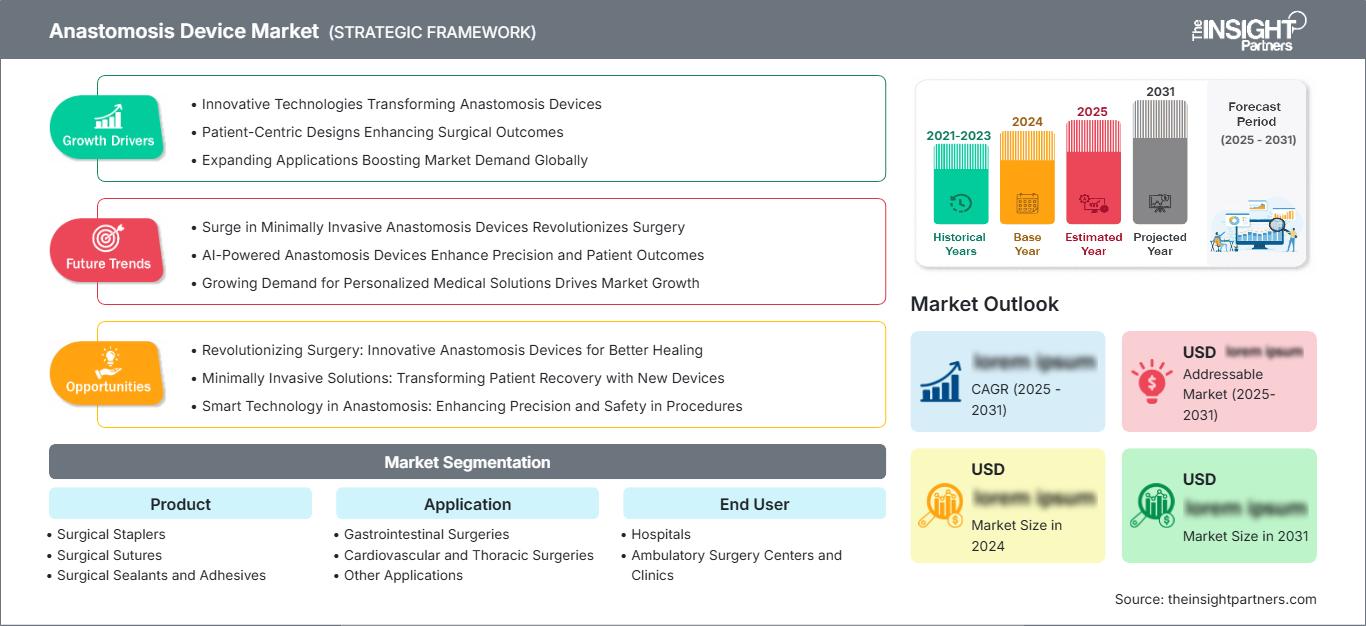
Anastomosis Device Market: Strategic Insights
Regional Insights
North America anastomosis device market
North America held 39–42% share in 2025 and is expected to grow at a CAGR of 8.2–8.8% during 2026–2034. The region benefits from high surgical volumes, advanced hospital infrastructure, and strong adoption of powered staplers, circular staplers, sealants, and robotic-assisted instruments. These factors support the anastomosis device market share across gastrointestinal, thoracic, cardiovascular, and bariatric procedures.
Demand is augmented by colorectal cancer surgery, obesity surgery, and hospitals' efforts to decrease complications, which increase length of stay and result in readmission. Purchasing departments require increasing clinical evidence of leak resistance, reduced blood loss, consistent reloading, and tissue handling. Manufacturers that offer field support, surgical training, and a large procedural range will be better off.
U.S. anastomosis device Market
The U.S. represented 84–87% of North America in 2025 and is projected to grow at a CAGR of 8.3–8.9% during 2026–2034. The demand will be fueled by high usage of minimally invasive surgery procedures, robotic systems, and outpatient surgical procedures. The colorectal, bariatric, thoracic, and cardiovascular programs will continue to be major consumers since the anastomotic integrity affects the infection probability, recuperation period, and overall costs incurred during the procedure.
Companies have a wide reach with Johnson & Johnson, Medtronic plc, Intuitive Surgical, Inc., Becton, Dickinson and Company, Boston Scientific Corporation, CONMED Corporation, and B. Braun Melsungen AG, having representatives in all hospitals. Trends indicate the adoption of powered staplers for colorectal and bariatric surgery, while sutures and sealants continue to play a significant role in vascular and thoracic repairs.
Europe anastomosis device Market
Europe held 26–29% share in 2025 and is expected to expand at a CAGR of 7.4–8.0% during 2026–2034, with Germany leading demand. The UK makes use of well-defined colorectal and bariatric pathways, although cost discipline is exercised when it comes to procurement. Increasingly, there is a need for devices that can integrate with the hospitals' laparoscopic and robotic operating room programs.
The demand in Germany is driven by the country's high levels of surgical specialization, technological standards in its hospitals, and training networks. The areas of demand are mainly colorectal, thoracic, and cardiovascular operations, where leakage, bleeding, and operating times are important quality parameters. There is continued growth in France, Italy, and Spain, driven by the centralization of cancer surgery, obesity management, and the slow introduction of robotic surgery.
APAC anastomosis device Market
APAC held 21–24% share in 2025 and is projected to grow at a CAGR of 9.8–10.5% during 2026–2034. Demand leadership in China is attributed to hospital construction of third-level hospitals, cancer surgeries, and local manufacturing, whereas in Japan and South Korea, emphasis is on precision surgery and robotics.
Growth drivers in India and Australia include private hospital building, bariatric surgery demand, and the use of laparoscopy. Government policies for the manufacturing of medical technology and infrastructure development are contributing to improved access. Suppliers have to reconcile innovation with cost considerations and distributor networks.
Middle East & Africa anastomosis device Market
The Middle East & Africa are expected to grow at a CAGR of 7.6–8.3% during 2026–2034, led by Saudi Arabia. There will be growth from hospitals that invest in infrastructure development, surgery centers, oncology services, and government-led modernization efforts in the Gulf healthcare systems.
There is demand for high-end surgical equipment in the UAE, but South Africa will still remain a key market through its private hospitals and oncology surgeries. The adoption in RoMEA is patchy due to disparities in budget allocation, surgeon training, and equipment availability. Energy-funded infrastructure initiatives drive advanced operating rooms in selected Gulf countries.
Segmentation Analysis
Product
The Product segment is expected to grow at a CAGR of 8.7–9.3% during 2026–2034. Demand is shaped by the shift from manual tissue approximation toward standardized mechanical and adjunctive closure technologies. The anastomosis device market scope is widening as surgeons seek consistent compression, better hemostasis, faster firing, seal reinforcement, and instruments compatible with open, laparoscopic, thoracoscopic, and robotic procedures.
- Surgical Staplers remain the leading product type because they support rapid, reproducible tissue approximation in gastrointestinal, bariatric, thoracic, and colorectal surgery, where staple-line integrity is critical.
- Surgical Sutures continue to be essential in complex reconstructive, vascular, and reinforcement procedures where surgeon control, material flexibility, and tissue-specific handling are required.
- Surgical Sealants and Adhesives are strategically important adjuncts because they help reinforce closures, reduce leakage risk, support hemostasis, and complement stapling or suturing in selected procedures.
Application
The Application segment is expected to grow at a CAGR of 8.8–9.4% during 2026–2034. Gastrointestinal procedures remain central because colorectal, bariatric, and bowel resections frequently require secure tissue reconnection. Cardiovascular and thoracic surgeries add high-value demand where precision, tissue fragility, and bleeding control influence device selection. Other applications support broader surgical utility in specialty settings.
- Gastrointestinal Surgeries generate the strongest demand because colorectal resections, bariatric procedures, and bowel repairs frequently depend on circular and linear stapling for reliable anastomosis formation.
- Cardiovascular and Thoracic Surgeries require high-confidence closure and tissue handling, particularly in vascular grafting, lung resections, and minimally invasive cardiac procedures where complications are costly.
- Other Applications include urologic, gynecologic, pediatric, and general surgery procedures where sutures, staplers, or sealants are selected according to anatomy, access route, and tissue condition.
End User
The End User segment is expected to grow at a CAGR of 8.5–9.1% during 2026–2034. Hospitals remain dominant due to procedure complexity, robotic platforms, intensive care backup, and multidisciplinary surgical teams. Ambulatory surgery centers and clinics are expanding as selected gastrointestinal, bariatric, and minimally invasive procedures migrate to lower-cost settings with appropriate patient selection and recovery pathways.
- Hospitals account for the greatest demand because complex colorectal, cardiovascular, thoracic, and oncology surgeries require advanced operating rooms, trained teams, intensive monitoring, and broad device inventories.
- Ambulatory Surgery Centers and Clinics are gaining strategic relevance as minimally invasive procedures, standardized protocols, and payer pressure move suitable cases away from inpatient environments.
Opportunity Snapshot
| End User | Revenue Contribution | Trend Tag | Adoption Stage |
| Hospitals | High | Robotic OR | Mature |
| Ambulatory Surgery Centers and Clinics | Medium | Outpatient Shift | Scaling |
Anastomosis Device Market Growth Drivers and Impact Analysis
Rising Minimally Invasive and Robotic Surgical Procedures
Demand is growing for tools that work effectively via a narrow access channel without compromising tissue. The surgeons require staplers, sutures, and sealers that ensure approximation even in the absence of tactile feedback, angled access, and variations in tissue thickness. The market opportunity is most apparent in colorectal, bariatric, thoracic, and certain cardiovascular surgeries, where shortened recovery period and reduced morbidity are key clinical objectives. Tool manufacturers gain when their products can be used in laparoscopic/robotic procedures, have clear reloads, and minimize surgeon variability. Hospitals like products that decrease procedure time and help in tracking quality indicators associated with complications and recovery.
Higher Burden of Cancer and Bariatric Surgery
Surgical resections for cancer and obesity procedures provide a stable market for anastomosis products since both procedures often necessitate a secure connection or dissection of tissues. Colon cancer, stomach cancer, lung cancer, and weight loss surgery procedures require effective stapling lines or closures to prevent infections, leaks, and bleeding complications. The business consequence is continued purchase of reloads, sutures, and sealants by hospitals in these highly utilized surgical units. Hospitals are willing to invest in equipment that can assist them to avoid complication costs, which an anastomotic leak can bring about, including increased length of stay and re-operation likelihood. Disease-specific evidence is valuable in tenders.
Hospital Focus on Complication Reduction and Standardization
There is increased focus on standardizing surgery processes in order to decrease variation, improve documentation, and reduce costs related to complications that could have been avoided. Anastomotic leakage, hemorrhage, and bad tissue approximation may lead to longer stays at hospitals and readmissions, thus making device efficiency a procurement consideration rather than a surgical one. This trend benefits powered staplers, advanced reloads, sealants, and training that assist in dealing with tissue inconsistency. This effect influences not only surgeons, but also purchasing groups that are becoming more interested in comparing the cost of episodes and clinical studies prior to signing new agreements.
Anastomosis Device Market Future Trends
Intelligent Stapling and Connected Operating Rooms
Future adoption will favor stapling systems that provide tissue feedback, adaptive compression, integrated leak testing, and compatibility with digital operating-room platforms. The anastomosis device market trends indicate that surgeons and hospitals will increasingly value instruments that reduce uncertainty during firing and help standardize performance across experience levels. Connected systems may support procedural documentation, reload tracking, and training analytics. However, adoption will depend on practical workflow benefits rather than technology novelty. Devices that integrate with robotic platforms and provide interpretable feedback without slowing surgery should gain preference in high-volume colorectal, bariatric, and thoracic programs.
Adjunctive Sealant Use in High-Risk Tissue Settings
Sealants and adhesives will be seen as being selective and evidence-based adjunctive products used during surgical procedures where the likelihood of leakage is higher, and/or there are problems with access to the site and/or the tissues involved are fragile. The products will be used by surgeons in conjunction with suturing or stapling in cases where the patient’s condition, quality of tissue, and difficulty of the operation increase the chances of complications. Growth will be driven by better protocols, economic benefit, and improved product handling.
Anastomosis Device Market Opportunities
Robotic-Compatible Stapling and Suturing Platforms
A major opportunity lies in developing stapling, suturing, and closure instruments optimized for robotic operating rooms. The anastomosis device market Forecasts indicate stronger uptake where devices improve precision, reduce tissue trauma, and integrate with robotic control systems. Manufacturers can invest in specialized reloads, wristed instruments, feedback systems, and surgeon education programs aligned with colorectal, thoracic, and cardiovascular applications. Partnerships with robotic surgery providers and high-volume academic centers can accelerate adoption. Commercial success will depend on proving that device integration improves workflow, consistency, and clinical outcomes enough to justify premium pricing.
Emerging-Market Surgical Capacity Expansion
Developing countries present a practical possibility as hospitals increase their provision of laparoscopic surgery, oncology treatments, and private specialty care. Providers can take advantage of this by developing product mixes that include top-quality technology for use in tertiary care facilities, together with affordable sutures, staplers, and sealants to be used in regional hospitals. Training will be key since the efficiency of devices will depend on how well surgeons are familiar with and choose the right reload or materials. Companies should focus on building up distributor capabilities, simulation tools, and local services. This possibility is highest in China, India, Southeast Asia, Gulf states, and certain African countries.
Recent Developments
- April 2026: Johnson & Johnson received European CE Mark approval for the ETHICON 4000 Stapler, certifying the advanced stapler and ETHICON 3D Reloads for open and laparoscopic surgery across the European Union. The system is designed to manage tissue thickness variation and support staple-line integrity across bariatric, colorectal, and thoracic procedures.
- January 2026: Intuitive Surgical, Inc. received U.S. FDA clearance for the da Vinci 5 system in certain cardiac procedures, including mitral valve repair and internal mammary artery mobilization for cardiac revascularization. The clearance expands robotic-assisted cardiac surgery applications and supports future demand for precision instruments used in minimally invasive tissue approximation.
- November 2025: Medtronic plc launched the Signia Circular Stapler with Tri-Staple technology on a limited basis, introducing powered intelligent clamping, adaptive compression, and integrated leak testing for alimentary tract anastomoses. The system received authorization in major markets, including the United States, Western Europe, and Japan, with full availability planned for 2026.
Frequently Asked Questions

- Comprehensive Market Sizing and Forecast Analysis
- Detailed Segmentation Analysis
- In-Depth Market Dynamics Assessment
- Regional and Country-Level Insights
- Competitive Landscape and Company Benchmarking
- Strategic Business Intelligence
Recent Reports
Testimonials

The Insight Partners' SCADA System Market report is comprehensive, with valuable insights on current trends and future forecasts. The team was highly professional, responsive, and supportive throughout. We are very satisfied and highly recommend their services.
RAN KEDEM Partner, Reali Technologies LTDs
I requested a report on a very specific software market and the team produced the report in a few days. The information was very relevant and well presented. I then requested some changes and additions to the report. The team was again very responsive and I got the final report in less than a week.
JEAN-HERVE JENN Chairman, Future Analytica
We worked with The Insight Partners for an important market study and forecast. They gave us clear insights into opportunities and risks, which helped shape our plans. Their research was easy to use and based on solid data. It helped us make smart, confident decisions. We highly recommend them.
PIYUSH NAGPAL Sr. Vice President, High Beam Global
The Insight Partners delivered insightful, well-structured market research with strong domain expertise. Their team was professional and responsive throughout. The user-friendly website made accessing industry reports seamless. We highly recommend them for reliable, high-quality research services
YUKIHIKO ADACHI CEO, Deep Blue, LLC.
This is the first time I have purchased a market report from The Insight Partners.While I was unsure at first, I visited their web site and felt more comfortable to take the risk and purchase a market report.I am completely satisfied with the quality of the report and customer service. I had several questions and comments with the initial report, but after a couple of dialogs over email with their analyst I believe I have a report that I can use as input to our strategic planning process.Thank you so much for taking the extra time and making this a positive experience.I will definitely recommend your service to others and you will be my first call when we need further market data.
JOHN SUZUKI President and Chief Executive Officer, Board Director, BK Technologies
I wish to appreciate your support and the professionalism you displayed in the course of attending to my request for information regarding to infectious disease IVD market in Nigeria. I appreciate your patience, your guidance, and the fact that you were willing to offer a discount, which eventually made it possible for us to close a deal. I look forward to engaging The Insight Partners in the future, all thanks to the impression you have created in me as a result of this first encounter.
DR CHIJIOKE ONYIA MANAGING DIRECTOR, PineCrest Healthcare Ltd.Reason to Buy
- Informed Decision-Making
- Understanding Market Dynamics
- Competitive Analysis
- Identifying Emerging Markets
- Customer Insights
- Market Forecasts
- Risk Mitigation
- Boosting Operational Efficiency
- Strategic Planning
- Investment Justification
- Tracking Industry Innovations
- Aligning with Regulatory Trends





 Get Free Sample for