
Antenna Switch Modules Market Size, Share & Growth by 2034
Coverage: By Band Type (Dual Band, Triple Band); Application (Cell Phones, Tablets, Others) , and Geography (North America, Europe, Asia Pacific, and South and Central America)
- Status : Data Released
- Report Code : TIPRE00020740
- Category : Electronics and Semiconductor
- No. of Pages : 150
- Available Report Formats :


- Last update date : July 17, 2026


2025 Market Size
US$ 2.91 Bn
Base year value
2034 Forecast
US$ 5.57 Bn
Projected by 2034
CAGR 2026-2034
7.47 %
Growth rate
Addressable Market
US$ 38.20 Bn
(2026-2034)
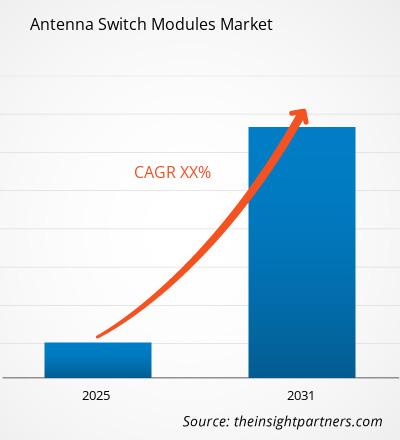
The Antenna Switch Modules Market is valued at US$ 2.91 Billion in 2025 and is projected to reach US 5.57 billion by 2034, advancing at a CAGR of 7.47% during the 2026–2034 forecast period. Such a pattern is caused by the increasing complexity of front-end architecture for radio frequencies in mobile wireless communication equipment. Currently, there are six to twelve antennas integrated in modern smartphones in order to enable carrier aggregation, MIMO operation, and multiple wireless protocols such as sub-GHz 5G up to mmWave band.
North America is one of the largest markets for antenna switch modules worldwide, as its market size is expected to exhibit a CAGR of 6.5% to 7.5% during the forecast period until 2034. There are several growth factors, including the availability of leading semiconductor designers with their R&D facilities located in California and Texas and defense and aerospace orders that require radiation-hardened RF switches.
Antenna Switch Modules Market Assessment and Insights
- North America holds an estimated 28–32% share of the global market in 2025 and is growing at a CAGR ranging between 6.5% and 7.5% during 2026–2034, driven by advanced 5G infrastructure deployment and substantial defense electronics procurement programs.
- US commands approximately 82–86% of the North American market in 2025 and is expanding at a CAGR between 6.0% and 7.0% through 2034, supported by leading fabless semiconductor design activity and military modernization initiatives.
- Europe accounts for an estimated 20–24% share of the global market in 2025 with a CAGR ranging from 6.0% to 7.0% during 2026–2034, led by Germany, the United Kingdom, and France, where automotive connectivity and industrial IoT applications drive specialized RF front-end demand.
- Asia Pacific captures an estimated 40–44% share of the global market in 2025 and is growing at a CAGR between 8.0% and 9.0% through 2034, with China, Japan, South Korea, and India representing dominant manufacturing and consumption hubs.
- Largest Segment by band type is the dual band segment, holding an estimated 58–64% market share in 2025 and growing at a CAGR between 6.5% and 7.5% during the forecast period, driven by widespread integration in mid-range smartphones and IoT devices.
- High Growth Segment by application is the tablets segment, capturing an estimated 18–22% share in 2025 and growing at a CAGR between 8.5% and 9.5% through 2034, propelled by cellular-enabled tablet adoption in enterprise and education verticals.
- Key companies analyzed in detail: Analog Devices, Inc., ABACOM Technologies Inc., Murata Manufacturing Co., Ltd., Qualcomm Technologies, Inc., TDK Electronics AG, Infineon Technologies AG, Skyworks Solutions, Inc., Qorvo, Inc., YAGEO Corporation, and CST Computer Simulation Technology GmbH.
Source: The Insight Partners' analysis based on proprietary research, government publications, company annual reports, investor presentations, industry databases, and expert interviews.
The evolution of RF switching has moved from PIN diode and GaAs pHEMT discrete circuits to fully integrated silicon-on-insulator or RF-SOI switch matrices that integrate several throw paths into a single package. The production economics have been affected by the shift towards 300mm wafer fabrication of RF-SOI substrates, which offer a cost saving of around 30% on a per-die basis as compared to 200mm manufacturing operations. The latest generation of antenna switch modules is designed with the MIPI RFFE digital interface that facilitates real-time impedance matching and diagnostics capability.
Investment patterns within the antenna switch modules market indicate growing capital allocation toward millimeter-wave capable switch technologies utilizing MEMS and advanced SOI processes optimized for frequencies above 24 GHz. Regulatory tailwinds from spectrum auctions across Southeast Asia, Latin America, and Africa are creating incremental demand for multi-band switching solutions in affordable 5G smartphones priced below US$ 200. The expansion of private 5G network deployments in industrial environments, supported by 3GPP Release 17 specifications, opens adjacent market opportunities for ruggedized antenna switch modules qualified for extended temperature ranges and high-vibration operating conditions, positively influencing the Antenna Switch Modules Market Size.
Antenna Switch Modules Market Report Scope
| Report Attribute | Details |
|---|---|
| Market size in 2025 | US$ 2.91 Billion |
| Market Size by 2034 | US$ 5.57 Billion |
| Global CAGR (2026 - 2034) | 7.47% |
| Historical Data | 2021-2024 |
| Forecast period | 2026-2034 |
Antenna Switch Modules Market Analysis
Demand for antenna switch modules is fundamentally linked to the proliferation of wireless standards and the corresponding expansion of RF complexity per device. The trajectory of the market benefits from smartphone OEMs integrating additional antenna paths to support 4x4 MIMO in sub-6 GHz bands and dual-connectivity architectures that simultaneously maintain links to LTE and 5G NR networks. These factors continue to shape the competitive landscape and Antenna Switch Modules Market Share across key application segments.
Value chain participants include substrate vendors that supply wafers with high-resistivity silicon substrates, foundry partners running RF-SOI process flows in 65nm/45nm technology nodes, packaging houses that provide Wafer-Level Chip Scale Packages, and test facilities that perform intermodulation distortion tests. Dynamics of supply are stable now after a period of shortage experienced in 2020–2022, when the capacity of wafers for RF-SOI processes increased by about 15%.
Competitive environment includes consolidation in RF front-end companies that try to provide a complete module solution, which consists of a power amplifier, low-noise amplifier, filter, and antenna switch module all in one package. Qualcomm Technologies uses the modem-to-antenna platform approach for design wins. At the same time, Skyworks Solutions and Qorvo compete on performance parameters such as insertion loss of less than 0.5 dB at 6 GHz and more than 80 dBc harmonic rejection.
Multilayer ceramic substrate technology has been adopted by Murata Manufacturing Co., Ltd., which has provided the company with an advantage in forming switches and filters into one compact unit. Investment trends suggest that there will be increased investment in gallium nitride on silicon switch devices, especially for base stations and military use cases where more than 10 watts of power is needed.
● REPORT CUSTOMIZATION
Tailor This Report To Align With Your Specific Business Requirements
This report can be customized to align precisely with your business objectives, scope, and target markets. Customization options include tailored segmentation, geography, competitive analysis, and strategic insights to support informed decision-making.
Customize This Report →WHAT YOU CAN ADJUST
- ● Segmentations
- ● Geography
- ● Competitive Analysis
- ● Language Preferences
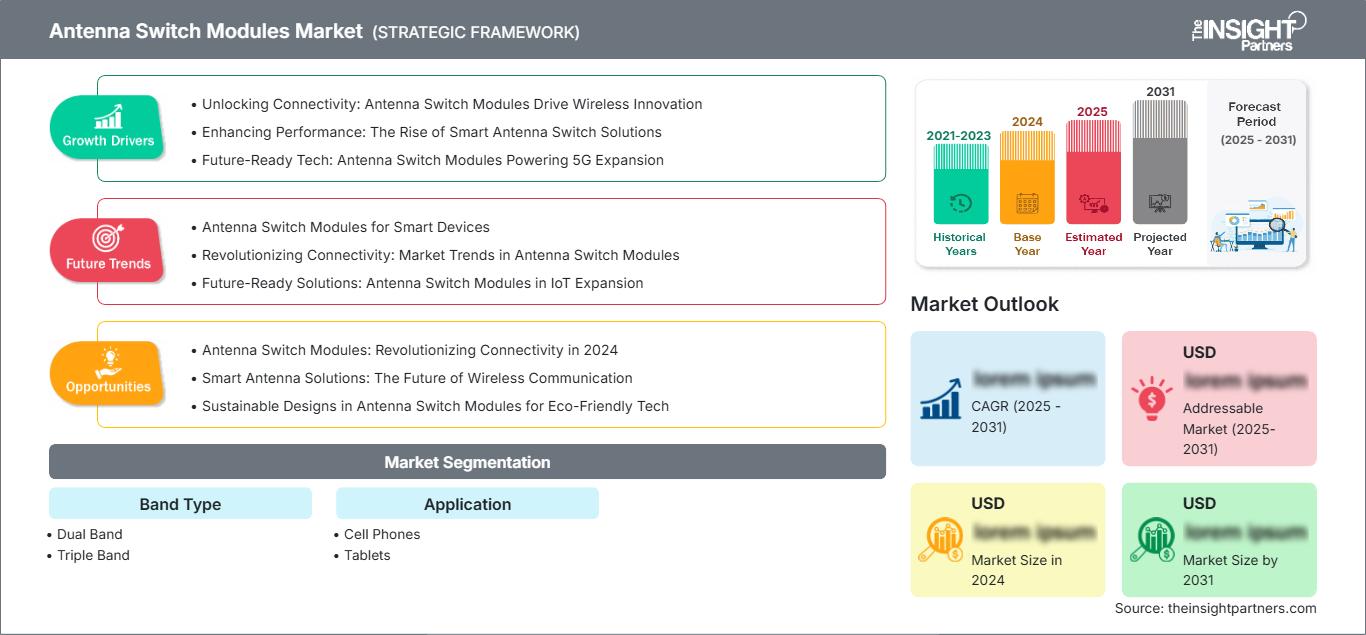
Antenna Switch Modules Market: Strategic Insights
Regional Insights
North America Antenna Switch Modules Market
The market commands an estimated 28–32% share of global revenue in 2025, underpinned by concentrated semiconductor design expertise and substantial defense electronics expenditure. The United States Department of Defense allocated approximately US$ 145 billion toward procurement and research development in fiscal year 2025, with electronic warfare and secure communications programs representing significant RF component demand drivers. These regional developments are examined in the Antenna Switch Modules Market Report.
The region benefits from a mature ecosystem of fabless semiconductor companies maintaining close collaborative relationships with domestic foundry operations and advanced packaging facilities. Research consortia including the Semiconductor Research Corporation, continue funding investigations into novel switching materials and architectures. The antenna switch modules market CAGR for North America ranges between 6.5% and 7.5% through 2034, with value growth supported by increasing RF complexity in premium-tier smartphones and expanding defense electronics content per platform.
U.S. Antenna Switch Modules Market
The market represents an estimated 82–86% of North American regional revenue in 2025, anchored by the world's largest concentration of fabless RF semiconductor companies and a defense procurement apparatus that prioritizes technological superiority in electromagnetic spectrum operations. Application trends demonstrate accelerating adoption of antenna switch modules supporting carrier aggregation combinations exceeding 200 MHz aggregate bandwidth in flagship smartphone platforms. The proliferation of Wi‑Fi 7 access points and client devices operating across 2.4 GHz, 5 GHz, and 6 GHz bands simultaneously requires advanced switching architectures with exceptional isolation between concurrent transmit and receive paths, supporting a positive Antenna Switch Modules Market Forecast.
Company presence spans leading integrated device manufacturers and pure-play RF front-end suppliers headquartered across California, Massachusetts, and North Carolina technology corridors. Skyworks Solutions, Inc. and Qorvo, Inc. maintain extensive in-house GaAs and RF-SOI fabrication capabilities within the United States, while Qualcomm Technologies, Inc. continues expanding its RF front-end portfolio through organic development and strategic acquisitions. The defense electronics segment demands antenna switch modules qualified to MIL-STD-883 standards with demonstrated reliability across temperature extremes from -55°C to +125°C. The CAGR for the U.S. antenna switch modules market is projected at 6.0–7.0% during the 2026–2034 forecast period.
Europe Antenna Switch Modules Market
The market holds around 20 to 24% of worldwide revenues in 2025 due to the robust manufacturing of automotive electronics in the region and rising focus on industrial IoT connectivity. The United Kingdom makes up roughly 22 to 28% of the European market share, with demand being driven by aerospace and defense electronics, where high-reliability RF switches are required by major firms such as BAE Systems. The National Semiconductor Strategy of the UK has also provided funds for studying compound semiconductors, thus supporting RF front-end innovations including switch solutions. These developments represent key Antenna Switch Modules Market Trends across the European region.
Germany accounts for around 20–25% of European antenna switch modules demand because of luxury vehicles made by BMW, Mercedes-Benz, and Volkswagen Group which use 6 to 10 cellular antennas for each vehicle in order to provide 5G telematics, V2X communications, and in-cabin services. Infineon Technologies AG carries out extensive research and development related to RF switches in Germany using its knowledge in the automotive industry qualification process in order to cater to vehicle makers across Europe and the globe. Together, France, Italy, and Spain account for around 30–35% of the European market. While France focuses on aerospace and defense applications through Thales Group orders, Italy is seen making investments in telecommunication infrastructure, while Spain is witnessing increasing demand for connected industrial machines for manufacturing automation.
APAC Antenna Switch Modules Market
The Asia Pacific antenna switch modules market commands an estimated 40–44% of global revenue in 2025, representing the largest regional share, and is projected to advance at a CAGR between 8.0% and 9.0% through 2034. China dominates regional consumption, accounting for approximately 48–55% of APAC demand, driven by smartphone production exceeding 350 million units annually across domestic brands including Huawei, Xiaomi, OPPO, and vivo. Government semiconductor self-sufficiency initiatives have catalyzed investment in domestic RF-SOI foundry capacity, reducing import dependence for antenna switch modules used in mid-range and entry-tier 5G handsets.
In total, Japan and South Korea constitute considerable demand for premium quality antenna switch modules, with the leading Japanese firm, Murata Manufacturing Co., Ltd., leading in the world technologies for multilayer ceramic integrated switch-filter modules. The South Korean electronics giant, Samsung Electronics, is leading the specifications for its flagship Galaxy series smartphones requiring antenna switch modules that have linearity good enough to support 256-QAM and beyond. India has been showing the maximum growth rate in the APAC region due to its electronics manufacturing hub scheme known as Production Linked Incentive (PLI) with an investment of more than US$ 10 billion made for the production of mobile devices.
Middle East & Africa Antenna Switch Modules Market
The Middle East and Africa antenna switch modules market accounts for an estimated 4–7% of global revenue in 2025, with expansion linked to telecommunications infrastructure modernization and smart device adoption across Gulf Cooperation Council economies. The Saudi Arabian market is the largest market in the region, where the digital transformation in vision 2030 and the widespread use of 5G technology by stc, Mobily, and Zain have increased the demand for RF front-end components in networks and smartphones. In the UAE, especially in Dubai and Abu Dhabi, the demand for high-end smartphones with advanced antenna switch modules is high.
South Africa acts as the main market in Sub-Saharan Africa, where telecom companies such as MTN and Vodacom are continuously increasing their network footprints using LTE and 5G networks, thereby generating the need for multiband RF devices in both the infrastructure and devices market segments. The rest of MEA demand varies depending on the degree of mobile broadband usage, while low-cost 4G smartphone usage has created volume demand for simple dual-band antenna switch modules. CAGR of the regional market is expected to be between 6.5% and 8.0% during the forecast period.
Segmentation Analysis
Band Type
The band type segment comprises dual-band and triple band configurations, with the antenna switch modules market evolving to accommodate increasing frequency band counts in mobile communication devices. The dual band segment represents the largest category, holding an estimated 58–64% share in 2025 and advancing at a CAGR between 6.5% and 7.5% through 2034. These switching solutions remain critical for cost-optimized smartphone designs and IoT endpoints where coverage of two primary frequency ranges satisfies connectivity requirements without unnecessary complexity.
- Dual Band Antenna Switch Modules cater to the largest number of wireless use cases, including from basic handsets all the way to industrial IoT sensing devices, where a dual band switching functionality is enough for providing adequate coverage for regional network compatibility. The robustness of the existing manufacturing facilities and high reliability metrics make them the leaders in terms of volumes.
- Triple Band Antenna Switch Modules cater to the increasing number of devices that require multiple connections using low-band, mid-band, and high-band frequencies, which allows achieving higher carrier aggregation throughput. This sub-segment is currently rising in premium smartphones and fixed wireless access equipment.
Application
The application segment consists of cell phones as well as tablets, where the scope of the antenna switch module market encompasses mobile computing device form factors that need effective RF front end designs. The cell phone application segment constitutes the major revenue contributor, whereas the tablets application is the growth-oriented one, growing at a CAGR of 8.5% to 9.5% from 2022 through 2034 due to increasing usage of cellular connection in enterprise, educational, and field service tablets.
- The major application segment for Antenna Switch Modules is cell phones, with more than 1.2 billion shipments of smartphones globally per year, and with the inclusion of 2-6 switch modules into each cell phone based on regional banding and MIMO design. The move to 5G from 4G architectures will increase the number of switch modules required in a phone by around 30-50%.
- Tablets have emerged as an important application segment for Antenna Switch Modules due to cellular-enabled tablets which enable always-on connectivity in enterprises that help mobility applications related to field service, logistics, and healthcare. This application segment also follows the same trend of increased RF complexities like smartphones, with the inclusion of 5G NR technology in premium tablets.
Opportunity Snapshot
| Application | Revenue Contribution | Trend Tag | Adoption Stage |
| Cell Phones | High | 5G Integration | Mature |
| Tablets | Medium | Enterprise Mobility | Scaling |
Antenna Switch Modules Market Growth Drivers and Impact Analysis
Escalating RF Complexity in 5G Smartphone Architectures
The evolution of the phone platform from 4G LTE to 5G NR has raised the number of bands supported per phone from about 15-20 to 30-40, leading to a direct multiplication effect on antenna switch module content per phone. On average, each additional band will require separate throw paths with an insertion loss of less than 0.5dB to achieve suitable link budgets, and carrier aggregation schemes requiring more than five carriers at once will need excellent linearity to avoid the effects of intermodulation distortion that can compromise receiver sensitivity. The 3GPP standards for 5G NR have specified more than 50 bands across sub-7GHz bands, with regional variations needing flexible switch setups that can be programmed according to the needs of different markets. The rise in such complexities has created a structure-driven demand for antenna switch modules that outstrips the increase in unit shipments of smartphones, as higher-end phones utilize four to eight antenna switch modules against two to three used in previous-generation phones.
Proliferation of Cellular Connectivity in IoT and Automotive Applications
The extension of cellular connectivity beyond smartphones to IoT endpoints, automotive telematics, and fixed wireless access equipment leads to various demand sources of application-specific antenna switch modules. Car manufacturers are equipping their vehicles with 5G telematics control units that need reliable and certified (AEC-Q100) antenna switch modules with operational temperatures between -40°C and +105°C. IoT gateways employed in industrial smart factories need durable switch modules that would provide specified parameters in spite of vibrations and electromagnetic interference. According to the GSMA, there will be about 5 billion licensed cellular IoT connections worldwide by 2030; each device would need at least one antenna switch module to select the right band. Automotive V2X communication systems using both cellular and short-range communication channels require complex switch topologies that can handle many simultaneous transmit and receive paths within different bands; therefore, there will be several (four or more in comparison with only two in 4G telematics) antenna switch modules in each car.
Advancements in RF-SOI and MEMS Switching Technologies
Innovations in semiconductor switching technology are pushing the boundaries of performance and lowering manufacturing costs through optimized wafer processes. RF-SOI technology at the 45nm and 28nm process nodes provides reductions in insertion losses of around 0.1–0.2 dB per decade improvement in processes that result in extended battery performance and reception under weak signal conditions. MEMS-based switching solutions provide extremely low static power consumption and excellent linearity with IP3 intercept points in excess of 80 dBm. In addition, MEMS-based switching technology is suitable for infrastructure and military applications as opposed to GaAs or Si on Sapphire solutions that have premium costs. The introduction of 300mm RF-SOI wafer processes by the leading foundries has resulted in a reduction of die costs by approximately 25–35% when compared to the previous 200mm process, making cost-effective deployment of high throw-count switches in mid-tier consumer products possible.
Antenna Switch Modules Market Future Trends
Integration of AI-Driven Adaptive Antenna Tuning Algorithms
The antenna switch modules market trends indicate growing adoption of artificial intelligence and machine learning algorithms embedded within RF front-end controllers to dynamically optimize switch configurations based on real-time operating conditions. Such adaptive systems tune antenna switch modules through analysis of the variations in impedance related to the hand grip position, distance from the user’s head and environmental reflections, reconfiguring the switch states in microseconds to ensure optimal antenna efficiency regardless of usage scenario. Modern smartphones feature a closed-loop tuning architecture, where the switch module impedance states are continuously tuned based on the measurement of the reflected power to increase total radiated power up to 1-3 dB in normal usage scenarios. The use of on-die temperature and voltage sensors in switch modules supplies additional input data for prediction algorithms, which can foresee the degradation of performance in advance. With the growing adoption of millimeter wave 5G technologies, AI beam management algorithms will be relying more and more on fast antenna switch modules, which are able to reconfigure phased array element connections in microseconds, thus requiring switching with sub-microsecond settling time.
Adoption of Wafer-Level Packaging for Millimeter-Wave Switch Modules
The trend towards wafer-level chip-scale and fan-out wafer-level packaging is impacting the antenna switch module shape and size, especially in millimeter-wave frequency bands where parasitic inductance from package interconnects becomes an issue above 24 GHz. Wafer-level chip-scale and fan-out wafer-level packaging techniques avoid wire bonding altogether and keep interconnect lengths below 50 microns, allowing for 0.3 to 0.5 dB lower insertion loss at 28 GHz than traditional laminate-based packaging technologies. The absence of a mold compound layer and substrate allows for a reduction in module height by 30% to 40%, which helps meet the ultra-thin requirements of foldable smartphones and wearables. Heterogeneous integration of antenna switch die, power amplifier and low-noise amplifier die in fan-out packaging technologies allows for RF front-end miniaturization, making it possible to reduce the overall front-end area by around 20% compared to the discrete solution. With the expansion of millimeter-wave 5G networks in North America, Japan, and South Korea, wafer-level packaged antenna switch modules are bound to become more common.
Antenna Switch Modules Market Opportunities
Open RAN Infrastructure Deployments Requiring Interoperable RF Front-End Solutions
The global telecommunications industry's shift toward Open Radio Access Network architectures creates substantial opportunities for antenna switch module suppliers offering standards-compliant, interoperable RF front-end solutions. Open RAN specifications mandate modular interfaces between radio units and distributed units, enabling network operators to source components from multiple vendors rather than purchasing integrated proprietary systems. This disaggregation opens the antenna switch modules market to suppliers previously excluded by vertically integrated equipment manufacturers, as performance specifications become transparent and compliance testing procedures standardized through the O-RAN Alliance. Network operators including Vodafone, Deutsche Telekom, and Rakuten Mobile have committed to significant Open RAN deployments, with cumulative investment projected to exceed US$ 15 billion through 2030. Antenna switch module manufacturers developing O-RAN compliant products with documented interoperability testing results can capture a share in this expanding infrastructure segment.
Satellite Direct-to-Device Connectivity Creating New Switching Requirements
The advent of satellite direct-to-device communication systems enabled via the 3GPP Release 17 NTN standards and the rollout of satellite direct-to-device services by companies such as AST SpaceMobile, SpaceX, and others brings about new challenges for the development of antenna switch modules in consumer smartphones. These satellite direct-to-device communication systems use frequencies that are close to or even overlap those used by the terrestrial cellular communication system and thus necessitate switching solutions that can handle satellite and terrestrial signals without interference due to an isolation level of more than 35 dB. The power handling capability required for the satellite uplink is higher than that in a typical smartphone, raising the need for robust antenna switches with higher compression levels. Apple, Samsung, and Huawei among others plan to implement satellite direct-to-device communication into their devices, and analysts estimate that satellite-enabled smartphones will reach more than 200 million annually by 2030.
Recent Developments
- May 2026: TDK Corporation (TSE: 6762) announced the FS3303, the first member of a major expansion of its micro POL family of ultra‑compact, non‑isolated DC‑DC power modules for optical modules in AI edge systems and other space‑constrained designs. Despite its small footprint of just 2.5 x 2.5 mm and a height of only 1.2 mm, the FS3303 can deliver 3 A at ambient temperatures of up to +90 °C (up to +125 °C with derating) and boasts a peak efficiency of around 95%. The FS3303-0400-AL is in full production and is sampling at major distributors.
- January 2025: Quectel Wireless Solutions, an end-to-end global IoT solutions provider, announces the launch of the world’s first 5G-advanced (5G-A) automotive-grade cellular module, the AR588MA, establishing it as the industry’s highest-performing and most reliable wireless communication product for vehicles.
- November 2025: Sivers Semiconductors AB (STO: SIVE), a global leader in photonics and wireless technologies, announced a mass-production purchase order agreement valued at approximately $3 million with Tachyon Networks Inc. ("Tachyon"), a pioneering provider of affordable fixed wireless and connectivity solutions, for 28GHz antenna modules.
Frequently Asked Questions

- Comprehensive Market Sizing and Forecast Analysis
- Detailed Segmentation Analysis
- In-Depth Market Dynamics Assessment
- Regional and Country-Level Insights
- Competitive Landscape and Company Benchmarking
- Strategic Business Intelligence
Recent Reports
Testimonials

The Insight Partners provided valuable market intelligence that supported our global go-to-market strategy. Their team was professional, responsive, and attentive to our feedback, providing thoughtful analysis and helpful methodological clarifications throughout the project.
Junmo Kim Chief Financial Officer (CFO), Enertech Co., Ltd.
The Insight Partners' SCADA System Market report is comprehensive, with valuable insights on current trends and future forecasts. The team was highly professional, responsive, and supportive throughout. We are very satisfied and highly recommend their services.
RAN KEDEM Partner, Reali Technologies LTDs
I requested a report on a very specific software market and the team produced the report in a few days. The information was very relevant and well presented. I then requested some changes and additions to the report. The team was again very responsive and I got the final report in less than a week.
JEAN-HERVE JENN Chairman, Future Analytica
We worked with The Insight Partners for an important market study and forecast. They gave us clear insights into opportunities and risks, which helped shape our plans. Their research was easy to use and based on solid data. It helped us make smart, confident decisions. We highly recommend them.
PIYUSH NAGPAL Sr. Vice President, High Beam Global
The Insight Partners delivered insightful, well-structured market research with strong domain expertise. Their team was professional and responsive throughout. The user-friendly website made accessing industry reports seamless. We highly recommend them for reliable, high-quality research services
YUKIHIKO ADACHI CEO, Deep Blue, LLC.
This is the first time I have purchased a market report from The Insight Partners.While I was unsure at first, I visited their web site and felt more comfortable to take the risk and purchase a market report.I am completely satisfied with the quality of the report and customer service. I had several questions and comments with the initial report, but after a couple of dialogs over email with their analyst I believe I have a report that I can use as input to our strategic planning process.Thank you so much for taking the extra time and making this a positive experience.I will definitely recommend your service to others and you will be my first call when we need further market data.
JOHN SUZUKI President and Chief Executive Officer, Board Director, BK Technologies
I wish to appreciate your support and the professionalism you displayed in the course of attending to my request for information regarding to infectious disease IVD market in Nigeria. I appreciate your patience, your guidance, and the fact that you were willing to offer a discount, which eventually made it possible for us to close a deal. I look forward to engaging The Insight Partners in the future, all thanks to the impression you have created in me as a result of this first encounter.
DR CHIJIOKE ONYIA MANAGING DIRECTOR, PineCrest Healthcare Ltd.Reason to Buy
- Informed Decision-Making
- Understanding Market Dynamics
- Competitive Analysis
- Identifying Emerging Markets
- Customer Insights
- Market Forecasts
- Risk Mitigation
- Boosting Operational Efficiency
- Strategic Planning
- Investment Justification
- Tracking Industry Innovations
- Aligning with Regulatory Trends





 Get Free Sample for