
Anti-corrosion Paper Market Demand, Share & Growth by 2034
Coverage: By Packaging Type (Bags, Rolls, Sheets); End-Use (Automotive Components, Defence and Military Equipment, Musical Components, Aerospace equipment, Others) , and Geography (North America, Europe, Asia Pacific, and South and Central America)
- Status : Data Released
- Report Code : TIPRE00025512
- Category : Chemicals and Materials
- No. of Pages : 150
- Available Report Formats :


- Last update date : August 27, 2026


2025 Market Size
US$ 2.69 Bn
Base year value
2034 Forecast
US$ 4.06 Bn
Projected by 2034
CAGR 2026-2034
5.28 %
Growth rate
Addressable Market
US$ 31.59 Bn
(2026-2034)
The anti-corrosion paper market is valued at US$ 2.69 Billion in 2025 and is projected to reach US$ 4.06 Billion by 2034, registering a CAGR of 5.28% during 2026–2034. Demand is supported by increasing requirements for dry corrosion protection of metal components during storage, transportation, and export logistics. VCI-treated kraft papers, recyclable protective formats, and application-specific solutions are strengthening adoption across automotive, defense, aerospace, and other metal-intensive manufacturing environments.
North America is expected to remain a structurally important regional market, supported by aerospace manufacturing, defense procurement, automotive component production, and established corrosion-control practices. The anti-corrosion paper market size is also influenced by the replacement of oil-based preservation methods with cleaner dry-packaging alternatives, while stricter sustainability expectations encourage recyclable and repulpable paper-based protection formats.
Anti-corrosion Paper Market Assessment and Insights
- North America: North America is estimated to hold a 38–42% share in 2025 and expand at a 4.9–5.5% CAGR between 2026–2034, supported by aerospace, automotive, defense, and industrial machinery applications.
- US: The US represents approximately 82–86% of North America's demand, with a 4.8–5.4% CAGR between 2026–2034, reflecting strong defense, aerospace, automotive, and precision-engineering requirements.
- Europe: Europe accounts for a 25–29% share in 2025 and is projected to grow at 4.8–5.4% CAGR between 2026–2034, led by Germany, Italy, France, the UK, and Spain.
- Asia Pacific: Asia Pacific represents a 21–25% share in 2025 and is expected to record a 6.4–7.1% CAGR between 2026–2034, with China, Japan, India, and South Korea driving industrial packaging consumption.
- Largest Segment: Bags are estimated to represent a 39–43% market share in 2025, with a 5.4–5.9% CAGR during 2026–2034 due to enclosed protection and logistics flexibility.
- High Growth Segment: Defence and Military Equipment is estimated at a 16–20% share in 2025 and is projected to grow at 6.2–6.8% CAGR during 2026–2034.
- Key companies analyzed in detail: Cortec Corporation, BRANOpac, Armor Protective Packaging, Northern Technologies International Corporation, Daubert Cromwell, Inc., Oji F-Tex Co., Ltd., Zeus Packaging, Green Packaging Inc., Sercalia, and Mabuchi Singapore Pte Ltd.
Source: The Insight Partners' analysis based on proprietary research, government publications, company annual reports, investor presentations, industry databases, and expert interviews.
From traditional oil, grease and wax packaging methods to dry VCI-containing packs for corrosion prevention and ease of handling, there have been developments in the market. Manufacturers are utilizing more neutral substrate kraft, controlled inhibitor dosage, multi-layered barriers, printing, and recyclable formats. Product design takes into account factors such as metal type, storage time, humidity, logistics, and pack shape.
Further development may be seen in recyclable formats, low-emission inhibitors and moisture barriers. The importance of the Asian Pacific region is expected to increase as manufacturing supply chains increase and the North American and European customers’ focus on easy unpacking and material recycling may be anticipated. Packaging of defense and aerospace goods will continue to drive higher-performance products in cases of extended storage and difficult logistics.
Anti-corrosion Paper Market Report Scope
| Report Attribute | Details |
|---|---|
| Market size in 2025 | US$ 2.69 Billion |
| Market Size by 2034 | US$ 4.06 Billion |
| Global CAGR (2026 - 2034) | 5.28% |
| Historical Data | 2021-2024 |
| Forecast period | 2026-2034 |
Anti-corrosion Paper Market Analysis
The anti-corrosion paper market growth is closely linked with the movement of metal components through manufacturing and distribution networks. Paper converters obtain kraft-based substrates, add corrosion inhibitors, and roll out paper or bags from the treated substrate. The packaging integrator customizes the form to suit the component, while the automotive, aircraft, defense, machinery, and electronics industries dictate the requirement for how long it will remain protected.
The demand is influenced by the cost of rework because of corrosion, the cost of rejection of components, the cost of cleaning and the delay in shipping. VCI paper is a dry means of protecting that may reduce the need for degreasing after storage. Availability of supply is based on kraft-paper substrates, chemicals required, converting capability, and regional logistics.
The anti-corrosion paper market analysis indicates a fragmented competitive structure combining specialized VCI manufacturers, protective-packaging companies, paper converters, and diversified industrial-material suppliers. Cortec Corporation and BRANOpac have a diversified range of products, while Armor Protective Packaging concentrates on VCI protective packaging products. NTI Corporation and Daubert Cromwell are positioned in terms of corrosion control technology and industrial packaging.
Positioning is now more dependent on customized products rather than paper supplies. Paper converting capabilities are provided by Oji F-Tex Co., Ltd., while packaging capabilities are represented by Zeus Packaging and Green Packaging Inc. Sercalia and Mabuchi Singapore Pte Ltd. cater to special regional needs. Key investment areas are now oriented towards recyclable substrates, barrier constructions, inhibitor effectiveness, and packaging, minimizing manual handling at component assembly and unpacking.
● REPORT CUSTOMIZATION
Tailor This Report To Align With Your Specific Business Requirements
This report can be customized to align precisely with your business objectives, scope, and target markets. Customization options include tailored segmentation, geography, competitive analysis, and strategic insights to support informed decision-making.
Customize This Report →WHAT YOU CAN ADJUST
- ● Segmentations
- ● Geography
- ● Competitive Analysis
- ● Language Preferences
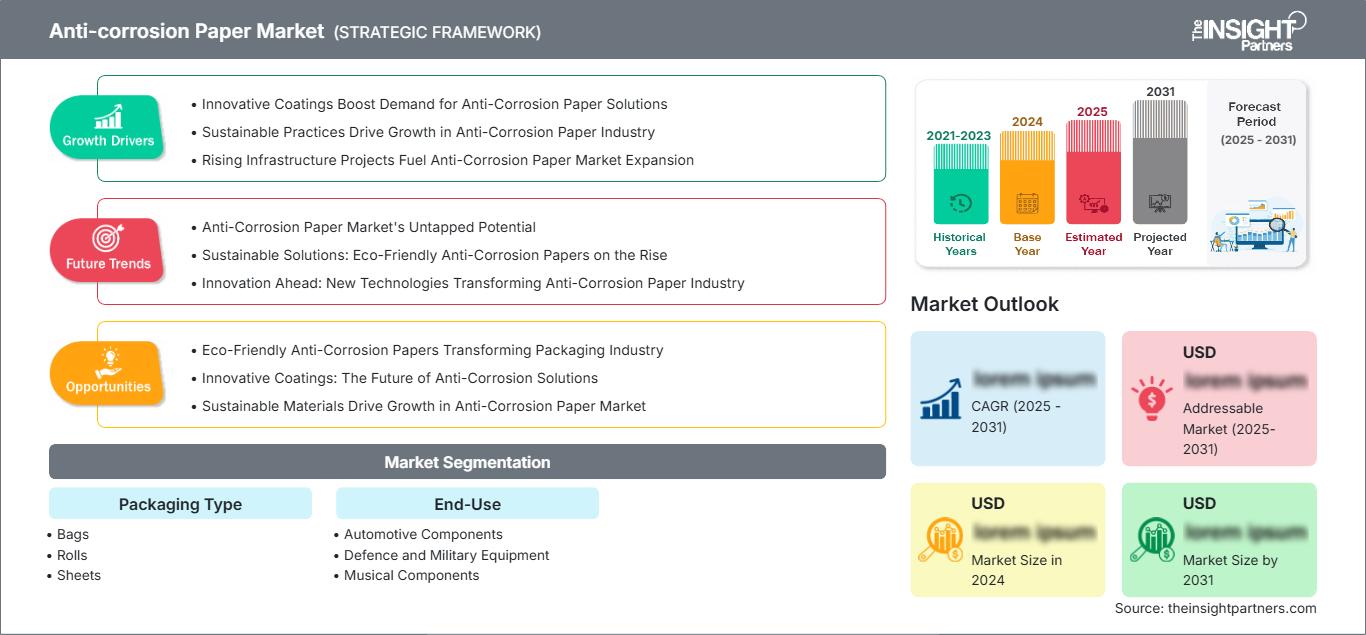
Anti-corrosion Paper Market: Strategic Insights
Regional Insights
North America anti-corrosion paper market
North America is estimated to account for 38–42% of the anti-corrosion paper market share in 2025, with a 4.9–5.5% CAGR through 2034. US leadership in regional consumption is attributed to its significant aerospace, defense, automotive, machinery, and metal-processing industries. Canada adds to this demand through its automotive, mining equipment, energy facilities, and machinery supply chains. Dry corrosion protection becomes highly important for components that need to pass through various phases of storage and transport.
This type of demand is strengthened by defense stocks, aerospace component logistics, and export-oriented automotive supply chains. There is an advantage in using VCI paper due to demands for more clean handling, as protected components typically do not need to undergo extensive oil removal before being assembled. Differentiation in products according to ferrous, non-ferrous, and mixed metals becomes common among regional converters.
U.S. anti-corrosion paper Market
The US represents approximately 82–86% of North American anti-corrosion paper market demand and is projected to expand at a 4.8–5.4% CAGR during 2026–2034. The company’s location is a result of high manufacturing of aerospace products, defense equipment repair, automotive manufacturing, machines, and the transportation of engineered components. The main suppliers of the country are Cortec Corporation, Armor Protective Packaging, Daubert Cromwell, and Northern Technologies International Corporation.
The applications range from engines and transmission parts, defense equipment, aircraft parts, tools, bearings, and steel fabrications. The customers of the aerospace and defense industry need constant protection while storing products for long periods of time, whereas automotive manufacturers value efficient packaging of high-volume components movement. Transportation for export purposes gives rise to products that should maintain the protection in a changing humidity and temperature environment.
Europe anti-corrosion paper Market
Europe is estimated to represent 25–29% of the global anti-corrosion paper market demand in 2025 and is forecast to grow at a 4.8–5.4% CAGR through 2034. Germany is the leading national market, supported by automotive, machinery, metalworking, aerospace, and industrial equipment production. The UK, France, Italy, and Spain also contribute through manufacturing and defense-related supply chains, with increasing attention to recyclable packaging materials.
Germany is still significant strategically as the producers of automobiles and machines has component networks that need proper control in terms of storage and transportation. In the UK, the sector includes aerospace, defense, automotive, and industrial engineering applications. This makes the country significant for VCI packaging needs. France is favored by aerospace and defense manufacturing, whereas the machinery and automobile components and metalworking industry in Italy drives its demand. Spain has automotive, industrial equipment, and export-oriented manufacturing.
APAC anti-corrosion paper Market
APAC accounts for an estimated 21–25% share of the anti-corrosion paper market in 2025 and is expected to grow at 6.4–7.1% CAGR through 2034. China leads regional demand, followed by Japan, India, South Korea, and Australia. Expanding automotive, machinery, electronics, shipbuilding, and metal-processing production increases requirements for corrosion protection across domestic and export supply chains.
China combines large manufacturing volumes with extensive export logistics, while Japan and South Korea emphasize precision components and industrial equipment. India's automotive and engineering expansion creates additional consumption opportunities, and Australia supports specialized mining and industrial applications. Regional manufacturers increasingly develop multilayer and reinforced VCI papers to address longer transport routes, humidity exposure, and demanding storage conditions.
Middle East & Africa anti-corrosion paper Market
The Middle East and Africa anti-corrosion paper market represents a smaller but developing demand center, with Saudi Arabia leading regional requirements across energy, industrial equipment, and infrastructure projects. The UAE supports re-export and logistics activity, while South Africa contributes through automotive, mining, and machinery applications. Regional growth is estimated at 4.7–5.3% CAGR through 2034.
Energy infrastructure and industrial diversification create requirements for corrosion protection during equipment storage and transportation. Saudi Arabia's manufacturing expansion supports demand for protective packaging around machinery and metal components, while UAE logistics hubs create opportunities for products used during international transit. South Africa's automotive and mining supply chains add recurring requirements for dry corrosion protection.
Segmentation Analysis
Packaging Type
Packaging Type is expected to grow at a 5.0–5.6% CAGR during 2026–2034. Format selection increasingly reflects automation, component geometry, protection duration, and labor requirements. Bags provide enclosed protection, rolls support continuous converting operations, and sheets offer flexibility for interleaving and wrapping. Manufacturers increasingly combine paper with barrier or reinforced structures where transport exposure requires additional mechanical or moisture resistance.
- Bags: Enclosed formats are strategically important for components requiring protection from surrounding atmospheric conditions, especially during warehouse storage and international transportation.
- Rolls: Continuous material formats serve high-throughput packaging operations and allow manufacturers to optimize wrapping dimensions according to component size and production requirements.
- Sheets: Cut-sheet formats are useful for interleaving and surface coverage, supporting metal components that require separation, abrasion resistance, or localized vapor protection.
End-Use
End-Use applications are projected to expand at a 5.3–5.9% CAGR during 2026–2034. Automotive Components generate recurring demand because of high shipment volumes, while defense and aerospace users value extended protection. Musical Components represent a specialized application, whereas aerospace equipment requires controlled packaging for high-value metal assemblies and precision parts.
- Automotive Components: Engine, transmission, braking, bearing, and fabricated metal components require protection during production staging, warehouse storage, export shipment, and supplier-to-assembly logistics.
- Defense and Military Equipment: Long storage periods and demanding logistics make corrosion protection important for spare parts, weapons-support equipment, vehicle components, and metal assemblies maintained within defense inventories.
- Musical Components: Metal strings, fittings, mechanisms, and precision components benefit from dry protection where surface corrosion can affect appearance, performance, or assembly quality.
- Aerospace equipment: High-value components require controlled packaging because corrosion, contamination, and surface damage can create significant inspection, rework, or replacement consequences.
Opportunity Snapshot
| End-Use | Revenue Contribution | Trend Tag | Adoption Stage |
| Automotive Components | High | Export Logistics | Mature |
| Defence and Military Equipment | Medium | Long Storage | Scaling |
| Musical Components | Low | Precision Protection | Emerging |
| Aerospace equipment | Medium | Asset Preservation | Scaling |
Anti-corrosion Paper Market Growth Drivers and Impact Analysis
Expansion of corrosion-sensitive industrial supply chains
In global manufacturing, an increasing number of production processes depend upon multi-step supply chains in which metal components will be stored in supplier premises, distribution centers, ports, and factories before use. The more steps that there are in a chain for transportation and storage, the higher the exposure of metal parts to humidity, temperature fluctuations, and air pollutants. Consequently, dry protection from corrosion becomes important not only at the point of origin but also downstream along the chain. Anticorrosion paper may be easily integrated into the current packaging process without using special equipment for application; thus, suppliers can provide parts with corrosion protection at the point of packaging.
Shift from oil-based preservation toward cleaner packaging
The selection of anti-corrosion strategies by manufacturers is increasingly being made not on the basis of material costs alone, but in terms of overall handling needs. Oil and grease offer good protection, but might require cleaning and handling issues related to people, assembly, and wastewater. VCI paper offers a dry form of protection, whereby the chemical inhibitor is embedded in the packaging material itself and creates a protective vapor around the metal part. Such a strategy will make unpacking easier and may even minimize secondary cleaning needs. The effect is especially dramatic on components that go from packaging straight to assembly or inspection. Paper-based approaches can enable corrosion protection to become consistent with a package reduction/recycling effort.
Rising requirements for extended storage and export protection
Defense inventories, aerospace components, aftermarket automotive parts, industrial machinery, and replacement equipment can require protection for substantially longer periods than standard factory-to-factory shipments. Extended storage creates greater exposure to atmospheric moisture and increases the consequences of corrosion-related degradation. Anti-corrosion paper suppliers, therefore, increasingly offer long-life grades, multilayer constructions, reinforced papers, and products designed for specific metal combinations. Export-oriented manufacturers also require protection that remains effective across variable climate zones and long transportation routes. This driver favors suppliers capable of validating performance under controlled corrosion tests and tailoring inhibitor loading to the application. It also encourages packaging engineers to evaluate corrosion protection alongside mechanical protection, moisture barriers, and storage duration.
Anti-corrosion Paper Market Future Trends
Development of multifunctional VCI paper structures
The anti-corrosion paper market trends are moving toward multifunctional structures that combine corrosion inhibition with moisture resistance, mechanical reinforcement, abrasion protection, and improved barrier performance. Future products are likely to incorporate multilayer paper constructions, selective polymer barriers, reinforced substrates, and application-specific inhibitor systems. Automotive and heavy-equipment users can benefit from formats designed for irregular components and longer transportation periods, while aerospace and defense applications may favor controlled protection for high-value parts. Digital printing and identification features could also become more common as manufacturers seek packaging that communicates component information, handling instructions, and protection requirements. These developments would shift competition from basic treated paper toward engineered protective packaging systems with measurable performance characteristics.
Greater integration of recyclable packaging materials
Sustainability requirements are expected to influence product formulation, substrate selection, and end-of-life handling. Suppliers are likely to prioritize neutral kraft papers, reduced-plastic constructions, repulpable grades, and inhibitor formulations compatible with paper recycling systems. This trend does not eliminate the need for technical barriers because corrosion protection must remain effective under real transportation and storage conditions. Instead, product development will increasingly balance corrosion performance with material recovery. Customers may evaluate packaging through broader lifecycle criteria, including paper content, coatings, chemical composition, disposal requirements, and replacement of oil-based protection. Suppliers able to document both corrosion performance and material characteristics should be better positioned for procurement processes that include environmental criteria.
Anti-corrosion Paper Market Opportunities
Localized production for export-oriented manufacturing clusters
The anti-corrosion paper market Forecasts indicate opportunities for suppliers to establish converting and technical-support capabilities near major manufacturing clusters in the Asia Pacific, Eastern Europe, Mexico, and the Middle East. Local production can reduce lead times for customized rolls, sheets, and bags while enabling faster adaptation to customer packaging specifications. Automotive and industrial suppliers often require different dimensions, inhibitor systems, and protection periods for individual components. Regional converting facilities can therefore create value through customization rather than competing only on material price. Investment priorities should include controlled impregnation or coating, testing capability, quality assurance, and technical application support. Proximity to export-oriented manufacturing customers can also improve responsiveness when production schedules change or new component programs are introduced.
Premium protection for aerospace and defense components
High-value aerospace and defense equipment creates an attractive opportunity for specialized corrosion-protection packaging because the economic consequence of component degradation can exceed the cost of packaging by a wide margin. Suppliers can develop application-specific grades for long-duration storage, sensitive alloys, precision assemblies, and equipment exposed to variable climatic conditions. Technical differentiation can include validated protection periods, reinforced paper, moisture barriers, traceability features, and packaging designs tailored to component geometry. Customers may also require documentation covering chemical composition, handling procedures, and performance testing. Companies entering this niche should prioritize qualification processes and long-term customer validation rather than commodity volume. Strategic partnerships with aerospace suppliers, defense contractors, and specialist logistics providers can provide routes to recurring demand.
Recent Developments
- March 31, 2026: Cortec Corporation highlighted its double-sided CorShield VpCI-146 Paper, which provides vapor-phase corrosion protection from both sides of the paper. The product is used for wrapping individual gears and bearings and for interleaving layers of automotive components. Cortec also notes its USDA Certified Biobased Product status, recyclability into new paper products, and compatibility with automated packaging operations.
- March 8, 2026: Shenyang Rustproof Packaging Material Co., Ltd. introduced VCI rust-proof paper for long-term storage of automotive components, including engine blocks, bearings, brake discs, and drive shafts. The packaging combines VCI-treated paper with a high-density polyethylene film to provide corrosion protection while improving resistance to moisture and external environmental conditions during storage and transportation.
Frequently Asked Questions

- Comprehensive Market Sizing and Forecast Analysis
- Detailed Segmentation Analysis
- In-Depth Market Dynamics Assessment
- Regional and Country-Level Insights
- Competitive Landscape and Company Benchmarking
- Strategic Business Intelligence
Recent Reports
Testimonials

The Insight Partners' SCADA System Market report is comprehensive, with valuable insights on current trends and future forecasts. The team was highly professional, responsive, and supportive throughout. We are very satisfied and highly recommend their services.
RAN KEDEM Partner, Reali Technologies LTDs
I requested a report on a very specific software market and the team produced the report in a few days. The information was very relevant and well presented. I then requested some changes and additions to the report. The team was again very responsive and I got the final report in less than a week.
JEAN-HERVE JENN Chairman, Future Analytica
We worked with The Insight Partners for an important market study and forecast. They gave us clear insights into opportunities and risks, which helped shape our plans. Their research was easy to use and based on solid data. It helped us make smart, confident decisions. We highly recommend them.
PIYUSH NAGPAL Sr. Vice President, High Beam Global
The Insight Partners delivered insightful, well-structured market research with strong domain expertise. Their team was professional and responsive throughout. The user-friendly website made accessing industry reports seamless. We highly recommend them for reliable, high-quality research services
YUKIHIKO ADACHI CEO, Deep Blue, LLC.
This is the first time I have purchased a market report from The Insight Partners.While I was unsure at first, I visited their web site and felt more comfortable to take the risk and purchase a market report.I am completely satisfied with the quality of the report and customer service. I had several questions and comments with the initial report, but after a couple of dialogs over email with their analyst I believe I have a report that I can use as input to our strategic planning process.Thank you so much for taking the extra time and making this a positive experience.I will definitely recommend your service to others and you will be my first call when we need further market data.
JOHN SUZUKI President and Chief Executive Officer, Board Director, BK Technologies
I wish to appreciate your support and the professionalism you displayed in the course of attending to my request for information regarding to infectious disease IVD market in Nigeria. I appreciate your patience, your guidance, and the fact that you were willing to offer a discount, which eventually made it possible for us to close a deal. I look forward to engaging The Insight Partners in the future, all thanks to the impression you have created in me as a result of this first encounter.
DR CHIJIOKE ONYIA MANAGING DIRECTOR, PineCrest Healthcare Ltd.Reason to Buy
- Informed Decision-Making
- Understanding Market Dynamics
- Competitive Analysis
- Identifying Emerging Markets
- Customer Insights
- Market Forecasts
- Risk Mitigation
- Boosting Operational Efficiency
- Strategic Planning
- Investment Justification
- Tracking Industry Innovations
- Aligning with Regulatory Trends





 Get Free Sample for