
Antistatic Agents Market Size, Trends & Growth by 2034
Coverage: By Polymer Type (Polypropylene (PP), Polyethylene (PE), Polyvinyl Chloride (PVC), Others); End Use (Packaging, Electronics, Automotive, Others) , and Geography (North America, Europe, Asia Pacific, and South and Central America)
- Status : Data Released
- Report Code : TIPRE00005468
- Category : Chemicals and Materials
- No. of Pages : 150
- Available Report Formats :


- Last update date : September 01, 2026


2025 Market Size
US$ 1.76 Bn
Base year value
2034 Forecast
US$ 2.69 Bn
Projected by 2034
CAGR 2026-2034
4.79 %
Growth rate
Addressable Market
US$ 20.16 Bn
(2026-2034)
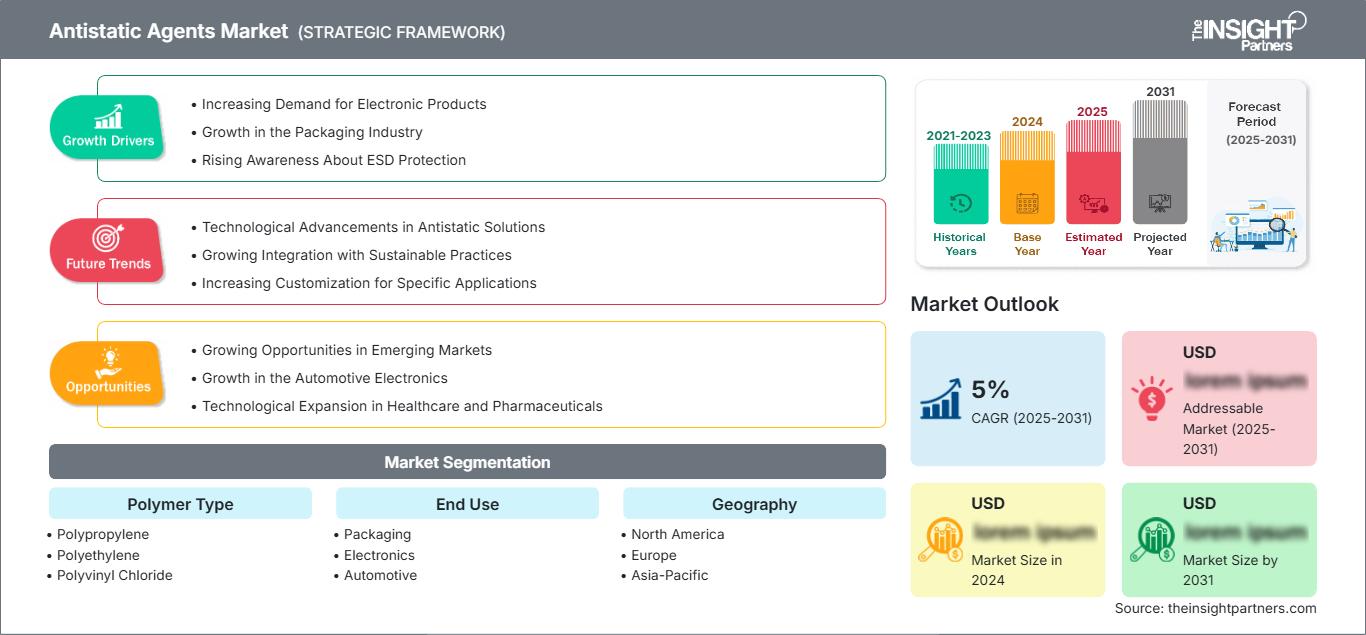
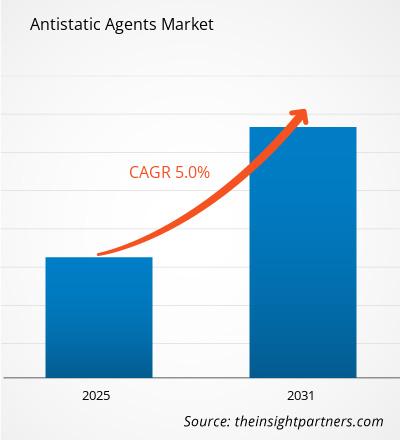
The antistatic agents market is valued at US$ 1.76 Billion in 2025 and is projected to reach US$ 2.69 Billion by 2034, expanding at a CAGR of 4.79% from 2026 to 2034. Demand is supported by the increasing use of polymer films, molded components, electronic packaging, and automotive plastics requiring controlled surface resistivity. Product development is increasingly focused on durable, low-migration, food-contact-compliant, and application-specific antistatic performance.
North America is positioned for steady expansion as packaging converters, electronics manufacturers, and automotive compounders adopt materials with tighter electrostatic-control requirements. The antistatic agents market size is expected to increase at an estimated 4.6–5.0% CAGR between 2026 and 2034, supported by advanced packaging formats, electronics manufacturing, and increasing use of engineered polymer compounds.
Antistatic Agents Market Assessment and Insights
- North America: The region is expected to account for a 27–31% share in 2025 and grow at a 4.6–5.0% CAGR between 2026–2034, supported by sophisticated packaging conversion, electronics manufacturing, automotive polymerization, and demand for consistent static control.
- US: The US is expected to represent 76–80% of North America's 2025 share, expanding at a 4.5–4.9% CAGR between 2026–2034, with packaging and electronics remaining principal applications.
- Europe: Europe is estimated at a 23–27% share in 2025 and a 4.2–4.6% CAGR between 2026–2034, led by Germany, France, Italy, and the UK, where regulatory requirements and premium polymer processing support adoption.
- Asia Pacific: Asia Pacific is projected to hold a 34–38% share in 2025 and grow at a 5.3–5.7% CAGR between 2026–2034, led by China, Japan, South Korea, and India through expanding packaging, electronics, and automotive production.
- Largest Segment: Polypropylene is estimated to hold a 42–46% market share in 2025, growing at a 4.6–5.0% CAGR between 2026–2034, supported by extensive film, packaging, and molded-product applications.
- High Growth Segment: Automotive is estimated to represent an 18–22% market share in 2025, expanding at a 5.5–5.9% CAGR between 2026–2034, driven by lightweight polymer components and electrical safety requirements.
- Key companies analyzed in detail: Arkema; BASF SE; Clariant AG; Croda International Plc.; DuPont de Nemours, Inc.; Evonik Industries AG; Kao Corporation; Emery Oleochemicals LLC; Fine Organic Industries Limited; Foster Corporation.
Source: The Insight Partners' analysis based on proprietary research, government publications, company annual reports, investor presentations, industry databases, and expert interviews.
The Antistatic Agents Market is moving away from traditional migratory surfactants toward newer formulations that offer quick charge decay, better durability, and lesser effect on optical and mechanical properties. The key factor behind this trend has been polymer compatibility since the processing requirements of PP, PE, and PVC vary quite widely. The addition of slip, release, dispersion, or other functionalities to antistatics is also being done by many formulators to enable the converter to simplify the additive system.
Investments will go into permanent and low-migration technologies, natural-based raw materials, and masterbatch products during the forecasted period. The Asia Pacific region will remain an important area for investments due to the use of film extrusion, electronic assembly, and automotive industry applications. Attention by the government towards food contact chemicals, fluorinated chemicals, and material make-up will lead to new formulations using better technologies and raw materials.
Antistatic Agents Market Report Scope
| Report Attribute | Details |
|---|---|
| Market size in 2025 | US$ 1.76 Billion |
| Market Size by 2034 | US$ 2.69 Billion |
| Global CAGR (2026 - 2034) | 4.79% |
| Historical Data | 2021-2024 |
| Forecast period | 2026-2034 |
Antistatic Agents Market Analysis
Antistatic Agents Market growth is heavily dependent on polymer demand as statics lead to efficiency losses and quality impairments in film extrusion, molding, filling, packaging, and handling operations. Value chain is composed of fatty acids, amines, esters, surfactants, specialty polymers, and inorganics; additive production; mixing; masterbatches; polymer compounding; conversion; and end use. High demand exists where static affects efficiency and quality of manufacturing processes.
Supply dynamics differ according to antistatic type as migratory types usually imply lower concentrations but are subject to humidity conditions and surface migration, while permanent polymer-based antistatics provide higher efficiency and more stable performance in the environment. Packaging converters take into consideration cost, migration, transparency, coefficient of friction, and food contact requirements. Electronics and automotive industries focus more on controlled resistivity, dimensional stability, thermal performance, and contamination prevention.
Positioning in the Antistatic Agents Market Report has come to depend upon application-oriented formulations and not just commodity pricing. Noroplast formulations for polyolefin masterbatches are marketed by Arkema. BASF SE provides the company's additive and process technology knowledge for wide-ranging polymer processing capabilities. Clariant AG has antistatic solutions in flexible and rigid packaging applications and Kao Corporation provides solutions based on resin kneading, masterbatch, and coatings in several polymer systems.
Investments in multiple function products and regional technical service offerings are strategic. Croda International Plc. and Emery Oleochemicals LLC take advantage of the power of specialty chemicals. Fine Organic Industries Limited provides antistatic products for BOPP films and automotive formulations. DuPont de Nemours, Inc., Evonik Industries AG, and Foster Corporation provide services of formulation and specialty materials. Manufacturers establish themselves through low dose, long life, food contact, and high-speed processability.
● REPORT CUSTOMIZATION
Tailor This Report To Align With Your Specific Business Requirements
This report can be customized to align precisely with your business objectives, scope, and target markets. Customization options include tailored segmentation, geography, competitive analysis, and strategic insights to support informed decision-making.
Customize This Report →WHAT YOU CAN ADJUST
- ● Segmentations
- ● Geography
- ● Competitive Analysis
- ● Language Preferences
Antistatic Agents Market: Strategic Insights
Regional Insights
North America antistatic agents market
North America is estimated to command a 27–31% of the Antistatic Agents Market share in 2025, with a 4.6–5.0% CAGR through 2034. The US dominates regional demand because of its extensive flexible packaging, electronics, automotive, and specialty-compounding industries. Mexico adds manufacturing demand through automotive assembly and packaging conversion, while Canada contributes through food packaging, industrial plastics, and consumer-product manufacturing.
Regional usage is guided by the necessity of reducing dust attraction, film blocking, electrostatic discharge, and handling issues. Packaging manufacturers are now giving preference to antistatic systems that can work well with high-speed extrusion and printing operations. The electronics industry gives importance to surface resistance control and contamination, while the automotive industry focuses on durability without affecting aesthetics and mechanical properties. Food-contact restrictions and chemical composition disclosure regulations help in this direction.
U.S. antistatic agents Market
US constitutes about 76-80% of the North American 2025 share and is projected to grow at a CAGR of 4.5-4.9% up to 2034. Applications include flexible packaging, consumer electronics, industrial parts, automotive interiors, and protective packaging. Increasingly, domestic compounders are including antistatic properties in the material approval criteria, as opposed to just viewing it as a downstream finishing need.
The application landscape includes masterbatch concentrates, low-migration additives, and permanent antistatics for specialized applications. Packaging continues to be an important end-use market, especially for films where there is a need for controlled static electricity when filling and processing. The electronics market will require higher electrical specifications, whereas the automotive market will increasingly see PP and engineered plastics being used.
Europe antistatic agents Market
The Europe region has an estimated 23-27% share in 2025 and is expected to have a growth rate of 4.2-4.6% CAGR, with Germany being the leading country market within the region. The demand drivers in the region include the development of automotive manufacturing, packaging conversion, electronics industry, and stricter chemical and circularity laws.
The UK retains its demand in packaging, plastics used for health applications, electrical parts, and industrial films. The strong position of Germany is based on its automotive manufacturing industry, machinery industry, electronics industry, and the development of the polymer compounding value chain. France and Italy add their demands through food packaging, consumer products, automotive parts, and specialty plastics.
APAC antistatic agents Market
APAC is estimated to hold a 34–38% share in 2025 and expand at a 5.3–5.7% CAGR, making it the leading regional growth market. China leads regional consumption, followed by Japan, South Korea, India, and Australia. Electronics manufacturing, BOPP film capacity, consumer packaging, and automotive production provide broad application exposure.
China has a combination of large polymer processing capability and electronics and packaging applications. Japan and South Korea focus on high performance polymers. India is driven by packaging and automotive manufacturing expansion. The demand in Australia is relatively small but specialized for industry applications. Regional demand for performance additives could be stimulated by local production and infrastructure development.
Middle East & Africa antistatic agents Market
Middle East and Africa represents a smaller demand base, with growth supported by plastics conversion, packaging, petrochemical integration, and industrial manufacturing. Saudi Arabia leads the regional opportunity, followed by the UAE and South Africa. The region benefits from integrated polymer feedstocks and investments in downstream plastics processing.
The petrochemical environment in Saudi Arabia enables polymer manufacturing and processing, while the UAE is investing in packaging and manufacturing facilities. South Africa is involved in food packaging, automobile parts, and industrial polymers. The rest of MEA region is still fragmented, although investments in infrastructure and consumer products manufacturing are expected to help drive growth at a steady pace of 4.1–4.5% CAGR until 2034.
Segmentation Analysis
Polymer Type
The Polymer Type segment is expected to expand at a 4.5–4.9% CAGR from 2026–2034. Selection is determined by resin polarity, crystallinity, processing temperature, surface migration, humidity sensitivity, and required permanence. PP remains particularly important because of its extensive use in packaging films and molded automotive components, while PE and PVC require chemistry optimized for different migration and processing behaviors.
- Polypropylene: Represents the largest polymer demand base because BOPP, CPP, injection-molded components, and automotive compounds require static control without sacrificing transparency, surface finish, or processing efficiency.
- Polyethylene: Demand is concentrated in films, bags, protective packaging, and molded products where antistatic performance reduces dust attraction, film handling problems, and static-related production interruptions.
- Polyvinyl Chloride: PVC applications require formulations compatible with flexible and rigid systems, particularly where antistatic performance must coexist with plasticizers, stabilizers, pigments, and demanding processing conditions.
End Use
The End Use segment is forecast to register a 4.9–5.3% CAGR from 2026–2034. Adoption depends on the operational consequences of static accumulation. Packaging generates substantial volume requirements, while electronics and automotive applications typically demand more tightly controlled and durable performance, creating opportunities for premium formulations and permanent antistatic technologies.
- Packaging: Remains the principal outlet, covering films, bags, containers, labels, and protective materials where static control improves filling, printing, converting, dust management, and product handling.
- Electronics: Requires precise static dissipation to protect sensitive components, reduce electrostatic discharge risks, and maintain clean surfaces in packaging, housings, trays, and manufacturing environments.
- Automotive: Demand is increasing for antistatic PP and related polymer compounds used in interiors, protective components, housings, and other applications where durability, appearance, and controlled surface properties matter.
Opportunity Snapshot
| End Use | Revenue Contribution (High/Medium/Low) | Trend Tag | Adoption Stage |
|---|---|---|---|
| Packaging | High | Film Control | Mature |
| Electronics | Medium | ESD Protection | Scaling |
| Automotive | Medium | Lightweighting | Scaling |
Antistatic Agents Market Growth Drivers and Impact Analysis
Expansion of Flexible and High-Speed Plastic Packaging
Flexible packaging is a major demand engine because film extrusion, printing, filling, and converting expose polymer surfaces to repeated friction and charge generation. As production lines become faster, static-related interruptions can create disproportionate losses through dust attraction, film adhesion, web instability, and handling defects. Antistatic additives provide a relatively low-cost method of addressing these issues without redesigning the polymer structure. Growth in multilayer films, BOPP, protective packaging, and lightweight formats therefore supports recurring additive consumption. Suppliers that can maintain optical clarity, sealability, print adhesion, and coefficient-of-friction performance alongside static control have an advantage. The market impact extends beyond additive volume because converters increasingly evaluate multifunctional formulations that combine antistatic and slip characteristics, reducing dosing complexity and improving production consistency.
Rising Electrostatic-Control Requirements in Electronics
Electronics manufacturing creates a distinct value pool because electrostatic discharge can damage sensitive components even when visible product defects are absent. Antistatic packaging, trays, films, housings, and handling materials are consequently evaluated against electrical performance requirements rather than simple surface appearance. The transition toward smaller components, denser assemblies, and increasingly sophisticated electronic systems raises the importance of predictable charge dissipation. Permanent antistatic technologies can command higher value where performance must remain stable during storage, transportation, repeated handling, or low-humidity conditions. Suppliers also face tighter expectations regarding ionic contamination, outgassing, transparency, and mechanical integrity. These requirements encourage collaboration between additive producers, compounders, electronics manufacturers, and packaging converters, strengthening technical qualification barriers and creating opportunities for specialized formulations rather than undifferentiated commodity products.
Lightweight Automotive Components Increase Polymer Functionality
Automotive manufacturers are substituting metals with polymers in selected interior, electrical, structural, and functional components to reduce vehicle weight and improve manufacturing flexibility. This substitution increases the number of polymer parts requiring controlled surface behavior. Antistatic performance becomes important where components attract dust, interact with electrical systems, or require stable surface properties over long service periods. Electric vehicles add another layer of material-performance requirements because high-voltage systems and electronic content increase sensitivity to electrical behavior. Compounders therefore seek additives that provide static dissipation without reducing impact strength, appearance, dimensional stability, or processability. Suppliers capable of tailoring antistatic performance to PP and other automotive polymers can benefit from qualification-driven relationships, where formulation consistency and long-term reliability are often more important than the lowest additive purchase price.
Antistatic Agents Market Future Trends
Permanent Antistatic Chemistry Gains Greater Importance
The antistatic agents market trends are expected to increasingly favor permanent or highly durable technologies that reduce dependence on surface migration. Conventional migratory additives can lose effectiveness as they are removed, washed, abraded, or exposed to changing humidity. Permanent polymeric systems can address these limitations by maintaining electrostatic performance within the polymer matrix or through stable conductive structures. Future formulations are likely to target lower addition rates, improved transparency, greater compatibility with recycled polymers, and minimal influence on mechanical properties. Development will also focus on applications where static control must remain consistent throughout the product lifecycle. This shift could expand premium additive opportunities in electronics, automotive, industrial packaging, and reusable polymer components where long-term performance is valued more highly than initial additive cost.
Multifunctional Additives Reduce Formulation Complexity
Future product development is likely to combine antistatic functionality with slip, release, dispersion, lubrication, or processing benefits. Such multifunctional systems can simplify additive inventories, reduce dosing points, and improve consistency during polymer conversion. The approach is particularly relevant to high-speed film production, where multiple individual additives can create compatibility issues, surface blooming, or fluctuations in coefficient of friction. Concentrated liquid systems and masterbatches may also gain traction because they enable more precise dosing and easier integration into automated production. Sustainability considerations will influence this trend, with producers evaluating vegetable-derived feedstocks, food-contact compliance, low-volatility formulations, and chemistries compatible with recycling streams. Product developers that solve several processing problems through one controlled formulation should gain stronger customer engagement and potentially shorter qualification cycles.
Antistatic Agents Market Opportunities
Develop Application-Specific Solutions for Electronics Packaging
Electronics packaging represents a strategic opportunity for suppliers able to move beyond general-purpose static control. Manufacturers can develop grades designed for trays, protective films, housings, component carriers, and transportation packaging, with performance tailored to surface resistivity, humidity conditions, cleanliness, and mechanical requirements. The antistatic agents market Forecasts indicate that electronics-related applications can support premium positioning because failure costs associated with electrostatic discharge exceed the incremental cost of specialized additives. Investment should therefore prioritize permanent chemistries, low contamination profiles, stable performance after repeated handling, and compatibility with engineering polymers. Suppliers can also strengthen their position by offering application testing, material qualification, and formulation support rather than selling additives as standalone chemicals. Regional production near electronics clusters would further reduce qualification and supply-chain barriers.
Expand Bio-Based and Low-Migration Formulations
Sustainability requirements create an opportunity to develop antistatic additives using renewable feedstocks while maintaining performance across demanding polymer-processing environments. Packaging converters increasingly need materials that satisfy food-contact requirements and support corporate sustainability targets without compromising transparency, sealability, or processing efficiency. Investment in bio-based esters, vegetable-derived surfactants, and lower-migration technologies can differentiate suppliers in applications where chemical composition is increasingly scrutinized. The opportunity is not limited to replacing one ingredient with another. Developers can redesign additive systems to reduce dosage, improve durability, and minimize interactions with recycling processes. Companies that combine renewable sourcing with robust technical documentation, regulatory support, and consistent global supply could establish stronger relationships with multinational packaging producers and consumer-product manufacturers.
Recent Developments
- April 2026: Avient Corporation launched Hiformer Slip + Antistatic for BOPP Films in Latin America. The super-concentrated liquid combines migratory slip and antistatic functions in one formulation, reducing formulation complexity while supporting consistent film performance. The launch directly targets BOPP converters seeking simplified dosing, improved processing efficiency, and controlled surface properties in packaging-film production.
- June 2025: Palsgaard A/S introduced Einar 987, a plant-based polymer additive designed as an alternative to ethoxylated amine chemistry in polypropylene and polyethylene processing. Its antistatic behavior helps reduce polymer powder adhesion during polymerization, while the company positioned the formulation as a food-grade, lower-toxicity alternative suitable for polyolefin production.
Frequently Asked Questions

- Comprehensive Market Sizing and Forecast Analysis
- Detailed Segmentation Analysis
- In-Depth Market Dynamics Assessment
- Regional and Country-Level Insights
- Competitive Landscape and Company Benchmarking
- Strategic Business Intelligence
Recent Reports
Testimonials

The Insight Partners provided valuable market intelligence that supported our global go-to-market strategy. Their team was professional, responsive, and attentive to our feedback, providing thoughtful analysis and helpful methodological clarifications throughout the project.
Junmo Kim Chief Financial Officer (CFO), Enertech Co., Ltd.
The Insight Partners' SCADA System Market report is comprehensive, with valuable insights on current trends and future forecasts. The team was highly professional, responsive, and supportive throughout. We are very satisfied and highly recommend their services.
RAN KEDEM Partner, Reali Technologies LTDs
I requested a report on a very specific software market and the team produced the report in a few days. The information was very relevant and well presented. I then requested some changes and additions to the report. The team was again very responsive and I got the final report in less than a week.
JEAN-HERVE JENN Chairman, Future Analytica
We worked with The Insight Partners for an important market study and forecast. They gave us clear insights into opportunities and risks, which helped shape our plans. Their research was easy to use and based on solid data. It helped us make smart, confident decisions. We highly recommend them.
PIYUSH NAGPAL Sr. Vice President, High Beam Global
The Insight Partners delivered insightful, well-structured market research with strong domain expertise. Their team was professional and responsive throughout. The user-friendly website made accessing industry reports seamless. We highly recommend them for reliable, high-quality research services
YUKIHIKO ADACHI CEO, Deep Blue, LLC.
This is the first time I have purchased a market report from The Insight Partners.While I was unsure at first, I visited their web site and felt more comfortable to take the risk and purchase a market report.I am completely satisfied with the quality of the report and customer service. I had several questions and comments with the initial report, but after a couple of dialogs over email with their analyst I believe I have a report that I can use as input to our strategic planning process.Thank you so much for taking the extra time and making this a positive experience.I will definitely recommend your service to others and you will be my first call when we need further market data.
JOHN SUZUKI President and Chief Executive Officer, Board Director, BK Technologies
I wish to appreciate your support and the professionalism you displayed in the course of attending to my request for information regarding to infectious disease IVD market in Nigeria. I appreciate your patience, your guidance, and the fact that you were willing to offer a discount, which eventually made it possible for us to close a deal. I look forward to engaging The Insight Partners in the future, all thanks to the impression you have created in me as a result of this first encounter.
DR CHIJIOKE ONYIA MANAGING DIRECTOR, PineCrest Healthcare Ltd.Reason to Buy
- Informed Decision-Making
- Understanding Market Dynamics
- Competitive Analysis
- Identifying Emerging Markets
- Customer Insights
- Market Forecasts
- Risk Mitigation
- Boosting Operational Efficiency
- Strategic Planning
- Investment Justification
- Tracking Industry Innovations
- Aligning with Regulatory Trends





 Get Free Sample for