
Apheresis Professional Market Growth, Demand & Size by 2034
Coverage: By Product (Devices and Disposables); Procedure (Leukapheresis, Plasmapheresis, Platelepheresis, Erthrocytapheresis, others); Application (Renal disorders, Hematological disorders, Neurological disorders, Autoimmune disorders, others); Technology (Centrifugation and Membrane separation), and Geography (North America, Europe, Asia Pacific, and South and Central America)
- Status : Data Released
- Report Code : TIPRE00027650
- Category : Life Sciences
- No. of Pages : 150
- Available Report Formats :


- Last update date : August 24, 2026


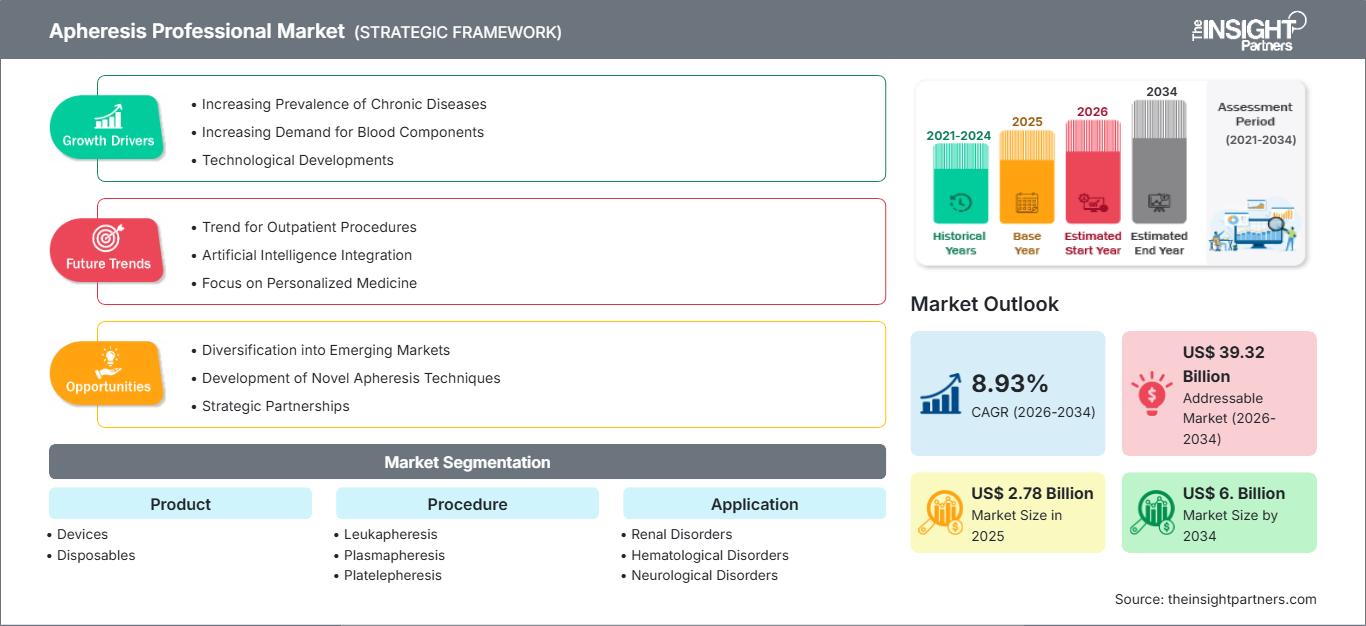
2025 Market Size
US$ 2.78 Bn
Base year value
2034 Forecast
US$ 6. Bn
Projected by 2034
CAGR 2026-2034
8.93 %
Growth rate
Addressable Market
US$ 39.32 Bn
(2026-2034)
The apheresis professional market was valued at US$ 2.78 Billion in 2025 and is projected to reach US$ 6.0 Billion by 2034, expanding at a CAGR of 8.93% during 2026–2034. The market covers devices and disposables supporting therapeutic and donor procedures, including leukapheresis, plasmapheresis, plateletpheresis, and erythrocytapheresis, with centrifugation and membrane separation technologies serving renal, hematological, neurological, and autoimmune applications.
North America is expected to remain a major regional contributor, supported by established blood-component collection networks, specialized therapeutic centers, and high adoption of automated separation platforms. The apheresis professional market size in the region is estimated to expand at a CAGR of 7.8–8.8% during 2026–2034, supported by recurring disposable utilization and replacement of mature equipment fleets.
Apheresis Professional Market Assessment and Insights
- North America: North America held a modeled 34–37% share in 2025 and is expected to grow at a CAGR of 7.8–8.8% during 2026–2034, supported by mature transfusion infrastructure, therapeutic centers, plasma collection, and established equipment replacement cycles.
- US: The US represented 86–89% of North American revenue in 2025 and is projected to grow at a CAGR of 7.7–8.7%, supported by high procedure volumes and specialized clinical infrastructure.
- Europe: Europe accounted for 25–28% in 2025 and is projected to expand at a CAGR of 7.9–8.9%, with Germany, the UK, France, Italy, and Spain supporting established blood-component and therapeutic programs.
- Asia Pacific: Asia Pacific represented 22–25% in 2025 and is expected to record a CAGR of 9.5–10.5%, led by China, Japan, South Korea, India, and Australia as specialized healthcare infrastructure expands.
- Largest Segment: Disposables held a modeled 67–71% market share in 2025 and are projected to grow at a CAGR of 7.9–8.9%, driven by recurring procedure-specific consumption.
- High Growth Segment: Centrifugation represented 43–47% market share in 2025 and is projected to grow at a CAGR of 9.0–10.0%, supported by automated separation and broad procedural applicability.
- Key companies analyzed in detail: Terumo Blood and Cell Technologies, Inc.; Fresenius SE & Co. KGaA; Haemonetics Corporation; Asahi Kasei Medical Co., Ltd.; B. Braun Melsungen AG; Baxter International Inc.; Cerus Corporation; Kaneka Corporation; Kawasumi Laboratories, Inc.; Nikkiso Co., Ltd.
Source: The Insight Partners' analysis based on proprietary research, government publications, company annual reports, investor presentations, industry databases, and expert interviews.
The apheresis professional market has progressed from standalone separation equipment toward integrated platforms combining automated controls, disposable circuits, sensors, collection components, and procedure-specific software. Production methods are increasingly focusing on validated single-use processes, closed system handling, uniform yields, and manufacturing reliability. WHO guidelines highlight the use of centrifugation and filtration techniques as well-established techniques for plasma separation, stressing on equipment validation, maintenance, performance testing, and technical support. Future development needs will be focused on expansion into Asian healthcare systems, certain Middle Eastern tertiary care hospitals, and special cell therapy centers. It is expected that investment will focus on scalable collection systems, technical support, disposable manufacturing capability, and digital traceability. Emphasis on safe blood systems will aid equipment modernization.
The 2026 report by WHO on a global scale reiterates the differences in availability, collection, regulation, and quality management of blood and plasma across different countries.
Apheresis Professional Market Report Scope
| Report Attribute | Details |
|---|---|
| Market size in 2025 | US$ 2.78 Billion |
| Market Size by 2034 | US$ 6. Billion |
| Global CAGR (2026 - 2034) | 8.93% |
| Historical Data | 2021-2024 |
| Forecast period | 2026-2034 |
Apheresis Professional Market Analysis
Demand across the market is supported by donor component collection and therapeutic procedures, as outlined in the Apheresis Professional Market Report. Plasma, platelets, leukocytes, and red cells create recurring requirements, while neurological, autoimmune, renal, and hematological indications broaden therapeutic utilization. The value chain encompasses device development, disposable manufacturing, anticoagulant sourcing, blood centers, hospitals, operator expertise, distribution, and technical services. According to WHO, apheresis is an example of a selective component collection process, wherein specific blood components are extracted while other components are returned to the donor.
The supply structure rewards firms that can balance reliable equipment with consumables. The devices need engineering and validation, software, and procedure-specific disposables, thus making it difficult for a firm to switch once installed. The procurement process takes into account the total cost per procedure, uptime of equipment, training and service provision, and supply continuity. The ecosystem is conducive for generating recurring revenue since there is the potential of creating demand for disposable items per procedure.
Competitive positioning in the apheresis professional market increasingly depends on installed base, disposable ecosystems, clinical applications, and service infrastructure. Terumo Blood and Cell Technologies, Inc. maintains broad exposure to blood management and cellular workflows, while Haemonetics Corporation has significant exposure to plasma and blood-center applications. Fresenius SE & Co. KGaA, Asahi Kasei Medical Co., Ltd., and B. Braun Melsungen AG participate across specialized blood-processing and therapeutic platforms.
Strategic investment is moving toward automation, cell-therapy compatibility, digital workflow management, and manufacturing capacity for recurring consumables. Baxter International Inc., Cerus Corporation, Kaneka Corporation, Kawasumi Laboratories, Inc., and Nikkiso Co., Ltd. add competitive depth through specialized technologies and geographic capabilities. The apheresis professional market analysis therefore favors suppliers combining capital equipment, validated consumables, regulatory expertise, technical service, and application support rather than companies competing primarily on equipment price.
● REPORT CUSTOMIZATION
Tailor This Report To Align With Your Specific Business Requirements
This report can be customized to align precisely with your business objectives, scope, and target markets. Customization options include tailored segmentation, geography, competitive analysis, and strategic insights to support informed decision-making.
Customize This Report →WHAT YOU CAN ADJUST
- ● Segmentations
- ● Geography
- ● Competitive Analysis
- ● Language Preferences
Apheresis Professional Market: Strategic Insights
Regional Insights
North America Apheresis Professional Market
North America accounted for 34–37% of the apheresis professional market share in 2025 and is projected to grow at a CAGR of 7.8–8.8% through 2034. The US represents most regional demand, supported by mature blood centers, tertiary hospitals, plasma collection facilities, and established therapeutic apheresis programs. Canada contributes through transfusion services and specialized hospital networks. Replacement demand remains important as providers modernize installed systems.
Clinical applications are becoming more diversified. Plasma and platelet collection continue to support blood-center utilization, while neurological, autoimmune, and hematological procedures support therapeutic demand. Cellular collection adds another application pathway as advanced therapy manufacturing expands. Procurement decisions increasingly incorporate uptime, consumable supply, operator training, maintenance, procedure flexibility, and lifecycle cost. These factors favor established suppliers with integrated service networks and validated disposable portfolios.
U.S. Apheresis Professional Market
The US represented 86–89% of North American revenue in 2025 and is expected to grow at a CAGR of 7.7–8.7% through 2034. Key Apheresis Professional Market Trends include expanding plasma collection activities, increasing adoption of therapeutic apheresis procedures, growing demand for blood components, and continued investment in specialized collection infrastructure. The sheer size of its hospital network, dedicated blood banks, plasma collection setup, and therapies offer substantial equipment and disposables demands on a recurring basis. Terumo Blood and Cell Technologies, Inc., Haemonetics Corporation, and other foreign firms have major commercial presence in the market.
It ranges from plasma and platelet collection to leukapheresis and therapeutic processes. The applications for neurological diseases and autoimmune disorders form recurring demands at hospitals, while cell collection contributes to advanced therapy workflows. The purchasers look into the issues of automation, procedural accuracy, training, data handling, customer support, and consumables supplies. High levels of equipment use increase the significance of uptime, making supplier connections with preventive maintenance crucial.
Europe Apheresis Professional Market
Europe represented 25–28% of the apheresis professional market in 2025 and is expected to grow at a CAGR of 7.9–8.9%. Germany leads, followed by the UK, France, Italy, and Spain. Well-developed transfusion systems, specialized hospitals, and therapeutic programs facilitate replacement and recurrent demand for disposables. Germany has a well-developed healthcare system and medical device industry.
The UK ensures the organization of blood components and clinical services, whereas France has organized demand for tertiary hospitals and a transfusion network. The contribution from Italy and Spain comes through hospital-based therapeutic procedures and regional blood service. In Europe, the procurement process focuses on workflow efficiency, equipment performance, staff competencies, and consumables availability. Quality regulatory requirements also stimulate documentation, equipment validation, and operational processes standardization, fostering demand for technology platforms.
APAC Apheresis Professional Market
APAC represented 22–25% of the apheresis professional market in 2025 and is projected to expand at a CAGR of 9.5–10.5%, the fastest regional rate. China is at the forefront, with Japan, South Korea, India, and Australia following close behind. Increased development of tertiary hospitals and specialty blood processing will drive adoption. Healthcare infrastructure development helps China, with clinical expertise available in Japan. South Korea, India, and Australia offer further opportunities due to their specialty treatments and blood processing abilities.
Middle East & Africa Apheresis Professional Market
The Middle East & Africa is projected to grow at a CAGR of 6.9–7.9%, with Saudi Arabia leading, followed by the UAE and South Africa. Gulf healthcare investments support advanced tertiary services, while South Africa serves as an important regional clinical center.
Saudi Arabia and the UAE benefit from hospital modernization and private healthcare investment. South Africa has established transfusion and specialist-care capabilities, whereas the rest of MEA remains more infrastructure-constrained. Energy revenues support healthcare infrastructure in Gulf economies, creating opportunities for centralized specialist services, equipment modernization, and regional referral centers.
Segmentation Analysis
Product
Product comprises Devices and Disposables and is projected to grow at a CAGR of 7.9–8.9% during 2026–2034. Disposables provide recurring revenue because procedure-specific circuits and collection components are consumed repeatedly, while devices establish installed-base relationships. The apheresis professional market scope across products is influenced by procedure volumes, replacement cycles, automation requirements, regulatory validation, and compatibility between equipment and consumables.
- Devices: Automated separation systems remain strategically important for donor and therapeutic procedures. Buyers increasingly prioritize process control, operator guidance, equipment uptime, software functionality, maintenance support, and compatibility with multiple clinical workflows.
- Disposables: Single-use tubing assemblies, collection kits, filters, and associated components generate recurring procedural demand. Their strategic importance is reinforced by sterility requirements, validated device compatibility, supply continuity, and infection-control considerations.
Procedure
Procedure includes Leukapheresis, Plasmapheresis, Platelepheresis, Erthrocytapheresis, and others, and is projected to grow at a CAGR of 8.2–9.2%. Demand combines donor collection with therapeutic applications, producing varied equipment utilization patterns. Procedure specialization influences consumable configuration, operator training, clinical protocols, and equipment selection across hospitals and blood centers.
- Leukapheresis: Cellular collection and therapeutic leukocyte removal support demand. Its strategic relevance is increasing as specialized cellular workflows require controlled collection, traceability, standardized procedures, and dependable processing performance.
- Plasmapheresis: Plasma collection and therapeutic plasma exchange create substantial procedural utilization. Demand benefits from plasma-product requirements and selected autoimmune, neurological, renal, and hematological treatment pathways.
- Platelepheresis: Targeted platelet collection remains important for transfusion services. Single-donor collection supports predictable component availability and can improve blood-center inventory planning for hospitals with recurring platelet requirements.
- Erthrocytapheresis: Red-cell exchange is a specialized therapeutic procedure concentrated in selected clinical populations. Its importance derives from repeated treatment requirements and controlled removal and replacement of erythrocyte components.
Application
The application includes Renal Disorders, Hematological Disorders, Neurological Disorders, Autoimmune Disorders, and others, and is projected to grow at a CAGR of 8.4–9.4%. Specialist treatment pathways, clinical evidence, reimbursement, trained personnel, and hospital infrastructure influence utilization. The apheresis professional market growth within applications is therefore closely linked to the expansion of tertiary-care capabilities.
- Renal Disorders: Selected renal conditions can require therapeutic plasma processing within specialist protocols. Adoption depends on clinical indication, treatment-center capabilities, disease severity, and availability of trained nephrology and apheresis teams.
- Hematological Disorders: Hematology supports both component collection and therapeutic procedures. Tertiary hospitals and blood centers remain important users, with demand shaped by disease-specific protocols and requirements for controlled cellular processing.
- Neurological Disorders: Neurological applications represent an established therapeutic use area. Utilization depends on specialist adoption, clinical guidelines, repeat-treatment requirements, and access to centers with experienced apheresis personnel.
- Autoimmune Disorders: Therapeutic removal of circulating pathogenic constituents can support selected autoimmune treatment pathways. Growing specialist awareness and protocol standardization can expand utilization within tertiary hospitals and dedicated treatment units.
Technology
Technology comprises Centrifugation and Membrane Separation and is projected to grow at a CAGR of 8.5–9.5%. Centrifugation remains broadly applicable across component collection, whereas membrane separation provides filtration-based approaches for selected therapeutic procedures. Technology selection depends on component characteristics, procedure requirements, throughput, automation, equipment design, and clinical protocol.
- Centrifugation: Centrifugation separates blood components according to density and supports numerous donor and therapeutic procedures. Automation, sensor integration, continuous monitoring, and programmable controls strengthen its role in high-volume clinical environments.
- Membrane Separation: Membrane-based systems provide selective filtration and remain relevant to therapeutic blood-processing applications. Their strategic importance is strongest where controlled removal of targeted plasma constituents supports specialized treatment protocols.
Opportunity Snapshot
| Segment Name | Revenue Contribution (High/Medium/Low) | Trend Tag (MAX 2 words) | Adoption Stage (Emerging/Scaling/Mature) |
| Renal Disorders | Medium | Plasma Exchange | Scaling |
| Hematological Disorders | High | Cell Collection | Mature |
| Neurological Disorders | High | Therapeutic Exchange | Mature |
| Autoimmune Disorders | High | Immune Removal | Scaling |
| Others | Medium | Specialty Care | Emerging |
Apheresis Professional Market Growth Drivers and Impact Analysis
Rising Need for Targeted Blood Component Collection
Selecting targeted plasma, platelets, leukocytes, and red cells as a method of collection imposes structural needs for automation of the process. Apheresis is capable of collecting the desired component while leaving other components within the blood back to the donor. This makes apheresis highly practical for organized blood services. The WHO guidelines are aware of this component-specific collection and stress donor selection, equipment control, quality systems, and procedural aspects. The commercial effect goes beyond the purchase of capital equipment, since a higher volume of the process translates into a higher consumption of disposables and collection components. Blood centers that want more components thus become a crucial market segment. Companies that can provide equipment, consumable availability, training of personnel, and servicing thus gain throughout the whole process cycle, not only selling equipment.
Broader Use of Therapeutic Apheresis
Therapeutic apheresis is creating more clinically addressable opportunities through extending its applications beyond that of donor collection through the inclusion of specific treatment paths of neurological, autoimmune, renal, and hematological diseases. Such an application portfolio is likely to generate demand in tertiary care hospitals because of the complexity of the procedures needed in such settings. An increase in the use of therapeutic apheresis will enhance the economics of the technology because there will be more opportunities to perform various procedures using the same platform, thereby increasing the efficiency of the technology in use. For medical device companies, having more clinical utility will encourage more investment in configurability, procedure-specific disposables, training, and other forms of support.
Modernization of Blood Processing Infrastructure
Another structural factor is the modernization of national blood systems, since governments and health care organizations have come to realize the need for safe, quality-assured, and robust blood systems. The 2025 framework by WHO for good practices covers aspects of blood collection, processing, storage, quality systems, and fractionation of plasma for use in industry. Modernization leads to a situation where there are chances to replace old systems that do not have automation, monitoring capability, connectivity, and validation capability. This also leads to the investment in the infrastructure of the service, preventive maintenance, operator certification, and disposable supplies that are validated. Modernization leads to a situation where the effect will be stronger in the emerging markets because the installation of modern systems will coincide with the emergence of central blood banks and tertiary hospitals.
Apheresis Professional Market Future Trends
Integration with Advanced Cell Processing
Cellular and gene therapy applications are likely to make cell collection operations more strategically valuable than ever before. Leukapheresis can be a source of starting cells for subsequent manufacturing processes, hence the need to ensure the quality and traceability of the collected cells and also how they are handled. In the future, collection devices will most probably be interfaced with software and manufahttps://www.humanizeai.pro/_next/static/media/SquareDouble.faccfce6.svgcturing devices to allow for integrated workflow systems that minimize manual handling processes. Collection equipment suppliers will probably compete based on validation of protocols, software interface capabilities, automated information capture systems, and the ability to work with dedicated disposable systems. This opportunity is not limited to the sale of equipment since other aspects of the collection process will form part of the value proposition of the business.
Connected and Resource-Efficient Platforms
Connected systems will certainly become more relevant for vendors as they strive to gain more insight into device usage, procedure performance, maintenance needs, and disposable usage. Digital tracking could be utilized to provide preventive services, centralized fleet management, and standardization of processes at geographically diverse facilities. Efficiency will affect the next generation of products, with the need for fewer materials used, shorter procedures, and less waste produced while maintaining sterility and efficiency. Hospitals might start comparing solutions based on the economics of ownership as opposed to acquisition cost alone. This trend would favor vendors that can offer a combination of hardware, software, analytics, technical service, and efficient consumables. With growing digital capabilities of hospitals, integration and cybersecurity will become purchasing criteria. High-volume blood centers and tertiary care hospitals are the places where connected systems will be adopted first due to their high utilization rates.
Apheresis Professional Market Opportunities
Emerging-Market Therapeutic Apheresis Centers
New healthcare systems offer a chance for creating specialized apheresis treatment facilities within tertiary hospitals and regional referral centers. Investors can focus on those institutions that have an increasing range of specialties but insufficient equipment fleets. The approach to commercial success can include such elements as automation, operator training, preventive maintenance, workflow assistance, and disposables delivery. Cooperation with top hospitals can aid in creating reference centers and procedural skills before regional rollout. Local servicing capabilities are especially important as any downtime can affect scheduled therapy and the cost-effectiveness of the equipment itself. Manufacturers can further increase the adoption rate through the creation of multi-indication platforms, which can be used for hematology, neurology, nephrology, and immunology departments. In case of public sector expansion in the country, combined models involving equipment, disposables, and service will be more sustainable compared to pure capital equipment sales.
Integrated Collection Solutions for Cell Therapy
There is a new set of investment opportunities for the integration between the apheresis collection and cellular manufacturing technologies. The collection devices can be integrated into a larger workflow involving digital identification, validated transportation, processing, and manufacturing documentation. These suppliers can form partnerships with biotech firms, therapy providers, specialist hospitals, and contract manufacturers to validate their collection process for new types of therapies. Interoperability represents the most attractive strategy since customers need continuity between the collection and manufacturing of patients or donors from start to end. There are also business models involving workflow validation, operator qualification, software solutions, and consumables. The apheresis professional market forecasts, therefore, point toward greater value creation from integrated ecosystems rather than isolated devices. Such positioning can generate recurring revenue while strengthening relationships with advanced therapy customers.
Recent Developments
- June 2026: Haemonetics Corporation updated its financial reporting structure, combining its former Plasma and Blood Center businesses into a single Apheresis segment and renaming its Hospital segment MedSurg. The change reflects management's operating structure and highlights a stronger organizational focus on apheresis-related activities within its portfolio.
- May 2026: Terumo Blood and Cell Technologies, Inc. announced a strategic collaboration with Steminent Biotherapeutics to advance late-stage manufacturing readiness for mesenchymal stem cell therapies. The collaboration focuses on automated and scalable cell expansion, extending the company's involvement in workflows adjacent to cellular collection and supporting broader advanced-therapy manufacturing capabilities.
- April 2025: Asahi Kasei Medical Co., Ltd. announced the operational launch of Asahi Kasei Life Science following a corporate restructuring. Asahi Kasei Medical retained its blood purification business, including hemodialysis and therapeutic apheresis, while other life-science activities were transferred to the new organization. The restructuring clarified business responsibilities around medical and life-science activities.
Frequently Asked Questions

- Comprehensive Market Sizing and Forecast Analysis
- Detailed Segmentation Analysis
- In-Depth Market Dynamics Assessment
- Regional and Country-Level Insights
- Competitive Landscape and Company Benchmarking
- Strategic Business Intelligence
Recent Reports
Testimonials

The Insight Partners' SCADA System Market report is comprehensive, with valuable insights on current trends and future forecasts. The team was highly professional, responsive, and supportive throughout. We are very satisfied and highly recommend their services.
RAN KEDEM Partner, Reali Technologies LTDs
I requested a report on a very specific software market and the team produced the report in a few days. The information was very relevant and well presented. I then requested some changes and additions to the report. The team was again very responsive and I got the final report in less than a week.
JEAN-HERVE JENN Chairman, Future Analytica
We worked with The Insight Partners for an important market study and forecast. They gave us clear insights into opportunities and risks, which helped shape our plans. Their research was easy to use and based on solid data. It helped us make smart, confident decisions. We highly recommend them.
PIYUSH NAGPAL Sr. Vice President, High Beam Global
The Insight Partners delivered insightful, well-structured market research with strong domain expertise. Their team was professional and responsive throughout. The user-friendly website made accessing industry reports seamless. We highly recommend them for reliable, high-quality research services
YUKIHIKO ADACHI CEO, Deep Blue, LLC.
This is the first time I have purchased a market report from The Insight Partners.While I was unsure at first, I visited their web site and felt more comfortable to take the risk and purchase a market report.I am completely satisfied with the quality of the report and customer service. I had several questions and comments with the initial report, but after a couple of dialogs over email with their analyst I believe I have a report that I can use as input to our strategic planning process.Thank you so much for taking the extra time and making this a positive experience.I will definitely recommend your service to others and you will be my first call when we need further market data.
JOHN SUZUKI President and Chief Executive Officer, Board Director, BK Technologies
I wish to appreciate your support and the professionalism you displayed in the course of attending to my request for information regarding to infectious disease IVD market in Nigeria. I appreciate your patience, your guidance, and the fact that you were willing to offer a discount, which eventually made it possible for us to close a deal. I look forward to engaging The Insight Partners in the future, all thanks to the impression you have created in me as a result of this first encounter.
DR CHIJIOKE ONYIA MANAGING DIRECTOR, PineCrest Healthcare Ltd.Reason to Buy
- Informed Decision-Making
- Understanding Market Dynamics
- Competitive Analysis
- Identifying Emerging Markets
- Customer Insights
- Market Forecasts
- Risk Mitigation
- Boosting Operational Efficiency
- Strategic Planning
- Investment Justification
- Tracking Industry Innovations
- Aligning with Regulatory Trends





 Get Free Sample for