
Application Integration Platform Market Demand, Share & Growth by 2034
Coverage: by Deployment (Cloud-based, On-Premise); End-user (BFSI, Government, IT and Telecommunication, Manufacturing, Retail, Others) , and Geography (North America, Europe, Asia Pacific, and South and Central America)
- Status : Data Released
- Report Code : TIPRE00006642
- Category : Technology, Media and Telecommunications
- No. of Pages : 150
- Available Report Formats :


- Last update date : August 26, 2026


2025 Market Size
US$ 13.09 Bn
Base year value
2034 Forecast
US$ 27.09 Bn
Projected by 2034
CAGR 2026-2034
8.42 %
Growth rate
Addressable Market
US$ 180.36 Bn
(2026-2034)
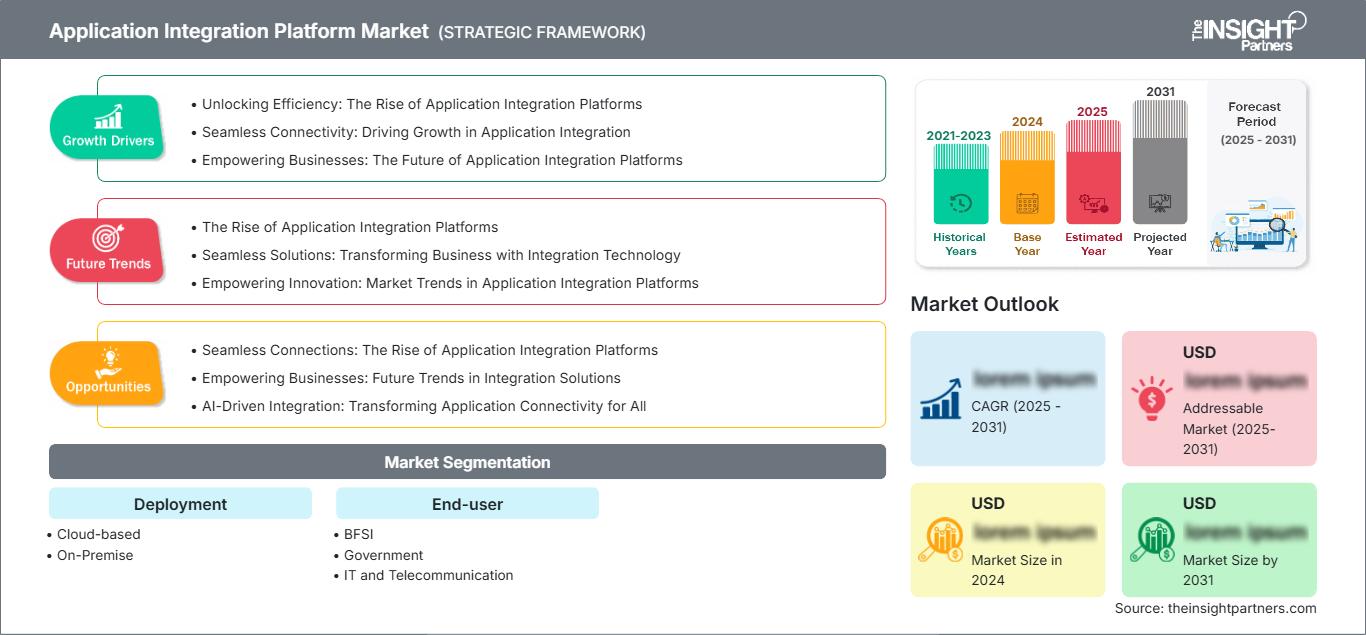
The global Application Integration Platform market was valued at US$ 13.09 billion in 2025 and is expected to reach US$ 27.09 billion by 2034; it is estimated to record a CAGR of 8.42% during 2026-2034.
Application Integration Platform Market Assessment and Insights
- North America accounted for 36–39% share in 2025 and is expected to grow at a CAGR between 2026–2034 of 8.8–9.6%, supported by mature cloud usage, API governance, AI workflow orchestration, and large enterprise modernization budgets.
- US represented 78–82% of North America in 2025 and is projected to grow at a CAGR between 2026–2034 of 8.9–9.7%, led by BFSI, federal modernization, and hyperscale cloud ecosystems.
- Europe held 24–27% share in 2025 and is forecast to grow at a CAGR between 2026–2034 of 8.2–9.0%, with Germany, the UK, and France leading regulated integration demand.
- Asia Pacific captured 22–25% share in 2025 and is estimated to grow at a CAGR between 2026–2034 of 10.6–11.8%, led by China, India, Japan, South Korea, and Australia.
- Largest Segment: Cloud-based deployment held 65–69% market share in 2025 and is expected to grow at a CAGR range of 10.1–11.0% due to scalability, faster provisioning, and SaaS integration demand.
- High Growth Segment: IT and Telecommunication held 20–24% market share in 2025 and is expected to grow at a CAGR range of 10.8–11.9% as providers automate service assurance and network workflows.
- Key companies analyzed in detail: Dell Technologies Inc., Informatica Inc., Microsoft Corporation, MuleSoft, LLC, Oracle Corporation, SAP SE, SnapLogic, Inc., Software AG, TIBCO Software Inc., Workato, Inc.
Source: The Insight Partners' analysis based on proprietary research, government publications, company annual reports, investor presentations, industry databases, and expert interviews.
Platform evolution has moved from point-to-point middleware toward API-first, event-driven, low-code, and AI-assisted integration architectures. The application integration platform market now depends on reusable connectors, policy-driven gateways, workflow automation, and managed runtime environments rather than manual interface development. The production paradigms are evolving into cloud control planes, hybrid agents, templating and monitoring layers that ensure reduced deployment time and yet provide security, auditing, and resilient operations.
Over the forecast period, the spend is likely to be focused on nascent digital economies, compliant cloud regions, and enterprise automation offerings that link legacy applications with SaaS, data, and AI platforms. Demand will be bolstered by government digital identity, open banking, smart manufacturing, and e-commerce platforms. The regulatory tailwind with regard to data residency, operational resilience, and auditing APIs will drive platform selection.
Application Integration Platform Market Report Scope
| Report Attribute | Details |
|---|---|
| Market size in 2025 | US$ 13.09 Billion |
| Market Size by 2034 | US$ 27.09 Billion |
| Global CAGR (2026 - 2034) | 8.42% |
| Historical Data | 2021-2024 |
| Forecast period | 2026-2034 |
Application Integration Platform Market Analysis
Demand is rising as enterprises replace fragmented integration scripts with managed platforms that support cloud, on-premise, and multi-cloud environments. The application integration platform market growth is anchored in ERP modernization, CRM expansion, data pipeline automation, and AI model enablement. Buyers increasingly evaluate platforms by connector depth, runtime reliability, API security, and the ability to orchestrate business processes across heterogeneous systems.
The ecosystem includes platform vendors, cloud service providers, system integrators, managed service partners, independent software vendors, and enterprise architecture teams. Supply is moving toward subscription-based delivery, embedded integration accelerators, and marketplaces of reusable connectors. This shift improves deployment velocity, but it also raises expectations for governance, version control, identity management, and cross-environment observability.
Competitive positioning is shaped by breadth of connectivity, AI-assisted development, enterprise-grade controls, and depth in regulated sectors. The application integration platform market analysis shows Microsoft Corporation, Oracle Corporation, SAP SE, and MuleSoft, LLC competing through ecosystem lock-in, while Workato, Inc., SnapLogic, Inc., Informatica Inc., Software AG, TIBCO Software Inc., and Dell Technologies Inc. compete through automation depth, data integration, or hybrid infrastructure alignment.
Investment trends favor vendors that combine application integration, API management, data movement, process automation, and agentic workflow execution. Strategic differentiation increasingly depends on reducing integration debt, supporting composable architecture, and providing measurable operational outcomes. Partnerships with cloud providers, system integrators, and SaaS vendors help expand platform reach while lowering implementation friction for enterprise buyers.
● REPORT CUSTOMIZATION
Tailor This Report To Align With Your Specific Business Requirements
This report can be customized to align precisely with your business objectives, scope, and target markets. Customization options include tailored segmentation, geography, competitive analysis, and strategic insights to support informed decision-making.
Customize This Report →WHAT YOU CAN ADJUST
- ● Segmentations
- ● Geography
- ● Competitive Analysis
- ● Language Preferences
Application Integration Platform Market: Strategic Insights
Regional Insights
North America application integration platform market
North America accounted for 36–39% share in 2025 and is expected to grow at a CAGR range of 8.8–9.6% during 2026–2034. The region’s application integration platform market share is supported by advanced SaaS penetration, cloud migration maturity, API lifecycle management, and high spending on enterprise automation across BFSI, retail, government, and technology sectors.
Structural demand is reinforced by compliance requirements, resilience planning, and digital service delivery. U.S. and Canadian enterprises are prioritizing platforms that unify identity, monitoring, workflow orchestration, and hybrid connectivity. The market benefits from hyperscale cloud ecosystems, large partner networks, and continuous modernization of legacy core systems.
U.S. application integration platform Market
According to the Application Integration Platform Market report, the U.S. represented 78–82% of the North American market in 2025 and is projected to grow at a CAGR of 8.9–9.7% during 2026–2034. Demand is concentrated in BFSI, healthcare administration, federal agencies, telecom operators, and digital-native retailers that require secure integration across SaaS applications, mainframe systems, data warehouses, and customer engagement platforms. Growing investments in cloud adoption, API management, hybrid integration, and enterprise modernization initiatives continue to support market expansion across the country.
Company presence is broad, with Microsoft Corporation, Oracle Corporation, MuleSoft, LLC, Workato, Inc., SnapLogic, Inc., Informatica Inc., and Dell Technologies Inc. strengthening competition through cloud marketplaces, partner programs, and AI-enabled integration tools. Application trends include automated claims processing, customer 360 workflows, fraud monitoring, service desk automation, and API-based citizen services.
Europe application integration platform Market
Europe held 24–27% share of the application integration platform market in 2025 and is expected to grow at a CAGR range of 8.2–9.0% through 2034. Germany is the leading country, supported by manufacturing digitization, SAP-centered enterprise estates, industrial automation, and integration needs across suppliers, logistics providers, and regulated data environments.
BFSI, government services, retail, and telecom segments display significant uptake in the United Kingdom, wherein open banking, cloud migration, and customer data unification push for purchases. Germany is focused on hybrid security, industrial data integration, and ERP modernization. France, Italy, and Spain provide contributions via e-government, retail modernization, and cloud-first public sector programs.
APAC application integration platform Market
APAC captured 22–25% share of the application integration platform market in 2025 and is projected to grow at a CAGR range of 10.6–11.8% during 2026–2034. China is the leading country, while India, Japan, South Korea, and Australia are scaling integration investments around digital banking, telecom automation, manufacturing execution systems, and public cloud adoption.
Industrial policy, smart factory programs, cross-border e-commerce, and national digital infrastructure initiatives are accelerating demand. Enterprises in the region require platforms that support multilingual operations, local data controls, mobile-first customer journeys, and hybrid integration between domestic systems, global SaaS platforms, and cloud-native applications.
Middle East & Africa application integration platform Market
The Middle East & Africa application integration platform market is forecast to grow at a CAGR range of 9.0–10.2% during 2026–2034, with Saudi Arabia leading regional adoption. Demand is supported by energy sector digitization, smart city programs, financial modernization, and cloud infrastructure investment in the UAE, Saudi Arabia, South Africa, and the Rest of MEA.
Energy producers, utilities, telecom operators, and government agencies need integration platforms to connect asset management, customer service, billing, analytics, and security systems. Data residency requirements and sovereign cloud initiatives are encouraging hybrid models that balance modernization with local control, operational continuity, and cybersecurity oversight.
Segmentation Analysis
Deployment
Deployment is expected to grow at a CAGR range of 9.3–10.1% during 2026–2034 as buyers balance cloud agility with legacy modernization. The application integration platform market scope across deployment models reflects different security, latency, compliance, and cost priorities. Cloud adoption is accelerating, but on-premise environments remain relevant where regulated workloads, custom applications, or low-latency systems require direct control.
- Cloud-based solutions lead adoption because they support rapid provisioning, elastic scaling, prebuilt connectors, centralized monitoring, and faster integration of SaaS applications across distributed enterprise environments.
- On-Premise deployment remains strategically important for banks, government agencies, manufacturers, and telecom operators managing sensitive workloads, legacy systems, strict residency mandates, or complex private infrastructure.
End-user
End-user demand is expected to grow at a CAGR range of 9.1–9.9% during 2026–2034, with adoption shaped by sector-specific modernization priorities. BFSI requires secure workflow and data exchange, the government emphasizes citizen services and compliance, IT and telecom prioritize automation, manufacturing needs plant-to-enterprise integration, and retail focuses on omnichannel operations and customer data synchronization.
- BFSI shows high revenue contribution because institutions need secure API connectivity, risk data movement, payment modernization, customer onboarding automation, and compliance-ready audit trails.
- Government adoption is scaling as agencies digitize citizen services, identity platforms, tax systems, procurement networks, and interdepartmental data exchange with stronger governance controls.
- IT and Telecommunication is the high-growth segment as operators automate service provisioning, network assurance, customer support, billing, partner APIs, and cloud-native operational workflows.
- Manufacturing relies on integration platforms to connect ERP, MES, quality systems, supplier portals, equipment data, and predictive maintenance applications across increasingly digital factories.
- Retail uses integration tools to synchronize e-commerce, inventory, point-of-sale, loyalty, logistics, payments, and marketing platforms for consistent omnichannel customer experiences.
Opportunity Snapshot
| End-user | Revenue Contribution (High/Medium/Low) | Trend Tag (MAX 2 words, specific) | Adoption Stage (Emerging/Scaling/Mature) |
| BFSI | High | Open Banking | Mature |
| Government | Medium | Citizen APIs | Scaling |
| IT and Telecommunication | High | Network Automation | Scaling |
| Manufacturing | Medium | Smart Factory | Scaling |
| Retail | Medium | Omnichannel Sync | Mature |
Application Integration Platform Market Growth Drivers and Impact Analysis
Hybrid Cloud Modernization Across Large Enterprises
The need for hybrid cloud modernization will drive this because organizations will not be able to move everything at once to the same environment. The banks, manufacturing companies, retailers, and governmental agencies will keep running their mainframe environments, private data centers, SaaS applications, and public clouds at the same time. An integration platform is what provides the necessary fabric that will be used to handle this complexity using secure agents, APIs, event streams, and reusable workflows. These vendors will find success in the market based on faster projects, less custom code, and better management of data movements.
API Economy and Real-Time Digital Services
More and more digital services leverage APIs that reveal their payments, identities, inventories, claims, logistics, and customer information internally and externally. This trend is critical in sectors such as finance, telecommunication, retailing, and government, where the bar for real-time services is being raised. Application integration platforms allow organizations to manage, govern, control, and consume APIs, integrating them into core application systems and business process management solutions. The consequence is moving from disconnected integration projects to managing APIs as products. Customers want to see integrated solutions that can handle API gateways, lifecycle management, developer portals, policy enforcement, and analytics.
AI-Ready Data and Workflow Orchestration
AI usage is driving up demand for enterprise data that is clean, governed, and accessible. AI models and agents provide only minimal benefit when there is a disconnect between the various types of customer data, transaction data, supply chain data, and service data. Platform solutions have become necessary for the connection of disparate data sources, initiation of workflow processes, enrichment of data context, and human intervention before actions are taken through automation. The market opportunity is in an expanded purchase justification, from IT integration to business process intelligence. Companies are looking at platform providers’ ability to enable natural language development, agent tools, policies, human intervention, and cloud AI integration.
Application Integration Platform Market Future Trends
Agentic Integration Becomes an Enterprise Operating Layer
Agentic integration will reshape application integration platform market trends as enterprises move from static workflows toward goal-driven automation. Future platforms will enable AI agents to identify approved tools, invoke APIs, get contextual information about the business, and run multistep processes within the constraints of the governance environment. This doesn't mean that integration architecture is unnecessary; it simply makes the security of the catalog, observability, and determinism more crucial. Consumers will demand from the platforms the ability to provide flexibility with models, access to tools like the MCP way, logging, policy enforcement, and human approval steps. The winners will be those who can provide transparency and reversibility for the agent actions.
Composable Industry Integration Templates Gain Priority
Templates specific to industry verticals will become more relevant as organizations look for quick time-to-value realization and reduced risk during implementations. Instead of developing everything from scratch, buyers will prefer pre-configured templates for claims management, loan origination, vendor management, order orchestration, telecom provisioning, and data interchange in smart factories. Templates will come with specific connectors, mappings, process flows, and compliance gates based on industry best practices. The phenomenon will play well into the hands of vendors that have a good ecosystem of partners and expertise in process development. Competition will no longer be about the number of connectors but also about the quality of re-usable business value delivery and implementations.
Application Integration Platform Market Opportunities
Modernization of Regulated Workflows
The regulated industries present good opportunities for investing as these industries require integration solutions that incorporate both automation and control. Banks, insurance firms, government bodies, utility companies, and healthcare administrators require linking of their existing legacy systems with cloud-based applications, and this has to be done without violating any regulations of auditability, privacy, or business continuity. The application integration platform market Forecasts indicate sustained demand where modernization is tied to regulatory reporting, customer experience, and cybersecurity objectives. Differentiation will depend on secure runtime options, role-based access, data lineage, encryption, and evidence-ready monitoring that helps buyers reduce risk while accelerating transformation.
Embedded Integration for SaaS and Vertical Platforms
Software-as-a-Service companies and vertical software companies are incorporating integration capabilities into their offerings in order to make it easier for them to bring customers on board. This represents a business opportunity for the platform providers to license connectors, automation capabilities, and workflow orchestration as embedded solutions. Manufacturers’ platforms, IT service management software, HR software, ecommerce platforms, and financial software can provide increased value to their customers by integrating themselves into existing systems without having to launch a special project for this purpose. This business model is very appealing since it allows creating recurring usage and extends reach of the vendor through partners.
Frequently Asked Questions

- Comprehensive Market Sizing and Forecast Analysis
- Detailed Segmentation Analysis
- In-Depth Market Dynamics Assessment
- Regional and Country-Level Insights
- Competitive Landscape and Company Benchmarking
- Strategic Business Intelligence
Recent Reports
Testimonials

The Insight Partners' SCADA System Market report is comprehensive, with valuable insights on current trends and future forecasts. The team was highly professional, responsive, and supportive throughout. We are very satisfied and highly recommend their services.
RAN KEDEM Partner, Reali Technologies LTDs
I requested a report on a very specific software market and the team produced the report in a few days. The information was very relevant and well presented. I then requested some changes and additions to the report. The team was again very responsive and I got the final report in less than a week.
JEAN-HERVE JENN Chairman, Future Analytica
We worked with The Insight Partners for an important market study and forecast. They gave us clear insights into opportunities and risks, which helped shape our plans. Their research was easy to use and based on solid data. It helped us make smart, confident decisions. We highly recommend them.
PIYUSH NAGPAL Sr. Vice President, High Beam Global
The Insight Partners delivered insightful, well-structured market research with strong domain expertise. Their team was professional and responsive throughout. The user-friendly website made accessing industry reports seamless. We highly recommend them for reliable, high-quality research services
YUKIHIKO ADACHI CEO, Deep Blue, LLC.
This is the first time I have purchased a market report from The Insight Partners.While I was unsure at first, I visited their web site and felt more comfortable to take the risk and purchase a market report.I am completely satisfied with the quality of the report and customer service. I had several questions and comments with the initial report, but after a couple of dialogs over email with their analyst I believe I have a report that I can use as input to our strategic planning process.Thank you so much for taking the extra time and making this a positive experience.I will definitely recommend your service to others and you will be my first call when we need further market data.
JOHN SUZUKI President and Chief Executive Officer, Board Director, BK Technologies
I wish to appreciate your support and the professionalism you displayed in the course of attending to my request for information regarding to infectious disease IVD market in Nigeria. I appreciate your patience, your guidance, and the fact that you were willing to offer a discount, which eventually made it possible for us to close a deal. I look forward to engaging The Insight Partners in the future, all thanks to the impression you have created in me as a result of this first encounter.
DR CHIJIOKE ONYIA MANAGING DIRECTOR, PineCrest Healthcare Ltd.Reason to Buy
- Informed Decision-Making
- Understanding Market Dynamics
- Competitive Analysis
- Identifying Emerging Markets
- Customer Insights
- Market Forecasts
- Risk Mitigation
- Boosting Operational Efficiency
- Strategic Planning
- Investment Justification
- Tracking Industry Innovations
- Aligning with Regulatory Trends





 Get Free Sample for