
Arthroscopic Orthopaedic Surgery Instruments Market Demand, Share & Growth by 2034
Coverage: By Product (Powered Shaver Systems, Visualization Systems, Fluid Management Systems, Ablation Systems, Arthroscopes, Arthroscope Implants, Accessories, and Disposables); Application (Hip, Knee, Shoulder, Spine, Foot and Ankle, Hand and Wrist, and Others); End Use (Hospitals, Clinics, Ambulatory Surgical Centers, and Others), and Geography (North America, Europe, Asia Pacific, and South and Central America)
- Status : Data Released
- Report Code : TIPRE00022288
- Category : Life Sciences
- No. of Pages : 150
- Available Report Formats :


- Last update date : September 09, 2026


2025 Market Size
US$ 127.84 Mn
Base year value
2034 Forecast
US$ 336.74 Mn
Projected by 2034
CAGR 2026-2034
11.36 %
Growth rate
Addressable Market
US$ 2,047.31 Mn
(2026-2034)
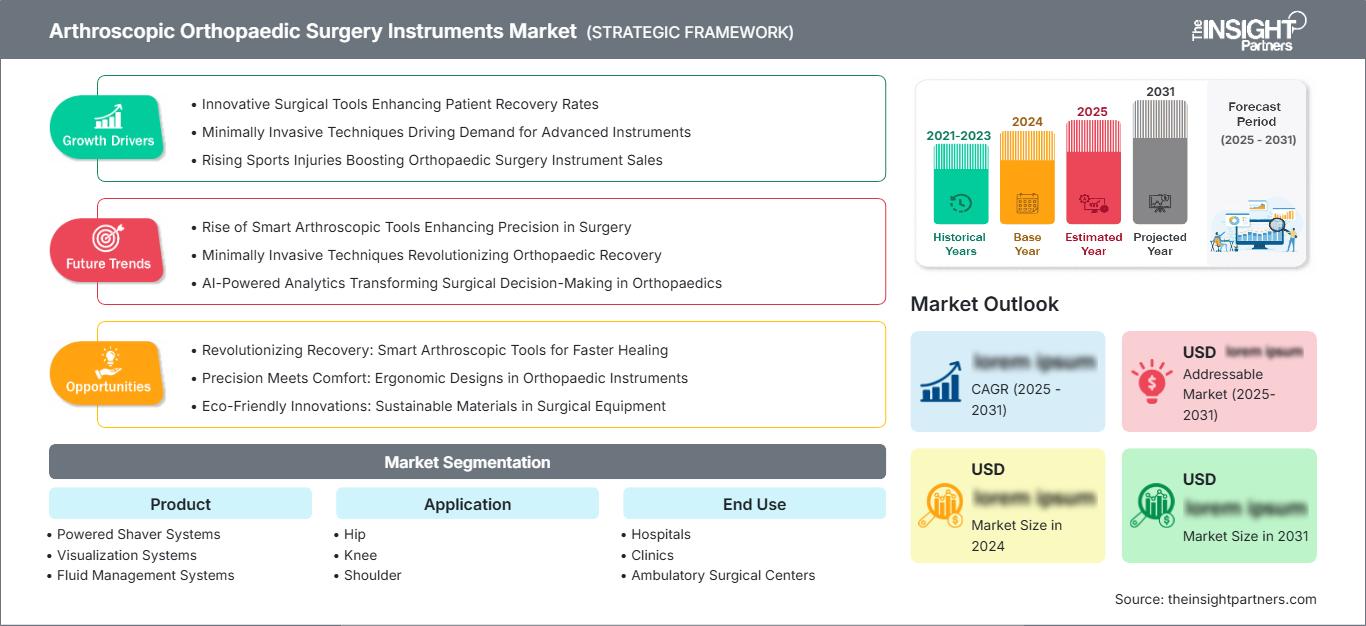
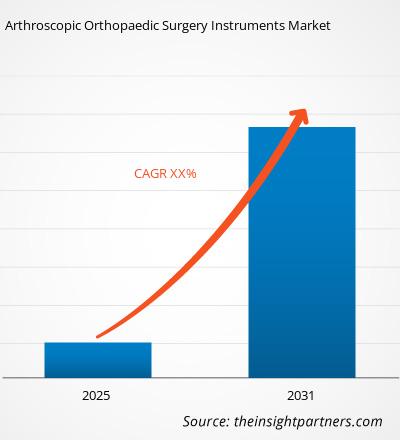
The Arthroscopic Orthopaedic Surgery Instruments market was valued at US$ 127.84 million in 2025 and is expected to reach US$ 336.74 million by 2034; it is estimated to record a CAGR of 11.36% during 2026-2034.
Arthroscopic Orthopaedic Surgery Instruments Market Assessment and Insights
- North America: North America is expected to hold a 38–42% Arthroscopic orthopaedic surgery instruments market share in 2025 and expand at a 10.5–11.5% CAGR between 2026–2034, supported by mature arthroscopy infrastructure, high procedure volumes, and rapid technology adoption.
- US: The US is estimated to represent 82–86% of North America in 2025, growing at a 10.3–11.3% CAGR during 2026–2034, supported by hospitals and ASCs.
- Europe: Europe is projected to account for a 27–31% share in 2025 and grow at a 11.0–12.0% CAGR during 2026–2034, led by Germany, the UK, France, Italy, and Spain.
- Asia Pacific: Asia Pacific is estimated at a 19–23% share in 2025 and is expected to grow at a 14.0–15.0% CAGR during 2026–2034, led by China, Japan, South Korea, India, and Australia.
- Largest Segment: Powered Shaver Systems represent the largest segment, with a 23–27% market share in 2025 and a 12.0–13.0% CAGR during 2026–2034, reflecting high procedural utilization.
- High Growth Segment: Visualization Systems are the high-growth segment, representing a 14–18% market share in 2025 and expanding at a 14.5–15.5% CAGR during 2026–2034.
- Key companies analyzed in detail: Arthrex, Smith & Nephew plc., DePuy Synthes, Stryker Corporation, CONMED Corporation, Zimmer Biomet Holdings, Inc., KARL STORZ SE & Co. KG, Richard Wolf GmbH, Olympus Corporation, and Medtronic plc.
Source: The Insight Partners' analysis based on proprietary research, government publications, company annual reports, investor presentations, industry databases, and expert interviews.
There has been progress in the field from traditional rigid scope-based instruments to the development of comprehensive platforms that include high-definition visualization, powered cutting, fluid handling, and radiofrequency ablation. Compact cameras and chip-on-tip innovations are opening up anatomically restricted areas. The focus of manufacturers has been on ergonomic handpieces, procedure-specific instruments, consoles, and disposables that make operating room procedures easy and setup simple.
In terms of technology investment, during the forecast period, technology investments are likely to be made in digital visualization, compact imaging, energy platforms, and procedure-specific instrumentation. Adoption is likely to become more prevalent in emerging healthcare delivery systems as orthopedic surgeons, private clinics, and ambulatory care settings enhance their ability to perform minimally invasive surgery. Requirements regarding the reprocessing of reusable devices, electrical safety, sterilization, and performance of devices will keep shaping purchasing decisions, while hospitals will increasingly consider equipment based on procedural economics rather than just cost.
Arthroscopic Orthopaedic Surgery Instruments Market Report Scope
| Report Attribute | Details |
|---|---|
| Market size in 2025 | US$ 127.84 Million |
| Market Size by 2034 | US$ 336.74 Million |
| Global CAGR (2026 - 2034) | 11.36% |
| Historical Data | 2021-2024 |
| Forecast period | 2026-2034 |
Arthroscopic Orthopaedic Surgery Instruments Market Analysis
The increase in demand for arthroscopic orthopaedic surgery instruments is closely linked to increased procedures, sport-related injuries, degenerative joint conditions and interest in minimal invasion surgeries. The value chain includes suppliers of instruments, manufacturers of components, visualization technology vendors, distributors, hospitals, clinics and ambulatory surgery centers. The product demand is determined by procedure complexity, surgeon preferences, existing equipment, disposable usage and replacement cycles. More hospitals are seeking out multi-application platforms.
The supplier-side trends in the Arthroscopic orthopaedic surgery instruments market involve the bundling of disposable revenue with capital equipment sales. The use of powered shaver blades, tubing, cannulas, ablation probes and disposables used during visualization procedures creates the necessity for regular purchases after initial installation of the platform. Such approach incentivizes the development of product ecosystems and procedure-specific portfolio by the suppliers. Manufacturing considerations include such aspects as precision, imaging quality, ergonomic design, sterilization compatibility and component reliability. The distributors continue playing an important role due to the fragmentation of the hospital and ASC client base.
According to the arthroscopic orthopaedic surgery instruments market analysis, the competitive landscape of the market can be described as having broad portfolios and good surgeon relationships. Arthrex provides a broad sports medicine ecosystem including visualization, resection, implants and accessories. Smith & Nephew plc. combines arthroscopy-enabling technologies with sports medicine implants, while Stryker Corporation offers integrated resection, energy, fluid management and visualization technologies. CONMED Corporation is competing with its arthroscopy instruments, pumps, cannulas and orthopedic repair solutions.
The competitive differentiation in the Arthroscopic orthopaedic surgery instruments market involves the development of platforms and procedure-specific innovations. Zimmer Biomet Holdings, Inc. and DePuy Synthes compete through their broad orthopedic portfolios. KARL STORZ SE & Co. KG and Richard Wolf GmbH bring visualization technologies to the competition, while Olympus Corporation and Medtronic plc. provide technology capabilities related to minimally invasive surgeries. Increasing investments are aimed at the development of compact imaging, digital integration, advanced energy delivery, single-use products and platforms allowing for outpatient surgery with consistent visualization and procedure control.
● REPORT CUSTOMIZATION
Tailor This Report To Align With Your Specific Business Requirements
This report can be customized to align precisely with your business objectives, scope, and target markets. Customization options include tailored segmentation, geography, competitive analysis, and strategic insights to support informed decision-making.
Customize This Report →WHAT YOU CAN ADJUST
- ● Segmentations
- ● Geography
- ● Competitive Analysis
- ● Language Preferences
Arthroscopic Orthopaedic Surgery Instruments Market: Strategic Insights
Regional Insights
North America Arthroscopic orthopaedic surgery instruments market
North America is estimated to hold a 38–42% Arthroscopic orthopaedic surgery instruments market share in 2025 and expand at a 10.5–11.5% CAGR through 2034. The US remains the principal contributor because of high arthroscopy procedure volumes, sophisticated orthopedic care, widespread ambulatory surgical centers, and strong adoption of advanced surgical equipment. Canada contributes through hospital modernization and increasing access to minimally invasive orthopedic procedures.
There are various factors that contribute to the success of the arthroscopic orthopaedic surgery instruments market in the regional segment. Some of these include fast acceptance of integrated consoles, powered shavers, HD visualization, fluid management devices and disposables. The demand is driven by the fact that ASCs now require more compact instruments with assured turnarounds. Sports medicine activities and surgeon preference also add to the growth in demand.
U.S. Arthroscopic orthopaedic surgery instruments market Market
The US accounts for 82–86% of North America's 2025 share and is expected to grow at a 10.3–11.3% CAGR during 2026–2034. Hospitals and ASCs are important purchasing centers, with outpatient migration supporting demand for compact visualization, powered resection, fluid management, and disposable accessories. Arthrex, Stryker Corporation, Smith & Nephew plc., and CONMED Corporation maintain substantial commercial presence across sports medicine and arthroscopy.
Application trend in the Arthroscopic orthopaedic surgery instruments market is moving toward knee and shoulder cases, with hip and extremities next. The needs of the ASC focus on devices that decrease setup time and streamline workflow processes, while hospital needs encompass greater procedure capabilities. Scope and console replacement is another avenue through which sales can occur. Room utilization efficiency is becoming an increasing consideration as well.
Europe Arthroscopic orthopaedic surgery instruments market Market
Europe is projected to represent a 27–31% share in 2025 and expand at an 11.0–12.0% CAGR, with Germany emerging as a leading national market. Advanced orthopedic skills, presence of hospitals, and rising number of surgeries performed outside hospitals help to facilitate penetration in Germany, the UK, France, Italy, and Spain.
The UK utilizes both traditional orthopedic centers and rising numbers of ambulatory facilities. The country of Germany enjoys its highly developed hospitals and orthopedic skills. France, Italy, and Spain have their contribution in the form of rising minimally invasive orthopedic operations and new surgical equipment. In all the countries under consideration, the issue of the life expectancy of the equipment becomes increasingly important for procurement.
APAC Arthroscopic orthopaedic surgery instruments market Market
APAC is estimated at a 19–23% share in 2025 and is forecast to grow at a 14.0–15.0% CAGR, making it the fastest-growing major region. China represents a leading market, followed by Japan, South Korea, India, and Australia. Expanding orthopedic capacity, private healthcare investment, and increasing surgeon training support adoption.
Both China and India have great potential due to increasing infrastructure in hospitals and increasing demand for minimally invasive procedures. Japan and South Korea focus on high technology and specialization in orthopedics, whereas Australia has developed surgical centers. Healthcare modernization efforts by governments, local production, and availability of specialists will progressively lead to higher penetration of systems, visualization systems, and arthroscopy disposables.
Middle East & Africa Arthroscopic orthopaedic surgery instruments market Market
Middle East and Africa is expected to expand at approximately 11.5–12.5% CAGR, with Saudi Arabia and the UAE representing leading markets. Modernization in healthcare, development of specialist hospitals, and the building up of sophisticated surgical facilities will be key drivers here, as South Africa will continue to play an important role in providing orthopedic care and training.
Saudi Arabia and the UAE will get a boost through investments in technologically advanced hospitals and ambulatory facilities. South Africa is a much more developed orthopedics market, but other countries in MEA will have to continue relying on procurement and specialist centers to a greater extent. Oil revenue of Gulf states is financing healthcare facility investments, while MEA region will eventually catch up.
Segmentation Analysis
Product
Product segmentation captures the capital equipment, visualization technologies, implants, accessories, and consumables required throughout arthroscopic procedures. The segment is expected to expand at a 13.0–14.0% CAGR during 2026–2034, driven by integrated operating-room platforms, increasing procedure volumes, replacement demand, and recurring disposable consumption. Manufacturers are increasingly designing products around specific anatomical applications and standardized procedural workflows.
- Powered Shaver Systems: Powered shavers remain central to tissue and bone resection, particularly in knee and shoulder procedures. Their importance is reinforced by demand for precise cutting, efficient debris removal, ergonomic handpieces, and compatibility with integrated consoles.
- Visualization Systems: Visualization systems are gaining strategic importance as high-definition imaging, compact cameras, and digital integration improve intraoperative anatomical assessment. Hospitals increasingly evaluate image quality, ergonomics, connectivity, and compatibility with broader surgical workflows.
- Fluid Management Systems: Fluid management systems maintain joint distension, pressure, and visualization during procedures. Demand is supported by increasingly complex arthroscopy, with integrated pump technologies helping standardize inflow, outflow, suction, and temperature management.
- Ablation Systems: Ablation systems support tissue resection, coagulation, and hemostasis through energy-based technologies. Their role is expanding as surgeons seek controlled tissue treatment and integrated platforms that reduce the number of separate consoles required.
- Arthroscopes: Arthroscopes remain fundamental visualization instruments, with demand increasingly shifting toward high-resolution, ergonomic, and application-specific designs. Compact and chip-on-tip technologies are particularly relevant for constrained anatomical spaces and minimally invasive approaches.
- Arthroscope Implants: Arthroscope implants support procedure-specific orthopedic repair strategies and complement instrumentation platforms. Demand depends on procedure volumes, surgeon preference, implant design, fixation requirements, and the increasing emphasis on tissue-preserving interventions.
- Accessories: Accessories include cannulas, hand controls, cables, adapters, positioning components, and supporting instruments. These products are strategically important because compatibility and procedural completeness influence purchasing decisions across both hospitals and outpatient surgical facilities.
- Disposables: Disposables include blades, tubing, probes, single-use scopes, and related components. Recurring utilization makes this category important to supplier economics, while hospitals increasingly balance infection-control requirements, operating-room efficiency, and per-procedure expenditure.
Application
Application segmentation reflects differences in anatomy, procedure complexity, instrument requirements, and surgeon specialization. The segment is projected to grow at a 12.5–13.5% CAGR during 2026–2034. Knee procedures remain a major demand base, while hip, shoulder, spine, foot and ankle, and hand and wrist applications broaden the addressable market for specialized instrumentation.
- Hip: Hip arthroscopy requires specialized access, visualization, and resection tools because of constrained anatomy. Demand is supported by increasing recognition of femoroacetabular impingement and greater availability of specialist hip-preservation services.
- Knee: Knee arthroscopy remains a major application because of sports injuries, meniscal procedures, ligament reconstruction, and established surgeon familiarity. The application supports broad utilization of shavers, scopes, fluid systems, and accessories.
- Shoulder: Shoulder arthroscopy benefits from increasing treatment of rotator cuff, instability, and related soft-tissue conditions. Procedure-specific anchors, visualization, resection, and fluid management technologies support continued instrument demand.
- Spine: Spine applications are developing through minimally invasive approaches requiring specialized visualization and instrumentation. Adoption depends strongly on clinical evidence, surgeon training, procedural economics, and regulatory acceptance of emerging techniques.
- Foot and Ankle: Foot and ankle arthroscopy represents a specialized application where compact visualization and appropriately sized instruments can improve access. Increasing sports medicine activity and specialist training support gradual equipment adoption.
- Hand and Wrist: Hand and wrist procedures require small-diameter scopes and precise instruments because of limited joint spaces. Technology advances in compact visualization and specialized accessories support expansion across selected specialist centers.
End Use
End Use segmentation covers hospitals, clinics, and ambulatory surgical centers, with the category expected to grow at a 12.0–13.0% CAGR during 2026–2034. Outpatient migration is particularly relevant because arthroscopy often supports shorter procedural pathways, making ASCs and specialized clinics increasingly important purchasers of compact, integrated systems.
- Hospitals: Hospitals remain major customers because they handle complex cases, maintain specialist departments, and require comprehensive equipment portfolios. Their purchasing decisions emphasize technology breadth, service support, equipment utilization, and integration with operating-room infrastructure.
- Clinics: Orthopedic clinics increasingly adopt selected arthroscopy technologies where specialist procedure volumes justify investment. Their priorities include compact systems, predictable workflow, ease of use, and equipment configurations suited to focused procedural offerings.
- Ambulatory Surgical Centers: ASCs represent an important growth channel because outpatient orthopedic procedures align with their efficiency-focused operating model. Demand favors compact platforms, rapid setup, disposable components, and integrated systems that can support multiple procedures within limited operating-room footprints.
Opportunity Snapshot
| Application | Revenue Contribution (High/Medium/Low) | Trend Tag (MAX 2 words) | Adoption Stage (Emerging/Scaling/Mature) |
| Hip | Medium | Hip Preservation | Scaling |
| Knee | High | ACL Repair | Mature |
| Shoulder | High | Rotator Cuff | Mature |
| Spine | Medium | Endoscopic Access | Emerging |
| Foot and Ankle | Medium | Nano Arthroscopy | Scaling |
| Hand and Wrist | Low | Small-Joint Access | Emerging |
Arthroscopic Orthopaedic Surgery Instruments Market Growth Drivers and Impact Analysis
Migration of Orthopedic Procedures Toward Outpatient Settings
As there is a shift in the movement of appropriate orthopedic procedures from inpatient hospitals to outpatient surgical centers, the purchasing needs for equipment are shifting as well. ASCs emphasize the need for small-scale equipment, workflow standardization, quick turnover, and predictable cost per case. Therefore, there will be more demand for arthroscopy systems that integrate resection, energy, fluid handling, and visualization into one unit. Moreover, there will be an increase in the use of single-use devices as they can simplify inventory management and minimize reliance on complicated reprocessing procedures. In terms of manufacturers, the patient movement from inpatient hospitals to outpatient centers broadens the customer base beyond large tertiary care hospitals. Also, it makes it necessary to consider products that are flexible enough to fit smaller operating room spaces.
Growing Sports Medicine and Joint Preservation Requirements
Sports medicine is an important demand generator in the Arthroscopic orthopaedic surgery instruments market because arthroscopy enables minimally invasive treatment of ligament, cartilage, meniscal, and soft-tissue injuries. Participation in organized sports, recreational fitness, and physically active aging populations increases the number of patients seeking joint-preserving interventions. Shoulder, knee, hip, and foot and ankle procedures therefore create recurring demand for specialized scopes, powered instruments, ablation systems, and accessories. Manufacturers benefit when their platforms cover multiple procedures because surgeon familiarity can encourage broader adoption within a facility. The commercial impact extends beyond capital equipment, since procedure volumes generate recurring consumption of blades, tubing, probes, cannulas, and other disposables. Product development is consequently moving toward integrated procedural ecosystems rather than standalone instruments.
Advances in Visualization and Instrument Miniaturization
Technological improvements in camera sensors, image processing, lighting, and instrument dimensions are expanding the capabilities of arthroscopic procedures. Smaller imaging systems can facilitate access to anatomically constrained spaces while maintaining direct visualization, and digital platforms can improve image management and operating-room integration. Miniaturization also supports specialized applications in the ankle, wrist, and other small joints that historically required more constrained instrumentation. Manufacturers can therefore expand their addressable market by adapting visualization technologies to previously difficult procedural environments. The impact is particularly relevant to specialist surgeons seeking less invasive access and more precise anatomical assessment. Continued improvement in image quality, ergonomics, connectivity, and disposable camera designs should encourage replacement of older visualization technologies and support premium product positioning.
Arthroscopic Orthopaedic Surgery Instruments Market Future Trends
AI-Enabled Visualization and Procedure Guidance
The Arthroscopic orthopaedic surgery instruments market trends show that AI-enabled visualization is expected to become increasingly relevant as manufacturers connect arthroscopic imaging with software-based anatomical recognition, measurement, and procedural guidance. Future systems may assist surgeons by highlighting structures, standardizing measurements, tracking instruments, and integrating preoperative imaging with intraoperative views. Such capabilities could improve consistency across surgeons while supporting training and documentation. The commercial opportunity will depend on clinical validation, regulatory acceptance, interoperability, and demonstrable improvements in procedural efficiency. Companies are likely to prioritize software-enabled upgrades that can extend the useful life of installed visualization platforms rather than requiring complete system replacement. As digital surgery ecosystems mature, data generated during procedures may also support quality improvement, education, and postoperative analysis, creating additional value beyond the physical instrument.
Procedure-Specific Single-Use Arthroscopy Ecosystems
Single-use technology is likely to progress from isolated components toward complete procedure-specific ecosystems. Instead of purchasing individual disposable scopes, blades, tubing, or probes, facilities may increasingly select standardized kits containing compatible components for defined procedures. This model can simplify inventory planning, reduce setup variability, and improve traceability. It may also support infection-control objectives where reusable equipment requires extensive reprocessing. Manufacturers will need to balance clinical performance with environmental considerations and per-procedure economics because disposable adoption increases material consumption. Future differentiation is therefore likely to include lower material usage, improved packaging, simplified disposal, and reliable performance. Procedure-specific configurations could be particularly attractive to ASCs, where predictable workflows and rapid room turnover strongly influence equipment purchasing decisions.
Arthroscopic Orthopaedic Surgery Instruments Market Opportunities
Localized Manufacturing and Distribution in Emerging Markets
Arthroscopic orthopaedic surgery instruments market Forecasts indicate meaningful opportunity for suppliers that establish localized manufacturing, assembly, service, and distribution capabilities across high-growth emerging markets. China, India, Southeast Asia, and selected Middle Eastern economies are expanding orthopedic infrastructure while improving specialist access. Localized supply can reduce procurement lead times, support regional pricing strategies, and improve availability of replacement components and disposables. Manufacturers can also partner with orthopedic training centers to accelerate surgeon familiarity with advanced arthroscopy technologies. The strongest investment cases are likely to combine competitive capital equipment with recurring consumables and service agreements. Companies should prioritize procedure clusters where specialist volumes are already developing rather than pursuing broad geographic coverage without adequate clinical support.
Integrated Platforms for Ambulatory Surgical Centers
The arthroscopic orthopaedic surgery instruments market also points toward opportunities around ASC-specific integrated platforms. ASCs require equipment that occupies limited space while supporting multiple procedures without lengthy configuration changes. Suppliers can respond with modular consoles combining powered resection, fluid management, and energy functions, supported by compatible visualization and disposable portfolios. Commercial strategies should emphasize total procedure cost, equipment utilization, staff workflow, and service responsiveness rather than capital price alone. Bundled purchasing models could further simplify acquisition for independent centers and regional ASC networks. Manufacturers with broad sports medicine portfolios can use existing surgeon relationships to expand platform penetration, while focused specialists can compete through application-specific products that solve access, visualization, or procedural efficiency challenges.
Recent Developments
- August 2026: Smith & Nephew plc. introduced the FLOW FLEXTEND COBLATION Wand, extending its FLOW-IQ technology with an adjustable-angle tip designed to improve access and tissue targeting during complex hip procedures. The company stated that the device was designed specifically around challenges encountered in hip arthroscopy and also supports applications involving knee and shoulder anatomies.
- May 2026: Arthrex highlighted clinical use of its NanoNeedle Scope 2.0 after orthopedic surgeon Neal ElAttrache used the system for Nano arthroscopy to remove loose bodies from an athlete's elbow. The chip-on-tip visualization system is designed around a small, flexible camera intended to facilitate direct visualization in constrained joint spaces while minimizing tissue disruption.
- August 2025: CONMED Corporation launched the BioBrace RC arthroscopic delivery system for rotator cuff repair augmentation. The system uses a preloaded BioBrace implant and integrated suture management to streamline preparation, delivery, and fixation. CONMED stated that the design was intended to support a more efficient arthroscopic augmentation workflow while maintaining the mechanical and biological characteristics of the implant.
Frequently Asked Questions

- Comprehensive Market Sizing and Forecast Analysis
- Detailed Segmentation Analysis
- In-Depth Market Dynamics Assessment
- Regional and Country-Level Insights
- Competitive Landscape and Company Benchmarking
- Strategic Business Intelligence
Recent Reports
Testimonials

The Insight Partners' SCADA System Market report is comprehensive, with valuable insights on current trends and future forecasts. The team was highly professional, responsive, and supportive throughout. We are very satisfied and highly recommend their services.
RAN KEDEM Partner, Reali Technologies LTDs
I requested a report on a very specific software market and the team produced the report in a few days. The information was very relevant and well presented. I then requested some changes and additions to the report. The team was again very responsive and I got the final report in less than a week.
JEAN-HERVE JENN Chairman, Future Analytica
We worked with The Insight Partners for an important market study and forecast. They gave us clear insights into opportunities and risks, which helped shape our plans. Their research was easy to use and based on solid data. It helped us make smart, confident decisions. We highly recommend them.
PIYUSH NAGPAL Sr. Vice President, High Beam Global
The Insight Partners delivered insightful, well-structured market research with strong domain expertise. Their team was professional and responsive throughout. The user-friendly website made accessing industry reports seamless. We highly recommend them for reliable, high-quality research services
YUKIHIKO ADACHI CEO, Deep Blue, LLC.
This is the first time I have purchased a market report from The Insight Partners.While I was unsure at first, I visited their web site and felt more comfortable to take the risk and purchase a market report.I am completely satisfied with the quality of the report and customer service. I had several questions and comments with the initial report, but after a couple of dialogs over email with their analyst I believe I have a report that I can use as input to our strategic planning process.Thank you so much for taking the extra time and making this a positive experience.I will definitely recommend your service to others and you will be my first call when we need further market data.
JOHN SUZUKI President and Chief Executive Officer, Board Director, BK Technologies
I wish to appreciate your support and the professionalism you displayed in the course of attending to my request for information regarding to infectious disease IVD market in Nigeria. I appreciate your patience, your guidance, and the fact that you were willing to offer a discount, which eventually made it possible for us to close a deal. I look forward to engaging The Insight Partners in the future, all thanks to the impression you have created in me as a result of this first encounter.
DR CHIJIOKE ONYIA MANAGING DIRECTOR, PineCrest Healthcare Ltd.Reason to Buy
- Informed Decision-Making
- Understanding Market Dynamics
- Competitive Analysis
- Identifying Emerging Markets
- Customer Insights
- Market Forecasts
- Risk Mitigation
- Boosting Operational Efficiency
- Strategic Planning
- Investment Justification
- Tracking Industry Innovations
- Aligning with Regulatory Trends





 Get Free Sample for