
Artificial Intelligence (AI) in Insurance Market Growth, Size & Forecast by 2034
Coverage: By Component (Software and Service), Technology (Machine Learning and Deep Learning, Natural Language Processing (NLP), Machine Vision, and Robotic Automation), Deployment (Cloud and On-Premise), Application (Claims Management, Risk Management and Compliance, Chatbots, and Others), End users (Life Insurance, Health Insurance, Title Insurance, Auto Insurance, and Others), and Geography
- Status : Data Released
- Report Code : TIPRE00010645
- Category : Technology, Media and Telecommunications
- No. of Pages : 150
- Available Report Formats :


- Last update date : September 01, 2026


2025 Market Size
US$ 5.13 Bn
Base year value
2034 Forecast
US$ 76.98 Bn
Projected by 2034
CAGR 2026-2034
35.11 %
Growth rate
Addressable Market
US$ 276.44 Bn
(2026-2034)
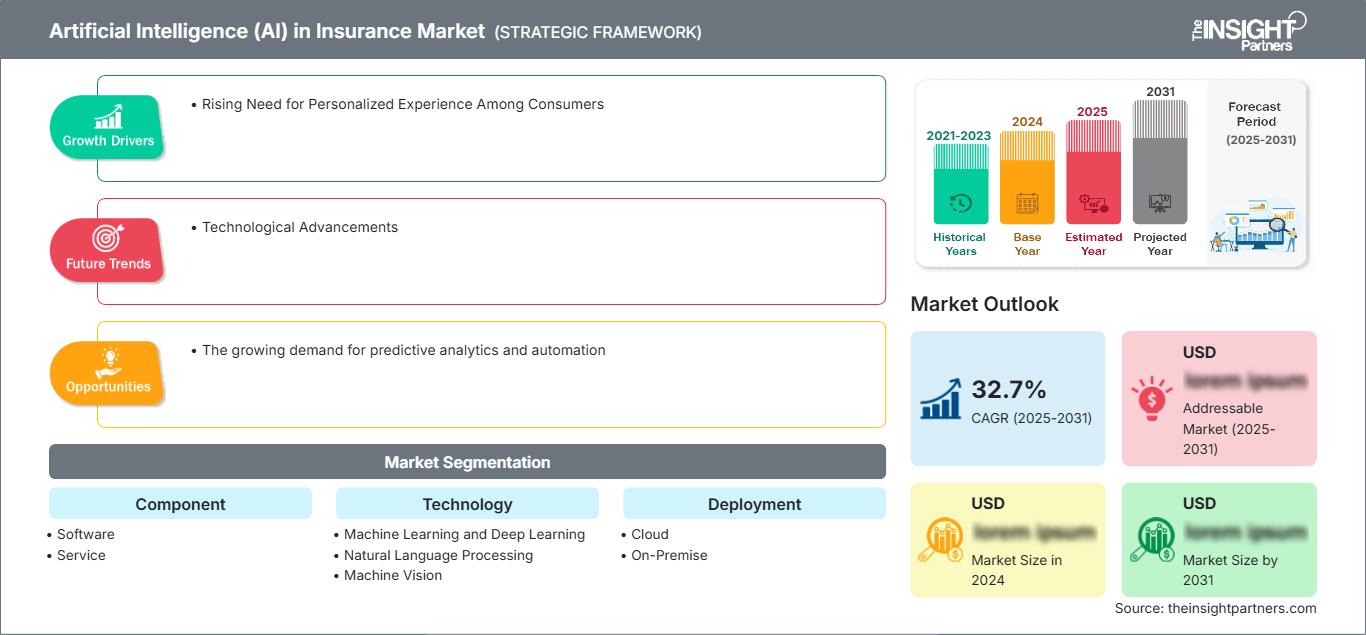
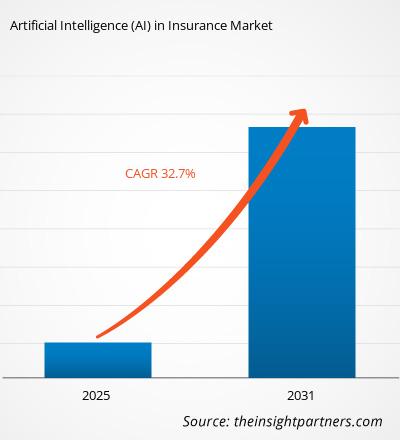
The artificial intelligence in insurance market was valued at US$ 5.13 Billion in 2025 and is projected to reach US$ 76.98 Billion by 2034, growing at a CAGR of 35.11 % during 2026–2034. Insurers are adopting AI to automate claims, improve underwriting precision, detect fraud, strengthen risk controls, and deliver faster digital customer support across life, health, property, casualty, and commercial insurance lines.
North America is advancing rapidly as insurers modernize core systems, adopt cloud-based analytics, and embed AI into claims and service workflows. The artificial intelligence in insurance market size is supported by a mature digital insurance infrastructure, regulatory attention to algorithmic governance, and high investment in fraud analytics. The region is expected to grow at a CAGR range of 32.0–35.0% during 2026–2034.
Artificial Intelligence (AI) in Insurance Market Assessment and Insights
- North America held a 38–41% share in 2025 and is growing at a CAGR range of 32.0–35.0% during 2026–2034, supported by claims automation, fraud analytics, and cloud insurance modernization.
- US represented 80–84% of North America in 2025 and is growing at a CAGR range of 33.0–36.0%, led by large carriers, insurtech adoption, and regulatory focus on AI governance.
- Europe accounted for a 24–27% share in 2025 and is growing at a CAGR range of 30.0–33.0%, with the UK, Germany, France, Italy, and Spain advancing AI-led insurance transformation.
- Asia Pacific captured a 25–28% share in 2025 and is growing at a CAGR range of 36.0–39.0%, led by China, Japan, South Korea, India, and Australia.
- Largest Segment: Software held a 64–67% market share in 2025 and is growing at a CAGR range of 34.0–37.0%, reflecting demand for predictive analytics, claims platforms, and fraud detection tools.
- High Growth Segment: Claims Management held a 35–38% market share in 2025 and is growing at a CAGR range of 38.0–41.0%, supported by document automation, image analysis, and faster settlement workflows.
- Key companies analyzed in detail: Amazon Web Services, Inc., Avaamo, Cape Analytics, LLC, IBM Corporation, Microsoft Corporation, Shift Technology, Wipro Limited, Avenga International GmbH, SAS Institute Inc., and OpenText Corporation.
Source: The Insight Partners' analysis based on proprietary research, government publications, company annual reports, investor presentations, industry databases, and expert interviews.
Insurance AI has moved from narrow fraud scoring and rule-based automation toward integrated platforms that process documents, images, voice records, claims histories, and third-party risk data. The artificial intelligence in insurance market is evolving as carriers connect machine learning, natural language processing, machine vision, and robotic automation with policy administration, claims, customer support, and compliance systems.
Future growth will depend on explainable AI, data governance, cloud migration, and regulator-ready model documentation. Emerging geographies are digitizing distribution and claims service, creating demand for scalable insurance intelligence. Investment is likely to favor vendors that can improve accuracy and operating speed while preserving human oversight in complex underwriting, medical review, and disputed claims decisions.
Artificial Intelligence (AI) in Insurance Market Report Scope
| Report Attribute | Details |
|---|---|
| Market size in 2025 | US$ 5.13 Billion |
| Market Size by 2034 | US$ 76.98 Billion |
| Global CAGR (2026 - 2034) | 35.11% |
| Historical Data | 2021-2024 |
| Forecast period | 2026-2034 |
Artificial Intelligence (AI) in Insurance Market Analysis
Demand is rising because insurers must process larger volumes of policyholder data, climate exposure data, medical records, property imagery, and customer interactions. Artificial intelligence in insurance market growth is reinforced by pressure to reduce claims leakage, shorten cycle times, and improve risk pricing. AI also helps carriers identify suspicious claim patterns that manual review teams may miss.
The ecosystem includes cloud providers, insurance software vendors, data science specialists, automation providers, consulting firms, and carrier technology teams. Artificial intelligence in insurance market analysis shows that value is shifting toward integrated platforms that combine data ingestion, model training, workflow orchestration, compliance review, and customer engagement. Buyers prefer solutions that connect with legacy policy and claims systems.
Competitive positioning is determined by the leaders in infrastructure and domain expertise. Amazon Web Services, Inc. and Microsoft Corporation are leaders in providing scalable cloud AI infrastructures, whereas IBM Corporation and SAS Institute Inc. focus on enterprise analytics and governance. Shift Technology, Cape Analytics, LLC, Avaamo, OpenText Corporation, Wipro Limited, and Avenga International GmbH specialize in fraud detection, property intelligence, conversational AI, content management, implementation, and insurance software engineering.
The investment areas are shifting towards generative AI assistants, claims intake automation, underwriting workbenches, compliance monitoring, and low-code insurance automation. The differentiation factors among vendors include explainability, deep integration capabilities, security features, and pre-built insurance solutions. Insurance carriers are also employing implementation partners to redesign their workflows because AI's value stems from process changes, not algorithm performance.
● REPORT CUSTOMIZATION
Tailor This Report To Align With Your Specific Business Requirements
This report can be customized to align precisely with your business objectives, scope, and target markets. Customization options include tailored segmentation, geography, competitive analysis, and strategic insights to support informed decision-making.
Customize This Report →WHAT YOU CAN ADJUST
- ● Segmentations
- ● Geography
- ● Competitive Analysis
- ● Language Preferences
Artificial Intelligence (AI) in Insurance Market: Strategic Insights
Regional Insights
North America artificial intelligence in insurance market
North America held a 38–41% share in 2025 and is projected to grow at a CAGR range of 32.0–35.0% during 2026–2034. The artificial intelligence in insurance market share is supported by large carrier technology budgets, advanced cloud adoption, and mature use of analytics in claims, underwriting, and fraud detection.
Regulatory guidance is making explainability and governance more important, especially for pricing, underwriting, and health-related decisions. Carriers are adopting AI to speed first notice of loss, triage claims, identify suspicious activity, and improve customer service. Strong company presence from Amazon Web Services, Inc., Microsoft Corporation, IBM Corporation, SAS Institute Inc., and Shift Technology supports regional deployment.
U.S. artificial intelligence in insurance Market
The U.S. represented 80–84% of North America Artificial Intelligence in Insurance Market in 2025 and is expected to grow at a CAGR range of 33.0–36.0%. Insurers with sizable portfolios of property, casualty, health, and life policies are deploying artificial intelligence in their processes of underwriting, prediction of claims severity, fraud detection, and chatbot-based customer interaction.
The need for application is particularly high in those companies that have a large number of claims, are exposed to lawsuits, and need to upgrade their digital capabilities. Regulations are also influencing the buying process as carriers need to incorporate human intervention, track and document models.
Europe artificial intelligence in insurance Market
Europe accounted for a 24–27% share of the Artificial Intelligence in Insurance Market in 2025 and is growing at a CAGR range of 30.0–33.0%. UK leadership in the insurance sector is shown through innovations in insurtech, specialty insurance analytics, and claims management. While in Germany, the areas of interest for AI involve risk modeling, product compliance, and operations automation in both life and non-life insurers. AI application in France, Italy, and Spain is growing in applications such as fraud detection, service automation, and claim documents processing. Europe pays more attention to data privacy, explainability, and customer fairness, which makes governance technologies more common in suppliers' portfolios.
APAC artificial intelligence in insurance Market
Asia Pacific Artificial Intelligence in Insurance Market held a 25–28% share in 2025 and is projected to grow at a CAGR range of 36.0–39.0%. China leads regional adoption through digital insurance ecosystems, mobile platforms, and AI-enabled distribution. Japan and South Korea focus on claims support and service automation.
India and Australia are expanding AI in health claims, motor insurance, and compliance workflows. Growth is supported by rising insurance penetration, mobile-first customer engagement, and large unstructured data volumes. Carriers use AI to reduce turnaround time, improve fraud detection, and scale service without proportional headcount increases.
Middle East & Africa artificial intelligence in insurance Market
The Middle East & Africa Artificial Intelligence in Insurance Market is projected to grow at a CAGR range of 27.0–30.0% during 2026–2034. The adoption by the UAE and Saudi Arabia is characterized by digital insurance solutions, smart mobility, and the modernization of the financial sector. Conversely, support from South Africa comes in the form of analytical fraud detection and health insurance.
Adoption in the region appears to be higher where insurers need quick claims management and more visibility into risks of motor, health, and commercial lines. Some of the obstacles that stand in the way include fragmentation of data and lack of expertise; this provides an opening for local implementation of AI.
Segmentation Analysis
Component
Component is expected to grow at a CAGR range of 34.0–37.0% during 2026–2034. The artificial intelligence in insurance market scope across components is widening as carriers combine software platforms with services for integration, governance, model validation, and change management. Software leads because insurers need tools that can ingest documents, images, claims records, and policyholder data.
- Software dominates spending because carriers require predictive analytics, automated claims tools, fraud detection engines, conversational assistants, and workflow orchestration integrated with policy and billing systems.
- Service demand is increasing as insurers need consulting, data preparation, model tuning, system integration, compliance support, and employee training to operationalize AI safely.
Technology
Technology is projected to grow at a CAGR range of 35.0–38.0% during 2026–2034. Insurance use cases require a combination of analytical, language, vision, and automation capabilities because carriers manage structured policy data as well as unstructured documents, photographs, voice transcripts, and correspondence.
- Machine Learning and Deep Learning allow for the provision of risk scoring, fraud pattern recognition, pricing assistance, claim severity prediction, and underwriting guidance through the analysis of historic and live datasets.
- Natural Language Processing assists in the interpretation of claim documents, legal papers, emails, phone calls, customer communications, and policy wording to accelerate reviews and minimize manual reading.
- Machine Vision assists in assessing properties, vehicles, and damages from imagery and drone imagery to help insurance companies better evaluate their claims and underwriting.
- Robotic Automation allows for repetitive back office processes to be automated, including data entry, document handling, payments, checks, and policy processing, while AI improves decisions.
Deployment
Deployment is expected to grow at a CAGR range of 33.0–36.0% during 2026–2034. Cloud adoption is increasing because insurers need scalable processing for claims spikes and model experimentation, while on-premise deployment remains relevant for sensitive workloads and strict internal data controls.
- Cloud supports elastic analytics, faster model deployment, disaster-event claims scaling, and API-based integration with external data, insurtech tools, and customer engagement platforms.
- On-Premise remains important for insurers with strict data residency, legacy system dependence, or sensitive underwriting and health data that require tighter internal infrastructure control.
Application
Application is projected to grow at a CAGR range of 36.0–39.0% during 2026–2034. Claims management leads near-term value because it directly affects expense ratios, settlement speed, fraud leakage, and customer satisfaction. Risk and compliance adoption is also rising as regulators scrutinize automated decision systems.
- Claims Management uses AI to capture first notice of loss, classify documents, detect damage, recommend reserves, identify fraud signals, and route complex cases to specialists.
- Risk Management and Compliance applies AI to monitor regulatory obligations, model risk, customer fairness, cyber exposure, catastrophe indicators, and portfolio-level underwriting performance.
- Chatbots support policy queries, claim status updates, quote assistance, payment reminders, and service triage, improving availability while reducing routine contact center workload.
Opportunity Snapshot
| Application | Revenue Contribution | Trend Tag | Adoption Stage |
| Claims Management | High | Claim Triage | Mature |
| Risk Management and Compliance | High | Model Governance | Scaling |
| Chatbots | Medium | Service AI | Scaling |
Artificial Intelligence (AI) in Insurance Market Growth Drivers and Impact Analysis
Need for Faster and More Accurate Claims Handling
Claim processing is one of the main expenses and experience driving costs for insurers since inefficiencies such as delays, leakage, and non-standard review could result in loss of profits and client trust. The technology facilitates faster handling of claims, triaging, data extraction, picture evaluation, fraud detection, and reserve estimates. This effect is most visible in the sectors of auto, property, and health insurance, in which volumes are significant and documentation comes in various forms. According to a 2025 study sponsored by SAS, AI agents will collaborate with human staff in claim, underwriting, and product areas.
Rising Fraud, Compliance, and Model Governance Pressure
Insurance fraud and regulatory scrutiny are rising at the same time that carriers are increasing digital service. AI helps detect abnormal claim behavior and enables more consistent compliance monitoring, but it also creates a need for model documentation, bias testing, and explainability. This driver is especially important in health, life, pricing, and underwriting decisions where automated outputs can affect customers materially. Carriers are therefore investing in platforms that combine accuracy with auditability, allowing business teams, compliance officers, and regulators to understand how decisions are supported.
Cloud Modernization of Legacy Insurance Systems
There are many insurers who still depend on their old policy management, billing, and claims systems, thus hindering the uptake of analytics. The cloud helps in ensuring that data is processed in bulk, integrating outside data sources, running machine learning pipelines, and developing digital service offerings quickly. This can be seen when there are catastrophes and large claim events, where the elasticity of cloud infrastructure helps in quick processing and analysis. Cloud AI helps carriers to implement use cases without having to redesign their core systems completely.
Artificial Intelligence (AI) in Insurance Market Future Trends
Agentic AI for Insurance Workflows
Artificial intelligence in the insurance market trends point toward AI agents that can perform multi-step insurance tasks under human supervision. Future systems will be able to summarize claim file information, identify evidence requirements, draft replies for customers, suggest subsequent action, and manage workflow queues. While human adjusters, underwriters, and compliance officers will still be making the decisions, routine coordination will become increasingly automated. Vendors offering permission control, audit logs, explainability, and integration with claims/policy management systems will see greater adoption rates.
Risk Prevention Through Connected and External Data
AI will become a powerful tool used by insurers in preventing losses instead of simply handling claims when losses have already been incurred. Data gathered using the connected vehicle technology, pictures of the property, weather data, cyber risks, health data, and the Internet of Things (IoT) can assist the carriers in detecting the risk indicators before it is too late.
Artificial Intelligence (AI) in Insurance Market Opportunities
Governed AI Platforms for Regulated Insurance Decisions
Artificial intelligence in insurance market Forecasts highlight a strong opportunity for platforms that combine automation with risk controls. Insurers need AI to accelerate decisions, but regulators and customers require explainability, fairness, privacy, and human oversight. Vendors can capture demand by offering model monitoring, bias testing, audit trails, and plain-language decision support. This opportunity is strongest for underwriting, claims denial review, health insurance, and pricing applications where opaque algorithms could create compliance and reputational exposure.
AI Claims Modernization for Mid-Sized Carriers
Insurers of mid-level size encounter similar complexities with respect to claims processing as large insurance companies but without having large AI engineering teams in place. Packaged claim automation, managed rollout, and cloud analytics can be used for modernizing such insurers without rebuilding whole core estates. The case is interesting because there is a tangible result that can pay off the investment in phases. For instance, vendors can make use of workflow configurations and insurance templates.
Frequently Asked Questions

- Comprehensive Market Sizing and Forecast Analysis
- Detailed Segmentation Analysis
- In-Depth Market Dynamics Assessment
- Regional and Country-Level Insights
- Competitive Landscape and Company Benchmarking
- Strategic Business Intelligence
Recent Reports
Testimonials

The Insight Partners provided valuable market intelligence that supported our global go-to-market strategy. Their team was professional, responsive, and attentive to our feedback, providing thoughtful analysis and helpful methodological clarifications throughout the project.
Junmo Kim Chief Financial Officer (CFO), Enertech Co., Ltd.
The Insight Partners' SCADA System Market report is comprehensive, with valuable insights on current trends and future forecasts. The team was highly professional, responsive, and supportive throughout. We are very satisfied and highly recommend their services.
RAN KEDEM Partner, Reali Technologies LTDs
I requested a report on a very specific software market and the team produced the report in a few days. The information was very relevant and well presented. I then requested some changes and additions to the report. The team was again very responsive and I got the final report in less than a week.
JEAN-HERVE JENN Chairman, Future Analytica
We worked with The Insight Partners for an important market study and forecast. They gave us clear insights into opportunities and risks, which helped shape our plans. Their research was easy to use and based on solid data. It helped us make smart, confident decisions. We highly recommend them.
PIYUSH NAGPAL Sr. Vice President, High Beam Global
The Insight Partners delivered insightful, well-structured market research with strong domain expertise. Their team was professional and responsive throughout. The user-friendly website made accessing industry reports seamless. We highly recommend them for reliable, high-quality research services
YUKIHIKO ADACHI CEO, Deep Blue, LLC.
This is the first time I have purchased a market report from The Insight Partners.While I was unsure at first, I visited their web site and felt more comfortable to take the risk and purchase a market report.I am completely satisfied with the quality of the report and customer service. I had several questions and comments with the initial report, but after a couple of dialogs over email with their analyst I believe I have a report that I can use as input to our strategic planning process.Thank you so much for taking the extra time and making this a positive experience.I will definitely recommend your service to others and you will be my first call when we need further market data.
JOHN SUZUKI President and Chief Executive Officer, Board Director, BK Technologies
I wish to appreciate your support and the professionalism you displayed in the course of attending to my request for information regarding to infectious disease IVD market in Nigeria. I appreciate your patience, your guidance, and the fact that you were willing to offer a discount, which eventually made it possible for us to close a deal. I look forward to engaging The Insight Partners in the future, all thanks to the impression you have created in me as a result of this first encounter.
DR CHIJIOKE ONYIA MANAGING DIRECTOR, PineCrest Healthcare Ltd.Reason to Buy
- Informed Decision-Making
- Understanding Market Dynamics
- Competitive Analysis
- Identifying Emerging Markets
- Customer Insights
- Market Forecasts
- Risk Mitigation
- Boosting Operational Efficiency
- Strategic Planning
- Investment Justification
- Tracking Industry Innovations
- Aligning with Regulatory Trends





 Get Free Sample for