
Automated Feeding Systems Market Growth, Demand & Size by 2034
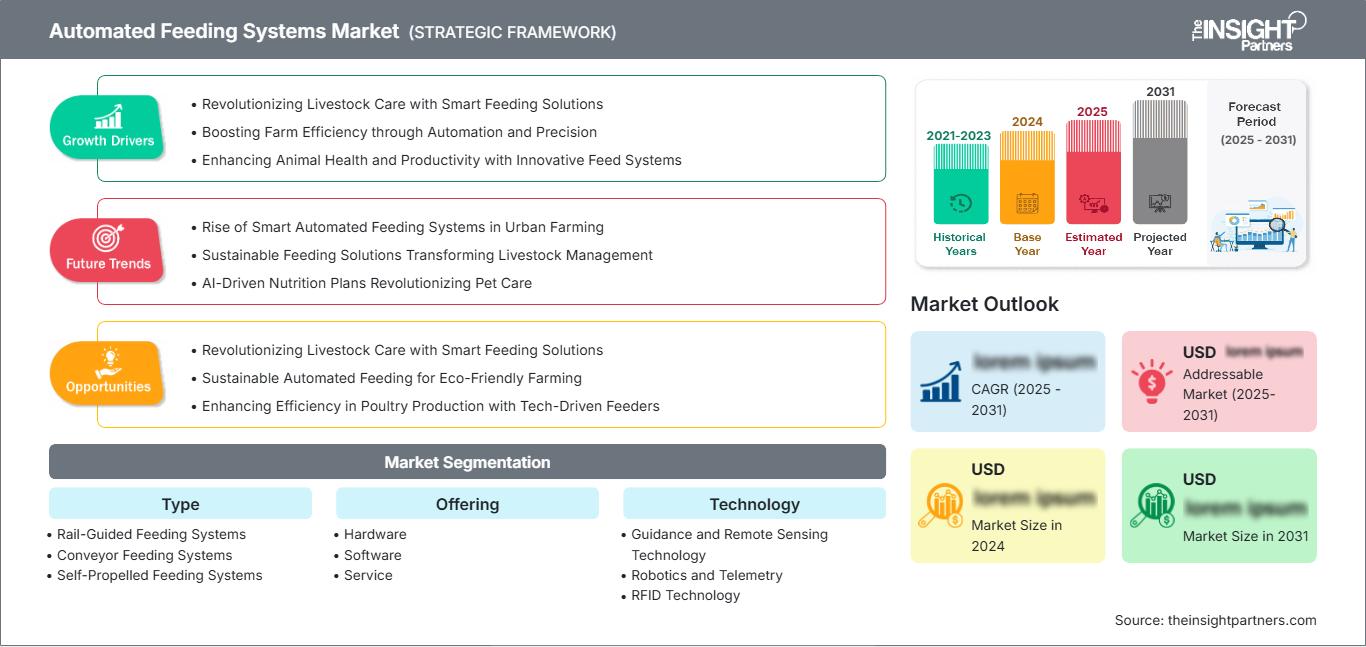
Coverage: by Type (Rail-Guided Feeding Systems, Conveyor Feeding Systems, and Self-Propelled Feeding Systems); Offering (Hardware, Software, and Service); Technology (Guidance and Remote Sensing Technology, Robotics and Telemetry, RFID Technology, and Others); and Livestock (Ruminants, Swine, Poultry, and Others), and Geography (North America, Europe, Asia Pacific, and South and Central America)
- Status : Data Released
- Report Code : TIPRE00003290
- Category : Electronics and Semiconductor
- No. of Pages : 150
- Available Report Formats :


- Last update date : July 28, 2026


2025 Market Size
US$ 7.51 Bn
Base year value
2034 Forecast
US$ 12.65 Bn
Projected by 2034
CAGR 2026-2034
5.97 %
Growth rate
Addressable Market
US$ 91.34 Bn
(2026-2034)
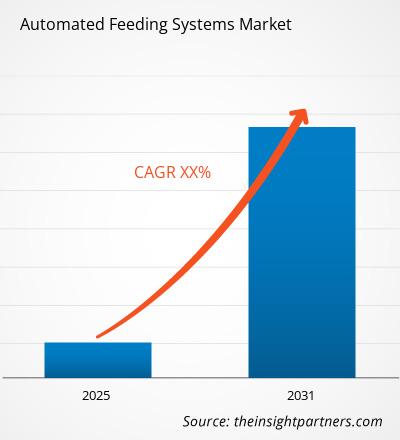
The Automated Feeding Systems Market is projected to grow from US$ 7.51 Billion in 2025 to US$ 12.65 Billion by 2034, registering a CAGR of 5.97% during 2026–2034. Adoption is expanding as livestock producers automate ration preparation, mixing, distribution, and feed monitoring to improve consistency, animal productivity, labor utilization, and feed conversion across dairy, swine, and poultry production systems.
North America remains a high-value adoption zone, with the Automated Feeding Systems Market size supported by dairy consolidation, skilled labor shortages, and farm-level digitization. The region is expected to advance at a 5.4–5.9% CAGR during 2026–2034, led by automated TMR distribution, robotic feed pushing, and connected herd-management platforms that help producers control feed losses and stabilize output.
Automated Feeding Systems Market Assessment and Insights
- North America accounted for 31–34% share in 2025 and is projected to grow at a CAGR of 5.4–5.9% between 2026–2034, supported by dairy automation, feed-cost control, and large-herd consolidation.
- US represented 74–78% of North America in 2025 and is expected to grow at a CAGR of 5.3–5.8% between 2026–2034, driven by labor substitution and precision dairy investments.
- Europe held 27–30% share in 2025 and is forecast to grow at a CAGR of 5.1–5.6% between 2026–2034, led by Germany, the Netherlands, France, Denmark, and the UK.
- Asia Pacific captured 22–25% share in 2025 and is expected to grow at a CAGR of 6.6–7.2% between 2026–2034, with China, Japan, India, South Korea, and Australia scaling automated livestock systems.
- Largest Segment Hardware held 58–62% market share in 2025 and is projected to grow at a CAGR of 5.3–5.8% during 2026–2034 as farms prioritize robots, mixers, bunkers, and conveyors.
- High Growth Segment Software held 16–19% market share in 2025 and is forecast to grow at a CAGR of 7.1–7.8% during 2026–2034 as analytics, ration optimization, and remote monitoring gain adoption.
- Key companies analyzed in detail: Afimilk Ltd., AgroLogic Ltd., BouMatic LLC, DeLaval Inc., GEA Group Aktiengesellschaft, Lely International N.V., Pellon Group Oy, Trioliet B.V., Valmetal Group, VDL Agrotech B.V.
Source: The Insight Partners' analysis based on proprietary research, government publications, company annual reports, investor presentations, industry databases, and expert interviews.
Livestock feeding automation has come a long way from being just an automated delivery system to becoming an advanced system that weighs feeds, mixes the rations, schedules feedings, and records consumption data. The Automated Feeding Systems Market is now developing due to features such as robotic mobility, feed-consumption sensing, and software-based feed rationing. Dairy farms continue to be the first adopters due to the significant operating costs associated with feed, whereas swine and poultry farms increasingly use automation for delivery and nutrition control.
The future growth will depend on farm extension in Asia Pacific, modernization subsidies in Europe, and labor shortages in North America. The investments are now directed toward platforms that can be installed in existing barns without any civil works. There is also interest in technologies related to the regulation of issues related to animal welfare, feed traceability, and nutrient efficiency.
Automated Feeding Systems Market Report Scope
| Report Attribute | Details |
|---|---|
| Market size in 2025 | US$ 7.51 Billion |
| Market Size by 2034 | US$ 12.65 Billion |
| Global CAGR (2026 - 2034) | 5.97% |
| Historical Data | 2021-2024 |
| Forecast period | 2026-2034 |
Automated Feeding Systems Market Analysis
The Automated Feeding Systems Market growth is linked to rising herd sizes, higher feed costs, and the need for consistent ration delivery. Automation is being applied to minimize variability of feeding, eliminate refusals, and allow small feeds in many operations. Automated systems that combine weighing, mixing, distributing, and pushing of the ration will help to keep better control of the process in cases when there is a shortage of labor and feeding is a critical factor of milk production, growth, and flock homogeneity.
The ecosystem consists of machine makers, barn integrators, nutritionists, software companies, distributors, and technicians. Dynamics of supply favors the suppliers who can provide robust hardware together with adequate technical support, since downtime impacts the animals’ regimen promptly. Self-propelled electric and rail-guided feeding machines are preferred where energy efficiency, repeatability, and reduction of diesel consumption become evident.
The Automated Feeding Systems Market analysis shows competition centered on system reliability, herd-management integration, and service coverage. DeLaval Inc., GEA Group Aktiengesellschaft, and Lely International N.V. differentiate through their use of robotics and technology ecosystem, whereas Trioliet B.V., Pellon Group Oy, Valmetal Group, and VDL Agrotech B.V. enhance their offerings related to specialized feed, mixing, and distribution systems.
Positioning has become more technology-, prevention-, and adaptation-driven than equipment-based. Afimilk Ltd., AgroLogic Ltd., and BouMatic LLC bring added value to their businesses through services such as monitoring, herd analytics, and automation system packages. It appears investors are focusing on scalable solutions where feed data can be combined with animal metrics.
● REPORT CUSTOMIZATION
Tailor This Report To Align With Your Specific Business Requirements
This report can be customized to align precisely with your business objectives, scope, and target markets. Customization options include tailored segmentation, geography, competitive analysis, and strategic insights to support informed decision-making.
Customize This Report →WHAT YOU CAN ADJUST
- ● Segmentations
- ● Geography
- ● Competitive Analysis
- ● Language Preferences
Automated Feeding Systems Market: Strategic Insights
Regional Insights
North America Automated Feeding Systems Market
North America held 31–34% share in 2025, reflecting high mechanization, larger dairy herd sizes, and advanced dealer networks. The market will grow at a 5.4%-5.9% CAGR in the period 2026-2034. Automatic feeding systems can be seen in use in dairy farms using TMR systems, robotized feed pushers, and ratio management software.
In North America, the Automated Feeding Systems Market share will be fueled by the continuous labor shortage on farms and feed efficiency. The consolidation of the dairy farming industry reported by the USDA will further drive the need for systems that can run effectively in large barns. The most effective will be those in which the farmers see improvements in refusals and feeding frequency.
U.S. Automated Feeding Systems Market
The U.S. accounted for 74–78% of North America in 2025 and is expected to grow at a 5.3–5.8% CAGR through 2034. Adoption is common within dairy-based states where mechanized feeding enables large herds, multiple barns, and the consistent distribution of rations among lactating, dry, and young animals.
Companies are represented by the Lely International N.V., DeLaval Inc., GEA Group Aktiengesellschaft, BouMatic LLC, Valmetal Group, and dealer-installed systems. Adoption trends involve robotic feed mixing equipment, automated calf feeders, feed pushers, and dashboard controls to allow managers to relate ration adjustments to milk production and feed consumption.
Europe Automated Feeding Systems Market
Europe represented 27–30% share in 2025 and is forecast to grow at a 5.1–5.6% CAGR during 2026–2034. Germany leads the market owing to its adoption of advanced dairy equipment, emphasis on energy efficiency, and modernization of farms. Other countries like the Netherlands and Denmark also continue to be benchmarks for robotic barn systems.
In the UK, the market is influenced by the shortage of labor, fluctuating feed prices, and an interest in automation systems that can be integrated into existing sheds. Germany has a manufacturing base for equipment along with high adoption rates for precise dairy equipment. There is selective adoption in France, Italy, and Spain, especially in commercial dairies.
APAC Automated Feeding Systems Market
Asia Pacific held 22–25% share in 2025 and is expected to post a 6.6–7.2% CAGR through 2034. China holds the top spot with help from scale farming, dairy modernization, and digital agriculture. Japan and South Korea employ automation to mitigate shortage of labor, whereas Australia emphasizes efficiency in the dairy production system which is associated with pasture.
While India lags behind in terms of adoption, the country represents a future opportunity with increasing organization within dairy and poultry production units. The reasons for industrial push come in the form of larger integrated farms, temperature stress reduction, and reliable feed conversion.
Middle East & Africa Automated Feeding Systems Market
Middle East & Africa is projected to grow at a 5.8–6.4% CAGR during 2026–2034, with Saudi Arabia leading adoption among large dairy complexes and food-security-driven livestock investments. In terms of feed delivery technology, the UAE is keen on automating their controlled environment farms, while in South Africa there is interest from commercial dairies that want regular ration distribution.
Conditions of energy and infrastructure dictate purchasing decisions in the region. Electric feeders, reliable conveyors, and monitoring systems become popular in areas with issues of heat, reliance on labor, and feed transportation affecting their production. Adoption in RoMEA countries is partial but large-scale farms are now considering automation to reduce wastage of feed and improve production.
Segmentation Analysis
Type
The Type segment is expected to grow at a 5.7–6.2% CAGR during 2026–2034. The Automated Feeding Systems Market scope across type is defined by barn layout, herd size, route flexibility, and feeding frequency. Rail-guided units suit predictable paths, conveyors support fixed distribution, and self-propelled feeders fit farms requiring flexible multi-zone delivery.
- Rail-Guided Feeding Systems remain important in structured dairy barns where repeatable routes, controlled mixing points, and predictable feeding alleys support operational efficiency and lower navigation complexity.
- Conveyor Feeding Systems serve farms needing stationary, continuous, or scheduled feed movement, especially where building layouts favor belt distribution and lower-mobility hardware over robotic units.
- Self-Propelled Feeding Systems are strategically significant for multi-barn operations because they navigate independently, support variable routes, and enable more frequent delivery without tractor dependence.
Offering
The Offering segment is projected to grow at a 5.9–6.4% CAGR during 2026–2034. Hardware currently anchors spending because feeding robots, mixers, conveyors, bunkers, and sensors require upfront capital. Software and services are gaining importance as farms demand remote diagnostics, ration analytics, preventive maintenance, and performance benchmarking over the full equipment lifecycle.
- Hardware held the largest position as producers prioritize reliable machines, durable mixing systems, and automated distribution assets that directly reduce labor and improve feed delivery consistency.
- Software is expanding as dashboards, recipe management, feed intake tracking, and remote alerts convert feeding equipment into decision-support platforms for managers and nutritionists.
- Service remains essential because installation quality, training, preventive maintenance, and rapid repair response strongly influence uptime, producer confidence, and system replacement decisions.
Technology
The Technology segment is forecast to grow at a 6.0–6.7% CAGR during 2026–2034. Guidance systems, telemetry, robotics, and identification technologies are converging to improve navigation safety, feed accuracy, and animal-level decision making. Demand is shifting toward platforms that can connect feeding activity with health, productivity, and inventory data.
- Guidance and Remote Sensing Technology supports route planning, obstacle detection, feed-height monitoring, and remote supervision, making it central to reliable robotic operation in complex barns.
- Robotics and Telemetry enables autonomous mixing, distribution, alerts, and performance tracking, helping producers manage larger livestock populations with fewer manual interventions.
- RFID Technology remains important where feeding systems connect animal identity, ration access, and herd-management records to improve nutritional precision and traceability.
Livestock
The Livestock segment is expected to grow at a 5.8–6.3% CAGR during 2026–2034. Ruminants dominate adoption because dairy feeding requires frequent ration adjustment, group-specific nutrition, and careful feed intake management. Swine and poultry demand is rising as integrators seek standardized feeding, better growth uniformity, and lower manual handling across larger production sites.
- Ruminants remain the core livestock category because dairy farms benefit directly from frequent fresh feed, controlled TMR preparation, and links between nutrition and milk performance.
- Swine adoption is driven by precision dosing, batch consistency, and automated delivery systems that reduce labor while supporting stage-based feeding programs.
- Poultry producers use automated feeding to improve flock uniformity, reduce wastage, and maintain consistent feed availability across high-density production environments.
Opportunity Snapshot
| Livestock | Revenue Contribution | Trend Tag | Adoption Stage |
| Ruminants | High | Precision TMR | Mature |
| Swine | Medium | Batch Feeding | Scaling |
| Poultry | Medium | Flock Uniformity | Scaling |
Automated Feeding Systems Market Growth Drivers and Impact Analysis
Labor Shortages Accelerate Robotic Feeding Adoption
Livestock feeding operations are routine, time-bound, and strenuous, thus offering some of the most evident opportunities for automation in commercial agricultural settings. As labor becomes increasingly scarce in rural settings, there is a shift from manual feed distribution using tractors to automatic machines capable of mixing and dispensing feed at regular intervals. The benefits are not only functional but also procedural since it allows the management to shift the labor force from feeding activities to the care of the herds, reproductive services, maintenance work, and record keeping.
Feed Efficiency Becomes a Board-Level Cost Priority
Feeds are the highest costs in animal farming, and therefore any improvement in feed ration formulation and efficiency will make a difference to the bottom line. Automation measures feeds, regulates their mixing, and distributes feeds in smaller quantities, thus reducing the amount of refuse and improving dry matter intake control. The Automated Feeding Systems Market gains from the ability of producers to relate data from systems to milk output, weight gain, or flock productivity. This offers a better rationale for investing than simply labor savings. As feed prices remain volatile, automation is judged on payback, consumption measurement, and loss prevention.
Connected Barns Improve Nutrition and Welfare Oversight
Digital barns are moving feeding from a standalone task to a connected management process. RFID, telemetry, feed-height sensors, and herd platforms allow producers to monitor whether animals receive the right ration at the right time. This improves early detection of consumption changes that may indicate health, heat stress, or grouping issues. Welfare expectations also favor consistent access to fresh feed and fewer disruptions in daily routines. For suppliers, the market impact is a shift toward integrated systems that combine equipment, software, and service agreements. Buyers increasingly prefer platforms that create records for nutrition, traceability, and compliance discussions.
Automated Feeding Systems Market Future Trends
AI-Based Ration Optimization Moves Into Daily Operations
The next phase of Automated Feeding Systems Market trends will be defined by software that adjusts feeding decisions using intake, milk, weight, and health signals. Rather than only executing fixed recipes, systems will recommend ration changes, feeding frequency, and group adjustments based on real-time performance. This trend will require stronger data interoperability between feeding equipment, milking systems, farm management software, and nutrition advisors. Producers are likely to adopt AI cautiously, but decision-support tools that reduce feed waste and stabilize output will gain credibility as field results accumulate.
Electric and Modular Platforms Redefine Farm Retrofitting
Electric self-propelled feeders and modular feed kitchens will become more attractive as farms seek automation without rebuilding barns. Battery-powered systems reduce diesel use, noise, and indoor emissions, while modular designs allow staged investment. This is important for mid-sized farms that cannot justify large civil works but still need consistent feeding. Suppliers that simplify installation, charging, route mapping, and service access will expand the addressable customer base. The trend also supports sustainability reporting because farms can document lower fuel consumption and more controlled feed distribution practices.
Automated Feeding Systems Market Opportunities
Retrofit Packages for Mid-Sized Dairy Farms
Mid-sized dairy farms represent a practical expansion opportunity because many face labor pressure but hesitate to fund full barn redesigns. Suppliers can address this gap with retrofit packages that combine compact feeders, flexible loading options, route mapping, and subscription-based monitoring. Financing models tied to labor savings, diesel reduction, and lower refusals would make adoption easier. Dealers can strengthen conversion by offering site audits that identify bottlenecks before equipment selection. The opportunity is strongest where farms already use robotic milking or digital herd tools, because feeding automation can be positioned as the next operational integration layer.
Data Services for Nutrition Benchmarking
Recurring data services can expand revenue beyond equipment sales by helping producers benchmark ration accuracy, feed consumption, leftovers, and production response. Nutritionists and farm managers need reliable records to compare ingredient changes, group performance, and seasonal intake shifts. Vendors that convert machine data into clear recommendations can build long-term service relationships and reduce price competition on hardware. This opportunity also supports enterprise customers operating multiple farms, because standardized dashboards enable cross-site comparisons. As connected feeding systems mature, analytics subscriptions could become a meaningful differentiator in the Automated Feeding Systems Market.
Recent Developments
- June 2025: Yanmar Holdings Co., Ltd., FOOD & LIFE COMPANIES LTD. (F&LC) and Owasebussan Co., Ltd. have officially launched a joint demonstration test in June 2025 to promote sustainability in aquaculture through the use of a remote automated feeding system for farmed yellowtail (Buri).
- May 2025: ABB has been selected to supply automation and electrical systems by animal nutrition and health specialist dsm-firmenich, as part of a project to develop a cattle feed additive production facility at Dalry, 40 kilometers west of Glasgow in Scotland, to support methane reduction goals in the livestock sector. ABB’s solutions will improve engineering efficiency, operator effectiveness and asset utilization.
- March 2025: Jetfeeder, a global leader in aquaculture technology, has introduced its new Nursery Edition Automatic Feeder, developed to deliver precise and consistent feeding for shrimp during the critical nursery phase. Purpose-built for hatchery and nursery operations, the Nursery Edition can support up to 500,000 shrimp per unit and is compatible with feed particle sizes ranging from 0.3 to 1.2 mm. This helps improve growth uniformity, optimize feed conversion, and reduce feed waste.
Frequently Asked Questions

- Comprehensive Market Sizing and Forecast Analysis
- Detailed Segmentation Analysis
- In-Depth Market Dynamics Assessment
- Regional and Country-Level Insights
- Competitive Landscape and Company Benchmarking
- Strategic Business Intelligence
Recent Reports
Testimonials

The Insight Partners' SCADA System Market report is comprehensive, with valuable insights on current trends and future forecasts. The team was highly professional, responsive, and supportive throughout. We are very satisfied and highly recommend their services.
RAN KEDEM Partner, Reali Technologies LTDs
I requested a report on a very specific software market and the team produced the report in a few days. The information was very relevant and well presented. I then requested some changes and additions to the report. The team was again very responsive and I got the final report in less than a week.
JEAN-HERVE JENN Chairman, Future Analytica
We worked with The Insight Partners for an important market study and forecast. They gave us clear insights into opportunities and risks, which helped shape our plans. Their research was easy to use and based on solid data. It helped us make smart, confident decisions. We highly recommend them.
PIYUSH NAGPAL Sr. Vice President, High Beam Global
The Insight Partners delivered insightful, well-structured market research with strong domain expertise. Their team was professional and responsive throughout. The user-friendly website made accessing industry reports seamless. We highly recommend them for reliable, high-quality research services
YUKIHIKO ADACHI CEO, Deep Blue, LLC.
This is the first time I have purchased a market report from The Insight Partners.While I was unsure at first, I visited their web site and felt more comfortable to take the risk and purchase a market report.I am completely satisfied with the quality of the report and customer service. I had several questions and comments with the initial report, but after a couple of dialogs over email with their analyst I believe I have a report that I can use as input to our strategic planning process.Thank you so much for taking the extra time and making this a positive experience.I will definitely recommend your service to others and you will be my first call when we need further market data.
JOHN SUZUKI President and Chief Executive Officer, Board Director, BK Technologies
I wish to appreciate your support and the professionalism you displayed in the course of attending to my request for information regarding to infectious disease IVD market in Nigeria. I appreciate your patience, your guidance, and the fact that you were willing to offer a discount, which eventually made it possible for us to close a deal. I look forward to engaging The Insight Partners in the future, all thanks to the impression you have created in me as a result of this first encounter.
DR CHIJIOKE ONYIA MANAGING DIRECTOR, PineCrest Healthcare Ltd.Reason to Buy
- Informed Decision-Making
- Understanding Market Dynamics
- Competitive Analysis
- Identifying Emerging Markets
- Customer Insights
- Market Forecasts
- Risk Mitigation
- Boosting Operational Efficiency
- Strategic Planning
- Investment Justification
- Tracking Industry Innovations
- Aligning with Regulatory Trends





 Get Free Sample for