
Automatic Train Control Market Growth, Size & Forecast by 2034
Coverage: By Service (Consulting, Integration and Deployment, Support and Maintenance); Automation (GOA 1, GOA 2, GOA3, GOA 4); Train Type (Metro Train, High-Speed Train, Passenger Train, Freight Train) , and Geography (North America, Europe, Asia Pacific, and South and Central America)
- Status : Data Released
- Report Code : TIPRE00004127
- Category : Electronics and Semiconductor
- No. of Pages : 150
- Available Report Formats :


- Last update date : July 17, 2026


2025 Market Size
US$ 4.00 Bn
Base year value
2034 Forecast
US$ 9.43 Bn
Projected by 2034
CAGR 2026-2034
10.01 %
Growth rate
Addressable Market
US$ 59.78 Bn
(2026-2034)
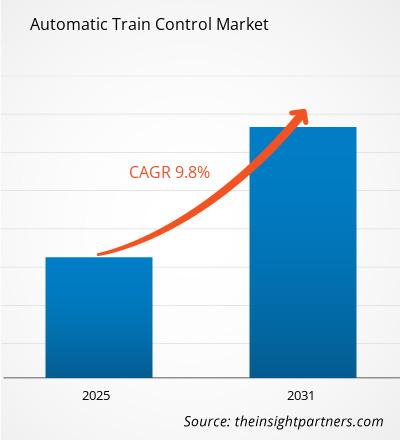
The Automatic Train Control Market was valued at US$ 4.00 billion in 2025 and is projected to reach US$ 9.43 billion by 2034, growing at a CAGR of 10.01% from 2026 to 2034. The market reflects rising deployment of digital signaling, automated supervision, train protection, and grade-of-automation upgrades across urban rail, metro, high-speed, mainline passenger, and freight networks.
Across North America, rail agencies are modernizing positive train control, metro signaling, and communications-based systems to improve safety, throughput, and service reliability. The Automatic Train Control Market size in the region is expected to expand at an estimated CAGR range of 8.8%–9.8% during 2026–2034, supported by corridor renewal, urban transit capacity needs, and software-led lifecycle upgrades.
Automatic Train Control Market Assessment and Insights
- North America held 22%–26% share in 2025 and is expected to grow at a CAGR of 8.8%–9.8% between 2026–2034, supported by PTC modernization and metro CBTC upgrades.
- US represented 76%–81% of North America in 2025 and is projected to grow at a CAGR of 8.9%–9.9% between 2026–2034.
- Europe accounted for 28%–32% share in 2025 and is forecast to grow at a CAGR of 9.2%–10.2% between 2026–2034, led by Germany, France, the UK, Italy, and Spain.
- Asia Pacific held 36%–40% share in 2025 and is projected to grow at a CAGR of 10.8%–11.8% between 2026–2034, supported by China, Japan, India, South Korea, and Australia.
- Largest Segment GoA 2 held an Automatic Train Control Market share of 34%–38% in 2025 and is expected to grow at a CAGR of 9.5%–10.5% between 2026–2034.
- High Growth Segment GoA 4 held a market share of 18%–22% in 2025 and is expected to grow at a CAGR of 12.0%–13.0% between 2026–2034.
- Key companies analyzed in detail: Alstom SA, Bombardier Inc., Cisco Systems, Inc., MERMEC S.p.A., MIPRO Electronics Co., Ltd., Siemens AG, Tech Mahindra Limited, Thales S.A., Toshiba India Private Limited, and WSP Global Inc.
Source: The Insight Partners' analysis based on proprietary research, government publications, company annual reports, investor presentations, industry databases, and expert interviews.
The Automatic Train Control Market has advanced from fixed-block signaling toward integrated train protection, supervision, and automatic operation platforms. Rail operators are prioritizing moving-block control, wireless train-to-ground communication, cybersecurity, digital interlockings, and predictive diagnostics. Production dynamics now favor modular onboard computers, wayside controllers, sensors, radio networks, and software validation packages that can be adapted to brownfield metro routes, new urban corridors, and intercity rail modernization programs.
Forward adoption will be strongest where cities require shorter headways, energy-efficient operations, and safer mixed-traffic corridors without continuously expanding track infrastructure. Emerging geographies are investing in metro extensions, high-speed rail, and national rail digitalization, while regulatory pressure favors certified safety systems. The Automatic Train Control Market benefits from public funding, asset renewal cycles, and interoperability programs that make digital signaling a core rail investment priority.
Automatic Train Control Market Report Scope
| Report Attribute | Details |
|---|---|
| Market size in 2025 | US$ 4.00 Billion |
| Market Size by 2034 | US$ 9.43 Billion |
| Global CAGR (2026 - 2034) | 10.01% |
| Historical Data | 2021-2024 |
| Forecast period | 2026-2034 |
Automatic Train Control Market Analysis
Demand is driven by the need to carry more passengers on constrained rail corridors while lowering collision risk, delay minutes, and manual operating variability. Automatic Train Control Market growth is supported by CBTC, ETCS, ATO, ATS, and PTC upgrades that improve train spacing, braking supervision, and real-time service regulation. Urbanization, multimodal mobility planning, and safety certification requirements make automation central to rail capacity planning.
The ecosystem includes signaling OEMs, telecom providers, onboard equipment suppliers, system integrators, rolling stock manufacturers, infrastructure contractors, cybersecurity specialists, and independent safety assessors. Supply dynamics favor vendors with SIL-certified platforms, local installation teams, lifecycle service capacity, and proven integration with legacy assets. Buyers assess interoperability, homologation timelines, software maintainability, radio resilience, and whole-life operating cost before awarding major control contracts.
The competitive landscape is concentrated around rail signaling leaders and specialist engineering firms. Alstom SA, Siemens AG, Thales S.A., MERMEC S.p.A., Toshiba India Private Limited, Cisco Systems, Inc., MIPRO Electronics Co., Ltd., Tech Mahindra Limited, WSP Global Inc., and Bombardier Inc. compete through installed base, software capability, local approvals, and ability to coordinate rolling stock, signaling, and communications packages.
Investment priorities are shifting toward cloud-supported supervision, digital twins, fail-safe communications, automated testing, and cybersecurity hardening. Automatic Train Control Market analysis increasingly considers network capacity gain, resilience during disruptions, and energy-optimized driving rather than hardware installation alone. Strategic positioning depends on demonstrating safe migration from legacy signaling, minimizing service interruption, and offering software upgrades that extend asset life across multiple rail operating environments.
● REPORT CUSTOMIZATION
Tailor This Report To Align With Your Specific Business Requirements
This report can be customized to align precisely with your business objectives, scope, and target markets. Customization options include tailored segmentation, geography, competitive analysis, and strategic insights to support informed decision-making.
Customize This Report →WHAT YOU CAN ADJUST
- ● Segmentations
- ● Geography
- ● Competitive Analysis
- ● Language Preferences
Automatic Train Control Market: Strategic Insights
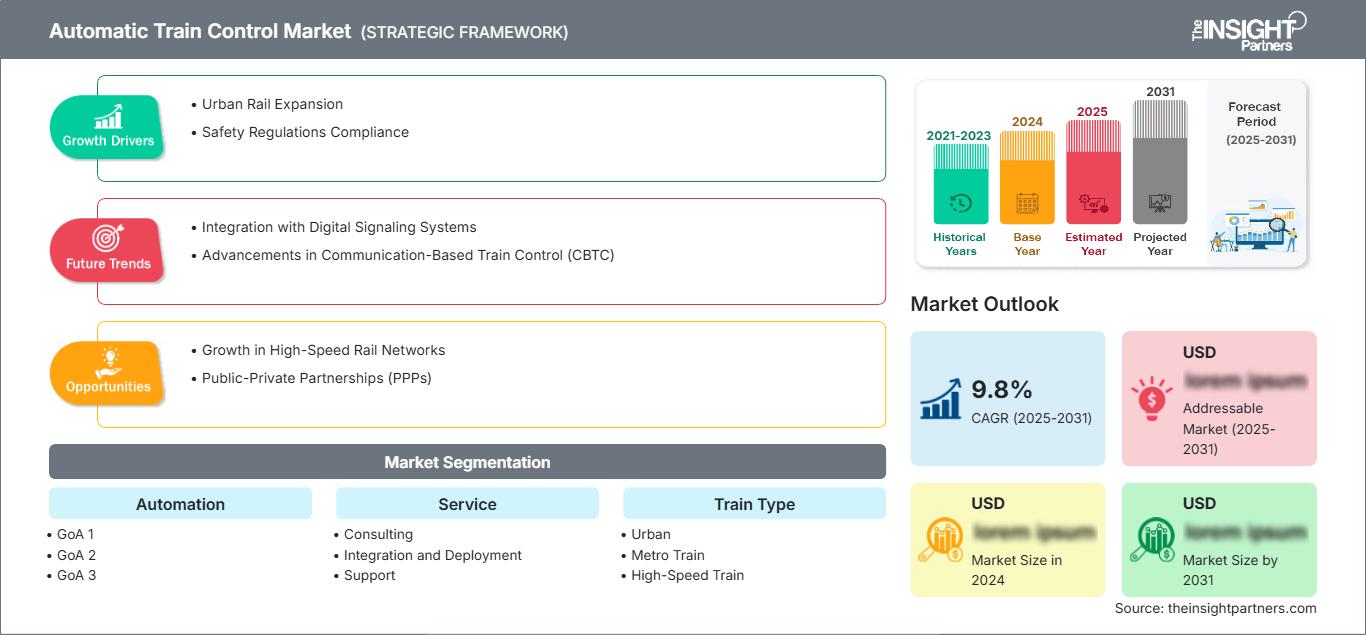
Regional Insights
North America Automatic Train Control Market
North America holds an estimated 22%–26% share in 2025 and is forecast to grow at 8.8%–9.8% through 2034. The Automatic Train Control Market share is reinforced by positive train control lifecycle work, metro capacity upgrades, and commuter rail modernization. U.S. freight and passenger operators prioritize safety supervision, while Canadian agencies focus on urban transit expansion and signaling renewal.
Regional demand is shaped by funding cycles, safety mandates, and the need to integrate automated control with aging track, rolling stock, and communications networks. Siemens AG and Alstom SA have highlighted digital rail and CBTC capabilities in 2025 communications, while Cisco Systems, Inc. supports secure rail networking. Service opportunities remain high because installed systems require testing, upgrades, and cybersecurity maintenance.
U.S. Automatic Train Control Market
The U.S. Automatic Train Control Market represents 76%–81% of North American demand in 2025 and is projected to expand at 8.9%–9.9%. Freight rail, commuter rail, and urban transit create a mixed demand base, with PTC maintenance, CBTC metro modernization, and automatic supervision upgrades occurring in parallel. Application trends include control center renewal, onboard equipment replacement, radio network strengthening, and integration with asset management systems.
Company presence includes Siemens AG, Alstom SA, Thales S.A., Cisco Systems, Inc., WSP Global Inc., Tech Mahindra Limited, and MERMEC S.p.A. through direct projects, engineering advisory roles, communications infrastructure, and software support. Operators increasingly request staged migration plans because service disruption on dense metro and commuter corridors can create immediate passenger, safety, and political consequences.
Europe Automatic Train Control Market
Europe accounts for 28%–32% share in 2025 and is expected to grow at 9.2%–10.2%. Germany leads through ETCS, ATO, digital rail, and S-Bahn modernization programs. The United Kingdom is developing its signaling and capacity management, while France focuses on metro automation and high-speed railway control. Italy and Spain are playing their part by upgrading national railways and signaling systems.
The European procurement strategy involves ensuring interoperability, safety certification, energy efficiency, and migration from the traditional signaling solution without significant service disruption. The company signed a contract in 2025 to install ETCS and GoA2 ATO on 82 S-Bahn trains in Hamburg. Siemens AG and Thales S.A. are among the major competitors in CBTC, ETCS, supervision, and control center systems.
APAC Automatic Train Control Market
APAC is expected to hold 36%–40% market share in 2025 and achieve growth of 10.8%–11.8%. The leading player in APAC is China, which is investing in metro expansion, HSR, and domestic signaling systems. In Japan and South Korea, automation is focused on precision, while in India, there is expansion in metros and regional railways, and in Australia, there are investments in capacity building and digital train control.
Adoption of regional transport systems is driven by industrial policy, smart city projects, and rail safety. The main rivals of Toshiba India Private Limited, MIPRO Electronics Co., Ltd., Siemens AG, Alstom SA, and Thales S.A. include companies that offer cost-efficiency and feasibility in projects. The greatest growth opportunities exist for metros that need shorter headways and for national railroads that need more capacity.
Middle East & Africa Automatic Train Control Market
Middle East & Africa is projected to grow at 9.0%–10.0%, with the UAE leading near-term adoption through metro automation, airport rail, and smart mobility programs. Saudi Arabia is developing its railway network as part of a diversification strategy, whereas South Africa plans to invest in selected upgrades to its passenger and freight networks.
Energy infrastructure, logistics corridors, and urban transit contribute to regional demand. Implementation is project-based due to differences in technological know-how, procurement methods, and financing among countries. Other opportunities in MEA relate to control systems, safety signaling, and rolling stock for metros and railways.
Segmentation Analysis
Automation
Automation is projected to grow at 10.0%–11.0% during 2026–2034. Automatic Train Control Market scope covers incremental movement from driver advisory and protected manual operation toward semi-automatic, driverless, and unattended systems. Adoption depends on passenger density, platform safety, radio reliability, control-room maturity, rolling stock interfaces, and the operator’s ability to certify higher grades without disrupting existing service.
- GoA 1 remains relevant for mainline and freight operations where automatic protection supervises speed and movement authority while drivers retain full operational control.
- GoA 2 leads adoption because semi-automatic operation improves consistency, energy use, and headways while retaining onboard staff for door control, supervision, and incident response.
- GoA 3 supports driverless operation with staff presence, making it attractive for metros seeking higher automation while maintaining customer-facing or contingency roles onboard.
- GoA 4 is strategically important for new metro corridors and airport links where unattended operation can optimize frequency, labor deployment, and timetable resilience.
Service
Service is forecast to grow at 9.4%–10.4% during 2026–2034. Consulting, integration, deployment, support, and maintenance are becoming more important because train control programs involve long approval cycles, multi-vendor interfaces, and safety-critical testing. Operators increasingly value lifecycle partners that can manage migration, documentation, cybersecurity, software patches, and operational readiness after commissioning.
- Consulting supports feasibility studies, architecture selection, safety cases, procurement strategy, and migration planning before operators commit capital to signaling modernization.
- Integration and Deployment captures high strategic value because onboard, wayside, telecom, control center, and rolling stock interfaces must operate safely as one certified system.
- Support is essential after launch, covering software troubleshooting, operator training, incident diagnostics, performance tuning, and coordination between suppliers and rail control teams.
- Maintenance provides recurring demand through testing, component replacement, cybersecurity updates, radio performance checks, and lifecycle extension of safety-critical train control assets.
Train Type
Train Type is expected to grow at 10.1%–11.1% during 2026–2034. Demand differs by route density, speed, stopping pattern, and safety case complexity. Urban and metro systems emphasize frequency and passenger throughput, high-speed lines prioritize braking supervision and interoperability, mainline passenger corridors require mixed-traffic control, and freight networks focus on safety overlay, scheduling reliability, and asset utilization.
- Urban rail uses automated control to manage dense stopping patterns, short dwell times, and frequent service changes across city corridors with constrained track capacity.
- Metro Train applications represent a core deployment base because CBTC and higher automation directly improve headways, platform management, energy use, and timetable recovery.
- High-Speed Train systems require precise supervision, interoperable signaling, and reliable onboard equipment to maintain safe operation at elevated speeds across long corridors.
- Mainline networks adopt train control to coordinate mixed services, improve safety margins, and modernize legacy signaling without fully replacing existing infrastructure immediately.
- Passenger Train deployments focus on service reliability, punctuality, safer braking supervision, and passenger confidence across commuter, regional, and intercity operations.
- Freight Train applications emphasize collision avoidance, speed enforcement, dispatch visibility, and network efficiency on corridors carrying heavy loads and mixed traffic.
Opportunity Snapshot
| Train Type | Revenue Contribution | Trend Tag | Adoption Stage |
| Urban | High | City Rail | Scaling |
| Metro Train | High | Driverless Metro | Mature |
| High-Speed Train | Medium | ETCS Upgrade | Scaling |
| Mainline | Medium | Digital Rail | Scaling |
| Passenger Train | Medium | Reliable Service | Scaling |
| Freight Train | Low | Safety Overlay | Emerging |
Automatic Train Control Market Growth Drivers and Impact Analysis
Urban Rail Capacity Pressure Accelerates Digital Signaling
The problem with densely populated urban areas is that they require more frequent train services without increasing track lengths, which makes automated train controls a capacity tool rather than a safety mechanism. CBTC and ATO technologies help to reduce headways, improve braking systems, and increase recovery times. The most significant effect on the market will be felt in metro corridors, which experience excess peak-hour demand relative to platform and signaling capacity. Additionally, transit authorities use automation technology to maintain service stability despite changes in travel patterns.
Safety Mandates and Asset Renewal Support Long Programs
Railway safety systems have sustained demand because railway control assets must undergo certification for design, testing, authorization, and maintenance. Positive train control, ETCS, ATP, and supervision systems help minimize the probability of collisions, overspeeding, and passing signals at danger. At present, many railway operators are renewing their interlockings, radio systems, onboard computer systems, and control room software. The commercial benefits of rail safety do not end with installation but continue through software assurance, cybersecurity fixes, spare parts, and recertifications. Vendors with documented safety cases and local homologation experience have a measurable advantage.
Energy Efficiency and Service Reliability Improve Business Cases
Automatic operation helps ensure smoother rides, less braking, and greater variability in recovery time, increasing the efficiency of energy consumption and timetabling. This particular driver is becoming increasingly relevant as transportation systems tie their investment decisions to sustainability, operations, and customer experience outcomes. With optimized driving modes, real-time monitoring, and a diagnostic system, an operator can control both punctuality and asset depreciation. Market relevance can be seen in subway, commuter, and high-speed rail projects, where the reliability of service intervals plays an important role in revenue and reputation.
Automatic Train Control Market Future Trends
Cloud-Supported CBTC Moves Toward Safety-Certified Deployment
Automatic Train Control Market trends will gradually revolve around cloud-based supervision systems, virtualized safety platforms, and software-defined signaling frameworks. Railway companies seek scalable control systems that reduce the complexity of wayside hardware while still providing fail-safe services. In 2025, Siemens AG introduced Train2Cloud and Signaling X to demonstrate how the CBTC system can gradually evolve into a cloud-based operation for metro systems. In the long run, certified platforms will help reduce the testing period and provide better redundancy and software updates.
Higher Grades of Automation Expand Beyond New Metros
Driverless and unattended operation will become increasingly prevalent as it migrates from custom-made metros to retrofitted urban, airport, and selected regional railways. The automated regional trains project by Alstom SA in Germany is an example of how ATO, perception systems, and ETCS can enable automation on existing railway lines. In future implementations, the systems will include sensing, obstacle avoidance, remote control, and digital rulebooks to handle the complexity of non-metro lines. The development will proceed with caution, taking into account certification, trade unions, emergency procedures, and public acceptance.
Automatic Train Control Market Opportunities
Brownfield Metro Migration Creates Multi-Phase Revenue
Many mature urban transit lines would benefit from capacity enhancements without closing their right-of-way for major rebuilding, thus opening the door to staged migration of signaling. The vendor companies have the option to focus on design activities, radio surveys, retrofitting of rolling stock, wayside renewal, control room modernization, testing, and maintenance through large-scale programs. Automatic Train Control Market Forecasts call for investing in migration kits to minimize service disruption and fast-track safety approval. This represents a business case for vendors capable of providing simulation, shadow mode testing, PIS integration, and training services.
Cybersecure Rail Communications Open Specialist Partnerships
The control of trains is predicated on the constant and reliable exchange of information among trainboard equipment, trackside infrastructure, the command centers, and the company's corporate network. As firms move towards using IP-based communication and remote diagnostic capabilities, cybersecurity is no longer just an afterthought but part of the buying process. The above considerations provide the foundation for synergy among signaling system OEMs, telecommunication companies, cybersecurity management companies, and IT integration providers in rail transportation. Cisco Systems, Inc. and Tech Mahindra Limited can provide their contributions through network security, surveillance, and lifecycle management services. Customers will find value in products that offer safety certification, intrusion detection, segmentation, and incident management.
Recent Developments
- June 2025: Siemens AG showcased Signaling X, Train2Cloud, CBTC, Digital Station, and RailXplore at the UITP Global Public Transport Summit in Hamburg. The company described Train2Cloud as a CBTC evolution using a wayside-oriented, cloud-based approach and Safety Integrity Level 4 applications on commercial off-the-shelf servers.
- April 2025: Alstom SA signed a contract with S-Bahn Hamburg worth more than EUR 60 million to retrofit 82 BR 490 trains with ETCS Onvia units and modern ATO technology for GoA2 semi-automatic operation. The program supports digital rail operations, shorter headways, higher passenger capacity, and reduced energy use.
- September 2024: Alstom SA presented the ARTE automated regional train project in Germany with LNVG, TU Berlin, and DLR, using ATO with ETCS and onboard perception to support automation on existing lines. The project demonstrated autonomous-mode travel and remote train operation, indicating broader retrofit potential beyond new metro systems.
Frequently Asked Questions

- Comprehensive Market Sizing and Forecast Analysis
- Detailed Segmentation Analysis
- In-Depth Market Dynamics Assessment
- Regional and Country-Level Insights
- Competitive Landscape and Company Benchmarking
- Strategic Business Intelligence
Recent Reports
Testimonials

The Insight Partners' SCADA System Market report is comprehensive, with valuable insights on current trends and future forecasts. The team was highly professional, responsive, and supportive throughout. We are very satisfied and highly recommend their services.
RAN KEDEM Partner, Reali Technologies LTDs
I requested a report on a very specific software market and the team produced the report in a few days. The information was very relevant and well presented. I then requested some changes and additions to the report. The team was again very responsive and I got the final report in less than a week.
JEAN-HERVE JENN Chairman, Future Analytica
We worked with The Insight Partners for an important market study and forecast. They gave us clear insights into opportunities and risks, which helped shape our plans. Their research was easy to use and based on solid data. It helped us make smart, confident decisions. We highly recommend them.
PIYUSH NAGPAL Sr. Vice President, High Beam Global
The Insight Partners delivered insightful, well-structured market research with strong domain expertise. Their team was professional and responsive throughout. The user-friendly website made accessing industry reports seamless. We highly recommend them for reliable, high-quality research services
YUKIHIKO ADACHI CEO, Deep Blue, LLC.
This is the first time I have purchased a market report from The Insight Partners.While I was unsure at first, I visited their web site and felt more comfortable to take the risk and purchase a market report.I am completely satisfied with the quality of the report and customer service. I had several questions and comments with the initial report, but after a couple of dialogs over email with their analyst I believe I have a report that I can use as input to our strategic planning process.Thank you so much for taking the extra time and making this a positive experience.I will definitely recommend your service to others and you will be my first call when we need further market data.
JOHN SUZUKI President and Chief Executive Officer, Board Director, BK Technologies
I wish to appreciate your support and the professionalism you displayed in the course of attending to my request for information regarding to infectious disease IVD market in Nigeria. I appreciate your patience, your guidance, and the fact that you were willing to offer a discount, which eventually made it possible for us to close a deal. I look forward to engaging The Insight Partners in the future, all thanks to the impression you have created in me as a result of this first encounter.
DR CHIJIOKE ONYIA MANAGING DIRECTOR, PineCrest Healthcare Ltd.Reason to Buy
- Informed Decision-Making
- Understanding Market Dynamics
- Competitive Analysis
- Identifying Emerging Markets
- Customer Insights
- Market Forecasts
- Risk Mitigation
- Boosting Operational Efficiency
- Strategic Planning
- Investment Justification
- Tracking Industry Innovations
- Aligning with Regulatory Trends





 Get Free Sample for