
Automotive Aerodynamic Market Drivers, Opportunities, Trends, and Forecasts by 2034
Coverage: By Application (Diffusers, Side Skirts, Spoilers, Wind Deflectors, Grille Shutter, Air Dam, and Others), By System (Active System and Passive System), By Vehicle Type (Passenger Vehicles and Commercial Vehicles), and Geography
- Status : Data Released
- Report Code : TIPAT00002481
- Category : Automotive and Transportation
- No. of Pages : 150
- Available Report Formats :


- Last update date : August 27, 2026


2025 Market Size
US$ 15.59 Bn
Base year value
2034 Forecast
US$ 24.38 Bn
Projected by 2034
CAGR 2026-2034
5.1 %
Growth rate
Addressable Market
US$ 181.42 Bn
(2026-2034)
The Automotive Aerodynamic Market manufacturers are increasingly integrating aerodynamic components to improve fuel efficiency, reduce emissions, enhance vehicle stability, and extend electric vehicle driving range. Consequently, the automotive aerodynamic market was valued at US$ 15.59 Billion in 2025 and is projected to reach US$ 24.38 Billion by 2034, advancing at a CAGR of 5.1% during 2026–2034. Growing vehicle electrification, tightening fuel economy regulations, and continuous innovation in active aerodynamic systems continue to strengthen long-term industry demand across passenger and commercial vehicle categories.
Across North America, regulatory emphasis on vehicle efficiency and increasing electric vehicle production are creating sustained opportunities for aerodynamic technologies. OEMs are expanding investments in lightweight exterior systems, active grille shutters, and intelligent airflow management to improve overall vehicle performance while meeting emissions standards. The expanding automotive aerodynamic market size is further supported by rising consumer preference for premium vehicles equipped with advanced aerodynamic features and growing investments in next-generation manufacturing capabilities.
Automotive Aerodynamic Market Assessment and Insights
- North America: Accounted for 28–32% of the global market in 2025, supported by stringent fuel economy regulations, strong EV production, and continuous investment in lightweight vehicle technologies. The regional market is projected to expand at a CAGR of 4.8–5.3% during 2026–2034.
- U.S.: Represented 78–82% of North American demand in 2025, driven by advanced automotive manufacturing, rapid EV adoption, and increasing integration of active aerodynamic technologies. The market is expected to register a CAGR of 4.9–5.4% through 2034.
- Europe: Held 25–29% of the global market in 2025, with Germany, the UK, and France leading demand owing to strong premium vehicle production and sustainability initiatives. The region is anticipated to grow at a CAGR of 4.7–5.2% during 2026–2034.
- Asia Pacific: Captured 34–38% of the global market in 2025, led by China, Japan, South Korea, and India through expanding vehicle production and increasing electric mobility investments. The regional market is forecast to grow at a CAGR of 5.7–6.3% during 2026–2034.
- Largest Segment: Passenger Vehicles accounted for 70–74% of market demand in 2025 and are expected to record a CAGR of 4.9–5.4% through 2034, supported by large-scale production and increasing aerodynamic optimization.
- High Growth Segment: Active System is projected to witness the strongest expansion with a CAGR of 6.2–6.8% during 2026–2034, supported by wider adoption in electric and premium vehicle platforms.
- Key companies analyzed in detail: Magna International Inc., Röchling Automotive SE & Co. KG, OPmobility SE, SMP Deutschland GmbH, Valeo SE, Polytec Holding AG, INOAC Corporation, AP Plasman Inc., REHAU Automotive SE & Co. KG, P.U. Tech Industry Co., Ltd., Brose Fahrzeugteile SE & Co. KG, HBPO GmbH, Spoiler Factory, Batz Group, AirFlow Deflector Inc., Piedmont Plastics Inc., Hilton Docker Mouldings Ltd., Johnson Electric Holdings Limited, Sonceboz SA.
Source: The Insight Partners' analysis based on proprietary research, government publications, company annual reports, investor presentations, industry databases, and expert interviews.
Continuous advancements in computational fluid dynamics, lightweight composite materials, and digitally engineered vehicle platforms have significantly reshaped the market over recent years. The automotive aerodynamic market forecast remains closely tied to ongoing innovations in vehicle efficiency and airflow optimization technologies. Manufacturers increasingly integrate active airflow management systems into new vehicle architectures to improve efficiency without compromising aesthetics or safety. At the same time, increasing production of electric vehicles has resulted in the significance of drag reduction, prompting manufacturers to manufacture intelligent aerodynamic solutions that maximize energy usage while driving.
Moving forward, the market is anticipated to see an impact from production growth in the Asia Pacific, ongoing investment in electric mobility, and stricter emission standards around the world. Growing efforts by governments for energy-efficient transport and initiatives of Original Equipment Manufacturers to improve the range of their batteries are expected to drive the adoption of aerodynamic solutions.
Automotive Aerodynamic Market Report Scope
| Report Attribute | Details |
|---|---|
| Market size in 2025 | US$ 15.59 Billion |
| Market Size by 2034 | US$ 24.38 Billion |
| Global CAGR (2026 - 2034) | 5.1% |
| Historical Data | 2021-2024 |
| Forecast period | 2026-2034 |
Automotive Aerodynamic Market Analysis
The automotive aerodynamic market growth is increasingly supported by regulatory requirements targeting lower carbon emissions, higher fuel efficiency, and improved electric vehicle performance. Both OEMs keep on incorporating both active and passive aerodynamic elements in vehicles so that drag is minimized while increasing stability when it comes to driving. Through technological developments in digital engineering, computational fluid dynamics, and lightweight polymers, OEMs have been able to achieve optimized air flow in the course of the development of vehicles.
The market consists of raw material suppliers, polymer processors, component manufacturers, system integrators, vehicle manufacturers, and the after-market participants. The synergy between material developers and automotive OEMs has become stronger since OEMs have been striving for aerodynamic solutions that are lightweight but durable. Supply chain has become oriented towards utilizing recyclable materials and molding technologies.
Competitive intensity within the automotive aerodynamic market analysis continues to rise as established suppliers expand technology portfolios through strategic investments, product innovation, and manufacturing modernization. Companies including Magna International Inc., Valeo SE, OPmobility SE, Röchling Automotive SE & Co. KG, Polytec Holding AG, Brose Fahrzeugteile SE & Co. KG, and Johnson Electric Holdings Limited are strengthening collaborations with global vehicle manufacturers to develop integrated aerodynamic systems capable of improving vehicle efficiency while supporting electrification strategies.
The trends seen in investments in this industry relate to intelligent aerodynamics, automation of production processes, sustainable materials innovation, and digital connectivity of manufacturing plants. The suppliers have developed their simulation technologies to reduce the product development time frame as well as design precision. On the other hand, the manufacturing plant expansion in the Asia-Pacific region and North America allows businesses to increase supply chain security and respond faster to the demands of electric car makers.
● REPORT CUSTOMIZATION
Tailor This Report To Align With Your Specific Business Requirements
This report can be customized to align precisely with your business objectives, scope, and target markets. Customization options include tailored segmentation, geography, competitive analysis, and strategic insights to support informed decision-making.
Customize This Report →WHAT YOU CAN ADJUST
- ● Segmentations
- ● Geography
- ● Competitive Analysis
- ● Language Preferences
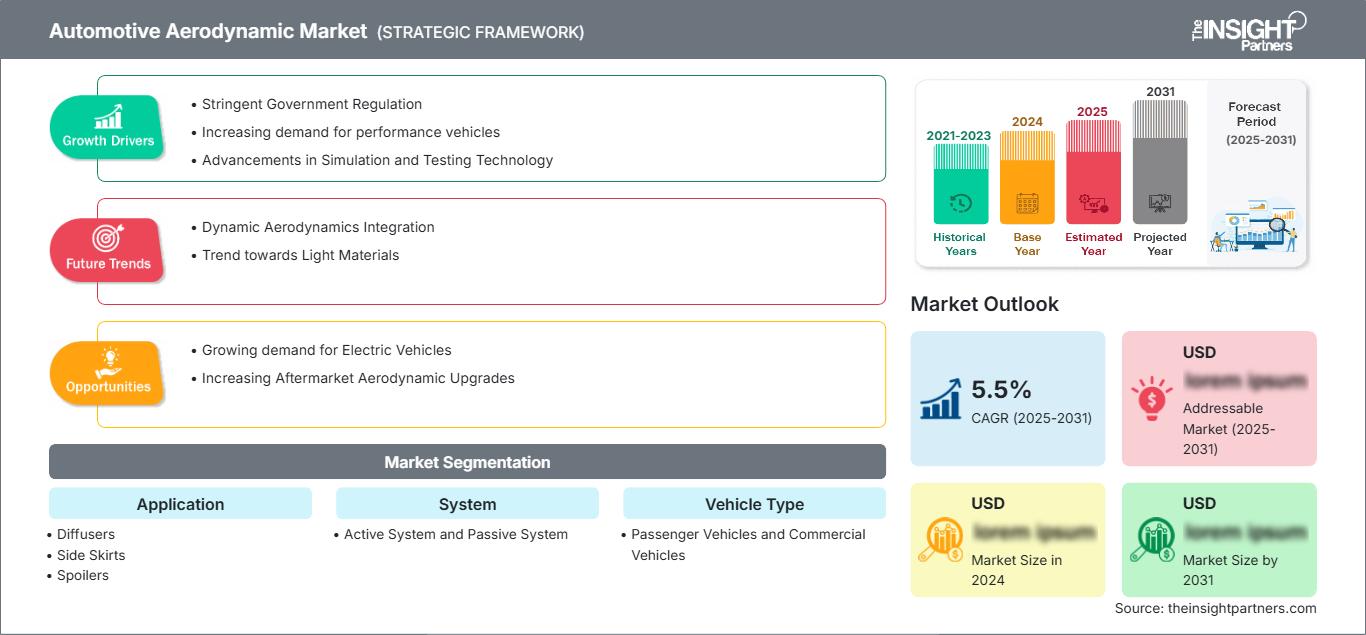
Automotive Aerodynamic Market: Strategic Insights
Regional Insights
North America Automotive Aerodynamic Market
North America accounted for 28–32% of the global market in 2025 and is projected to expand at a CAGR of 4.8–5.3% during 2026–2034. Regulatory standards related to fuel economy and greenhouse gas emissions continue to encourage automakers to incorporate advanced aerodynamic components into new vehicle platforms. The region also benefits from a strong supplier network, high adoption of premium vehicles, and increasing investment in electric vehicle manufacturing.
The automotive aerodynamic market share in North America remains supported by continuous product innovation involving active grille shutters, adaptive spoilers, lightweight air dams, and intelligent airflow systems. Automotive manufacturers are increasingly using computational fluid dynamics and virtual testing to optimize vehicle performance before production. Growing collaboration between OEMs and component suppliers, combined with investments in localized manufacturing, is expected to strengthen regional competitiveness while supporting demand for advanced aerodynamic technologies across passenger and commercial vehicle segments.
U.S. Automotive Aerodynamic Market
The United States represented 78–82% of North America's market in 2025 and is anticipated to register a CAGR of 4.9–5.4% through 2034. Solid automotive manufacturing within the country, electric vehicles assembly and adoption of advanced aerodynamic technologies are the key factors that shape the market growth. Automakers place an increased focus on lightweight exterior components that contribute to the range, efficiency and stability of their vehicles amid the changing government regulations regarding efficiency.
Major suppliers such as Magna International Inc., Valeo SE, Johnson Electric Holdings Limited, Brose Fahrzeugteile SE & Co. KG and OPmobility SE have considerable engineering, manufacturing and customer services capabilities targeting U.S. carmakers. Increasing use of active grille shutters, adaptive spoilers, air management systems and lightweight composites demonstrates the increased interest among consumers in efficiency and technologically advanced vehicles.
Europe Automotive Aerodynamic Market
Europe captured 25–29% of the global market in 2025 and is forecast to expand at a CAGR of 4.7–5.2% through 2034. Germany remains the leading regional market owing to its concentration of premium vehicle manufacturers, advanced engineering capabilities, and continuous investment in lightweight mobility technologies. Increasing regulatory emphasis on carbon reduction further accelerates the integration of sophisticated aerodynamic systems across new vehicle platforms.
The UK is continuously developing electric cars and high-performance automotive platforms, making room for active aerodynamic solutions that enhance fuel efficiency and improve handling. Germany profits from advanced research capabilities, cooperation of original equipment manufacturers and suppliers, and simulation-driven vehicle development to enhance its leading position in the regional automotive ecosystem.
France, Italy, and Spain together account for substantial regional demand owing to existing automotive manufacturing operations and growing investment in sustainable transportation. France develops its activities in the fields of electrification and light weighting, Italy utilizes experience in premium and sports cars, where optimal airflow is important, while Spain increases automotive production with the help of export-oriented manufacturing. The demand is expected to remain healthy for the forecast period.
APAC Automotive Aerodynamic Market
Asia Pacific held 34–38% of the global market in 2025 and is projected to record the fastest regional expansion at a CAGR of 5.7–6.3% through 2034. China leads regional demand through large-scale vehicle manufacturing, rapid electric vehicle adoption, and strong investment in advanced automotive technologies.
Japan and South Korea continue contributing through technological innovation and premium vehicle production, while India benefits from expanding passenger vehicle manufacturing and supportive industrial policies. Australia supports regional demand through specialty automotive applications and increasing adoption of efficient mobility technologies, strengthening Asia Pacific's long-term competitive position.
Middle East & Africa Automotive Aerodynamic Market
The Middle East & Africa automotive aerodynamic market is expected to experience steady expansion during the forecast period, supported by a CAGR of 4.2–4.8%. Saudi Arabia leads regional demand through automotive manufacturing initiatives and industrial diversification, while the United Arab Emirates continues investing in advanced mobility infrastructure and premium vehicle adoption.
South Africa remains an important automotive production hub supported by established export-oriented manufacturing capabilities. The Rest of the Middle East & Africa is gradually adopting advanced aerodynamic components as vehicle efficiency standards evolve and transportation infrastructure improves. Rising investment in industrial development and logistics is expected to create additional opportunities for component suppliers.
Segmentation Analysis
Application
The Application segment remains central to the automotive aerodynamic market, with manufacturers continuously introducing innovative airflow management technologies that improve efficiency and vehicle stability. Increasing adoption of active and passive exterior components across electric and conventional vehicles supports sustained demand. The automotive aerodynamic market scope continues to expand as OEMs prioritize integrated aerodynamic designs for improved energy efficiency. This segment is projected to grow at a CAGR of 5.3–5.8% during 2026–2034.
- Diffusers: Improve underbody airflow, enhance vehicle stability at higher speeds, and are increasingly integrated into premium passenger vehicles and electric models requiring optimized aerodynamic performance and energy efficiency.
- Side Skirts: Reduce airflow turbulence around vehicle sides, improving efficiency and driving stability while supporting lightweight exterior design strategies across multiple vehicle platforms.
- Spoilers: Widely adopted in passenger vehicles to improve downforce, reduce drag, and enhance overall driving performance, particularly in premium, electric, and performance-oriented vehicle categories.
- Wind Deflectors: Improve airflow around windows and vehicle cabins while reducing wind noise, making them increasingly popular across both OEM installations and aftermarket applications.
- Grille Shutter: Active grille shutter systems optimize airflow according to cooling requirements, improving fuel economy and extending electric vehicle driving range through intelligent airflow control.
- Air Dam: Positioned beneath the front bumper, air dams reduce underbody turbulence and improve aerodynamic efficiency while supporting vehicle stability during highway operation.
System
The System segment is evolving as manufacturers increasingly integrate adaptive aerodynamic technologies into modern vehicle platforms. While passive systems remain widely deployed because of their cost-effectiveness and reliability, active systems continue gaining momentum in premium and electric vehicles. The segment is anticipated to expand at a CAGR of 5.5–6.0% during 2026–2034.
- Active System: Electronically controlled aerodynamic components automatically adjust according to vehicle speed and operating conditions, improving efficiency, cooling performance, and overall driving dynamics.
- Passive System: Fixed aerodynamic components remain extensively used because of their lower manufacturing costs, design simplicity, durability, and compatibility across high-volume vehicle production.
Vehicle Type
Passenger and commercial vehicles collectively drive demand for aerodynamic technologies as manufacturers focus on improving efficiency, reducing emissions, and enhancing vehicle performance. Passenger vehicles remain the dominant category because of their higher production volumes, while commercial vehicles increasingly adopt aerodynamic components to improve fleet operating efficiency. The Vehicle Type segment is projected to grow at a CAGR of 4.9–5.4% during 2026–2034.
- Passenger Vehicles: Represent the largest demand base owing to extensive production volumes, rapid electric vehicle adoption, premium vehicle expansion, and continuous integration of advanced aerodynamic systems.
- Commercial Vehicles: Increasingly incorporate aerodynamic solutions to reduce fuel consumption, improve long-distance operating efficiency, lower emissions, and enhance logistics fleet productivity.
Opportunity Snapshot
| Segment Name | Revenue Contribution | Trend Tag | Adoption Stage |
|---|---|---|---|
| Diffusers | Medium | Underbody Flow | Scaling |
| Side Skirts | Medium | Drag Reduction | Mature |
| Spoilers | High | Active Aero | Mature |
| Wind Deflectors | Medium | Cabin Comfort | Mature |
| Grille Shutter | High | Thermal Control | Scaling |
| Air Dam | High | Fuel Efficiency | Mature |
| Others | Low | Custom Design | Emerging |
Automotive Aerodynamic Market Growth Drivers and Impact Analysis
Stringent fuel economy and vehicle emission regulations
Fuel efficiency and emission norms are continuously tightening in North America, Europe, and the Asia Pacific, thereby driving car makers to enhance vehicle aerodynamics. Aerodynamic drag plays an important role in reducing fuel usage in internal combustion engines as well as increasing the range of batteries in electric cars. Car manufacturers are incorporating spoilers, active grill shutters, air dams, and diffusers into their vehicles to comply with such norms. Cleaner transportation policies not only help in improving the use of lightweight material and flow management technology but also provide suppliers with lucrative business opportunities.
Expansion of global electric vehicle manufacturing
The rapid expansion of the electric vehicle market has brought about a greater focus on aerodynamics due to the direct influence of drag reduction on the efficiency of the electric battery. Automakers are working towards optimizing the design of the body of the car with the help of sophisticated simulation software, as well as by incorporating systems that can control air flow dynamically. Advanced composite materials, along with electronically actuated systems, are incorporated as standard in premium electric cars and will eventually make their way into mass-produced models. Significant investment is being made in production facilities around the world, specifically designed for electric cars, which will result in sustained pressure on the suppliers to offer new aerodynamic solutions.
Advancements in digital engineering and lightweight materials
Computational Fluid Dynamics, digital twins, and virtual vehicle validation have revolutionized aerodynamic product development. Engineers can assess airflow efficiency in the initial stages of the design process, saving on development costs and hastening the process of getting the products into the market. At the same time, innovations in recyclable polymers, engineering plastics, carbon fiber composites, and other lightweight materials allow manufacturers to enhance the aerodynamics of their vehicles without adding more weight to them. An automated manufacturing process makes it possible to improve production efficiency and facilitate the mass production of advanced aerodynamic devices.
Automotive Aerodynamic Market Future Trends
Integration of intelligent active aerodynamic systems
Manufacturers are increasingly developing adaptive aerodynamic technologies capable of responding automatically to vehicle speed, braking conditions, cooling requirements, and battery temperature. This evolution represents one of the defining automotive aerodynamic market trends, particularly for electric and premium vehicles, where efficiency improvements directly influence driving range and performance. Future vehicle architectures will integrate sensors, electronic actuators, and artificial intelligence to optimize airflow continuously while minimizing energy consumption. Continued software integration and connected vehicle technologies are expected to make intelligent aerodynamic systems standard across broader vehicle categories during the forecast period.
Greater adoption of sustainable lightweight materials
Future vehicle development will increasingly prioritize recyclable polymers, bio-based composites, and lightweight engineering materials that reduce environmental impact while maintaining structural performance. Automotive manufacturers are expected to replace heavier conventional materials with advanced alternatives that improve aerodynamic efficiency without compromising durability or safety. Sustainable manufacturing practices, circular economy initiatives, and stricter environmental regulations will encourage suppliers to develop eco-friendly aerodynamic components using lower-carbon production processes. Continuous innovation in material science is likely to support long-term competitiveness while helping manufacturers achieve ambitious sustainability and vehicle efficiency objectives.
Automotive Aerodynamic Market Opportunities
Expansion of active aerodynamic technologies in mass-market vehicles
Opportunities are increasing as active aerodynamic technologies transition from premium vehicles into high-volume passenger vehicle platforms. Declining component costs, improved actuator reliability, and advances in electronic control systems enable manufacturers to deploy adaptive airflow solutions across broader vehicle segments. Suppliers capable of delivering cost-effective integrated systems can establish long-term partnerships with global OEMs while expanding production capacity. Standardization of modular aerodynamic platforms, combined with increasing electrification, creates attractive investment opportunities for companies seeking sustainable revenue growth and stronger competitive differentiation within evolving global automotive manufacturing ecosystems.
Localized manufacturing and next-generation component development
Growing investments in regional manufacturing facilities create opportunities for suppliers to strengthen supply chain resilience and improve customer responsiveness. Companies establishing engineering centers near major automotive production hubs can accelerate product development, reduce logistics costs, and support localized vehicle platforms more effectively. Demand for recyclable materials, intelligent airflow management technologies, and digitally engineered components is expected to encourage additional capital investment, strategic partnerships, and technology licensing. Organizations focusing on innovation, manufacturing flexibility, and integrated engineering capabilities are well positioned to capture expanding demand generated by evolving global vehicle production and electrification strategies.
Frequently Asked Questions

- Comprehensive Market Sizing and Forecast Analysis
- Detailed Segmentation Analysis
- In-Depth Market Dynamics Assessment
- Regional and Country-Level Insights
- Competitive Landscape and Company Benchmarking
- Strategic Business Intelligence
Recent Reports
Testimonials

The Insight Partners' SCADA System Market report is comprehensive, with valuable insights on current trends and future forecasts. The team was highly professional, responsive, and supportive throughout. We are very satisfied and highly recommend their services.
RAN KEDEM Partner, Reali Technologies LTDs
I requested a report on a very specific software market and the team produced the report in a few days. The information was very relevant and well presented. I then requested some changes and additions to the report. The team was again very responsive and I got the final report in less than a week.
JEAN-HERVE JENN Chairman, Future Analytica
We worked with The Insight Partners for an important market study and forecast. They gave us clear insights into opportunities and risks, which helped shape our plans. Their research was easy to use and based on solid data. It helped us make smart, confident decisions. We highly recommend them.
PIYUSH NAGPAL Sr. Vice President, High Beam Global
The Insight Partners delivered insightful, well-structured market research with strong domain expertise. Their team was professional and responsive throughout. The user-friendly website made accessing industry reports seamless. We highly recommend them for reliable, high-quality research services
YUKIHIKO ADACHI CEO, Deep Blue, LLC.
This is the first time I have purchased a market report from The Insight Partners.While I was unsure at first, I visited their web site and felt more comfortable to take the risk and purchase a market report.I am completely satisfied with the quality of the report and customer service. I had several questions and comments with the initial report, but after a couple of dialogs over email with their analyst I believe I have a report that I can use as input to our strategic planning process.Thank you so much for taking the extra time and making this a positive experience.I will definitely recommend your service to others and you will be my first call when we need further market data.
JOHN SUZUKI President and Chief Executive Officer, Board Director, BK Technologies
I wish to appreciate your support and the professionalism you displayed in the course of attending to my request for information regarding to infectious disease IVD market in Nigeria. I appreciate your patience, your guidance, and the fact that you were willing to offer a discount, which eventually made it possible for us to close a deal. I look forward to engaging The Insight Partners in the future, all thanks to the impression you have created in me as a result of this first encounter.
DR CHIJIOKE ONYIA MANAGING DIRECTOR, PineCrest Healthcare Ltd.Reason to Buy
- Informed Decision-Making
- Understanding Market Dynamics
- Competitive Analysis
- Identifying Emerging Markets
- Customer Insights
- Market Forecasts
- Risk Mitigation
- Boosting Operational Efficiency
- Strategic Planning
- Investment Justification
- Tracking Industry Innovations
- Aligning with Regulatory Trends





 Get Free Sample for