
Automotive Electronic Brake Force Distribution (EBD) System Market Share, Demand & Growth by 2034
Coverage: by Component (Hardware, Software); Vehicle Type (Passenger Vehicle, Light Commercial Vehicle, Heavy Commercial Vehicle) , and Geography (North America, Europe, Asia Pacific, and South and Central America)
- Status : Data Released
- Report Code : TIPRE00008017
- Category : Automotive and Transportation
- No. of Pages : 150
- Available Report Formats :


- Last update date : August 12, 2026


2025 Market Size
US$ 3.13 Bn
Base year value
2034 Forecast
US$ 4.39 Bn
Projected by 2034
CAGR 2026-2034
3.83 %
Growth rate
Addressable Market
US$ 34.15 Bn
(2026-2034)
The Automotive Electronic Brake Force Distribution System Market is growing steadily owing to the increased usage of advanced braking systems in automobiles. It is estimated that the market value was US$ 3.13 billion in 2025 and will reach US$ 4.39 billion by 2034 with a CAGR of 3.83% from 2026 to 2034. The increased usage of advanced braking systems as well as stringent safety measures in vehicles will continue driving the market growth.
In North America, the automobile industry will focus on using electronic brake technologies in order to adhere to the safety regulations. The automotive electronic brake force distribution system market size will be driven by factors such as increasing adoption of advanced driver assistance systems, premium automobiles production, and intelligent braking systems investments. The region's demand will grow at a CAGR of 3.6% to 4.2%.
Automotive Electronic Brake Force Distribution (EBD) System Market Assessment and Insights
- North America: Strong vehicle safety regulations, rapid adoption of electronic braking technologies, and growing production of SUVs and pickup trucks support regional demand. Automotive Electronic Brake Force Distribution System Market Share in 2025: 31–34%. CAGR between 2026–2034: 3.6–4.2%.
- U.S.: High penetration of ADAS-equipped vehicles, robust OEM investments, and early technology adoption strengthen market demand. Share in 2025: 74–78% of North America. CAGR between 2026–2034: 3.7–4.3%.
- Europe: Germany, France, Italy, and the UK continue driving demand through stringent vehicle safety legislation and premium vehicle production. Share in 2025: 26–29%. CAGR between 2026–2034: 3.4–4.0%.
- Asia Pacific: China, Japan, South Korea, and India remain major production hubs supported by expanding vehicle manufacturing and increasing adoption of electronic safety systems. Share in 2025: 34–37%. CAGR between 2026–2034: 4.1–4.7%.
- Largest Segment: Passenger Vehicle accounted for the largest industry contribution owing to higher production volumes and increasing integration of electronic braking technologies. Market share in 2025: 68–72%. CAGR between 2026–2034: 3.8–4.2%.
- High Growth Segment: Software is expected to witness the fastest expansion due to increasing software-defined vehicle architectures and electronic brake control innovations. Market share in 2025: 26–30%. CAGR between 2026–2034: 4.8–5.4%.
- Key companies analyzed in detail: Aisin Corporation, Autoliv Inc., Brakes India Limited, Continental AG, DENSO Corporation, FTE automotive GmbH, Robert Bosch GmbH, Tim Castellaw Toyota, ZF CV Systems Global GmbH (formerly WABCO), ZF Friedrichshafen AG.
Source: The Insight Partners' analysis based on proprietary research, government publications, company annual reports, investor presentations, industry databases, and expert interviews.
Electronically controlled brake system designs have undergone major changes owing to the development of electronic control units, wheel speed sensors, hydraulic control modules, and braking algorithms. There is an ongoing trend of automotive companies substituting their mechanical systems for electric brake force distribution systems with the capability to regulate brake force depending on the speed, load, road surface, and steering angle of vehicles. The development has turned into a vital part in the design of vehicle stability control systems and anti-lock braking systems.
Future growth of the market will be based on electrification, vehicle platforms, and self-driving technologies. Investments in Asia Pacific, North America, and Europe due to various safety programs and initiatives are predicted to contribute to further penetration of electronically controlled braking systems. The regulatory support of safety features along with innovations in vehicle electronics will drive the demand for the period under review.
Automotive Electronic Brake Force Distribution (EBD) System Market Report Scope
| Report Attribute | Details |
|---|---|
| Market size in 2025 | US$ 3.13 Billion |
| Market Size by 2034 | US$ 4.39 Billion |
| Global CAGR (2026 - 2034) | 3.83% |
| Historical Data | 2021-2024 |
| Forecast period | 2026-2034 |
Automotive Electronic Brake Force Distribution (EBD) System Market Analysis
The growth of the automotive electronic brake force distribution system market has been positively impacted by increased regulation on occupant safety and vehicle stability. Contemporary passenger cars have been seen to be increasingly employing advanced electronic brakes in addition to anti-lock braking systems, electronic stability control systems, and traction control systems. Increased manufacturing of electric cars and luxury cars also impacts positively on growth of installation rates due to their advanced electronic brake technology.
The automotive electronic brake force distribution system value chain is composed of semiconductor producers, sensor producers, hydraulic brake components producers, electronic control unit producers, software providers, automotive parts providers, and global car manufacturers. The increased availability of semiconductors, continuous investment in smart vehicle electronics, and increased cooperation between OEMs and brake systems producers positively impacts the production process notwithstanding supply chain disruptions.
Competitive environment in the automotive electronic brake force distribution system market analysis involves ongoing investments in advanced braking systems, software development and electronic control systems. The companies such as Robert Bosch GmbH, Continental AG, ZF Friedrichshafen AG, DENSO Corporation, Aisin Corporation, and Autoliv Inc. are consistently adding to their portfolio of electronic braking systems through strategic collaborations and innovations as well as integrating with future driver assistance systems.
There is a growing need for manufacturers to invest in the development of modular electronic braking systems suitable for hybrid, battery electric and self-driving vehicles. Investments in software development, lightweight solutions, cybersecurity and functional safety will be beneficial for competitiveness and regulatory compliance.
● REPORT CUSTOMIZATION
Tailor This Report To Align With Your Specific Business Requirements
This report can be customized to align precisely with your business objectives, scope, and target markets. Customization options include tailored segmentation, geography, competitive analysis, and strategic insights to support informed decision-making.
Customize This Report →WHAT YOU CAN ADJUST
- ● Segmentations
- ● Geography
- ● Competitive Analysis
- ● Language Preferences
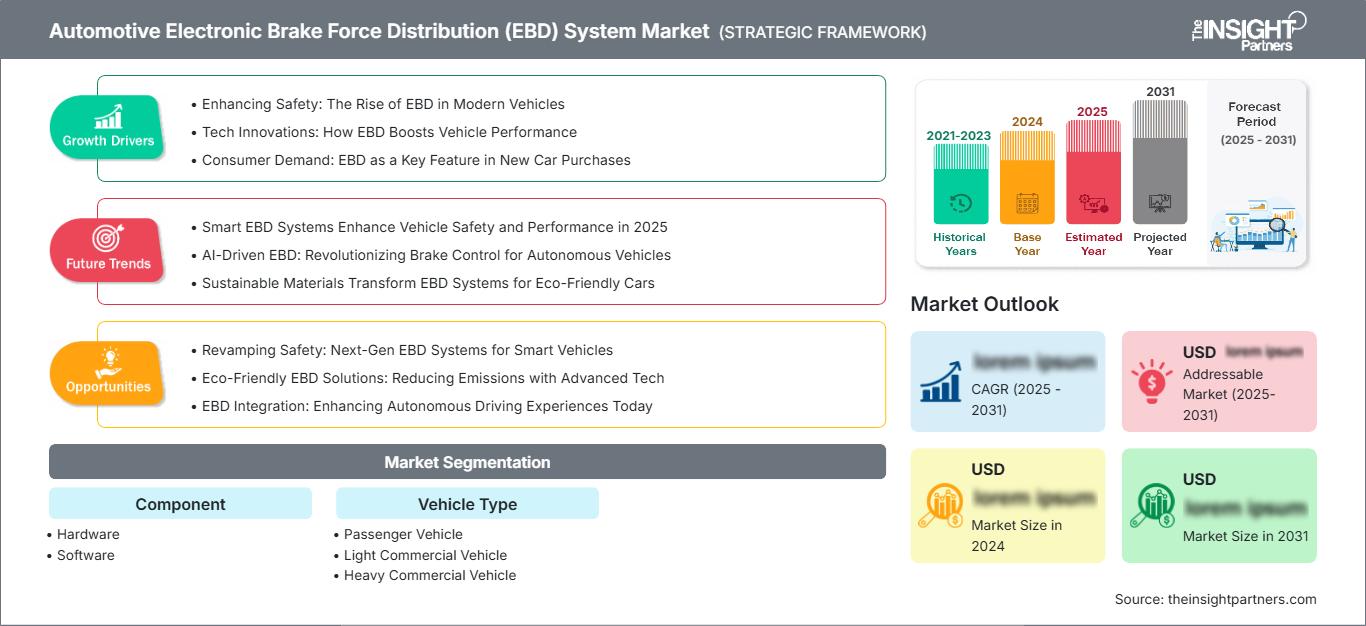
Automotive Electronic Brake Force Distribution (EBD) System Market: Strategic Insights
Regional Insights
North America Automotive Electronic Brake Force Distribution System Market
North America held the share of 31-34% of the market of automotive electronic brake force distribution system in 2025 and expected to register a CAGR of 3.6-4.2% during 2025-2034. The region has well-established automotive manufacturing, vehicle safety norms, and incorporation of electronic braking technology in passenger cars, sports utility vehicles, pickup trucks, and commercial vehicles. Growing demand for cars equipped with safety features keeps supporting OEMs' investments in electronic braking technology.
United States, Canada, and Mexico constitute one region which forms an integrated ecosystem in the manufacturing of automobiles with robust Tier I supplier base and semiconductor capabilities. Regulatory push towards electronic stability control, anti-lock braking system, and driver assistance systems keep growing demand for the products. Growing production of electric vehicles and development of software-defined vehicle platforms further augments regional growth prospects.
U.S. Automotive Electronic Brake Force Distribution System Market
The United States represented 74–78% of the North American market during 2025 while recording an estimated CAGR of 3.7–4.3% throughout the forecast period. Vehicle manufacturers continue introducing electronically controlled braking platforms that integrate brake force distribution with electronic stability control and autonomous emergency braking functions. Growing production of premium passenger vehicles and electric vehicles further increases installation rates across new vehicle platforms.
Major automotive suppliers including Robert Bosch GmbH, Continental AG, ZF Friedrichshafen AG, Autoliv Inc., and DENSO Corporation maintain extensive engineering, manufacturing, and research operations supporting OEM requirements across the country. Continuous software development, electronic control unit advancements, and adoption of intelligent braking technologies enable manufacturers to satisfy evolving regulatory requirements while improving overall vehicle safety and braking performance.
Europe Automotive Electronic Brake Force Distribution System Market
Europe captured 26–29% of the global market in 2025 and is anticipated to register a CAGR ranging between 3.4–4.0% during the forecast period. Germany remains the regional leader because of its concentration of premium automobile manufacturers and advanced automotive technology suppliers. The country's focus on vehicle electrification and intelligent mobility continues accelerating deployment of electronic braking solutions across multiple vehicle categories.
The United Kingdom continues expanding demand through increasing adoption of electric vehicles, connected mobility technologies, and government initiatives encouraging advanced safety systems. France, Italy, and Spain collectively strengthen regional demand through diversified automotive manufacturing, increasing electronic component integration, and modernization of commercial vehicle fleets. Continuous implementation of European vehicle safety regulations supports sustained adoption of electronic brake force distribution technologies across domestic and export-oriented vehicle production.
APAC Automotive Electronic Brake Force Distribution System Market
Asia Pacific accounted for 34–37% of the global market during 2025 and is projected to register the fastest regional CAGR of 4.1–4.7% through 2034. China remains the largest contributor owing to its extensive automotive production capacity, while Japan and South Korea continue leading technological innovation in intelligent braking systems.
India and Australia are witnessing increasing deployment of electronic braking technologies as vehicle safety regulations become more comprehensive. Growing electric vehicle production, expanding domestic manufacturing, and government incentives supporting automotive modernization continue creating favorable conditions for sustained regional market expansion.
Middle East & Africa Automotive Electronic Brake Force Distribution System Market
The Middle East & Africa market is expected to record a CAGR of 3.1–3.7% during the forecast period. Saudi Arabia and the United Arab Emirates continue investing in automotive manufacturing, mobility infrastructure, and smart transportation initiatives, supporting gradual adoption of advanced braking technologies across passenger and commercial vehicles.
South Africa remains the leading automotive production hub within Africa, while the Rest of Middle East & Africa continues experiencing gradual demand supported by commercial fleet modernization and improved vehicle safety standards. Increasing infrastructure investments and expansion of regional automotive assembly operations are expected to strengthen future adoption of electronic brake force distribution systems.
Segmentation Analysis
Component
The Component segment is projected to register a CAGR of 3.9–4.3% between 2026 and 2034. The automotive electronic brake force distribution system market scope continues expanding as manufacturers increase investments in advanced electronic hardware, embedded software, intelligent sensors, and integrated braking controllers capable of supporting connected and autonomous vehicle platforms. Continued advancements in semiconductor technology further improve braking precision, diagnostics, and overall system reliability.
- Hardware remains the largest contributor because electronic control modules, sensors, hydraulic units, and associated components form the foundation of electronic brake force distribution systems across passenger and commercial vehicle platforms.
- Software continues gaining strategic importance as intelligent braking algorithms, predictive diagnostics, cybersecurity, and over-the-air update capabilities become increasingly integrated within modern vehicle electronic architectures.
Vehicle Type
The Vehicle Type segment is expected to expand at a CAGR of 3.7–4.1% during the forecast period. Passenger vehicle production continues driving overall demand, while increasing adoption of electronic safety technologies in commercial vehicles supports broader market penetration. Growing electrification and regulatory emphasis on vehicle safety further contribute to sustained demand across all vehicle categories.
- Passenger Vehicle represents the largest revenue contributor because most newly manufactured passenger cars integrate electronic brake force distribution together with anti-lock braking systems and electronic stability control as standard safety equipment.
- Light Commercial Vehicle adoption continues increasing as fleet operators prioritize driver safety, lower maintenance costs, and regulatory compliance across logistics, delivery, and urban transportation applications.
- Heavy Commercial Vehicle demand is supported by increasing integration of intelligent braking technologies for improved vehicle stability, heavy-load control, and enhanced operational safety under diverse driving conditions.
Opportunity Snapshot
| Vehicle Type | Revenue Contribution | Trend Tag | Adoption Stage |
| Passenger Vehicle | High | ADAS Integration | Mature |
| Light Commercial Vehicle | Medium | Fleet Safety | Scaling |
| Heavy Commercial Vehicle | Medium | Stability Control | Scaling |
Automotive Electronic Brake Force Distribution (EBD) System Market Growth Drivers and Impact Analysis
Stringent Global Vehicle Safety Regulations Accelerating Electronic Brake Adoption
Vehicle safety regulations continue to represent one of the strongest catalysts for electronic brake force distribution system deployment worldwide. Regulatory authorities across North America, Europe, China, Japan, South Korea, and several emerging economies increasingly mandate advanced braking technologies as part of broader road safety initiatives. Electronic brake force distribution works alongside anti-lock braking systems and electronic stability control to optimize braking force according to vehicle load and road conditions, reducing stopping distances and improving directional stability. As automotive manufacturers strive to comply with evolving safety legislation while achieving higher vehicle safety ratings, installation rates continue increasing across passenger cars and commercial vehicles. This regulatory environment encourages suppliers to develop more intelligent, compact, and software-enabled braking solutions capable of supporting future mobility platforms.
Expansion of Electric and Software-Defined Vehicles Supporting Advanced Braking Systems
Rapid electrification of the automotive industry is creating favorable conditions for electronically controlled braking technologies. Battery electric vehicles and hybrid electric vehicles rely extensively on electronic control systems that seamlessly coordinate regenerative braking, electronic stability control, and brake force distribution. Software-defined vehicle architectures further enable centralized control of multiple safety functions through integrated electronic control units. Automotive manufacturers are investing in intelligent braking platforms capable of receiving software updates throughout the vehicle lifecycle while supporting autonomous driving features. As global electric vehicle production continues expanding, suppliers are increasing research activities focused on lightweight actuators, functional safety software, and advanced electronic controllers designed specifically for next-generation vehicle platforms.
Growing Consumer Preference for Active Safety Features Enhancing Market Penetration
Consumers increasingly consider active safety technologies when purchasing new vehicles, encouraging manufacturers to expand the availability of advanced braking systems across multiple vehicle categories. Features including automatic emergency braking, adaptive cruise control, lane keeping assistance, and electronic stability control rely on precise electronic brake management to deliver optimal performance. Electronic brake force distribution significantly enhances these integrated safety systems by continuously adjusting braking pressure according to dynamic driving conditions. Rising public awareness of vehicle safety, stronger insurance incentives for advanced safety technologies, and increasing safety assessment requirements from regulatory organizations collectively contribute to higher adoption rates across passenger vehicles, light commercial vehicles, and heavy commercial vehicles worldwide.
Automotive Electronic Brake Force Distribution (EBD) System Market Future Trends
Integration of Intelligent Brake Control with Software-Defined Vehicle Platforms
The automotive electronic brake force distribution system market trends indicate increasing convergence between intelligent braking technologies and centralized vehicle computing architectures. Vehicle manufacturers are replacing distributed electronic control systems with centralized computing platforms capable of managing multiple safety functions simultaneously. Electronic brake force distribution software is expected to become increasingly adaptive through artificial intelligence, predictive diagnostics, and over-the-air software updates. This evolution enables continuous performance optimization, simplified system maintenance, and improved compatibility with autonomous driving technologies while reducing overall electronic system complexity.
Increasing Adoption of Brake-by-Wire Technologies Across Premium Vehicles
Brake-by-wire technology is gradually transitioning from premium vehicle platforms toward broader commercial adoption as manufacturers pursue lighter, more responsive braking architectures. Electronic brake force distribution systems are expected to play an increasingly important role within these fully electronic braking environments by enabling precise pressure modulation, improved integration with regenerative braking systems, and enhanced compatibility with autonomous driving applications. Continuous improvements in functional safety certification, cybersecurity, and electronic redundancy are expected to accelerate market acceptance throughout the forecast period.
Automotive Electronic Brake Force Distribution (EBD) System Market Opportunities
Expansion Across Emerging Automotive Manufacturing Hubs
Rapid expansion of vehicle manufacturing facilities throughout India, Southeast Asia, Eastern Europe, and Latin America presents significant long-term investment opportunities. The automotive electronic brake force distribution system market Forecasts indicate increasing installation of electronic safety technologies as regional governments strengthen vehicle safety regulations and manufacturers introduce globally standardized vehicle platforms. Component suppliers investing in localized manufacturing, engineering support, and regional partnerships are expected to strengthen supply chain resilience while reducing production costs. Continued industrialization and rising consumer demand for safer vehicles provide favorable conditions for long-term capacity expansion and technology transfer initiatives.
Development of Next-Generation Integrated Electronic Braking Platforms
Growing demand for integrated vehicle safety architectures creates opportunities for suppliers capable of combining brake force distribution, electronic stability control, autonomous emergency braking, and predictive diagnostics within unified electronic platforms. Manufacturers investing in software development, semiconductor integration, lightweight materials, and intelligent sensors are expected to improve competitive positioning as software-defined vehicles become increasingly common. Strategic collaboration between OEMs, semiconductor manufacturers, and braking technology providers is likely to accelerate commercialization of highly integrated braking systems supporting future autonomous and connected mobility ecosystems.
Frequently Asked Questions

- Comprehensive Market Sizing and Forecast Analysis
- Detailed Segmentation Analysis
- In-Depth Market Dynamics Assessment
- Regional and Country-Level Insights
- Competitive Landscape and Company Benchmarking
- Strategic Business Intelligence
Recent Reports
Testimonials

The Insight Partners' SCADA System Market report is comprehensive, with valuable insights on current trends and future forecasts. The team was highly professional, responsive, and supportive throughout. We are very satisfied and highly recommend their services.
RAN KEDEM Partner, Reali Technologies LTDs
I requested a report on a very specific software market and the team produced the report in a few days. The information was very relevant and well presented. I then requested some changes and additions to the report. The team was again very responsive and I got the final report in less than a week.
JEAN-HERVE JENN Chairman, Future Analytica
We worked with The Insight Partners for an important market study and forecast. They gave us clear insights into opportunities and risks, which helped shape our plans. Their research was easy to use and based on solid data. It helped us make smart, confident decisions. We highly recommend them.
PIYUSH NAGPAL Sr. Vice President, High Beam Global
The Insight Partners delivered insightful, well-structured market research with strong domain expertise. Their team was professional and responsive throughout. The user-friendly website made accessing industry reports seamless. We highly recommend them for reliable, high-quality research services
YUKIHIKO ADACHI CEO, Deep Blue, LLC.
This is the first time I have purchased a market report from The Insight Partners.While I was unsure at first, I visited their web site and felt more comfortable to take the risk and purchase a market report.I am completely satisfied with the quality of the report and customer service. I had several questions and comments with the initial report, but after a couple of dialogs over email with their analyst I believe I have a report that I can use as input to our strategic planning process.Thank you so much for taking the extra time and making this a positive experience.I will definitely recommend your service to others and you will be my first call when we need further market data.
JOHN SUZUKI President and Chief Executive Officer, Board Director, BK Technologies
I wish to appreciate your support and the professionalism you displayed in the course of attending to my request for information regarding to infectious disease IVD market in Nigeria. I appreciate your patience, your guidance, and the fact that you were willing to offer a discount, which eventually made it possible for us to close a deal. I look forward to engaging The Insight Partners in the future, all thanks to the impression you have created in me as a result of this first encounter.
DR CHIJIOKE ONYIA MANAGING DIRECTOR, PineCrest Healthcare Ltd.Reason to Buy
- Informed Decision-Making
- Understanding Market Dynamics
- Competitive Analysis
- Identifying Emerging Markets
- Customer Insights
- Market Forecasts
- Risk Mitigation
- Boosting Operational Efficiency
- Strategic Planning
- Investment Justification
- Tracking Industry Innovations
- Aligning with Regulatory Trends





 Get Free Sample for