
Axial Flow Compressor Market Size, Share & Forecast by 2034
Coverage: By Stage Type (Single-stage, Multi-stage); Type (Vertical Axial Compressor, Horizontal Axial Compressor); End-user (Oil and Gas, Chemical, Marine, Power Generation, Others) , and Geography (North America, Europe, Asia Pacific, and South and Central America)
- Status : Data Released
- Report Code : TIPRE00018727
- Category : Electronics and Semiconductor
- No. of Pages : 150
- Available Report Formats :


- Last update date : July 20, 2026


2025 Market Size
US$ 8.87 Bn
Base year value
2034 Forecast
US$ 12.64 Bn
Projected by 2034
CAGR 2026-2034
4.01 %
Growth rate
Addressable Market
US$ 97.67 Bn
(2026-2034)
The global Axial Flow Compressor market was valued at US$ 8.87 billion in 2025 and is expected to reach US$ 12.64 billion by 2034; it is estimated to record a CAGR of 4.01% during 2026-2034.
Axial Flow Compressor Market Assessment and Insights
- North America: The region accounts for 24–28% share in 2025 and grows at a CAGR range of 3.9–4.4% during 2026–2034, supported by LNG terminals, refinery revamps, and gas-fired power reliability projects.
- US: The country represents 74–78% of North America in 2025 and grows at a CAGR range of 4.0–4.5% during 2026–2034, led by shale gas and petrochemicals.
- Europe: Europe holds 20–24% share in 2025 and grows at a CAGR range of 3.5–4.1% during 2026–2034, with Germany, the UK, France, Italy, and Spain leading retrofit demand.
- Asia Pacific: Asia Pacific holds 34–38% share in 2025 and grows at a CAGR range of 5.0–5.6% during 2026–2034, led by China, Japan, South Korea, India, and Australia.
- Largest Segment: Multi-stage compressors hold 66–70% market share in 2025 and grow at a CAGR range of 4.4–4.9% during 2026–2034 because industrial processes need pressure stability.
- High Growth Segment: Power generation holds 18–22% market share in 2025 and grows at a CAGR range of 5.1–5.7% during 2026–2034 through grid flexibility investments.
- Key companies analyzed in detail: Elliott Group; General Electric Company; Howden Compressors Limited; Ingersoll Rand Inc.; Everllence SE; Mitsubishi Power, Ltd.; Mitsui E&S Co., Ltd.; Siemens AG; Wärtsilä Corporation; Zhejiang Kaishan Compressor Co., Ltd.
Source: The Insight Partners' analysis based on proprietary research, government publications, company annual reports, investor presentations, industry databases, and expert interviews.
Axial compression technology has matured into an efficient tool for refinery applications, air separation units, gas processing facilities, and heavy industries, with its choice primarily based on its flow performance capabilities. Factors like variable guide vanes, optimized blades, digital control and sensing, as well as rotor dynamics considerations, play an equally important role in value delivery throughout the lifecycle compared to rated capacity. Engineering of the compression package in terms of production dynamics is going towards designing packages that are more modular, service-friendly, and that reduce outage duration.
Future procurement trends will be defined by developments in Asia with respect to the growth of industrial capacities, developments in North America as regards the construction of new gas facilities, and European decarbonization projects, which require compression in large volumes. Investments will focus on compressor trains, which are compatible with the addition of hydrogen, carbon capture technologies, ammonia, LNG, and flexible power generation.
Axial Flow Compressor Market Report Scope
| Report Attribute | Details |
|---|---|
| Market size in 2025 | US$ 8.87 Billion |
| Market Size by 2034 | US$ 12.64 Billion |
| Global CAGR (2026 - 2034) | 4.01% |
| Historical Data | 2021-2024 |
| Forecast period | 2026-2034 |
Axial Flow Compressor Market Analysis
Axial Flow Compressor Market growth is driven by high-volume process air requirements, LNG expansion, hydrogen and ammonia projects, and continued reliance on efficient gas-fired generation for system balancing. IEA scenarios indicate rising electricity demand and sustained natural gas relevance into the 2030s, creating a durable base for compression equipment in power, liquefaction, pipeline, and industrial processes.
The value chain includes aerodynamic design teams, forged and machined rotor suppliers, casing manufacturers, bearing and seal specialists, control-system providers, EPC contractors, and aftermarket service networks. Supply dynamics favor vendors that can validate performance, manage long-lead metallurgy, provide field balancing, and support operating envelopes across air, process gases, CO₂, and fuel-gas compression duties.
The market analysis of Axial Flow Compressors shows a high level of market concentration where engineering reputation, installed base, and service capability play a greater role than just the price. Elliott Group and Everllence SE are strong competitors in heavy-duty turbomachinery, whereas General Electric Company, Mitsubishi Power, Ltd., Siemens AG, and Wärtsilä Corporation link compressor demand to power, marine, and energy transition segments.
Key investment areas include the development of condition-based monitoring systems, standardization of platform design, energy saving retrofits, and local presence near LNG, petrochemical, and power hubs. Howden Compressors Limited, Ingersoll Rand Inc., Mitsui E&S Co., Ltd., and Zhejiang Kaishan Compressor Co., Ltd. raise the competitive pressure by developing specialized solutions, regional presence, and lifecycle support.
● REPORT CUSTOMIZATION
Tailor This Report To Align With Your Specific Business Requirements
This report can be customized to align precisely with your business objectives, scope, and target markets. Customization options include tailored segmentation, geography, competitive analysis, and strategic insights to support informed decision-making.
Customize This Report →WHAT YOU CAN ADJUST
- ● Segmentations
- ● Geography
- ● Competitive Analysis
- ● Language Preferences
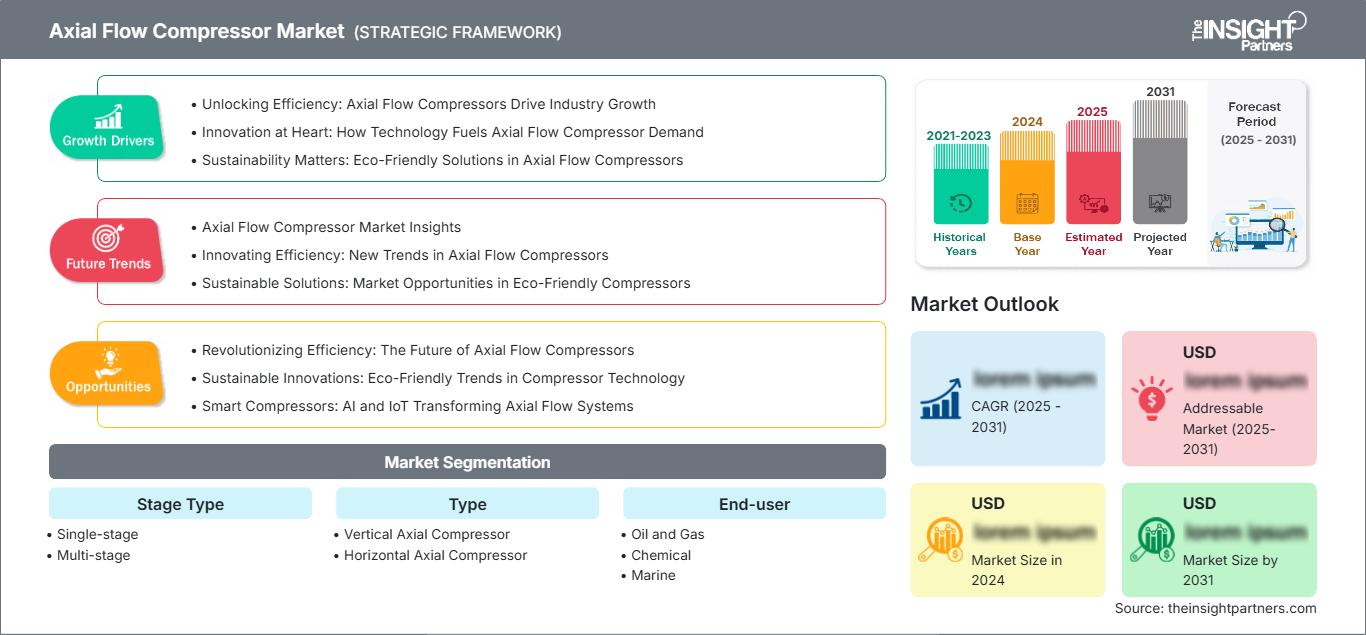
Axial Flow Compressor Market: Strategic Insights
Regional Insights
North America Axial Flow Compressor Market
North America holds 24–28% share in 2025 and is projected to grow at a CAGR range of 3.9–4.4% during 2026–2034. Axial Flow Compressor Market share is supported by shale gas processing, LNG export terminals, refinery optimization, and petrochemical expansions along the U.S. Gulf Coast. Operators prioritize compressor efficiency, surge control, and service availability because unplanned downtime can halt continuous production.
Canada contributes through oil sands, gas processing, hydrogen pilots, and industrial decarbonization projects, while Mexico supports demand from refining, power, and manufacturing investments. Replacement demand is important because many installed compressors were specified for older process conditions. Retrofit projects increasingly combine aerodynamic upgrades, control modernization, and remote diagnostics to extend asset life without full train replacement.
U.S. Axial Flow Compressor Market
The U.S. represents 74–78% of North America in 2025 and grows at a CAGR range of 4.0–4.5% during 2026–2034. Demand is concentrated in LNG liquefaction, natural gas liquids processing, refining, petrochemicals, and peaking power facilities. Elliott Group, General Electric Company, Ingersoll Rand Inc., Siemens AG, and Mitsubishi Power, Ltd. benefit from installed equipment, service networks, and rotating-equipment engineering capabilities.
Application trends emphasize large air and process-gas flows, compressor uprates, spare rotor programs, and controls that improve turndown under variable plant loads. U.S. buyers also value domestic machining, repair, and emergency service capacity because outage windows in refineries and LNG plants are tightly scheduled. Digital monitoring is moving from an optional add-on to a standard reliability practice.
Europe Axial Flow Compressor Market
Europe accounts for 20–24% share in 2025 and grows at a CAGR range of 3.5–4.1% during 2026–2034. Germany leads through chemicals, industrial gases, turbomachinery engineering, and energy-efficiency retrofits. The UK supports offshore, LNG, and carbon capture activity, while France, Italy, and Spain contribute through refining upgrades, power flexibility, hydrogen clusters, and process-industry modernization.
European demand is shaped by energy-security policy, emissions reduction, and high electricity costs that make compressor efficiency financially material. Operators often prefer lifecycle upgrades over new-build capacity because permitting and capital discipline remain tight. Everllence SE, Siemens AG, Howden Compressors Limited, and MAN’s successor turbomachinery network give the region strong engineering depth for axial, radial, and hybrid compressor solutions.
APAC Axial Flow Compressor Market
APAC holds 34–38% share in 2025 and is projected to grow at a CAGR range of 5.0–5.6% during 2026–2034. China leads through steel, chemicals, air separation, LNG, and power projects, followed by Japan, South Korea, India, and Australia. Industrial scale and localized manufacturing improve adoption economics.
Policy support for gas infrastructure, hydrogen, ammonia, and industrial decarbonization sustains compressor procurement. India adds refining, fertilizer, and power demand, while Japan and South Korea focus on high-efficiency turbomachinery for LNG, shipbuilding, and clean-fuel value chains. Australia supports LNG maintenance and mining-related compression.
Middle East & Africa Axial Flow Compressor Market
The Middle East & Africa is projected to grow at a CAGR range of 4.6–5.2% during 2026–2034. Saudi Arabia moves forward in the sectors of gas processing, petrochemicals, refining, and industrial diversification, while UAE drives LNG, power, and port energy infrastructure. In South Africa, there is replacement demand in the power and process industries.
The RoMEA market will still depend on projects for procurement, which will be linked to upstream developments, fertilizers, desalination, and power reliability. The heat in the climate makes cooling and material issues more critical. There is an advantage for the compressor companies with their own workshops and spare parts availability in the region.
Segmentation Analysis
Stage Type
Stage Type is projected to grow at a CAGR range of 4.3–4.8% during 2026–2034. The Axial Flow Compressor Market scope is widest in multi-stage systems because plants require high flow, stable pressure ratios, and efficient operation across continuous duty cycles. Single-stage equipment remains relevant where pressure lift is modest, layout simplicity matters, or compact installations prioritize lower capital intensity.
- Single-stage: Single-stage units serve applications requiring high flow with limited pressure rise, giving operators simpler maintenance, compact installation, and lower upfront cost in selected ventilation, process-air, and auxiliary duties.
- Multi-stage: Multi-stage compressors dominate large process plants because staged aerodynamics improve pressure development, efficiency, and operating flexibility in LNG, air separation, refining, petrochemical, and power-generation environments.
Type
Type is expected to grow at a CAGR range of 4.1–4.7% during 2026–2034. Vertical and horizontal configurations are selected according to footprint, maintenance access, process layout, driver alignment, and foundation constraints. Horizontal axial compressors remain common in heavy-duty compressor trains, while vertical designs can fit space-limited industrial layouts where plant architecture constrains conventional equipment orientation.
- Vertical Axial Compressor: Vertical designs support installations where footprint, duct routing, and plant layout are restrictive, helping operators integrate high-flow compression into constrained industrial environments without extensive civil modification.
- Horizontal Axial Compressor: Horizontal compressors are preferred for large trains because they simplify rotor access, alignment, inspection, and coupling with steam turbines, gas turbines, or electric motor drivers.
End-user
End-user is forecast to grow at a CAGR range of 4.5–5.1% during 2026–2034. Oil and gas remain central because production, liquefaction, and processing require large-volume compression. Chemical plants use axial units for process air and feed-gas duties, marine demand follows propulsion and LNG systems, and power generation accelerates through flexible gas turbines and grid-support projects.
- Oil and Gas: Oil and gas users require continuous-duty compressors for LNG, gas processing, refinery air, and pipeline-related services where reliability, surge protection, and service availability drive procurement decisions.
- Chemical: Chemical producers use axial compression for air separation, nitric acid, fertilizer, petrochemical, and process-gas applications, where efficiency gains translate directly into lower energy intensity.
- Marine: Marine applications benefit from compressor technologies linked to LNG carriers, onboard power, shipyard systems, and fuel-gas handling as vessel efficiency and alternative-fuel adoption increase.
- Power Generation: Power generation demand rises as gas turbines, peaking plants, and hybrid energy systems require efficient airflow, compressor maintenance, and upgrades that improve availability under flexible operating cycles.
Opportunity Snapshot
| End-user | Revenue Contribution | Trend Tag | Adoption Stage |
| Oil and Gas | High | LNG Expansion | Mature |
| Chemical | High | Process Air | Mature |
| Marine | Medium | LNG Vessels | Scaling |
| Power Generation | Medium | Grid Flex | Scaling |
Axial Flow Compressor Market Growth Drivers and Impact Analysis
LNG, Gas Processing, and Energy Security Investment
Natural gas infrastructure is a major driver because liquefaction, regasification, processing, and pipeline support rely on large rotating equipment with high flow and dependable uptime. The International Energy Agency expects natural gas demand to remain relevant into the 2030s under stated policy pathways, while new LNG capacity reshapes trade flows. This creates opportunities for compressor trains, upgrades, spare rotors, and long-term service agreements. Market impact is strongest in the U.S., Qatar, Australia, China, and India, where energy security and industrial growth intersect. For the Axial Flow Compressor Market, gas-sector investment sustains demand beyond new-build equipment by expanding aftermarket, controls, and performance-improvement work.
Industrial Efficiency and Emissions Reduction Requirements
The compressor is one of the biggest consumers of energy at the continuous processing plants, and this means that minor efficiencies would have an effect on costs, emissions, and competitiveness. As a result, refineries, fertilizer manufacturers, steel producers, and chemical plants are considering blade optimization, inlet guide vane technology, better sealing systems, and performance monitoring using digital solutions. It can be seen in the increase of retrofits when users are not replacing their equipment but saving energy and improving reliability. With carbon pricing, companies' zero-emission targets, and high energy costs, there is enough justification for such investments. Suppliers that can prove and demonstrate life-cycle savings and short downtime execution would benefit from that.
Power System Flexibility and Turbine Fleet Support
Rising renewable generation requires flexible gas-fired generation, peaking generation, and power plants that are reliable and can be started up quickly, have ramping capability and operate well under variable loads. The importance of axial compression cannot be ignored in relation to gas turbine operation and service ecosystems associated with compressors. The peak electrical demand is forecast to grow substantially by 2035 based on IEA analysis. This would imply an increased requirement for generation resources that are resilient and support the grid system. The implications of the above include demand for inspections of compressors, blade repair work, controls and other service contracts.
Axial Flow Compressor Market Future Trends
Hydrogen, Ammonia, and Carbon Capture Ready Designs
Axial Flow Compressor Market trends will increasingly center on designs compatible with hydrogen blending, ammonia value chains, and carbon capture processes. Future projects will demand materials, seals, aerodynamics, and control systems capable of dealing with various molecular weight compounds, corrosive properties, and operating ranges safely. There will be an increased need for closer cooperation between compressor manufacturers and EPCs, licensors, and plant owners in the front-end engineering process. This trend does not apply only to new facilities since many refineries, chemical plants, and power plants will have needs for upgrading facilities producing lower carbon fuels and capturing carbon dioxide emissions.
Digital Twins and Predictive Compressor Operations
Digital twins will become more widely used in compressor services for earlier warning about fouling, surge risk, vibrations, and losses in efficiency. These future systems will use information from operations, thermodynamic models, inspection reports, and maintenance records in order to make suggestions about performing cleaning or inspections or making control adjustments before performance losses occur and cause any negative consequences. This will affect competition between suppliers since software and analytics, as well as remote engineering services, will play their role in purchasing decisions. Companies without sufficient experience in working with rotating equipment may choose OEM monitoring agreements.
Axial Flow Compressor Market Opportunities
Aftermarket Modernization of Installed Compressor Fleets
Axial Flow Compressor Market Forecasts point to a strong opportunity in retrofits, uprates, spare rotors, controls, and condition-monitoring packages for aging installed fleets. Many refineries, natural gas facilities, and chemical complexes are looking at the extension of equipment life rather than the replacement of entire trains due to factors such as permits, capital expenditure limitations, and restricted outages for new builds. The supplier should focus on aerodynamics modifications, sealing technologies, guide vane improvement, and faster field support services. The reasons this strategy would work well are that investment in modernizations is more stable compared to the investment in green field projects and there is also the energy savings angle.
Localized Manufacturing and Service in Asia Pacific
The Asia Pacific region provides an actionable business opportunity in respect of localized manufacture, packaging, testing, and servicing of compressors as project owners continue to demand faster delivery and reduced logistics risks. The two largest economies of China and India offer scale in chemicals, refining, fertilizer, power, and industrial gas applications, whereas the developed nations of Japan and South Korea provide experience in high-end liquefied natural gas, shipbuilding, and hydrogen. Localized operations will help new market players and existing vendors gain a competitive edge by providing localized machining and rotor balancing services and engaging EPC contractors.
Recent Developments
- April 2026: ShaanGu successfully commissioned the blast furnace gas residual-pressure recovery turbine-generator unit and axial-flow compressor set supplied for a new industrial park project in Indonesia. The equipment was successfully installed and completed a first trial run, with all technical indicators meeting design requirements. The customized solution includes an energy recovery turbine unit that utilizes residual pressure and heat from blast furnace top gas for power generation, along with an axial-flow compressor set featuring low energy consumption, stable operation, and a wide adjustment range to improve blast furnace efficiency and energy utilization.
- September 2025: OJUS Power and Technologies entered into a strategic partnership with Hitachi Industrial Equipment Systems (HIES) to launch a new range of advanced industrial air compressors in India. Under the agreement, OJUS will serve as the pan-India distributor for Hitachi’s portfolio of oil-injected and oil-free rotary screw, reciprocating, and scroll compressors, catering to industries including automotive, pharmaceuticals, food processing, engineering, cement, and chemicals. The partnership combines Hitachi’s compressor technology with OJUS’s nationwide sales and service network to deliver energy-efficient, reliable compressed-air solutions and to strengthen India–Japan industrial collaboration.
- June 2024: Mirai Intex announced the successful completion of stress testing for its world’s first R290 (propane) turbo compressor designed for commercial and industrial refrigeration applications. The new MT230 and MT350 oil-free turbo compressors, with cooling capacities of 230 kW and 350 kW, are intended for air- and water-cooled chillers.
Frequently Asked Questions

- Comprehensive Market Sizing and Forecast Analysis
- Detailed Segmentation Analysis
- In-Depth Market Dynamics Assessment
- Regional and Country-Level Insights
- Competitive Landscape and Company Benchmarking
- Strategic Business Intelligence
Recent Reports
Testimonials

The Insight Partners' SCADA System Market report is comprehensive, with valuable insights on current trends and future forecasts. The team was highly professional, responsive, and supportive throughout. We are very satisfied and highly recommend their services.
RAN KEDEM Partner, Reali Technologies LTDs
I requested a report on a very specific software market and the team produced the report in a few days. The information was very relevant and well presented. I then requested some changes and additions to the report. The team was again very responsive and I got the final report in less than a week.
JEAN-HERVE JENN Chairman, Future Analytica
We worked with The Insight Partners for an important market study and forecast. They gave us clear insights into opportunities and risks, which helped shape our plans. Their research was easy to use and based on solid data. It helped us make smart, confident decisions. We highly recommend them.
PIYUSH NAGPAL Sr. Vice President, High Beam Global
The Insight Partners delivered insightful, well-structured market research with strong domain expertise. Their team was professional and responsive throughout. The user-friendly website made accessing industry reports seamless. We highly recommend them for reliable, high-quality research services
YUKIHIKO ADACHI CEO, Deep Blue, LLC.
This is the first time I have purchased a market report from The Insight Partners.While I was unsure at first, I visited their web site and felt more comfortable to take the risk and purchase a market report.I am completely satisfied with the quality of the report and customer service. I had several questions and comments with the initial report, but after a couple of dialogs over email with their analyst I believe I have a report that I can use as input to our strategic planning process.Thank you so much for taking the extra time and making this a positive experience.I will definitely recommend your service to others and you will be my first call when we need further market data.
JOHN SUZUKI President and Chief Executive Officer, Board Director, BK Technologies
I wish to appreciate your support and the professionalism you displayed in the course of attending to my request for information regarding to infectious disease IVD market in Nigeria. I appreciate your patience, your guidance, and the fact that you were willing to offer a discount, which eventually made it possible for us to close a deal. I look forward to engaging The Insight Partners in the future, all thanks to the impression you have created in me as a result of this first encounter.
DR CHIJIOKE ONYIA MANAGING DIRECTOR, PineCrest Healthcare Ltd.Reason to Buy
- Informed Decision-Making
- Understanding Market Dynamics
- Competitive Analysis
- Identifying Emerging Markets
- Customer Insights
- Market Forecasts
- Risk Mitigation
- Boosting Operational Efficiency
- Strategic Planning
- Investment Justification
- Tracking Industry Innovations
- Aligning with Regulatory Trends





 Get Free Sample for