
Capacitor Market Growth, Trends & Forecast by 2034
Coverage: By Type (Ceramic Capacitor, Film Capacitor, Electrolytic Capacitors, Variable Capacitors); Application (Energy Storage, Power Conducting, Motor Starter, Oscillator, Others) , and Geography (North America, Europe, Asia Pacific, and South and Central America)
- Status : Data Released
- Report Code : TIPRE00024665
- Category : Electronics and Semiconductor
- No. of Pages : 150
- Available Report Formats :


- Last update date : August 05, 2026


2025 Market Size
US$ 31.60 Bn
Base year value
2034 Forecast
US$ 45.02 Bn
Projected by 2034
CAGR 2026-2034
4.01 %
Growth rate
Addressable Market
US$ 347.97 Bn
(2026-2034)
The Capacitor Market size was worth US$ 31.60 billion in 2025 and forecasted to be US$ 45.02 billion by 2034, registering a CAGR of 4.01% between 2026 and 2034. This growth is attributed to growing application of ceramic, film, electrolytic, and variable capacitors within energy storage, power transmission, motor starters, and oscillators applications that require reliable and small sized and thermally stable products.
North America will grow at CAGR of 3.6-4.0% due to grid modernization, EV charger technology, aerospace electronics, and data center power density requirements. Growth in the Capacitor Market in North America is influenced more by high-value industrial demand than the volumes of consumer electronic products, especially in the US.
Capacitor Market Assessment and Insights
- North America accounted for 23–26% share in 2025 and is projected to grow at a CAGR of 3.6–4.0% during 2026–2034, driven by grid upgrades, EV charging, and data center electronics.
- US represented 78–82% of North America in 2025 and is expected to grow at a CAGR of 3.7–4.1% during 2026–2034.
- Europe held 19–22% share in 2025 and is forecast to grow at a CAGR of 3.4–3.8%, led by Germany, France, the UK, Italy, and Spain.
- Asia Pacific captured 44–48% share in 2025 and is expected to grow at a CAGR of 4.4–4.8%, led by China, Japan, South Korea, India, and Taiwan.
- Largest Segment Ceramic Capacitor held 48–52% market share in 2025, with CAGR of 3.8–4.2% during 2026–2034, supported by MLCC use in electronics and EVs.
- High Growth Segment Energy Storage held 28–32% market share in 2025, with CAGR of 4.6–5.0% during 2026–2034, supported by renewable inverters and backup systems.
- Key companies analyzed in detail: Cornell Dubilier Electronics, Inc.; Illinois Capacitor, Inc.; TDK Electronics AG; Würth Elektronik eiSos GmbH & Co. KG; Taicon Corporation; Toshin Kogyo Co., Ltd.; CapXon Electronic Industrial Co., Ltd.; Elna Co., Ltd.; G-Luxon Electronics Co., Ltd.; Panasonic Industry Co., Ltd.
Source: The Insight Partners' analysis based on proprietary research, government publications, company annual reports, investor presentations, industry databases, and expert interviews.
Design drivers have evolved away from mere capacitance availability to compact, high ripple, low ESR, and application-qualified solutions. Consistent lead times for 2025, observed in all passive component channels, signal improved management following previous shortages, as AI server farms, EV traction inverters, industrial drives, and renewable energy converters are driving higher value content requirements. Ceramic components continue to dominate volume, although film and electrolytic hybrid designs are growing significance in high voltage conversion circuits.
Future requirements will be driven by localized electronics manufacturing, increased EV charging stations, and policy-driven spending on robust power systems. Multi-sourcing of manufacturing locations, automotive qualification of products, and optimal materials are projected to be design focuses for manufacturers. Emerging regions of Asia and select infrastructure markets in the Middle East will contribute additional demand through the use of industrial automation, smart grid, and distributed energy assets.
Capacitor Market Report Scope
| Report Attribute | Details |
|---|---|
| Market size in 2025 | US$ 31.60 Billion |
| Market Size by 2034 | US$ 45.02 Billion |
| Global CAGR (2026 - 2034) | 4.01% |
| Historical Data | 2021-2024 |
| Forecast period | 2026-2034 |
Capacitor Market Analysis
Capacitor Market growth is attributed to increased electrification, switching frequencies, and the requirement for stability in power supply within a smaller form factor. According to the IEA electricity outlook, demand will continue to rise in the sectors of transport, industry, data centers, and buildings, hence increasing the need for power conversion equipment. In these sectors, the capacitors ensure filtration, smoothing, absorbing of surge currents, and buffering of energy.
The ecosystem includes dielectric suppliers, aluminum foil manufacturers, ceramic powder suppliers, winding and sintering facilities, distributors, and OEMs’ qualifications team. The market dynamics remain sensitive to availability of barium titanate, polypropylene film, aluminum, and specialty polymers. Automotive and industrial buyers are increasingly relying on their approved vendor list making it a hindrance for new competitors while a stabilizing factor for incumbent players.
Capacitor Market Analysis indicates that the market comprises a competitive environment comprising both generic passive component companies as well as companies specialized in technology. Panasonic Industry Co., Ltd is enhancing the manufacturing capability for hybrid capacitors while TDK Electronics AG manufactures film and aluminum capacitors with the help of its EPCOS legacy. Würth Elektronik eiSos GmbH & Co. KG concentrates on providing design-in services for industrial electronics.
Cornell Dubilier Electronics, Inc., Illinois Capacitor, Inc., Taicon Corporation, Toshin Kogyo Co., Ltd., CapXon Electronic Industrial Co., Ltd., Elna Co., Ltd., and G-Luxon Electronics Co., Ltd. compete by providing reliability, quick lead times, and specific application portfolio. Investments are being made in the following areas - miniature packaging, increased voltage rating, and production redundancy in certain regions for end-users.
● REPORT CUSTOMIZATION
Tailor This Report To Align With Your Specific Business Requirements
This report can be customized to align precisely with your business objectives, scope, and target markets. Customization options include tailored segmentation, geography, competitive analysis, and strategic insights to support informed decision-making.
Customize This Report →WHAT YOU CAN ADJUST
- ● Segmentations
- ● Geography
- ● Competitive Analysis
- ● Language Preferences
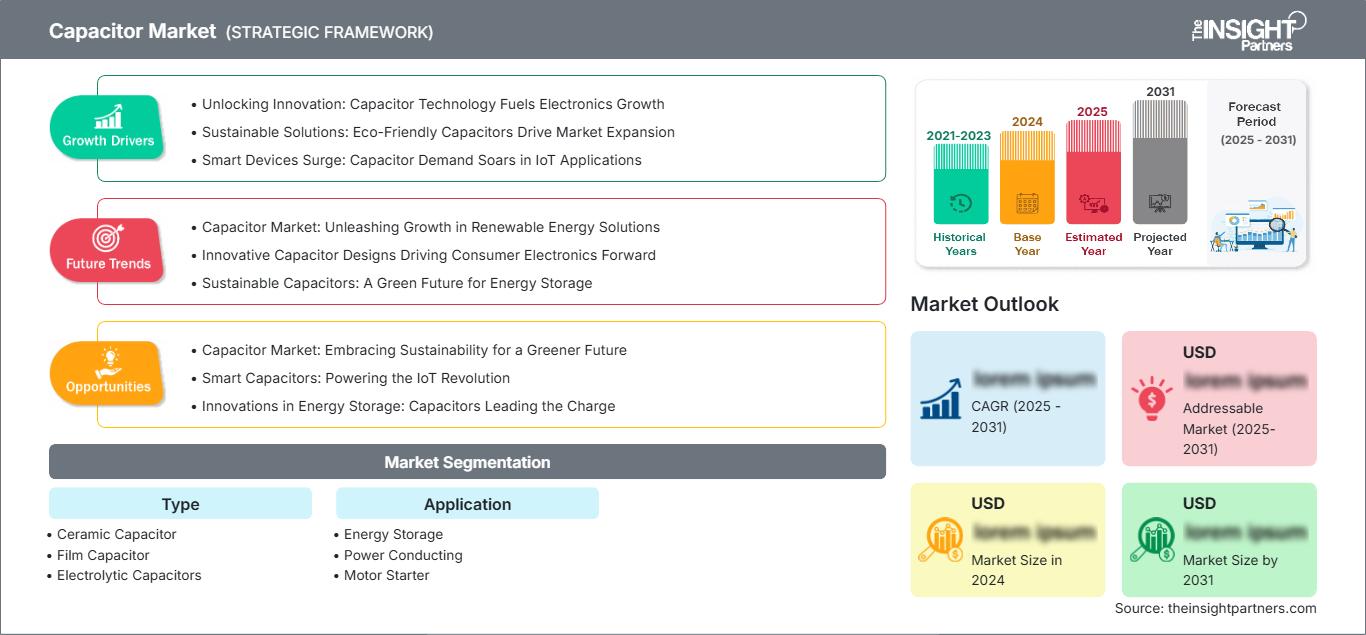
Capacitor Market: Strategic Insights
Regional Insights
North America Capacitor Market
North America held 23–26% share in 2025 and is expected to grow at a CAGR of 3.6–4.0% during 2026–2034. The region benefits from advanced industrial automation, aerospace electronics, medical devices, and high-density computing infrastructure. The Capacitor Market share is supported by demand for qualified components that meet reliability standards in power supplies, motor drives, and grid-connected equipment.
U.S. grid modernization, EV charger deployment, and reshoring of electronics assembly are creating selective opportunities for film, aluminum electrolytic, and ceramic capacitors. Canada contributes through renewable integration and industrial electrification, while Mexico supports regional electronics assembly. Buyers prioritize supplier traceability, lifecycle continuity, and design support, making established distributors and application engineers important to purchasing decisions.
U.S. Capacitor Market
North America was dominated by the U.S. in 2025, accounting for 78–82%, and is expected to expand at a CAGR of 3.7–4.1% between 2026 and 2034. The sectors where demand has been high include data centers, defense electronics, electric vehicle infrastructure, renewables inverters, and medical equipment. American buyers are placing greater importance on capacitor availability, product longevity, and compliance documents for critical applications.
Corporate presence is strengthened by Cornell Dubilier Electronics, Inc. and Illinois Capacitor, Inc., along with international corporations that cater to U.S. original equipment manufacturers through distributors. Trends in application have seen high ripple aluminum electrolytic, DC link film capacitors, and MLCCs in server boards. Purchasing departments are weighing pricing against qualification risks in aerospace, industrial drives, and charging equipment.
Europe Capacitor Market
Europe represented 19-22% market share in 2025 and is anticipated to experience CAGR of 3.4-3.8% from 2026 to 2034. Germany represents the dominant country driven by automotive electronics, industrial automation, renewable power conversion, and precise manufacturing. The UK invests in aerospace and defense, as well as in power electronics, where reliable, documented items are of great importance in the procurement process.
France, Italy, and Spain create additional demand through railway transportation, energy infrastructure, industrial motors and drives, and distributed solar systems. The policies related to energy efficiency and product conformity in Europe increase the value of longer-lasting and higher thermal properties capacitors. Two important regionally relevant players in the industry are TDK Electronics AG and Würth Elektronik eiSos GmbH & Co. KG.
APAC Capacitor Market
APAC gained 44-48% share in 2025 and is forecasted to expand at a CAGR of 4.4-4.8% during 2026-2034. The key country in APAC is China owing to electronics manufacturing, electric vehicle manufacturing, solar inverter manufacturing, and localization of components. Japan and South Korea provide impetus for advanced material industry, MLCC manufacturing, and automotive electronics industry.
India and Australia provide growth through renewables, industrial automation, and grids. Taiwan provides infrastructure for semiconductors and servers that require high-volume passive components. Companies from the region, including Taicon Corporation, CapXon Electronic Industrial Co., Ltd., Elna Co., Ltd., and G-Luxon Electronics Co., Ltd., are in competition due to costs and responsiveness.
Middle East & Africa Capacitor Market
The Middle East & Africa region is projected to register a compound annual growth rate (CAGR) of 3.2–3.6% between 2026 and 2034, owing to utility-scale power generation projects in Saudi Arabia, industrial diversification, and infrastructure modernization. UAE supports through data centers, electrification of buildings, and installation of renewables, which require reliable power electronics.
South Africa and Rest of MEA are supporting through grid reliability projects, mining projects, and backup power systems. The buying of capacitor products in this region is driven by applications, and the purchasers prefer rugged electrolytic and film capacitors due to their robustness for such applications.
Segmentation Analysis
Type
The Type segment is expected to grow at a CAGR of 3.9–4.3% during 2026–2034. Capacitor Market scope across type is defined by voltage range, dielectric performance, endurance, ESR, and mounting format. OEMs select technologies according to board density, ripple current, operating temperature, and lifecycle requirements, making technical fit more important than unit price in automotive, industrial, and power applications.
- Ceramic Capacitor leads due to MLCC adoption in smartphones, vehicles, servers, and control boards, offering compact size, fast response, and scalable production for high-volume electronic assemblies.
- Film Capacitor is strategically important in DC-link, renewable inverter, motor drive, and power factor correction uses, where high voltage tolerance and self-healing properties improve system reliability.
- Electrolytic Capacitors remain essential for bulk energy storage and filtering in power supplies, industrial equipment, and consumer electronics, especially where high capacitance is needed at practical cost.
- Variable Capacitors serve specialized tuning, oscillator, and RF adjustment needs, with demand concentrated in instrumentation, communication equipment, and legacy systems requiring precise capacitance control.
Application
The Application segment is forecast to grow at a CAGR of 4.2–4.6% during 2026–2034. Demand is moving toward systems where capacitors improve power quality, reduce voltage ripple, enable motor starting, and stabilize oscillation. Energy transition, industrial automation, and compact electronics are increasing design complexity, encouraging suppliers to provide validated components with clear performance margins.
- Energy Storage holds strong strategic value as renewable inverters, backup power, UPS systems, and EV power electronics require capacitors for short-duration charge buffering and voltage stabilization.
- Power Conducting supports current smoothing, filtering, and power delivery in industrial drives, chargers, converters, and power supplies, making it central to reliable electrical system operation.
- Motor Starter demand remains tied to HVAC, pumps, compressors, and industrial machinery, where capacitors provide phase shifting and starting torque for efficient motor operation.
- Oscillator applications rely on stable capacitance for timing and frequency control in communication devices, instrumentation, control circuits, and electronic systems requiring signal precision.
Opportunity Snapshot
| Application | Revenue Contribution | Trend Tag | Adoption Stage |
| Energy Storage | High | Grid Storage | Scaling |
| Power Conducting | High | Power Density | Mature |
| Motor Starter | Medium | Efficient Motors | Mature |
| Oscillator | Low | Signal Timing | Scaling |
Capacitor Market Growth Drivers and Impact Analysis
Electrification of Mobility and Charging Infrastructure
Capacitors are gaining importance in the areas of EV platforms, on-board charging equipment, DC fast charging stations, and battery management systems. According to IEA-related reports, global EV sales crossed 20 million in 2025, leading to the presence of a large installed base of power electronics. This works well in favor of ceramic capacitors for the control board, film capacitors for DC-link application, and electrolytic capacitors for bulk filtering purposes. The greatest advantage is seen in APAC, Europe, and the U.S., as the qualification process favors companies with reliable documentation and long manufacturing life cycles.
Expansion of Renewable Power Conversion Systems
Capacitors are needed for solar, wind, storage, and grid interconnect applications in order to control voltage, reactive power and to safeguard equipment against transients. The projections made by IEA concerning renewables until 2030 imply further deployment, thus providing the opportunity to target inverters and converters parts. Film capacitors gain from high voltage DC link requirements, whereas aluminum electrolytic ones still have their place in auxiliary power sources. Those manufacturers who will manage to increase thermal robustness and reduce failure rates will win designs due to the higher maintenance costs involved.
Higher Power Density in Data Centers and Industrial Electronics
AI servers, high-performance computing, robotics, and automated production lines are raising current density and thermal stress in electronic assemblies. Passive component channel data in 2025 showed stable capacitor lead times but improving demand signals from AI chipsets and EV propulsion, indicating a shift toward higher-value capacitors. MLCCs support processor decoupling, while polymer and hybrid electrolytics help stabilize compact power modules. This driver improves margins for suppliers with advanced materials, low-ESR designs, and application engineering teams capable of supporting fast qualification in dense electronic systems.
Capacitor Market Future Trends
Shift Toward Hybrid and Polymer Architectures
Capacitor Market trends point toward wider adoption of hybrid and polymer electrolytic designs where customers need lower ESR, higher ripple performance, and better endurance in compact footprints. These devices will gain share in automotive, industrial, and high-output USB-C power systems because they bridge the performance gap between conventional aluminum electrolytics and more expensive alternatives. Suppliers are expected to expand capacity for compact case sizes and improve multi-site production strategies, enabling OEMs to reduce board space while maintaining reliability in thermally constrained electronics.
Design-In Prioritization of Reliability Documentation
Future procurement will increasingly depend on validation evidence, lifecycle assurance, and compliance documentation rather than catalog specifications alone. Automotive, aerospace, medical, and energy customers are extending qualification scrutiny because capacitor failure can disrupt entire power systems. Suppliers with AEC-Q200-compatible portfolios, moisture-resistance data, derating guidance, and traceable manufacturing records will gain stronger negotiating positions. This trend will favor companies that combine component breadth with engineering support, especially in regions where OEMs are localizing production but still require globally comparable reliability standards.
Capacitor Market Opportunities
Localized Supply for Automotive and Industrial Customers
Regional sourcing programs create an opportunity for suppliers to establish qualified production, stocking, and technical support closer to automotive and industrial OEMs. Capacitor Market Forecasts favor companies that can shorten lead times while maintaining consistent electrical performance across facilities. North America and Europe offer attractive design-in opportunities because customers value traceability and qualification stability, while APAC remains essential for scale. Investments in redundant tooling, local warehousing, and application engineering can reduce procurement risk and help suppliers win long-cycle contracts in power electronics platforms.
High-Voltage Components for Renewable and EV Systems
High-voltage film capacitors, advanced MLCCs, and robust aluminum electrolytics offer clear investment potential as renewable inverters, charging stations, and EV powertrains shift toward higher efficiency architectures. Suppliers can differentiate through self-healing films, improved dielectric stability, and packages designed for heat dissipation. Partnerships with inverter manufacturers, charger OEMs, and industrial drive producers can accelerate qualification. The opportunity is not limited to volume growth; it includes premium pricing for components that reduce system losses, extend service intervals, and support safer operation under demanding electrical stress.
Recent Developments
- July 2026: TAIYO YUDEN launched the HVX (-K) and HTX (-K) series of conductive polymer hybrid aluminum electrolytic capacitors for 48V automotive power systems. The new AEC-Q200-qualified capacitors support up to 80V operation, offer higher capacitance and ripple current capability, and are designed for ADAS, power steering, and EV applications.
- May 2026: VINATech introduced its next-generation Hybrid Supercapacitor technology, combining the high energy density of batteries with the fast charging and long cycle life of supercapacitors. The solution is aimed at automotive, industrial, and renewable energy applications requiring reliable power backup and peak power support.
- July 2026: TAIYO YUDEN also announced its new high-voltage capacitor portfolio to address the growing demand for smarter and more efficient vehicles. The capacitors improve power stability, reduce electrical noise, and support high-temperature operation, making them suitable for advanced automotive electronics and electrified powertrains.
Frequently Asked Questions

- Comprehensive Market Sizing and Forecast Analysis
- Detailed Segmentation Analysis
- In-Depth Market Dynamics Assessment
- Regional and Country-Level Insights
- Competitive Landscape and Company Benchmarking
- Strategic Business Intelligence
Recent Reports
Testimonials

The Insight Partners' SCADA System Market report is comprehensive, with valuable insights on current trends and future forecasts. The team was highly professional, responsive, and supportive throughout. We are very satisfied and highly recommend their services.
RAN KEDEM Partner, Reali Technologies LTDs
I requested a report on a very specific software market and the team produced the report in a few days. The information was very relevant and well presented. I then requested some changes and additions to the report. The team was again very responsive and I got the final report in less than a week.
JEAN-HERVE JENN Chairman, Future Analytica
We worked with The Insight Partners for an important market study and forecast. They gave us clear insights into opportunities and risks, which helped shape our plans. Their research was easy to use and based on solid data. It helped us make smart, confident decisions. We highly recommend them.
PIYUSH NAGPAL Sr. Vice President, High Beam Global
The Insight Partners delivered insightful, well-structured market research with strong domain expertise. Their team was professional and responsive throughout. The user-friendly website made accessing industry reports seamless. We highly recommend them for reliable, high-quality research services
YUKIHIKO ADACHI CEO, Deep Blue, LLC.
This is the first time I have purchased a market report from The Insight Partners.While I was unsure at first, I visited their web site and felt more comfortable to take the risk and purchase a market report.I am completely satisfied with the quality of the report and customer service. I had several questions and comments with the initial report, but after a couple of dialogs over email with their analyst I believe I have a report that I can use as input to our strategic planning process.Thank you so much for taking the extra time and making this a positive experience.I will definitely recommend your service to others and you will be my first call when we need further market data.
JOHN SUZUKI President and Chief Executive Officer, Board Director, BK Technologies
I wish to appreciate your support and the professionalism you displayed in the course of attending to my request for information regarding to infectious disease IVD market in Nigeria. I appreciate your patience, your guidance, and the fact that you were willing to offer a discount, which eventually made it possible for us to close a deal. I look forward to engaging The Insight Partners in the future, all thanks to the impression you have created in me as a result of this first encounter.
DR CHIJIOKE ONYIA MANAGING DIRECTOR, PineCrest Healthcare Ltd.Reason to Buy
- Informed Decision-Making
- Understanding Market Dynamics
- Competitive Analysis
- Identifying Emerging Markets
- Customer Insights
- Market Forecasts
- Risk Mitigation
- Boosting Operational Efficiency
- Strategic Planning
- Investment Justification
- Tracking Industry Innovations
- Aligning with Regulatory Trends





 Get Free Sample for