
Cell Expansion Technologies Market Trends, Demand & Growth by 2034
Coverage: By Product (Consumables, Culture Flasks and Accessories, and Instruments); Type (Mammalian, Microbial, and Others); Application (Biopharmaceuticals, Tissue Culture and Engineering, Vaccine Production, Drug Development, Gene Therapy, Cancer Research, Stem Cell Research, and Others); End use (Biopharmaceutical and Biotechnology Companies, Research Institutes, Cell Banks, and Others), and Geography (North America, Europe, Asia Pacific, and South and Central America)
- Status : Data Released
- Report Code : TIPRE00020821
- Category : Life Sciences
- No. of Pages : 150
- Available Report Formats :


- Last update date : September 09, 2026


2025 Market Size
US$ 13.28 Bn
Base year value
2034 Forecast
US$ 31.36 Bn
Projected by 2034
CAGR 2026-2034
10.01 %
Growth rate
Addressable Market
US$ 198.47 Bn
(2026-2034)
The Cell Expansion Technologies Market was valued at US$ 13.28 Billion in 2025 and is expected to reach US$ 31.36 Billion by 2034, registering a CAGR of 10.01% during 2026–2034. The growing requirement for scalable culturing platforms, consumables, culturing devices, and automation technologies is fueling the growth of the market, driven by developments in the production of biologics, cell-based research, vaccines, and advanced therapies.
North America continues to dominate as the largest commercialization center for cell expansion technologies, accounting for a projected CAGR of 9.5% to 10.1% in the period 2026 to 2034. Growth in the Cell Expansion Technologies Market Size is being driven by the region’s extensive experience in biopharmaceutical manufacturing, research in cell and gene therapies, and use of closed system processes.
Cell Expansion Technologies Market Assessment and Insights
- North America: The region represented an estimated 39–42% share in 2025 and is projected to expand at a 9.5–10.1% CAGR between 2026–2034, supported by biologics capacity, advanced therapy pipelines, and automated manufacturing adoption.
- US: The country accounted for approximately 86–89% of North American revenue in 2025 and is expected to grow at a 9.6–10.2% CAGR between 2026–2034, led by commercial bioprocessing investments.
- Europe: Europe held an estimated 27–30% share in 2025 and is forecast to register a 9.2–9.8% CAGR between 2026–2034. Germany, the UK, and France lead regional demand through biologics production and translational research.
- Asia Pacific: Asia Pacific represented approximately 22–25% share in 2025 and is projected to record a 10.8–11.5% CAGR between 2026–2034, driven by China, Japan, South Korea, India, and Australia.
- Largest Segment: Consumables held an estimated 44–47% market share in 2025 and is expected to expand at a 10.3–10.9% CAGR between 2026–2034, reflecting recurrent media, reagent, and disposable requirements.
- High Growth Segment: Gene Therapy represented approximately 8–11% market share in 2025 and is projected to grow at a 12.5–13.4% CAGR between 2026–2034, supported by viral-vector and engineered-cell pipelines.
- Key companies analyzed in detail: Thermo Fisher Scientific Inc., GE HealthCare Technologies Inc., Corning Incorporated, STEMCELL Technologies Inc., Merck KGaA, Miltenyi Biotec B.V. & Co. KG, Becton, Dickinson and Company, Terumo BCT, Inc., Sartorius AG, Takara Bio Inc., Trinova Biochem GmbH, upcyte technologies GmbH, Lonza Group AG, Sigma-Aldrich, Inc., Beckman Coulter, Inc., and General Electric Company.
Source: The Insight Partners' analysis based on proprietary research, government publications, company annual reports, investor presentations, industry databases, and expert interviews.
The industry has moved away from labor-intensive planar culture techniques and into scalable suspension, fixed-bed, microcarrier, and single use bioreactors. The industry is increasingly employing automated systems for feeding, environmental control, cell counting, and harvest processes in order to limit the manual processes involved. Chemically defined and serum free media are enhancing process reproducibility, while closed system connectors and disposable fluid paths help avoid exposure to contaminants. These changes are helping to transform the cell expansion process into a manufacturing process able to produce biologics, vaccines, and advanced therapies.
During the forecast period, capacity expansions in Asia Pacific and select European biomanufacturing clusters will increase the pool of suppliers. Funding for regenerative medicine, domestic vaccine manufacturing, and biosimilar manufacturing will help drive procurement of equipment and consumables. There is regulatory encouragement to characterize the processes and use traceable raw materials, and advanced manufacturing techniques. Vendors able to connect development scale processes with GMP manufacturing will benefit from programs transitioning from the discovery lab into manufacturing.
Cell Expansion Technologies Market Report Scope
| Report Attribute | Details |
|---|---|
| Market size in 2025 | US$ 13.28 Billion |
| Market Size by 2034 | US$ 31.36 Billion |
| Global CAGR (2026 - 2034) | 10.01% |
| Historical Data | 2021-2024 |
| Forecast period | 2026-2034 |
Cell Expansion Technologies Market Analysis
Growth in the Cell Expansion Technologies Market for Cell Expansion Technologies will be driven by increasing production of monoclonal antibodies, recombinant proteins, vaccines, genetically modified immune cells, and viral vectors. The supply side of the upstream vendors includes media, sera, cytokines, vessels, bioreactors, cell selection, sensors, and analytical equipment, which are integrated into validated cell expansion processes by the manufacturers. Materials that are consumed provide constant demand since each batch requires sterile media, additives, tubing, connections, and growth surfaces.
Vendor capabilities to control the quality of the critical raw materials and keep stock in the regions are favored in terms of supply dynamics. Components of the cell culture need to be of known origin, consistent lots, and cold chain management, thus supplier qualification becomes crucial. The customers prefer interoperable platforms which reduce process revalidation during scaling up. Nonetheless, specific cytokines, recombinant growth factors, and GMP-grade media may have a long period of qualification.
According to Cell Expansion Technologies Market report, the competition landscape comprises of both diversified life sciences companies and specialized cell processing technology companies. Thermo Fisher Scientific Inc., Merck KGaA, Sartorius AG, Lonza Group AG, and Corning Incorporated are competing through their diversified product lines comprising of media, vessels, instruments, and process management products. On the other hand, Miltenyi Biotec B.V. & Co. KG, Terumo BCT, Inc., STEMCELL Technologies Inc., and Takara Bio Inc. are creating differentiation in cell therapy and research processes.
Investments are flowing into closed systems, modularity, digital batch records, and application specific media products. Becton, Dickinson and Company, as well as Beckman Coulter, Inc. are enhancing upstream workflows by developing cell characterization and analytical instruments. The strategic positioning is shifting more towards validation data, regulatory information, services, and process transfer capabilities than product performance.
● REPORT CUSTOMIZATION
Tailor This Report To Align With Your Specific Business Requirements
This report can be customized to align precisely with your business objectives, scope, and target markets. Customization options include tailored segmentation, geography, competitive analysis, and strategic insights to support informed decision-making.
Customize This Report →WHAT YOU CAN ADJUST
- ● Segmentations
- ● Geography
- ● Competitive Analysis
- ● Language Preferences
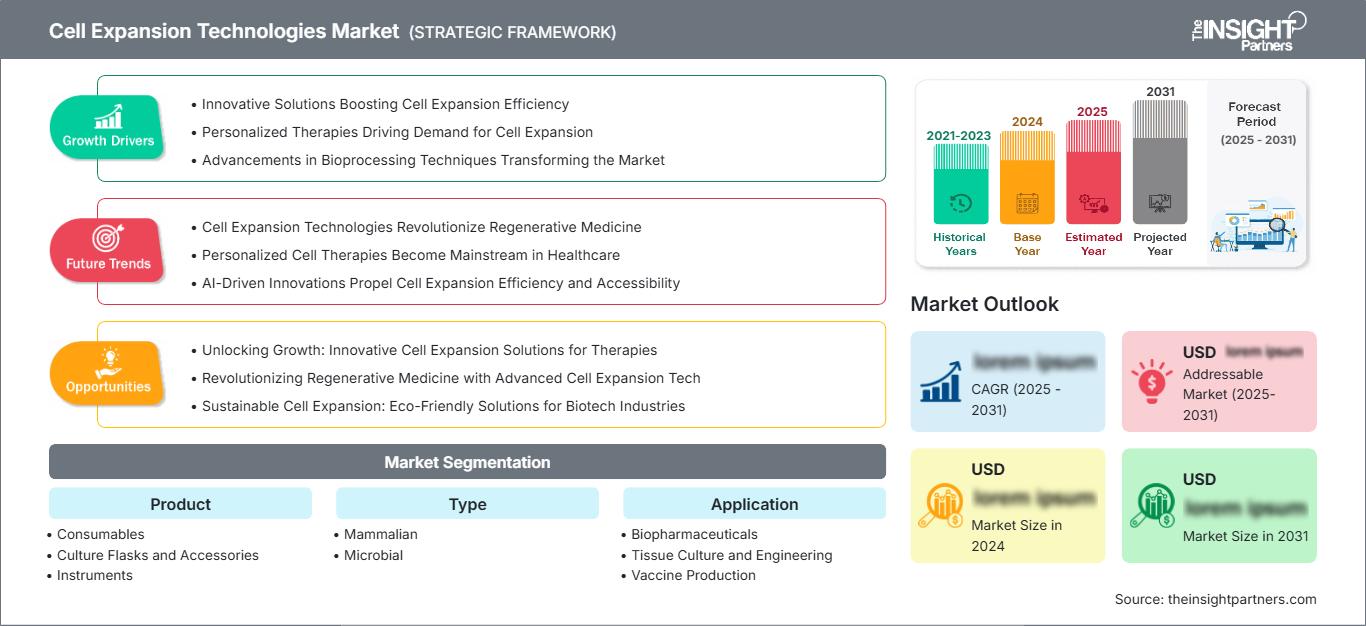
Cell Expansion Technologies Market: Strategic Insights
Regional Insights
North America Cell Expansion Technologies Market
The North America market holds an approximate 39-42% market share in 2025 and is expected to grow at a 9.5-10.1% CAGR in 2026-2034. The cell expansion technologies market share comprises a highly centralized biopharmaceutical industry, advanced academic research networks, and initial adoption of cell and gene therapy technologies. Demand includes items such as single-use bioreactors, culture vessels, immune cell media, analytical equipment, and automated closed systems.
Regional procurement is based on the idea that processes should be scalable to progress from a development stage to a GMP stage without any process modifications. In Canada, there are advantages provided by stem cell research, cancer immunotherapy, and biopharmaceutical manufacturing, but the US dominates the purchases of such technology commercially. The supply chain, the capabilities of contract manufacturing companies, and knowledge of regulations allow for a shortened technology transfer period.
U.S. Cell Expansion Technologies Market
The USA accounted for about 86–89% of the revenue in North America in 2025 and is expected to grow at a CAGR of 9.6–10.2% in 2026-2034. Its standing is further strengthened with biotechnology hubs in Massachusetts, California, North Carolina, Maryland, and Pennsylvania. Such ecosystems comprise venture-backed developers, pharma manufacturers, research hospitals, contract manufacturers, and providers of GMP-grade cell culture ingredients.
Thermo Fisher Scientific Inc., Corning Incorporated, Becton, Dickinson and Company, and Beckman Coulter, Inc. operate strong commercial and technology presences in the nation. Application trends are moving towards CAR-T production, allogeneic cell technologies, recombinant biologicals, new cancer models, and viral vector production. End-users need more closed workflows, digital documentation, in-line monitoring, and raw material tracing to manage comparability risks in transition of projects from one facility to another and scale changes.
Europe Cell Expansion Technologies Market
In 2025, Europe was accounted for an estimated share of 27-30% and is forecasted to grow at a CAGR of 9.2-9.8% during 2026-2034. Germany is positioned to be the dominant player via bioprocess engineering, production of pharmaceuticals and manufacturing of instrumentation. Sartorius AG, Merck KGaA, and Miltenyi Biotec B.V. & Co. KG add value by virtue of the strengths in bioreactors, media, cell selection, and closed process.
The UK benefits from translational medicine networks, advanced therapy facilities, and biotech companies tied to universities. The developers in this region have an inclination toward clinical flexibility, distributed processing, and technology transfer to the contract manufacturing organizations.
France makes use of vaccine manufacturing capacity along with research on biologics and oncology; whereas, Italy and Spain focus on academic cell therapy and manufacturing. In the regions listed above, GMP compliant processes free of animal-derived components along with cross border supplies make procurement easier.
APAC Cell Expansion Technologies Market
The Asia Pacific region is estimated to have a market share of 22-25% in 2025 and is expected to grow at a CAGR of 10.8-11.5% between 2026-2034, which makes it the fastest growing regional segment. China is the key driver in terms of increased capacities in biologics and equipment manufacture, whereas Japan and South Korea are contributing in advanced regenerative medicine and biosimilars.
India is developing its vaccines, biosimilars, and contract manufacturing sector. Australia is contributing to research and development of cell therapies by means of specialist organizations.
Middle East & Africa Cell Expansion Technologies Market
It is projected that the Middle East and Africa region will post a CAGR of 8.0% to 8.8% in 2026 to 2034. Saudi Arabia is a leading market on account of healthcare localization, biotech activities, and domestic drug manufacturing facilities. UAE is growing research infrastructure and precise medicine while South Africa is a hub of vaccine research and clinical labs.
Adoption will be limited to major hospitals, university, and government organizations. Reliability of cold chain logistics, capacity building, and services will define the growth opportunity. MEA outside the Middle East will provide selected markets for vaccines, cancer studies, and cell banking.
Segmentation Analysis
Product
The product segment is projected to expand at a 9.8–10.4% CAGR during 2026–2034. The Cell Expansion Technologies Market scope covers recurring consumables, culture flasks and accessories, and capital instruments used from research through production. Procurement is shifting toward integrated product families that preserve process consistency across scales. Vendors are differentiating through sterility assurance, application data, supply reliability, and compatibility with closed manufacturing workflows.
- Consumables: Recurring requirements for media, sera, buffers, supplements, cytokines, and disposable assemblies give consumables the strongest revenue contribution and make lot consistency central to supplier selection.
- Culture Flasks and Accessories: Multilayer vessels, culture bags, microcarriers, connectors, and closed transfer assemblies remain strategically important for adherent-cell scale-up, seed trains, and contamination-controlled handling.
- Instruments: Bioreactors, incubators, cell counters, centrifuges, and automated processors support reproducible expansion, with purchasing increasingly linked to digital monitoring, closed operation, and scalable throughput.
Type
The type segment is forecast to grow at a 9.7–10.3% CAGR during 2026–2034. Mammalian systems remain central to complex biologics and advanced therapies, while microbial systems support high-throughput production of recombinant products and research materials. Platform choice depends on cell sensitivity, desired product quality, productivity, contamination controls, and downstream processing requirements.
- Mammalian: Mammalian cell expansion dominates complex protein, viral-vector, vaccine, and therapeutic-cell workflows because it supports biologically relevant processing, although media expense and process sensitivity increase operating complexity.
- Microbial: Microbial platforms provide rapid growth, established scale-up methods, and comparatively efficient production for selected recombinant proteins, enzymes, plasmids, and research reagents.
Application
The application segment is expected to record a 10.2–10.8% CAGR during 2026–2034. Commercial biologics provide the established demand base, while gene therapy, cancer research, and stem-cell programs create higher technical requirements. Expansion systems must accommodate distinct cell densities, nutrient profiles, shear sensitivities, and quality attributes, favoring configurable platforms rather than uniform equipment architectures.
- Biopharmaceuticals: Large-scale production of antibodies, recombinant proteins, and biosimilars sustains demand for high-density culture, optimized media, process monitoring, and reliable seed-train technologies.
- Tissue Culture and Engineering: Three-dimensional models, organoids, scaffolds, and regenerative constructs require controlled expansion that preserves cell phenotype, viability, and differentiation potential across repeated passages.
- Vaccine Production: Cell-based vaccine workflows need dependable scale-up, rapid campaign changeovers, and contamination control, making single-use vessels and closed fluid transfer strategically valuable.
- Drug Development: Screening and toxicity studies require reproducible cell populations, standardized culture conditions, and automation that can increase throughput while reducing operator-dependent variability.
- Gene Therapy: Viral-vector and engineered-cell programs require specialized media, scalable producer-cell systems, closed processing, and documented raw materials suitable for regulated manufacturing.
- Cancer Research: Tumor models, immune-cell studies, and personalized assays create demand for physiologically relevant cultures, high-viability expansion, and accurate cell characterization.
- Stem Cell Research: Pluripotent and mesenchymal stem-cell workflows prioritize phenotype retention, gentle handling, xeno-free media, and scalable systems capable of supporting regenerative medicine development.
End use
The end-use segment is projected to expand at a 9.9–10.5% CAGR during 2026–2034. Biopharmaceutical and biotechnology companies account for the largest commercial demand because they operate development and manufacturing workflows. Research institutes influence early technology selection, while cell banks require controlled expansion and preservation processes that maintain identity, viability, sterility, and traceability.
- Biopharmaceutical and Biotechnology Companies: These organizations purchase integrated platforms for discovery, process development, clinical supply, and commercial manufacturing, emphasizing validation support, scalability, and dependable consumable supply.
- Research Institutes: Universities and public laboratories require flexible, application-diverse systems that support exploratory research, translational studies, workforce training, and collaboration with therapeutic developers.
- Cell Banks: Cell repositories depend on standardized expansion, characterization, contamination testing, and cryopreservation workflows to produce consistent master and working cell banks.
Opportunity Snapshot
| Application | Revenue Contribution | Trend Tag | Adoption Stage |
| Biopharmaceuticals | High | Intensified Culture | Mature |
| Tissue Culture and Engineering | Medium | 3D Tissues | Scaling |
| Vaccine Production | High | Cell Vaccines | Mature |
| Drug Development | Medium | Predictive Models | Scaling |
| Gene Therapy | High | Vector Scale-up | Scaling |
| Cancer Research | Medium | Immune Models | Scaling |
| Stem Cell Research | Medium | Xeno-free Media | Emerging |
Cell Expansion Technologies Market Growth Drivers and Impact Analysis
Expansion of Biologics and Biosimilar Manufacturing
Biologics manufacturing demands consistent cell growth throughout seed train, development and commercial vessel stages. Increased pipelines of antibodies, recombinants, vaccines, and biosimilars mean an increased need for media, surface, disposable assembly systems, instrumentation, and bioreactors. The commercial significance is not limited to initial purchases because proven processes lead to recurring needs for compatible disposables and replacement parts. Localized supply, traceability of raw materials, and process development expertise of companies make qualification shorter for customers. In parallel, intensive culture and increased cell density promote the need for improved oxygenation, feeding control, instrument compatibility, and harvesting management. These needs benefit companies that provide complete workflows rather than products alone.
Industrialization of Cell and Gene Therapy Workflows
Advanced therapies are moving from manually operated clinical processes toward closed, automated, and digitally documented production. Expansion is often a critical manufacturing step because final dose availability depends on viable cell yield, phenotype, potency, and contamination control. Autologous therapies require dependable parallel processing of patient-specific batches, whereas allogeneic platforms need larger, repeatable production runs. This divergence creates demand for modular technologies that support both scale-out and scale-up. Automated cell selection, activation, feeding, expansion, washing, and formulation reduce transfers between devices and limit operator exposure. Suppliers that demonstrate process comparability and integration with quality-control systems can influence platform selection early in clinical development, creating long-duration consumable and service revenue.
Shift Toward Reproducible Animal-Origin-Free Culture
Variability and traceability concerns surrounding serum and animal-derived components are accelerating adoption of chemically defined, serum-free, and xeno-free formulations. These media improve control over critical raw materials and support standardized processes across development sites. Their impact is especially important for stem cells, immune cells, viral-vector producer lines, and regenerative medicine, where subtle culture changes may affect phenotype or potency. Adoption also creates technical demand for cell-specific optimization because removing serum can alter growth kinetics and attachment behavior. Media suppliers are consequently combining formulations with cytokines, coatings, supplements, and technical support. Successful products can become embedded in regulated processes, producing recurring revenue and high customer retention after clinical validation.
Cell Expansion Technologies Market Future Trends
Data-Driven Adaptive Cell Culture
Cell Expansion Technologies Market trends will increasingly reflect integration of online sensors, automated imaging, metabolic measurements, and predictive software. Instead of relying primarily on fixed feeding schedules and endpoint testing, future platforms will adjust nutrients, gases, agitation, and harvest timing against real-time cell conditions. Digital records will improve deviation investigation and technology transfer, while multivariate models can identify yield or quality drift earlier. Adoption will begin in high-value biologics and advanced therapies, where batch failure has substantial financial consequences. Suppliers will compete on sensor reliability, software interoperability, cybersecurity, and the quality of application-specific process models.
Distributed and Modular Advanced Therapy Production
Compact automated platforms are expected to support production closer to hospitals and regional treatment centers. This model can reduce transport dependencies for time-sensitive autologous cells and enable capacity additions without constructing large centralized facilities. Modular systems will require standardized disposable kits, remote monitoring, digital batch release, and consistent operator training. Commercial success will depend on proving equivalent product quality across multiple locations. Equipment vendors may increasingly combine instruments, consumables, software, maintenance, and regulatory documentation through recurring service models. The trend will also encourage collaboration among technology suppliers, hospitals, contract manufacturers, and therapy developers to establish interoperable production networks.
Cell Expansion Technologies Market Opportunities
Localized Biomanufacturing Platforms in Asia Pacific
Asia Pacific presents an investment opportunity for suppliers offering cost-appropriate, GMP-compatible expansion systems backed by regional service and consumable availability. Cell Expansion Technologies Market Forecasts indicate that China, India, South Korea, Japan, and Australia will generate differentiated demand across biosimilars, vaccines, regenerative medicine, and contract manufacturing. Vendors should localize application laboratories, technical training, inventory, and selected manufacturing rather than relying solely on exports. Partnerships with domestic biopharmaceutical producers can accelerate product qualification and adapt workflows to regional cell lines. Modular systems that bridge research and pilot manufacturing are particularly relevant for organizations building capabilities progressively while managing capital expenditure and regulatory risk.
Application-Specific Media and Process Development Services
Suppliers can capture additional value by developing media, supplements, coatings, and feeding strategies for defined cell types rather than selling general-purpose formulations. Immune cells, induced pluripotent stem cells, mesenchymal cells, HEK293 producer cells, and difficult-to-culture primary cells have distinct metabolic and phenotypic requirements. Combining consumables with design-of-experiment studies, scale-up support, analytical characterization, and GMP transition services can shorten customer development timelines. Investment should prioritize animal-origin-free formulations, stable cytokines, raw-material documentation, and compatibility with closed equipment. This service-led model strengthens customer retention because optimized formulations become integrated with product specifications, regulatory submissions, and manufacturing controls.
Recent Developments
- March 2026: Sartorius AG launched the Eveo Cell Therapy Platform, an integrated system for automated, multi-parallel production and quality control of autologous therapies. The modular platform combines cell selection, activation, gene modification, expansion, washing, concentration, and formulation. Sartorius reported that the compact configuration could increase cleanroom output by up to fourfold and substantially reduce modeled CAR-T manufacturing costs.
- December 2025: Lonza Group AG received the US Food and Drug Administration’s Advanced Manufacturing Technologies designation for its Cocoon Platform. The functionally closed, automated system supports end-to-end cell therapy manufacturing with configurable protocols and single-use cassettes. The designation provides opportunities for earlier regulatory engagement and may reduce technology-related uncertainty for developers incorporating the platform into cellular therapy manufacturing processes.
- May 2025: Corning Incorporated showcased its cell culture scale-up portfolio at ISCT 2025, including configurable closed-system assemblies, CellSTACK and HYPERStack vessels, CellCube modules, microcarriers, the Ascent fixed-bed bioreactor system, and three-dimensional culture solutions. The portfolio addressed progression from research to production and reflected increasing demand for closed, scalable adherent-cell workflows used in cell and gene therapy development.
Frequently Asked Questions

- Comprehensive Market Sizing and Forecast Analysis
- Detailed Segmentation Analysis
- In-Depth Market Dynamics Assessment
- Regional and Country-Level Insights
- Competitive Landscape and Company Benchmarking
- Strategic Business Intelligence
Recent Reports
Testimonials

The Insight Partners' SCADA System Market report is comprehensive, with valuable insights on current trends and future forecasts. The team was highly professional, responsive, and supportive throughout. We are very satisfied and highly recommend their services.
RAN KEDEM Partner, Reali Technologies LTDs
I requested a report on a very specific software market and the team produced the report in a few days. The information was very relevant and well presented. I then requested some changes and additions to the report. The team was again very responsive and I got the final report in less than a week.
JEAN-HERVE JENN Chairman, Future Analytica
We worked with The Insight Partners for an important market study and forecast. They gave us clear insights into opportunities and risks, which helped shape our plans. Their research was easy to use and based on solid data. It helped us make smart, confident decisions. We highly recommend them.
PIYUSH NAGPAL Sr. Vice President, High Beam Global
The Insight Partners delivered insightful, well-structured market research with strong domain expertise. Their team was professional and responsive throughout. The user-friendly website made accessing industry reports seamless. We highly recommend them for reliable, high-quality research services
YUKIHIKO ADACHI CEO, Deep Blue, LLC.
This is the first time I have purchased a market report from The Insight Partners.While I was unsure at first, I visited their web site and felt more comfortable to take the risk and purchase a market report.I am completely satisfied with the quality of the report and customer service. I had several questions and comments with the initial report, but after a couple of dialogs over email with their analyst I believe I have a report that I can use as input to our strategic planning process.Thank you so much for taking the extra time and making this a positive experience.I will definitely recommend your service to others and you will be my first call when we need further market data.
JOHN SUZUKI President and Chief Executive Officer, Board Director, BK Technologies
I wish to appreciate your support and the professionalism you displayed in the course of attending to my request for information regarding to infectious disease IVD market in Nigeria. I appreciate your patience, your guidance, and the fact that you were willing to offer a discount, which eventually made it possible for us to close a deal. I look forward to engaging The Insight Partners in the future, all thanks to the impression you have created in me as a result of this first encounter.
DR CHIJIOKE ONYIA MANAGING DIRECTOR, PineCrest Healthcare Ltd.Reason to Buy
- Informed Decision-Making
- Understanding Market Dynamics
- Competitive Analysis
- Identifying Emerging Markets
- Customer Insights
- Market Forecasts
- Risk Mitigation
- Boosting Operational Efficiency
- Strategic Planning
- Investment Justification
- Tracking Industry Innovations
- Aligning with Regulatory Trends





 Get Free Sample for