
Clean-in-Place Market Demand, Share & Growth by 2034
Coverage: By Offering (Reuse Clean-in-Place Systems, Single-use Clean-in-Place Systems); System Type (Multi-tank Systems, Single-tank Systems, Two-tank Systems, Tank Washers, Spray Balls and nozzles, Sensors, Others); Industry Vertical (Pharmaceutical, Fruit and Vegetable Processing, Processed Food, Brewery and Beverage, Others) , and Geography (North America, Europe, Asia Pacific, and South and Central America)
- Status : Data Released
- Report Code : TIPRE00004793
- Category : Electronics and Semiconductor
- No. of Pages : 150
- Available Report Formats :


- Last update date : July 28, 2026


2025 Market Size
US$ 15.92 Bn
Base year value
2034 Forecast
US$ 43.81 Bn
Projected by 2034
CAGR 2026-2034
11.91 %
Growth rate
Addressable Market
US$ 262.24 Bn
(2026-2034)
The Clean-in-Place Market was worth US$ 15.92 billion in 2025 and forecast to be at US$ 43.81 billion by 2034 with a CAGR of 11.91% during 2026-2034. Clean-in-Place systems provide automation of sanitization processes of tanks, pipelines, filling machines, heat exchangers, and processing lines without disassembling them and thus contribute towards validation of hygiene, decreased downtime and efficiency of sanitation performance.
North America region is forecasted to show growth in the range of 10.8%-11.6% CAGR due to modern food safety legislation, sterile production in pharmaceutical industries and automation in beverages industry. Clean-in-Place Market size in North America region is estimated on the basis of installed capacity of dairy and brewery industries, FDA-based validation methods and increase in the use of sensor-based dosing technology.
Clean-in-Place Market Assessment and Insights
- North America: The region holds 32–35% share in 2025 and grows at a CAGR range of 10.8–11.6% during 2026–2034, supported by validated sanitation, dairy automation, and biopharma capacity.
- US: The country represents 78–82% of North America in 2025 and grows at a CAGR range of 10.7–11.5% during 2026–2034, led by aseptic processing and breweries.
- Europe: The region accounts for 24–27% share in 2025 and grows at a CAGR range of 9.8–10.6% during 2026–2034, with Germany, France, the UK, Italy, and Spain leading adoption.
- Asia Pacific: The region holds 27–30% of the Clean-in-Place Market share in 2025 and grows at a CAGR range of 12.6–13.4% during 2026–2034, led by China, India, Japan, South Korea, and Australia.
- Largest Segment: Reuse Clean-in-Place Systems hold 60–64% market share in 2025 and grow at a CAGR range of 10.9–11.7% during 2026–2034 through chemical and water recovery.
- High Growth Segment: Single-use Clean-in-Place Systems hold 36–40% market share in 2025 and grow at a CAGR range of 12.8–13.6% during 2026–2034 as flexible bioprocessing expands.
- Key companies analyzed in detail: Alfa Laval AB; Bionet Servicios Técnicos SL; FILAMATIC; GEA Group Aktiengesellschaft; Krones AG; KHS GmbH; Millitec Food Systems Ltd; SPX FLOW, Inc.; SYSBIOTECH SARL; Tetra Pak International S.A.
Source: The Insight Partners' analysis based on proprietary research, government publications, company annual reports, investor presentations, industry databases, and expert interviews.
Process evolution is taking sanitization from fixed-duration wash cycles to data-driven cleaning. Sensors measuring conductivity, turbidity, temperature, pressure, and flow are being used by process operators to demonstrate the effectiveness of soil removal rather than excessive cleaning of circuits. The production staff is also looking at skid design based on decreased hold-up volume, flexibility in recipes, and chemical recovery for greater uptime in multiple product facilities.
Future developments would be based on the scale of the Asian food processing industry, biomanufacturing in North America, and sustainability activities in Europe that would use fewer resources such as water and energy. Investments would be made in modular skids, hygienic valve manifolds, and software validation. Sanitization procedures, allergen control, and sterilization needs would ensure the relevance of automation systems irrespective of financial considerations.
Clean-in-Place Market Report Scope
| Report Attribute | Details |
|---|---|
| Market size in 2025 | US$ 15.92 Billion |
| Market Size by 2034 | US$ 43.81 Billion |
| Global CAGR (2026 - 2034) | 11.91% |
| Historical Data | 2021-2024 |
| Forecast period | 2026-2034 |
Clean-in-Place Market Analysis
Growth in the Market is driven by increased need for hygiene, faster changeover, and recording of cleaning parameters. Allergen control is needed in food plants; flavor carryover control is needed in beverages companies; validated cleaning is needed in pharmaceuticals for their sterile and potent products. The ecosystem consists of OEMs of equipment, tank washer manufacturers, valve manufacturers, automation, chemicals, integrators, and factory quality assurance groups.
The supply chain favors vendors with hygienic design, consistent spray distribution, remote servicing capability, and an integrated control philosophy. Prospective buyers consider the total cost of ownership in terms of water recovery, reuse of chemicals, steam requirements, batch time, and validation manpower. With more multi-product factories being built, the CIP system is becoming a plant-wide efficiency solution rather than a simple cleaning tool.
Positioning in Clean-in-Place Market Report includes skid engineering, hygienic equipment, expertise in application and life cycle services. Alfa Laval AB, GEA Group Aktiengesellschaft, Krones AG, KHS GmbH, SPX FLOW, Inc., and Tetra Pak International S.A. have positioned themselves through their diverse range of beverages and food processing products, whereas Bionet Servicios Técnicos SL, FILAMATIC, Millitec Food Systems Ltd, and SYSBIOTECH SARL provide solutions to niche requirements.
Market investments indicate favor towards modular cleanability, smaller tanks, intelligent dosing, and batch record keeping electronically. Market strategy now focuses on demonstrating savings in terms of cleaning times, effluent volume, and operator involvement. Manufacturers offering hygiene solutions along with automated systems, commissioning services, and validation will have the edge when customers move towards sanitizing platforms globally.
● REPORT CUSTOMIZATION
Tailor This Report To Align With Your Specific Business Requirements
This report can be customized to align precisely with your business objectives, scope, and target markets. Customization options include tailored segmentation, geography, competitive analysis, and strategic insights to support informed decision-making.
Customize This Report →WHAT YOU CAN ADJUST
- ● Segmentations
- ● Geography
- ● Competitive Analysis
- ● Language Preferences
Clean-in-Place Market: Strategic Insights
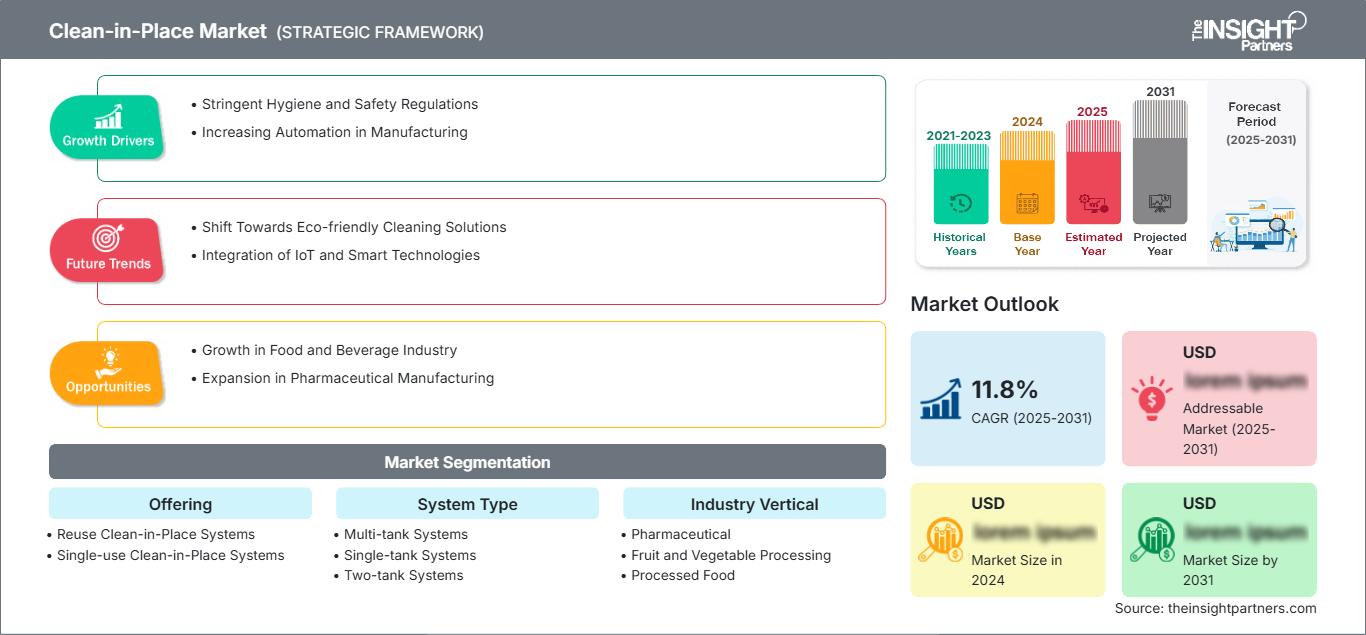
Regional Insights
North America Clean-in-Place Market
The North American region has a market share between 32-35% in 2025, with a CAGR in the range of 10.8-11.6% forecasted for 2026-2034. The market share of Clean-in-Place is driven by the presence of mature facilities in terms of the dairy industry, brewery, ready-to-drink beverages, and pharmaceuticals that require sanitization process.
The FDA inspection process, HACCP systems, and food allergy labelling have influenced the purchase of automation in order to manage risk. The regional demand is additionally driven by a shortage of labor within the sanitation teams and increasing utility expenses for water-stressed production sites. Operators are retrofitting their legacy skids by installing conductivity sensors, recipe management, and chemical recovery tanks.
U.S. Clean-in-Place Market
The U.S. constitutes 78-82% of North America in 2025 and grows with CAGR between 10.7%-11.5% in 2026 to 2034. The key applications include aseptic beverages, dairy alternatives, injectable drugs, biologics, craft brewing, and processed food products. Leading players with high application proximity include Alfa Laval AB, GEA Group Aktiengesellschaft, SPX FLOW, Inc., FILAMATIC, and Tetra Pak International S.A.
Applications' latest trends include skid retrofits, portable CIP systems for small-scale processing facilities, automation of filling machine cleaning, and digital batch logs for quality management. U.S. facilities are assessing low-rinse formula due to the fact that the cost of wastewater discharging and caustic handling impact the operations budget. Cycle repeatability documentation is vital for pharmaceutical companies, and quick changeover and reduced product waste for beverages.
Europe Clean-in-Place Market
The European region holds a market share of 24–27% in 2025 and is expected to grow with a CAGR range of 9.8–10.6% from 2026 to 2034. Germany leads the region due to engineering in the dairy sector, brewing equipment, pharmaceutical manufacturing, and hygienic components that help in high adoption of specifications. The UK provides demand from ready meals, beverages, contract manufacturing, and biologics facility requirements.
France, Italy, and Spain contribute through dairy co-operatives, wine, processed food, and aseptic filling lines. European consumers give high importance to energy conservation, chemical handling, operator safety, and traceability of documents. This helps in growth of companies such as GEA Group Aktiengesellschaft, Krones AG, KHS GmbH, Alfa Laval AB, and Tetra Pak International S.A.
APAC Clean-in-Place Market
APAC region holds the market share of 27–30% in 2025 and is expected to expand at CAGR of 12.6–13.4% during 2026-2034. The countries dominating the region include China, India, Japan, South Korea, and Australia. Increased demand can be attributed to dairy modernization, beverages plant capacities, packaged foods capacity, and pharmaceutical industry expansion.
Government support to ensure food safety, export-driven production, and domestic biopharmaceuticals boosts the use of automated cleaning systems. Indian processing firms have started using skids instead of manual washdown while Japan and South Korea focus on precision control. Australian processing plants also increase demand for water-efficient cleaning due to increasing costs of utilities and stricter environmental regulations.
Middle East & Africa Clean-in-Place Market
ME&A region forecasted to exhibit growth with CAGR of 8.5-9.3% for the period 2026-2034. Saudi Arabia ranks among key countries due to investments in dairy, bottled beverages, and food security. The UAE increases market by contributing demand from packaged food and hospitality beverage production applications. South Africa will cater to dairy, brewing, and processed food applications.
Adoption of RO ME&A region is driven by installation of new processing plants, water reuse requirements, and standards of imported equipment. Programs relating to energy and infrastructure have resulted in bigger centralized food production facilities but still availability of services acts as purchasing criterion. Buyers prefer systems that require minimal operating exposure.
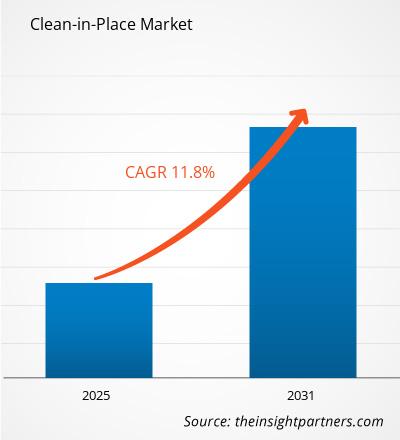
Segmentation Analysis
Offering
Offering is projected to grow at a CAGR range of 11.4–12.2% during 2026–2034. Clean-in-Place Market scope is defined by whether users recover cleaning media or prioritize disposable, campaign-specific flow paths. Selection depends on batch frequency, contamination risk, water cost, chemical recovery value, and validation burden across pharmaceutical, beverage, and food processing facilities.
- Reuse Clean-in-Place Systems: Reuse systems lead installations where high-volume plants can recover caustic, acid, and rinse water, lowering operating cost while supporting repeatable sanitation in dairy, beverages, and processed foods.
- Single-use Clean-in-Place Systems: Single-use systems gain relevance in bioprocessing, pilot plants, and high-mix facilities where contamination avoidance, rapid changeover, and reduced validation complexity outweigh recurring consumable costs.
System Type
System Type is expected to grow at a CAGR range of 11.2–12.0% during 2026–2034. Demand reflects plant size, circuit complexity, tank availability, and automation maturity. Multi-tank systems suit large continuous facilities, while compact single-tank and two-tank arrangements support smaller processors. Tank washers, spray balls and nozzles, and sensors determine cleaning coverage and validation quality.
- Multi-tank Systems: Multi-tank systems dominate complex plants because separate detergent, acid, rinse, and recovery tanks enable faster sequencing, stronger chemical management, and parallel cleaning of multiple circuits.
- Single-tank Systems: Single-tank systems serve small processors and pilot lines where lower capital cost, compact footprint, and simpler operation are more important than high-throughput cleaning flexibility.
- Two-tank Systems: Two-tank systems balance cost and performance by separating wash and rinse functions, helping mid-sized beverage, dairy, and food plants improve turnaround without large skid complexity.
- Tank Washers: Tank washers are strategic in vessels with residues, foams, or viscous products because rotating impact patterns improve coverage, reduce manual entry, and support safer confined-space practices.
- Spray Balls and nozzles: Spray balls and nozzles remain essential low-maintenance components for sanitary vessels, offering predictable wetting patterns where residues are moderate and validated placement is well engineered.
- Sensors: Sensors are increasingly specified to verify conductivity, temperature, flow, pressure, and turbidity, allowing plants to reduce over-cleaning while strengthening audit evidence and cycle consistency.
Industry Vertical
Industry Vertical is projected to grow at a CAGR range of 11.6–12.4% during 2026–2034. Pharmaceutical plants prioritize validated repeatability, fruit and vegetable processors focus on residue and microbial control, processed food manufacturers need allergen management, and brewery and beverage users value rapid changeovers. Each vertical links sanitation performance with uptime, compliance, and brand protection.
- Pharmaceutical: Pharmaceutical demand is tied to GMP validation, sterile processing, biologics, and high-potency manufacturing where documented cleaning cycles reduce cross-contamination risk and support batch release.
- Fruit and Vegetable Processing: Fruit and vegetable processors use CIP to remove sugars, fibers, acids, and microbial residues from conveyors, pipes, tanks, and fillers while preserving product throughput.
- Processed Food: Processed food facilities require flexible sanitation across sauces, soups, dairy-based meals, and ready-to-eat lines where allergen control and flavor changeover drive cleaning intensity.
- Brewery and Beverage: Brewery and beverage plants depend on CIP for fermentation tanks, bright beer tanks, fillers, and pasteurizers, with rapid cleaning supporting flavor integrity and production scheduling.
Opportunity Snapshot
| Industry Vertical | Revenue Contribution | Trend Tag | Adoption Stage |
| Pharmaceutical | High | Validated Cycles | Scaling |
| Fruit and Vegetable Processing | Medium | Residue Control | Scaling |
| Processed Food | High | Allergen Safety | Mature |
| Brewery and Beverage | High | Flavor Changeover | Mature |
| Others | Low | Selective Use | Emerging |
Clean-in-Place Market Growth Drivers and Impact Analysis
Stricter Hygiene Validation Across Regulated Manufacturing
Manufacturers of food products, beverages, and pharmaceuticals need to show that their cleaning procedures are effective at removing residues, allergens, microorganisms, and active compounds. This is having an effect in increasing the number of automated systems that log data on temperature, conductivity, contact time, flow rate, and concentration for each circuit in use. Manual cleaning is difficult to validate, and can be a danger to employees due to exposure to chemicals, as well as being less consistent across shifts. CIP systems can eliminate some of these problems by generating repeatable procedures and verifiable data. Manufacturers who sell overseas or to large retail chains get extra value out of this capability.
Water, Chemical, and Energy Efficiency Becoming Procurement Criteria
Operating margins are becoming the name of the game for utilities and waste water treatment costs. Reuse systems, precise rinse termination, energy recovery, and exact dosing will help reduce wasteful usage while guaranteeing the wash. The marketplace effect will be moving from simple skids to systems which measure the savings and connect with the plant sustainability reporting system. Plants that process beverages, dairies, and other food items are especially good targets since even slight improvements per wash will add up over hundreds of washes per year.
Expansion of Aseptic Beverages and Biopharmaceutical Capacity
Aseptic beverages, dairy substitutes, injectables, and biologics all require clean processing areas where any failure in the cleaning procedure could lead to loss of production or costly investigations. This factor makes there be an increased need for validated CIP/SIP systems, hygienic valves, orbital welds, and automatic documentation. In addition, biopharmaceutical customers require flexible systems due to the need for campaign manufacturing and expensive products while beverages manufacturers want faster changes from one flavor to another and packaging style. The commercial significance here is that there will be more demand for engineering systems and not components.
Clean-in-Place Market Future Trends
AI-Assisted Cleaning Recipes and Real-Time Verification
Clean-in-Place Market trends will increasingly favor adaptive recipes that adjust rinse duration, chemical dosing, and temperature based on live soil indicators rather than fixed timers. Future systems will combine turbidity, conductivity, flow, and pressure data with analytics to verify endpoint cleanliness and flag abnormal cycles. This can reduce over-cleaning while improving assurance for complex residues. Adoption will be strongest in plants with frequent product changes, high utility costs, and strict documentation requirements. Vendors that translate sensor data into simple operator decisions will have an advantage because sanitation teams need actionable evidence, not just more alarms.
Compact Modular Skids for Distributed Processing Networks
Distributed food, beverage, and specialty pharmaceutical production will create demand for compact modular skids that can be installed quickly and replicated across sites. Future buyers will expect factory-tested units, plug-and-play controls, and standardized documentation packages that reduce commissioning risk. Modular systems can also support regional brands, pilot plants, and contract manufacturers that lack space for large centralized CIP rooms. This trend changes vendor economics by increasing the importance of configurable platforms, remote diagnostics, and service packages. Suppliers able to deliver repeatable modules with local support can capture expansion programs across multiple small and mid-sized facilities.
Clean-in-Place Market Opportunities
Retrofit Programs for Legacy Food and Beverage Plants
Clean-in-Place Market Forecasts point to a strong retrofit opportunity as older plants seek validated cleaning without full line replacement. Many facilities operate legacy tanks, fillers, and piping that can be upgraded with new valve clusters, spray devices, sensors, dosing modules, and control software. The investment case is practical because retrofits can reduce downtime, improve audit evidence, and defer larger capital projects. Suppliers should target installed bases in dairy, beverages, sauces, and ready meals with phased upgrade packages. Financing, operator training, and pre-engineered validation templates can shorten approval cycles and make sanitation modernization more accessible.
Bioprocessing and High-Mix Pharmaceutical Manufacturing
Bioprocessing, cell therapy support operations, and contract pharmaceutical manufacturing create an opportunity for flexible cleaning platforms. These users need fast campaign changeovers, documented residue control, and compatibility with stainless steel and single-use process areas. CIP vendors can differentiate by offering modular skids, recipe libraries, and validation consulting suited to smaller batches and higher product value. The opportunity is action-oriented because capacity additions often require sanitation decisions early in facility design. Suppliers that work with engineering firms and quality teams before equipment layout is frozen can influence specifications and secure long-term service relationships.
Recent Developments
- September 2025: Ecolab launched Ecolab CIP IQ, an AI-enhanced clean-in-place (CIP) monitoring and optimization solution for the food and beverage industry, and announced a strategic partnership with 4T2 Sensors. The collaboration integrates 4T2 Sensors' patented real-time fluid sensing technology with Ecolab's 3D TRASAR™ sensors to optimize CIP processes, enabling up to 15% greater operational efficiency and 20% lower water consumption. As part of the agreement, Ecolab secured an exclusive license to 4T2 Sensors' CIP optimization and fluid quality monitoring technology for the food and beverage sector, strengthening its digital water management and sustainable manufacturing capabilities.
- August 2025: Schneider Electric highlighted the use of AI-powered Clean-in-Place (CIP) optimization to enhance cleaning efficiency, reduce resource consumption, and increase production capacity in the food and beverage industry. By integrating AI with existing CIP systems, the solution enables real-time monitoring of process parameters, predictive analytics, and automated process optimization, helping manufacturers reduce water, chemical, and energy usage while shortening cleaning cycles and improving traceability. The initiative reinforces Schneider Electric's strategy to advance sustainable, data-driven industrial operations through AI-enabled digital transformation.
- May 2024: Tetra Pak launched its Factory Sustainable Solutions offering, introducing a factory-wide approach to optimize energy, water, and clean-in-place (CIP) operations for food and beverage manufacturers. The new solution combines advanced processing technologies, digital monitoring, and tailored service expertise to improve production efficiency, reduce utility consumption, and lower environmental impact. The launch reinforces Tetra Pak's strategy to support manufacturers in achieving sustainability goals while enhancing operational performance and reducing total operating costs.
Frequently Asked Questions

- Comprehensive Market Sizing and Forecast Analysis
- Detailed Segmentation Analysis
- In-Depth Market Dynamics Assessment
- Regional and Country-Level Insights
- Competitive Landscape and Company Benchmarking
- Strategic Business Intelligence
Recent Reports
Testimonials

The Insight Partners' SCADA System Market report is comprehensive, with valuable insights on current trends and future forecasts. The team was highly professional, responsive, and supportive throughout. We are very satisfied and highly recommend their services.
RAN KEDEM Partner, Reali Technologies LTDs
I requested a report on a very specific software market and the team produced the report in a few days. The information was very relevant and well presented. I then requested some changes and additions to the report. The team was again very responsive and I got the final report in less than a week.
JEAN-HERVE JENN Chairman, Future Analytica
We worked with The Insight Partners for an important market study and forecast. They gave us clear insights into opportunities and risks, which helped shape our plans. Their research was easy to use and based on solid data. It helped us make smart, confident decisions. We highly recommend them.
PIYUSH NAGPAL Sr. Vice President, High Beam Global
The Insight Partners delivered insightful, well-structured market research with strong domain expertise. Their team was professional and responsive throughout. The user-friendly website made accessing industry reports seamless. We highly recommend them for reliable, high-quality research services
YUKIHIKO ADACHI CEO, Deep Blue, LLC.
This is the first time I have purchased a market report from The Insight Partners.While I was unsure at first, I visited their web site and felt more comfortable to take the risk and purchase a market report.I am completely satisfied with the quality of the report and customer service. I had several questions and comments with the initial report, but after a couple of dialogs over email with their analyst I believe I have a report that I can use as input to our strategic planning process.Thank you so much for taking the extra time and making this a positive experience.I will definitely recommend your service to others and you will be my first call when we need further market data.
JOHN SUZUKI President and Chief Executive Officer, Board Director, BK Technologies
I wish to appreciate your support and the professionalism you displayed in the course of attending to my request for information regarding to infectious disease IVD market in Nigeria. I appreciate your patience, your guidance, and the fact that you were willing to offer a discount, which eventually made it possible for us to close a deal. I look forward to engaging The Insight Partners in the future, all thanks to the impression you have created in me as a result of this first encounter.
DR CHIJIOKE ONYIA MANAGING DIRECTOR, PineCrest Healthcare Ltd.Reason to Buy
- Informed Decision-Making
- Understanding Market Dynamics
- Competitive Analysis
- Identifying Emerging Markets
- Customer Insights
- Market Forecasts
- Risk Mitigation
- Boosting Operational Efficiency
- Strategic Planning
- Investment Justification
- Tracking Industry Innovations
- Aligning with Regulatory Trends





 Get Free Sample for