
Compressor Control System Market Size, Growth & Demand by 2034
Coverage: By Component (Programmable Logic Controller (PLC), Supervisory Control and Data Acquisition (SCADA), Others); End-user (Oil and Gas, Petrochemical, Energy and Mining, Power Generation, Refining, Others) , and Geography (North America, Europe, Asia Pacific, and South and Central America)
- Status : Data Released
- Report Code : TIPRE00008265
- Category : Electronics and Semiconductor
- No. of Pages : 150
- Available Report Formats :


- Last update date : July 28, 2026


2025 Market Size
US$ 6.84 Bn
Base year value
2034 Forecast
US$ 13.84 Bn
Projected by 2034
CAGR 2026-2034
8.15 %
Growth rate
Addressable Market
US$ 92.96 Bn
(2026-2034)
The Compressor Control System Market is expected to go up from US$ 6.84 billion in 2025 to reach US$ 13.84 billion in 2034 at a CAGR of 8.15%. The market growth is fueled by automation in compressors, surge protection, energy management, and higher uptime expectations in oil and gas, petrochemical, energy & mining, power generation, and refineries.
The Compressor Control System Market size in North America is propelled by brownfield refinery upgrades, LNG infrastructure, pipeline compression equipment modernization, and electrification in industrial applications. North America is expected to grow at a CAGR of 7.6-8.3% over 2026-2034 with the help of digital control system retrofits, cyber-security ready PLC design, and SCADA systems.
Compressor Control System Market Assessment and Insights
- North America held 31–34% share in 2025 and is projected to grow at a 7.6–8.3% CAGR between 2026–2034, supported by LNG, shale gas, refinery automation, and pipeline integrity programs.
- US accounted for 72–76% of North America in 2025 and is expected to grow at a 7.7–8.4% CAGR between 2026–2034, led by compressor station modernization.
- Europe represented 24–27% share in 2025 and is forecast to grow at a 6.9–7.6% CAGR between 2026–2034, led by Germany, the UK, France, Italy, and Spain.
- Asia Pacific captured 28–31% share in 2025 and is set to grow at an 8.7–9.4% CAGR between 2026–2034, with China, India, Japan, South Korea, and Australia driving upgrades.
- Largest Segment Oil and Gas held 34–38% market share in 2025 and is projected to grow at a 7.8–8.5% CAGR between 2026–2034.
- High Growth Segment Supervisory Control and Data Acquisition held 39–43% market share in 2025 and is forecast to grow at an 8.9–9.6% CAGR between 2026–2034.
- Key companies analyzed in detail: ANEST IWATA Corporation, Compressor Controls Corporation, Emerson Electric Co., FS-Elliott Co., LLC, Gardner Denver, Inc., Ingersoll Rand Inc., RENNER Kompressoren GmbH, Rockwell Automation, Inc., Schneider Electric SE, Woodward, Inc.
Source: The Insight Partners' analysis based on proprietary research, government publications, company annual reports, investor presentations, industry databases, and expert interviews.
Compressor control in the digital age has evolved from individual pressure control to optimization throughout the plant as PLCs, SCADA, sensing technologies, anti-surging algorithms, and remote diagnostics work as an optimization system. Load balancing, anti-surging control, and condition monitoring have become key priorities since compressor packages play crucial roles in gas processing, refining, petrochemical manufacturing, and power generation processes. This has led to a shift in purchasing from parts replacements to lifecycle automation solutions.
There is potential for greater investment activity due to the growth of midstream gas infrastructure, LNG receiving facilities, refining capabilities, and utility systems in developing countries. Also, regulations regarding energy consumption and emission reporting increase the need for visibility of compressor systems. As a result, the market for Compressor Control Systems will be driven by reliability, safety, cybersecurity, and energy efficiency.
Compressor Control System Market Report Scope
| Report Attribute | Details |
|---|---|
| Market size in 2025 | US$ 6.84 Billion |
| Market Size by 2034 | US$ 13.84 Billion |
| Global CAGR (2026 - 2034) | 8.15% |
| Historical Data | 2021-2024 |
| Forecast period | 2026-2034 |
Compressor Control System Market Analysis
Growth in Compressor Control Systems Market relies on sectors where pressure regulation, process continuity, and equipment protection determine the economics of production. Oil & Gas companies utilize control systems to eliminate the problem of surge, synchronize multi-compressor stations, and decrease fuel expenses. Petrochemical and refining segment customers emphasize tight process integration whereas power generation and mining buyers look for robust systems for harsh environment compressors.
Value chain for the industry includes compressor OEMs, automation platform suppliers, control software companies, field instrumentation companies, system integrators, and service providers. Suppliers gain an advantage in the integration of hardware availability with domain-specific tuning. Customers usually take into account such factors as lifecycle support, cybersecurity features, and distributed control system interfacing before purchasing.
Competitive pressure comes from automation giants and compressor specialists' ambitions to expand their installed base. Emerson Electric Co., Rockwell Automation, Inc., Schneider Electric SE, Woodward, Inc., and Compressor Controls Corporation compete through the scope of the platforms, libraries of applications, and services. According to the Compressor Control System Market report, the expertise in the domain plays equally important role as the controller's functionality.
Strategic focus shifts to predictive diagnostics, edge computing, remote commissioning, and compressor controls packages. ANEST IWATA Corporation, FS-Elliott Co., LLC, Gardner Denver, Inc., Ingersoll Rand Inc., and RENNER Kompressoren GmbH create a competitive advantage by means of their partnerships with compressor equipment manufacturers. Meanwhile, automation companies benefit from greater digitalization budget of the whole plant and cybersecurity renewals.
● REPORT CUSTOMIZATION
Tailor This Report To Align With Your Specific Business Requirements
This report can be customized to align precisely with your business objectives, scope, and target markets. Customization options include tailored segmentation, geography, competitive analysis, and strategic insights to support informed decision-making.
Customize This Report →WHAT YOU CAN ADJUST
- ● Segmentations
- ● Geography
- ● Competitive Analysis
- ● Language Preferences
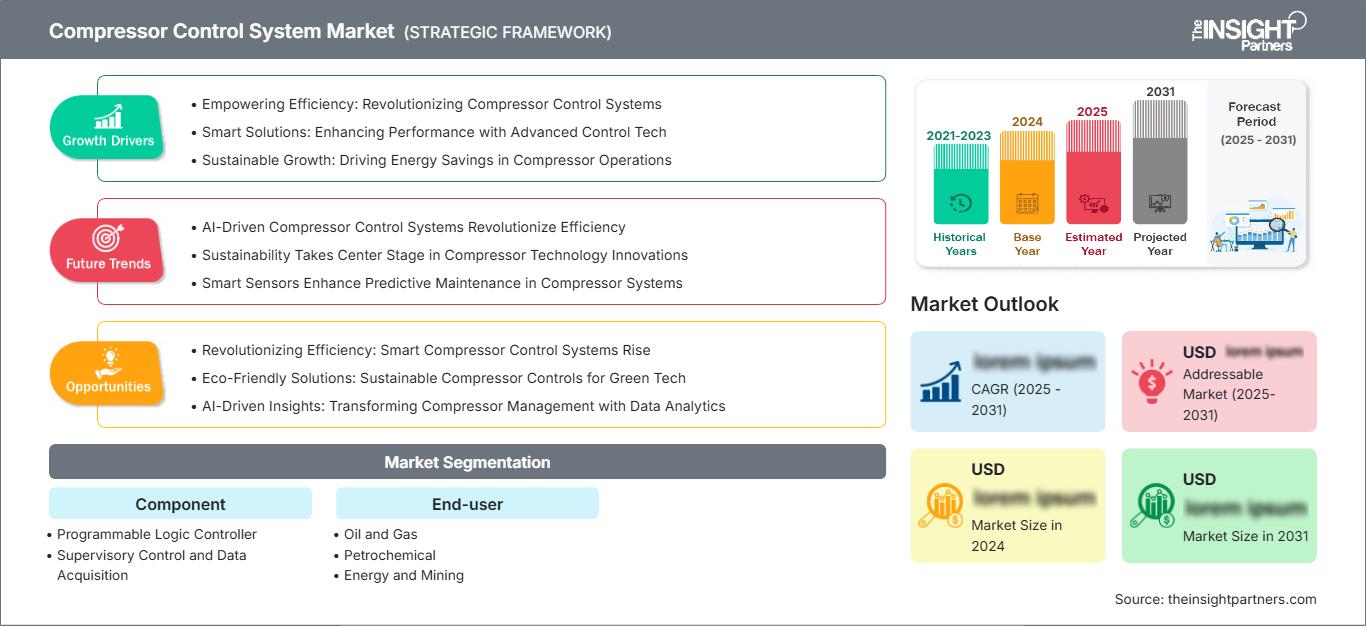
Compressor Control System Market: Strategic Insights
Regional Insights
North America Compressor Control System Market
North America contributed a share of 31%-34% in 2025 and is expected to grow at a 7.6%-8.3% CAGR in 2026-2034. This region has advantages in LNG liquefaction, gas gathering, shale processing, and refinery upgrade. Operators are upgrading legacy panels to new systems using PLC and SCADA technologies for better surge protection, visibility, and compressor availability.
In addition, the Compressor Control System Market share in North America also has to deal with an advanced base that needs security upgrades and lifecycle management. The energy efficiency programs, lack of technicians, and strict operational documentation are driving operators towards predictive maintenance. Most investments will be made on the US Gulf Coast, Canadian gas grid, and industrial manufacturing facilities.
U.S. Compressor Control System Market
North America comprises 72–76% of the US in 2025 and is expected to have a CAGR of 7.7–8.4% till 2034. Market demand is dominated by applications related to natural gas compression, liquefied natural gas export terminals, refining facilities, petrochemical plants, and industrial air handling. Industry trends include ant-surge control, compressor sequencing, emission-based monitoring, and enterprise maintenance integration.
Company participation is prominent in automation, control systems, and compressors. Major players such as Emerson Electric Co., Rockwell Automation, Inc., Compressor Controls Corporation, Ingersoll Rand Inc., Gardner Denver, Inc., and Woodward, Inc. offer services for retrofits and turnkey projects via regional service networks. The Compressor Control System Market receives an impetus from the preference of operators for reliability, cyber security compliance, and less commissioning risk.
Europe Compressor Control System Market
The Europe region accounts for 24–27% share in 2025 and will register a 6.9–7.6% CAGR for the period 2026–2034. Germany leads in the region due to the presence of process industries, compressor OEMs, and advanced industrial automation. The market in the United Kingdom derives growth support from offshore energy resources, reliable gas transmission programs, and refinery controls upgrade.
France, Italy, and Spain derive contribution from petrochemical plants, power generation facilities, food processing and industrial utilities. Europe buyers lay stress on lifetime energy savings, compliance with CE standards in automation, and compatibility with sustainability reporting systems. Suppliers like Schneider Electric SE, RENNER Kompressoren GmbH, etc., will gain support from digital connectivity of compressors and modernization.
APAC Compressor Control System Market
APAC secured a market share of 28–31% in 2025 and is anticipated to register a CAGR of 8.7–9.4% between 2026 and 2034. Leading countries are China, which drives regional demand due to refining, petrochemicals, LNG terminaling, and process automation. Japan and South Korea emphasize reliability in control, whereas India is adding gas network, refining, and industrial capacity growth.
Australia is contributing through mining, LNG, and energy infrastructures where remote sensing is crucial. Industrial and energy efficiency initiatives, driven by government policies, are boosting the use of sophisticated compressor controls. The Compressor Control System Market in APAC is localizing as equipment providers are expanding their services and retrofitting activities.
Middle East & Africa Compressor Control System Market
The Middle East and Africa region is anticipated to witness a compound annual growth rate (CAGR) of 7.9–8.6% from 2026 to 2034, led by Saudi Arabia in terms of adoption. Adoption depends on oil extraction, gas processing and treatment, refining, petrochemicals, and utilities related to water desalination. UAE is increasing gas and industrial capacity, while South Africa is promoting mining and electricity generation compression requirements.
In the case of the rest of MEA region, adoption is project-based, with higher importance placed on compressors that are able to operate in hot climate conditions and in distant locations. Service and spare parts availability, together with ability to integrate with existing control room facilities, are vital purchase criteria.
Segmentation Analysis
Component
The Component segment is forecast to grow at an 8.2–8.9% CAGR during 2026–2034 as buyers combine deterministic control with plantwide visualization. The Compressor Control System Market scope includes controller logic, supervisory software, sensor integration, communication protocols, and service configuration that enable safer compressor operation across continuous-process facilities.
- Programmable Logic Controller remains central for fast response, shutdown logic, sequencing, and surge protection, especially where deterministic execution and ruggedized hardware are required in compressor stations.
- Supervisory Control and Data Acquisition is gaining strategic importance because operators need remote visibility, alarm rationalization, performance analytics, and integrated dashboards across distributed compressor assets.
End-user
The End-user segment is projected to grow at a 7.9–8.6% CAGR during 2026–2034 as critical industries modernize compression assets for reliability and energy discipline. Adoption is strongest where compressor downtime disrupts throughput, safety, or export commitments, making control system quality a direct contributor to operating performance.
- Oil and Gas leads demand because upstream, midstream, LNG, and pipeline networks depend on continuous compression, accurate surge management, and remote monitoring for high-value assets.
- Petrochemical facilities use compressor controls to stabilize feedstock flows, reduce unplanned shutdowns, and coordinate process units where pressure variation can affect yield and safety.
- Energy and Mining users require rugged controls for remote sites, compressed air systems, and process compression, with emphasis on maintainability, alarms, and harsh-environment reliability.
- Power Generation applications focus on turbine support systems, fuel gas compression, emissions-linked monitoring, and reliable auxiliary operations across thermal and flexible generation plants.
- Refining demand is tied to hydrogen, catalytic cracking, and process gas units, where compressor control upgrades support throughput, safety interlocks, and energy efficiency.
Opportunity Snapshot
| End-user | Revenue Contribution | Trend Tag | Adoption Stage |
| Oil and Gas | High | LNG Compression | Mature |
| Petrochemical | Medium | Process Stability | Scaling |
| Energy and Mining | Medium | Remote Assets | Scaling |
| Power Generation | Medium | Fuel Gas | Scaling |
| Refining | High | Hydrogen Units | Mature |
Compressor Control System Market Growth Drivers and Impact Analysis
Energy Efficiency Pressure Across Process Industries
Compressors are among the most energy-intensive rotating assets in industrial plants, making control optimization a practical route to lower operating costs. Advanced load sharing, variable-speed coordination, leak-linked monitoring, and real-time performance dashboards help facilities reduce wasted compression and stabilize pressure bands. The impact is strongest in refineries, petrochemical complexes, LNG sites, and mining operations where electricity or fuel costs are material. This driver expands the Compressor Control System Market by shifting purchase justification from equipment safety alone toward measurable energy savings, emissions reduction, and lifecycle performance improvement.
Automation Retrofits in Aging Compressor Fleets
Many compressor fleets still depend on outdated relay logic, limited local panels, or fragmented control rooms that restrict visibility and diagnostics. Retrofit projects allow operators to modernize without replacing the entire compressor package, reducing capital intensity while improving uptime. This is especially relevant for gas transmission, refining, and power assets built before current digital standards. The commercial effect is a wider serviceable installed base for automation vendors, system integrators, and compressor specialists, with recurring demand for engineering, commissioning, tuning, cybersecurity hardening, and long-term support contracts.
Expansion of LNG and Gas Infrastructure
Gas processing, LNG liquefaction, regasification, and pipeline networks require compressor trains that operate safely under changing flow and pressure conditions. Control systems protect high-value rotating equipment while maintaining export schedules and contractual delivery reliability. As countries diversify gas supply and invest in energy security, compression infrastructure becomes a core automation opportunity. This driver strengthens project demand in North America, APAC, and the Middle East, where operators specify advanced anti-surge control, redundant PLCs, remote monitoring, and SCADA connectivity for new compressor stations.
Compressor Control System Market Future Trends
AI-Assisted Compressor Performance Optimization
Compressor Control System Market trends are moving toward AI-assisted analytics that compare operating envelopes, vibration signals, pressure profiles, and historical maintenance events. These tools will help operators predict surge risk, detect efficiency drift, and prioritize service before production losses occur. Adoption will likely begin in high-value LNG, refinery, and petrochemical assets before expanding into broader industrial air networks. The trend creates differentiation for vendors that can combine machine learning models with proven compressor domain logic and auditable recommendations.
Cybersecure Edge Control Architectures
Future compressor control architectures will place more intelligence at the edge while maintaining secure links to plant historians, maintenance systems, and enterprise dashboards. This design reduces latency for critical protection logic and supports remote supervision without exposing core control functions unnecessarily. Cybersecurity certification, user access governance, and segmented networks will become procurement differentiators. Vendors able to deliver secure-by-design platforms, rapid patch management, and compatibility with existing DCS environments will gain preference in regulated and mission-critical facilities.
Compressor Control System Market Opportunities
Retrofit Bundles for Brownfield Facilities
Brownfield facilities offer a strong route for Compressor Control System Market Forecasts because operators can improve compressor reliability without major process redesign. Vendors can package PLC replacement, SCADA visualization, sensor upgrades, anti-surge tuning, cybersecurity assessment, and operator training into phased modernization programs. This approach fits refineries, petrochemical sites, pipeline stations, and power plants with constrained shutdown windows. Commercial success will depend on proving payback through avoided downtime, reduced energy use, faster troubleshooting, and lower maintenance uncertainty.
Localized Service Ecosystems in Emerging Markets
Emerging markets need compressor control suppliers that can support commissioning, spares, tuning, and troubleshooting close to operating sites. Establishing certified local integrator networks in India, Southeast Asia, the Middle East, and Africa can shorten response times and improve buyer confidence. This opportunity is especially attractive for vendors serving oil and gas, mining, power, and industrial utilities. Local support also helps adapt global platforms to regional standards, workforce skills, and harsh operating environments.
Recent Developments
- June 2025: Celeroton proud to introduce our latest innovation in compressed air technology – a cutting-edge turbo compressor with integrated electronics that delivers unmatched performance in a compact form.
- January 2025: Elgi Equipments has announced the launch of a new product on February 8 during a global press conference. The new solution is designed to improve the efficiency of air compressors, vacuum products, and blowers. While the product has not yet been named, it introduces an advanced system that enhances the efficiency and reliability of air compressors through dynamic capacity and demand balancing.
- March 2026: Copeland has introduced its ZF/ZFI 10–20HP scroll compressors and solutions for low-temperature cold chain applications. The new product line is designed to deliver flexible cooling solutions for the food industry, helping customers improve performance, lower operating costs, and meet strict sustainability standards. It also supports the advancement of low-temperature cooling solutions to enhance the efficiency and sustainability of the cold chain across Asia.
Frequently Asked Questions

- Comprehensive Market Sizing and Forecast Analysis
- Detailed Segmentation Analysis
- In-Depth Market Dynamics Assessment
- Regional and Country-Level Insights
- Competitive Landscape and Company Benchmarking
- Strategic Business Intelligence
Recent Reports
Testimonials

The Insight Partners' SCADA System Market report is comprehensive, with valuable insights on current trends and future forecasts. The team was highly professional, responsive, and supportive throughout. We are very satisfied and highly recommend their services.
RAN KEDEM Partner, Reali Technologies LTDs
I requested a report on a very specific software market and the team produced the report in a few days. The information was very relevant and well presented. I then requested some changes and additions to the report. The team was again very responsive and I got the final report in less than a week.
JEAN-HERVE JENN Chairman, Future Analytica
We worked with The Insight Partners for an important market study and forecast. They gave us clear insights into opportunities and risks, which helped shape our plans. Their research was easy to use and based on solid data. It helped us make smart, confident decisions. We highly recommend them.
PIYUSH NAGPAL Sr. Vice President, High Beam Global
The Insight Partners delivered insightful, well-structured market research with strong domain expertise. Their team was professional and responsive throughout. The user-friendly website made accessing industry reports seamless. We highly recommend them for reliable, high-quality research services
YUKIHIKO ADACHI CEO, Deep Blue, LLC.
This is the first time I have purchased a market report from The Insight Partners.While I was unsure at first, I visited their web site and felt more comfortable to take the risk and purchase a market report.I am completely satisfied with the quality of the report and customer service. I had several questions and comments with the initial report, but after a couple of dialogs over email with their analyst I believe I have a report that I can use as input to our strategic planning process.Thank you so much for taking the extra time and making this a positive experience.I will definitely recommend your service to others and you will be my first call when we need further market data.
JOHN SUZUKI President and Chief Executive Officer, Board Director, BK Technologies
I wish to appreciate your support and the professionalism you displayed in the course of attending to my request for information regarding to infectious disease IVD market in Nigeria. I appreciate your patience, your guidance, and the fact that you were willing to offer a discount, which eventually made it possible for us to close a deal. I look forward to engaging The Insight Partners in the future, all thanks to the impression you have created in me as a result of this first encounter.
DR CHIJIOKE ONYIA MANAGING DIRECTOR, PineCrest Healthcare Ltd.Reason to Buy
- Informed Decision-Making
- Understanding Market Dynamics
- Competitive Analysis
- Identifying Emerging Markets
- Customer Insights
- Market Forecasts
- Risk Mitigation
- Boosting Operational Efficiency
- Strategic Planning
- Investment Justification
- Tracking Industry Innovations
- Aligning with Regulatory Trends





 Get Free Sample for