
Computer Bluetooth Module Market Analysis and Forecast by Size, Share, Growth, Trends 2034
Coverage: By Type (Bluetooth Low Energy (BLE) Modules, Dual-mode Bluetooth Modules, Classic Bluetooth Modules); Applications (Laptop, Desktop Computer), and Geography (North America, Europe, Asia Pacific, and South and Central America)
- Status : Data Released
- Report Code : TIPRE00017127
- Category : Electronics and Semiconductor
- No. of Pages : 150
- Available Report Formats :


- Last update date : October 26, 2026


2025 Market Size
US$ 4.57 Bn
Base year value
2034 Forecast
US$ 9.24 Bn
Projected by 2034
CAGR 2026-2034
8.17 %
Growth rate
Addressable Market
US$ 62.17 Bn
(2026-2034)
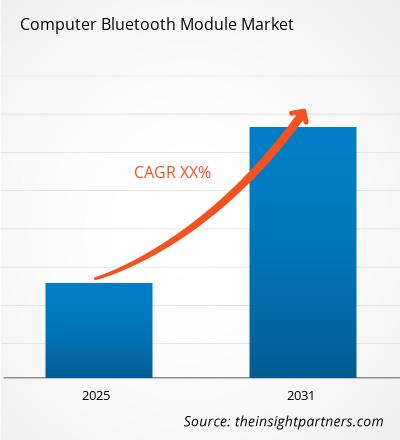
The Computer Bluetooth Module Market is estimated at US$ 4.57 Billion in 2025 and forecast to grow to US$ 9.24 Billion by 2034 at a CAGR of 8.17% from 2026 to 2034. Expansion will be driven by rising shipments of devices with Bluetooth functionality, whose figures, according to industry sources, exceed 5.3 billion in 2025, and increasing implementation of Bluetooth Low Energy on platform devices, peripherals, and connected computing accessories.
Within North America, the computer Bluetooth Module Market size will be driven by enterprise refresh cycles of laptop devices, hybrid work peripherals, and increasing demand for secure wireless connectivity solutions. It is anticipated to grow at a CAGR of 7.4–8.0% from 2026 to 2034 due to the concentration of the market within the U.S. in terms of PC OEMs and commercial fleets, and rapid adoption of Bluetooth 5.x modules.
Computer Bluetooth Module Market Assessment and Insights
- North America held 28–32% share in 2025 and is forecast to grow at a 7.4–8.0% CAGR between 2026–2034, led by commercial PCs, premium laptops, and enterprise peripheral upgrades.
- US accounted for 72–76% of North America in 2025 and should expand at a 7.5–8.1% CAGR, supported by OEM design activity and connected workplace devices.
- Europe represented 18–22% share in 2025 and is projected at a 6.9–7.6% CAGR between 2026–2034, with Germany, the UK, and France leading business PC replacement.
- Asia Pacific captured 39–43% share in 2025 and is expected to grow at an 8.8–9.5% CAGR between 2026–2034, driven by China, Japan, South Korea, and India.
- Largest Segment Bluetooth Low Energy Modules held 50–54% market share in 2025 and is forecast to grow at an 8.5–9.2% CAGR during 2026–2034.
- High Growth Segment Laptop applications accounted for 66–70% market share in 2025 and are projected to grow at an 8.4–9.0% CAGR during 2026–2034.
- Key companies analyzed in detail: Fujitsu Limited, Hosiden Corporation, Laird Connectivity, Microchip Technology Inc., Murata Manufacturing Co., Ltd., Qualcomm Technologies, Inc., Silicon Laboratories Inc., STMicroelectronics N.V., TAIYO YUDEN CO., LTD., Texas Instruments Incorporated.
Source: The Insight Partners' analysis based on proprietary research, government publications, company annual reports, investor presentations, industry databases, and expert interviews.
Module design has transitioned from the basic task of replacing cables to providing connectivity solutions for always-on computing, device pairing, and secure accessories control. Production trends tend to focus on certified compact modules, antenna-included packages, and software stacks, which minimize the amount of time required to validate these modules by OEMs. The market gains due to Bluetooth LE proliferation, improved co-existence with Wi-Fi, and the need for PC manufacturers to find the best compromise between cost, range, latency, and power consumption.
As far as future trends are concerned, investments will shift towards Asia-based assembly systems, U.S. enterprise computing upgrades, and Europe's demand for power efficient workstations. Spectrum efficient wireless devices support, company-specific cybersecurity regulations, and government-driven digitalization efforts are expected to contribute further to adoption. In emerging countries, market growth will come due to the production of laptops, while in established markets certified modules with a long lifetime and secure firmware will be preferred.
Computer Bluetooth Module Market Report Scope
| Report Attribute | Details |
|---|---|
| Market size in 2025 | US$ 4.57 Billion |
| Market Size by 2034 | US$ 9.24 Billion |
| Global CAGR (2026 - 2034) | 8.17% |
| Historical Data | 2021-2024 |
| Forecast period | 2026-2034 |
Computer Bluetooth Module Market Analysis
The market is driven by increased use of wireless keyboards, mice, headsets, controllers and conference devices in corporate and consumer computers. Annual Bluetooth device shipments have surpassed 5.3 billion units in 2025 according to Bluetooth SIG, and the Low Energy function is now available as standard features in new connected devices. This makes it less risky for OEMs and prompts them to install certified modules instead of additional adapter modules.
Supply factors include semiconductors, radio frequency certifications, module size and compatibility of firmware. Manufacturers of modules targeting PCs need to integrate chips, antennas, firmware stack, drivers and approval processes for Windows, Linux and corporate deployments. Highest demand is from markets that need laptop and desktop computers to have reliable pairing, low power in standby mode and co-existence with dense Wi-Fi connections.
The competitive landscape for the market is illustrated by the presence of Fujitsu Limited, Murata Manufacturing Co., Ltd., Qualcomm Technologies, Inc., Silicon Laboratories Inc., STMicroelectronics N.V., and Texas Instruments Incorporated. These companies are competing on the basis of integration, power efficiency, and design capabilities. Hosiden Corporation, Laird Connectivity, Microchip Technology Inc., and TAIYO YUDEN CO., LTD. add value to the specialized module segment by offering certified designs along with OEM partnerships.
Key areas for investment include Bluetooth 5.4 capabilities, LE Audio compliance, enhanced security provision, and smaller package size for thin notebooks. From a strategic standpoint, it pays to be a vendor offering reference designs, product longevity, and quick compliance. Pricing is a relevant consideration; however, it is not the primary selection criteria in module purchases.
● REPORT CUSTOMIZATION
Tailor This Report To Align With Your Specific Business Requirements
This report can be customized to align precisely with your business objectives, scope, and target markets. Customization options include tailored segmentation, geography, competitive analysis, and strategic insights to support informed decision-making.
Customize This Report →WHAT YOU CAN ADJUST
- ● Segmentations
- ● Geography
- ● Competitive Analysis
- ● Language Preferences
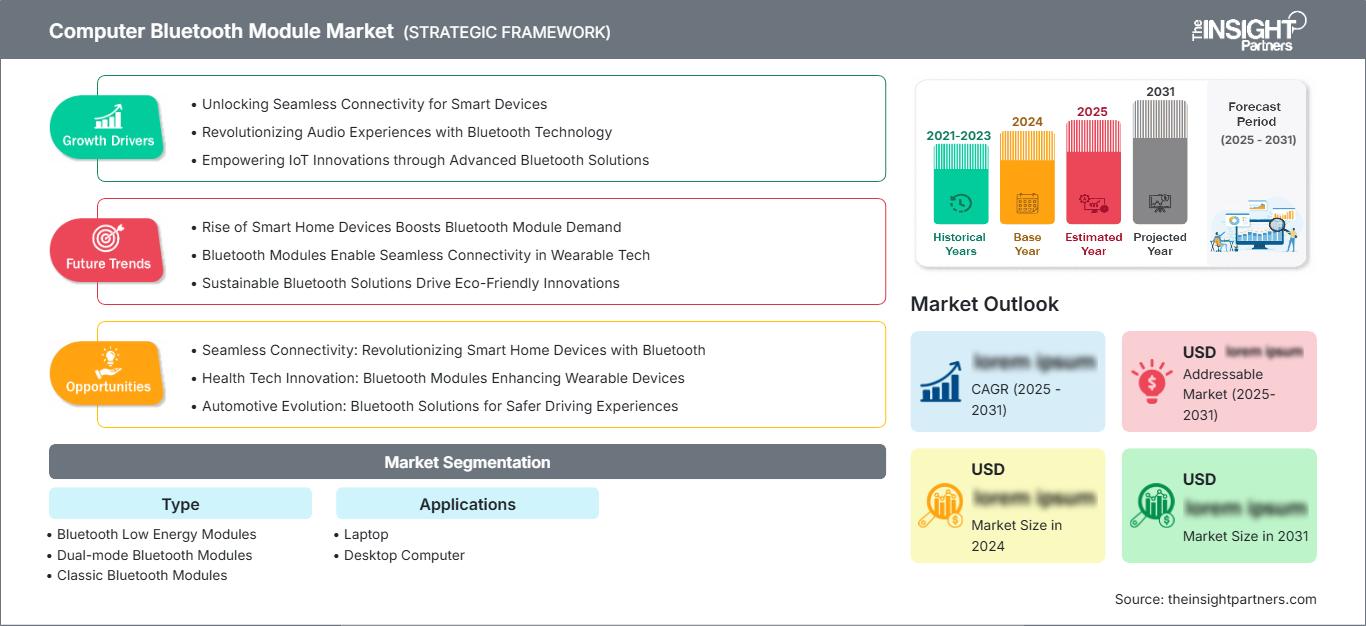
Computer Bluetooth Module Market: Strategic Insights
Regional Insights
North America computer Bluetooth Module Market
North America held 28–32% of the computer Bluetooth Module Market share in 2025 and is expected to expand at a 7.4–8.0% CAGR during 2026–2034. Demand is anchored in commercial notebook fleets, hybrid-work accessories, and high penetration of Bluetooth-enabled peripherals across corporate environments.
Structural drivers include enterprise refresh cycles, device management requirements, and rising use of wireless headsets for collaboration platforms. The region also benefits from strong design-in support from semiconductor suppliers and module specialists, making it a preferred market for certified, low-latency, and security-ready computing connectivity modules.
U.S. computer Bluetooth Module Market
North America accounted for 72-76% of the U.S. in 2025 and is forecasted to have a CAGR of 7.5-8.1% from 2025-2034. The deployment happens in enterprise laptops, high-end desktops, docking systems, and collaboration peripherals that are deployed by finance, health, educational institutions, and tech companies.
The representation of these companies is enhanced by Qualcomm Technologies Inc., Texas Instruments Inc., Microchip Technology Inc., Silicon Laboratories Inc., and Laird Connectivity. The applications in use are those of Bluetooth Low Energy Modules in battery-sensitive peripherals and dual-mode in cases where backwards compatibility is required.
Europe computer Bluetooth Module Market
Share of Europe will range between 18% and 22% in 2025 and the region is projected to register a CAGR of 6.9%-7.6% during 2026-2034. Germany emerges dominant on account of industrial PC requirements and corporate hardware purchasing, whereas the UK encourages usage of premium laptops in services and public sector digital work programs.
France, Italy, and Spain gain from educational technology, SMB computing, and government modernization initiatives. European consumers focus on energy efficiency, documentation requirements, and product lifecycle availability. All these factors help the sales of certified modules offered by companies such as STMicroelectronics N.V. and Murata Manufacturing Co., Ltd.
APAC computer Bluetooth Module Market
The Asia Pacific region has 39-43% market share in 2025 and is expected to have a CAGR of 8.8-9.5% in the period of 2026-2034. China dominates due to high volume production capacity in PCs, whereas Japan and South Korea provide high engineering expertise of components, miniaturization, and quality-oriented notebooks.
The demand for computers in India and Australia will be supplemented by digitization in enterprises, education devices, and upgrading of computing systems in the region. Manufacturing policies and supply chain localization boost the regional presence. The market gains from the geographical closeness of manufacturers of modules, OEMs, EMS, and antenna designers.
Middle East & Africa computer Bluetooth Module Market
Middle East & Africa is smaller but is projected to grow at a 6.8–7.4% CAGR during 2026–2034. Saudi Arabia and the UAE lead adoption through digital government, energy-sector modernization, and enterprise device procurement across offices, campuses, and industrial facilities.
South Africa and the Rest of MEA support incremental demand through education computing, telecom-linked enterprise projects, and infrastructure investments. Module selection emphasizes cost-effective reliability, certification, and long-range stability in dense buildings, making dual-mode and BLE-certified products relevant to institutional buyers.
Segmentation Analysis
Type
The Type segment is expected to grow at a 7.9–8.6% CAGR during 2026–2034 as OEMs balance energy efficiency, legacy support, and platform certification. The market scope across type categories reflects a shift toward Bluetooth Low Energy Modules for modern laptops, while dual-mode modules remain important where backward compatibility is essential.
- Bluetooth Low Energy Modules lead adoption because notebooks and peripherals need low standby current, secure pairing, and long battery life without sacrificing stable accessory connectivity.
- Dual-mode Bluetooth Modules remain strategically important for PCs serving mixed accessory environments, enabling compatibility with both modern LE devices and installed Classic Bluetooth peripherals.
- Classic Bluetooth Modules serve legacy audio, keyboard, mouse, and industrial computing use cases where established profiles and mature compatibility remain more important than ultra-low power consumption.
Applications
The Applications segment is projected to grow at an 8.1–8.8% CAGR during 2026–2034, supported by notebook mobility, desktop modernization, and peripheral bundling. Laptops dominate because Bluetooth is central to cable-free work, conferencing, and multi-device pairing, while desktop computers use modules for compact form factors and enterprise accessory management.
- Laptop demand is strongest because mobile workers require integrated connectivity for headsets, keyboards, mice, styluses, and nearby device synchronization across office, home, and travel environments.
- Desktop Computer adoption is rising in small-form-factor PCs, all-in-one systems, education labs, and enterprise deployments where Bluetooth reduces cabling and supports standardized wireless peripherals.
Opportunity Snapshot
| Applications | Revenue Contribution | Trend Tag | Adoption Stage |
| Laptop | High | Hybrid Work | Mature |
| Desktop Computer | Medium | Cable Reduction | Scaling |
Computer Bluetooth Module Market Growth Drivers and Impact Analysis
Enterprise Device Refresh and Hybrid Work Peripherals
Commercial PC refresh cycles create steady module demand because organizations now procure laptops with standardized wireless accessory support. Hybrid work has expanded headset, keyboard, mouse, camera-control, and conferencing device usage, making Bluetooth reliability a procurement factor rather than a convenience feature. The computer Bluetooth Module Market gains when OEMs embed certified modules that reduce pairing failures, support centralized device policies, and lower helpdesk friction. Impact is strongest in sectors with large managed fleets, including education, financial services, healthcare, and public administration. As enterprises replace pandemic-era devices, suppliers offering stable drivers, low standby current, and long lifecycle support can capture repeat design wins.
Bluetooth Low Energy Integration in Computing Platforms
Bluetooth Low Energy is reshaping computer connectivity because it supports persistent accessory availability with reduced power draw. Industry sources indicate single-mode LE shipments are growing much faster than dual-mode Bluetooth devices, reinforcing the long-term migration toward low-power architectures. For notebooks, this improves battery management when paired with mice, styluses, tags, and collaboration accessories. For desktops, it supports compact and cable-free installations. The market impact is a shift in module specifications toward LE compatibility, stronger coexistence, improved security, and firmware updateability. Vendors that combine certified hardware with robust software stacks can shorten OEM validation cycles and reduce product-launch risk.
Certified Module Adoption to Reduce Engineering Complexity
PC OEMs increasingly choose certified Bluetooth modules to compress development schedules and reduce regulatory uncertainty across multiple geographies. A pre-certified module can lower RF design burden, antenna tuning risk, and compliance documentation effort, especially for manufacturers shipping the same platform into North America, Europe, and Asia Pacific. This driver benefits suppliers with strong application engineering, reference layouts, and documentation packages. The computer Bluetooth Module Market therefore rewards vendors that provide integrated antennas, validated drivers, and operating-system support. The practical impact is faster time-to-market, fewer redesigns, and improved consistency across laptop and desktop product families.
Computer Bluetooth Module Market Future Trends
LE Audio and Multi-Device Collaboration Readiness
The next phase of computer Bluetooth Module Market trends will focus on LE Audio readiness, improved headset switching, and better multi-device collaboration. As enterprises standardize wireless meeting rooms and personal audio devices, PCs will need modules that support lower latency, efficient broadcast audio features, and stronger coexistence in crowded office spectrum. This trend is not only about audio quality; it also affects procurement because IT teams want predictable pairing, firmware security, and compatibility with collaboration software. Module vendors able to validate LE Audio use cases with leading PC platforms can differentiate beyond price and capture premium notebook designs.
Security-Managed Wireless Accessory Ecosystems
Future demand will increasingly reflect enterprise security expectations for paired accessories. Wireless keyboards, mice, tags, and headsets are becoming managed endpoints, not isolated peripherals. This will push module specifications toward stronger authentication, controlled pairing, firmware integrity, and lifecycle patch support. The trend favors suppliers that can integrate hardware security features, provide transparent update mechanisms, and maintain compatibility across operating-system revisions. For computer OEMs, secure Bluetooth implementation reduces operational risk and supports regulated industries. Over time, module selection may be influenced as much by security governance and fleet manageability as by radio performance or unit cost.
Computer Bluetooth Module Market Opportunities
Design Wins in AI-Ready and Premium Notebook Platforms
Premium notebook platforms offer attractive computer Bluetooth Module Market Forecasts because buyers increasingly expect seamless accessory ecosystems around productivity, collaboration, and device continuity. Suppliers can target AI-ready laptops, creator notebooks, and commercial ultrabooks where space constraints, power budgets, and user experience justify higher-value modules. The opportunity is strongest for vendors that provide compact footprints, robust coexistence with Wi-Fi 6E and Wi-Fi 7, and validated driver support. Partnerships with OEM design teams can secure multi-year platform positions. Actionable priorities include early reference-design engagement, regional certification packages, and performance testing in dense workplace environments.
Localized Electronics Manufacturing and Certified Module Supply
Regional electronics manufacturing policies create an opportunity for certified Bluetooth module suppliers to support localized PC assembly. India, Southeast Asia, and parts of the Middle East are encouraging device manufacturing and enterprise technology deployment, which can increase demand for compliant, ready-to-integrate modules. Suppliers that establish local distribution, technical support, and regulatory documentation can reduce OEM friction. The opportunity extends beyond low-cost components because manufacturers need dependable sourcing, antenna guidance, and lifecycle support. Early engagement with contract manufacturers and regional PC brands can help module vendors convert policy-driven assembly growth into recurring revenue.
Recent Developments
- March 2026: Quectel launched the FCE870Q, a high-performance Wi-Fi 7 and Bluetooth 6.0 module delivering data rates of up to 5.8 Gbps. The module supports 4K-QAM, 320 MHz bandwidth and enhanced Multi-Link Single Radio (eMLSR) technology, targeting low-latency applications such as AR/VR, 4K/8K streaming and industrial IoT.
- September 2025: Digi International introduced the Digi XBee® 3 BLU intelligent wireless module featuring Bluetooth Low Energy (BLE) 5.4, integrated MicroPython programmability and Digi TrustFence® security. The module is designed for industrial, healthcare, retail and smart-building IoT applications, enabling secure device provisioning, edge processing and mobile management.
- June 2025: STMicroelectronics announced the mass production of its ST67W611M1 Wi-Fi 6 and Bluetooth Low Energy 5.4 combo module. The pre-certified module accelerates development of connected devices for industrial and consumer markets by providing integrated wireless connectivity with reduced design complexity and faster time-to-market.
Frequently Asked Questions

- Comprehensive Market Sizing and Forecast Analysis
- Detailed Segmentation Analysis
- In-Depth Market Dynamics Assessment
- Regional and Country-Level Insights
- Competitive Landscape and Company Benchmarking
- Strategic Business Intelligence
Recent Reports
Testimonials

The Insight Partners provided valuable market intelligence that supported our global go-to-market strategy. Their team was professional, responsive, and attentive to our feedback, providing thoughtful analysis and helpful methodological clarifications throughout the project.
Junmo Kim Chief Financial Officer (CFO), Enertech Co., Ltd.
The Insight Partners' SCADA System Market report is comprehensive, with valuable insights on current trends and future forecasts. The team was highly professional, responsive, and supportive throughout. We are very satisfied and highly recommend their services.
RAN KEDEM Partner, Reali Technologies LTDs
I requested a report on a very specific software market and the team produced the report in a few days. The information was very relevant and well presented. I then requested some changes and additions to the report. The team was again very responsive and I got the final report in less than a week.
JEAN-HERVE JENN Chairman, Future Analytica
We worked with The Insight Partners for an important market study and forecast. They gave us clear insights into opportunities and risks, which helped shape our plans. Their research was easy to use and based on solid data. It helped us make smart, confident decisions. We highly recommend them.
PIYUSH NAGPAL Sr. Vice President, High Beam Global
The Insight Partners delivered insightful, well-structured market research with strong domain expertise. Their team was professional and responsive throughout. The user-friendly website made accessing industry reports seamless. We highly recommend them for reliable, high-quality research services
YUKIHIKO ADACHI CEO, Deep Blue, LLC.
This is the first time I have purchased a market report from The Insight Partners.While I was unsure at first, I visited their web site and felt more comfortable to take the risk and purchase a market report.I am completely satisfied with the quality of the report and customer service. I had several questions and comments with the initial report, but after a couple of dialogs over email with their analyst I believe I have a report that I can use as input to our strategic planning process.Thank you so much for taking the extra time and making this a positive experience.I will definitely recommend your service to others and you will be my first call when we need further market data.
JOHN SUZUKI President and Chief Executive Officer, Board Director, BK Technologies
I wish to appreciate your support and the professionalism you displayed in the course of attending to my request for information regarding to infectious disease IVD market in Nigeria. I appreciate your patience, your guidance, and the fact that you were willing to offer a discount, which eventually made it possible for us to close a deal. I look forward to engaging The Insight Partners in the future, all thanks to the impression you have created in me as a result of this first encounter.
DR CHIJIOKE ONYIA MANAGING DIRECTOR, PineCrest Healthcare Ltd.Reason to Buy
- Informed Decision-Making
- Understanding Market Dynamics
- Competitive Analysis
- Identifying Emerging Markets
- Customer Insights
- Market Forecasts
- Risk Mitigation
- Boosting Operational Efficiency
- Strategic Planning
- Investment Justification
- Tracking Industry Innovations
- Aligning with Regulatory Trends





 Get Free Sample for